
PUBLISHER: Mordor Intelligence | PRODUCT CODE: 2063693

PUBLISHER: Mordor Intelligence | PRODUCT CODE: 2063693
United States Bulky Waste Collection Services - Market Share Analysis, Industry Trends & Statistics, Growth Forecasts (2026 - 2031)
According to Mordor Intelligence, the united states bulky waste collection services market size was valued at USD 8.26 billion in 2025 and is estimated to grow from USD 8.69 billion in 2026 to reach USD 11.41 billion by 2031, at a CAGR of 5.58% during the forecast period (2026-2031).
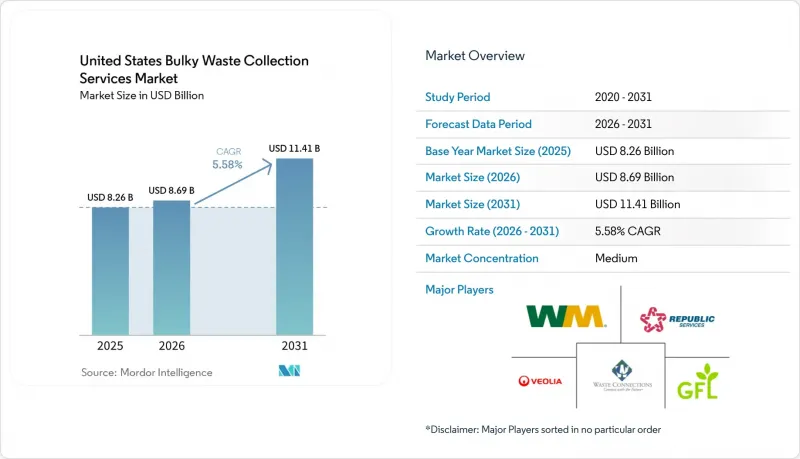
This report is Segmented by Collection Model (Curbside, On-Demand, Hybrid, Contracted B2B, and Others), by Source (Residential, Commercial, Industrial, Municipal, and Others), and by Waste Type (Furniture & Upholstery, Metal & Scrap Items, White Goods/Appliances, Construction & Demolition, and Others). The Market Forecasts are Provided in Terms of Value (USD) and Volume (Tons).
United States Bulky Waste Collection Services Market Trends and Insights
Multifamily Housing Construction Boom in Sunbelt States
High-density multifamily projects increase furniture turnover and move-in discard events, leading to more on-demand bulky pickups and roll-off requests for property managers. New developments often use centralized enclosures that restrict oversized items and encourage scheduled or app-based removal instead of uncoordinated curbside placement. Minimum-service standards in large complexes favor operators that can respond quickly and provide digital confirmations for residents and leasing offices. The United States bulky waste collection services market benefits as these communities cluster in metros with sustained in-migration and active building pipelines. The resulting increase in service demand raises route density and reduces deadhead time for private fleets, supporting stable pricing over multi-year windows.
HOA Covenant Enforcement and Curbside Placement Restrictions
Homeowners associations commonly restrict bulk-item placement to narrow windows and assess fines for violations, which steers residents toward same-day or next-day removal booked through digital channels. This pattern is most visible in master-planned communities where design standards discourage curb piles and board rules convert occasional municipal pickups into recurring private calls. As a result, on-demand haulers expand into targeted ZIP codes with high HOA penetration and clear off-street pick-up requirements. The United States bulky waste collection services market is growing as households weigh the cost of a ticket and truck rental against the convenience of a scheduled garage-to-truck service. The enforcement environment aligns the incentives of residents, HOA boards, and haulers to meet short service windows while offering transparent pricing.
Illegal Dumping Epidemic on Federal and Rural Public Lands
Illegal dumping on public lands diverts funds to cleanup and weakens service expansion in rural counties, especially where distances to permitted sites are long. Cleanups range from modest efforts to complex projects involving hazardous materials, which can escalate costs and timelines. The visibility of dump sites then attracts more offenders, degrading property values and increasing enforcement demands. The United States bulky waste collection services market loses reportable volume when material bypasses formal channels and ends up on federal tracts. Federal agencies and cities document persistent costs, which reinforce the value of accessible legal options and resident education.
Other drivers and restraints analyzed in the detailed report include:
- Hurricane and Wildfire Disaster Recovery Recurring Cycles
- Municipal Franchise Agreement Renewals Favoring Integrated Service Providers
- Labor Shortage and Rising Insurance Costs for Manual Collection
For complete list of drivers and restraints, kindly check the Table Of Contents.
Segment Analysis
In 2025, curbside services captured a 46.21% market share, owing to their structured model that promises predictable collection schedules, clear placement guidelines, and dependable service for both residents and property managers. This segment benefits from HOA regulations and municipal frameworks that standardize waste placement and curbside collection processes. Regions with dedicated routes for bulky waste and adequate budget allocations have widely adopted municipal curbside programs, ensuring consistent service. Major players like Waste Management Inc. and Republic Services bolster curbside operations by focusing on route optimization and integration with disposal services. In summary, curbside services are a cornerstone of the United States' bulky waste collection market, especially in well-organized urban and suburban areas.
The United States bulky waste collection services market for on-demand collection is projected to grow at a 6.34% CAGR through 2031, supporting multi-truck franchise scaling and gains in route density in high-growth corridors. These patterns increase the addressable base for integrated haulers and franchise networks that coordinate through centralized dispatch and mobile driver tools.Growth in On-Demand is further reinforced by county emergency protocols and seasonal events that require rapid deployment of extra trucks, crews, and containers. Hybrid models that combine scheduled bulk days with on-demand pickups appeal to suburban municipalities, though adoption remains incremental in tight-budget areas. Contracted B2B agreements with multifamily communities and senior-living operators provide a stable base, but they grow more slowly than retail on-demand due to longer contract cycles.
List of Companies Covered in this Report:
- Waste Management, Inc.
- Republic Services, Inc.
- Veolia Environment S.A.
- GFL Environmental Inc.
- Waste Connections, Inc.
- Recology Inc
- SUEZ S.A.
- Groot Industries
- Valet Living
- Stericycle, Inc.
- Airtasker Limited
- Casella Waste Systems, Inc.
- Rumpke Waste & Recycling
- Neighborly (Junk King parent)
- Waste Pro
- Waste Connections
- Junk King
- LoadUp Technologies
- Barna Recycling
- Bin There Dump That
Additional Benefits:
- The market estimate (ME) sheet in Excel format
- 3 months of analyst support
TABLE OF CONTENTS
1 Introduction
- 1.1 Study Assumptions & Market Definition
- 1.2 Scope of the Study
2 Research Methodology
3 Executive Summary
4 Market Landscape
- 4.1 Market Overview
- 4.2 Market Drivers
- 4.2.1 Multifamily Housing Construction Boom in Sunbelt States
- 4.2.2 HOA Covenant Enforcement and Curbside Placement Restrictions
- 4.2.3 Hurricane and Wildfire Disaster Recovery Recurring Cycles
- 4.2.4 Municipal Franchise Agreement Renewals Favoring Integrated Service Providers
- 4.2.5 "Fast Furniture" E-Commerce Replacement Cycles Accelerating
- 4.2.6 Junk Removal Franchising and Private Equity Consolidation
- 4.3 Market Restraints
- 4.3.1 Illegal Dumping Epidemic on Federal and Rural Public Lands
- 4.3.2 Labor Shortage and Rising Insurance Costs for Manual Collection
- 4.3.3 State-by-State Mattress Recycling Infrastructure Gaps
- 4.3.4 Donation Center Capacity Saturation Post-Pandemic
- 4.4 Value / Supply-Chain Analysis
- 4.4.1 Collection scheduling systems
- 4.4.2 Route optimization methods
- 4.4.3 Dispatch and logistics framework
- 4.5 Regulatory Landscape
- 4.6 Technological Outlook
- 4.7 Porter's Five Forces
- 4.7.1 Threat of New Entrants
- 4.7.2 Bargaining Power of Suppliers
- 4.7.3 Bargaining Power of Buyers
- 4.7.4 Threat of Substitutes
- 4.7.5 Industry Rivalry
- 4.8 Impact of GenAI-Powered Waste Collection on Service Providers' Revenue Growth
5 Market Size & Growth Forecasts
- 5.1 By Collection Model
- 5.1.1 Curbside
- 5.1.2 On-Demand
- 5.1.3 Hybrid
- 5.1.4 Contracted B2B
- 5.1.5 Others
- 5.2 By Source
- 5.2.1 Residential
- 5.2.2 Commercial
- 5.2.3 Industrial
- 5.2.4 Municipal/Government
- 5.2.5 Others (Religious Institutions, Temporary Disaster Relief Camps, Film/TV Production Sets)
- 5.3 By Waste Type
- 5.3.1 Furniture & Upholstery
- 5.3.2 Metal & Scrap Items
- 5.3.3 White Goods/Appliances
- 5.3.4 Construction & Demolition
- 5.3.5 Others
6 Competitive Landscape
- 6.1 Market Concentration
- 6.2 Strategic Moves
- 6.3 Market Share Analysis
- 6.4 Company Profiles {(includes Global level Overview, Market level overview, Core Segments, Financials as available, Strategic Information, Products & Services, and Recent Developments)}
- 6.4.1 Waste Management, Inc.
- 6.4.2 Republic Services, Inc.
- 6.4.3 Veolia Environment S.A.
- 6.4.4 GFL Environmental Inc.
- 6.4.5 Waste Connections, Inc.
- 6.4.6 Recology Inc
- 6.4.7 SUEZ S.A.
- 6.4.8 Groot Industries
- 6.4.9 Valet Living
- 6.4.10 Stericycle, Inc.
- 6.4.11 Airtasker Limited
- 6.4.12 Casella Waste Systems, Inc.
- 6.4.13 Rumpke Waste & Recycling
- 6.4.14 Neighborly (Junk King parent)
- 6.4.15 Waste Pro
- 6.4.16 Waste Connections
- 6.4.17 Junk King
- 6.4.18 LoadUp Technologies
- 6.4.19 Barna Recycling
- 6.4.20 Bin There Dump That
7 Market Opportunities & Future Outlook
- 7.1 Smart Cities & IoT Integration
- 7.2 Producer Responsibility Expansion

