PUBLISHER: Mordor Intelligence | PRODUCT CODE: 2063717

PUBLISHER: Mordor Intelligence | PRODUCT CODE: 2063717
Diabetic Nephropathy Drugs - Market Share Analysis, Industry Trends & Statistics, Growth Forecasts (2026 - 2031)
According to Mordor Intelligence, the diabetic nephropathy drugs market size is projected to be USD 3.20 billion in 2025, USD 3.40 billion in 2026, and reach USD 4.60 billion by 2031, growing at a CAGR of 6.30% from 2026 to 2031.
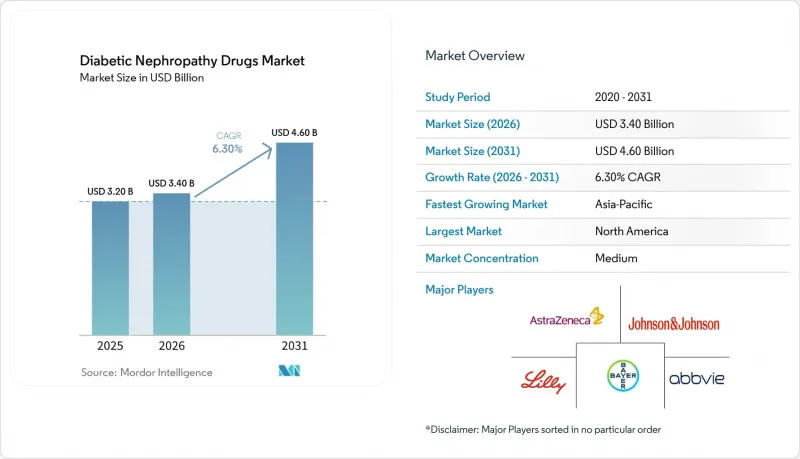
This report is Segmented by Drug Class (ACE Inhibitors, Angiotensin II Receptor Blockers, SGLT2 Inhibitors, and More), Diabetes Type (Type-1, Type-2), Distribution Channel (Hospital Pharmacies, Retail/Community Pharmacies, Online Pharmacies), and Geography (North America, Europe, Asia Pacific, Middle East & Africa, South America). The Market Forecasts are Provided in Terms of Value (USD).
Global Diabetic Nephropathy Drugs Market Trends and Insights
Rising Diabetes Prevalence & Ageing Population
Escalating diabetes prevalence, particularly the 68% surge in type 2 diabetes projected for Asia by 2045, is enlarging the addressable base for the diabetic nephropathy drugs market. Genetic susceptibility at lower body-mass indices accelerates kidney complications, prompting earlier screening programs reliant on biomarkers such as NGAL and KIM-1. Ageing adds further strain, as natural declines in renal function hasten the transition from microalbuminuria to overt nephropathy. Health systems are rolling out population-wide screening alongside prevention campaigns. These intertwined demographic pressures are expected to sustain long-run growth for the diabetic nephropathy drugs market.
Clinical Adoption of SGLT2 Inhibitors Post-CREDENCE & EMPA-REG Trials
Landmark trials such as CREDENCE and EMPA-REG demonstrated renal and cardiovascular protection independent of glucose control, driving guideline upgrades that elevate SGLT2 inhibitors to first-line status. Real-world evidence indicates a 45% lower in-hospital mortality for continuous SGLT2 inhibitor users during admissions. The recent U.S. approval of sotagliflozin for heart failure in chronic kidney disease broadens applicability. Adoption gaps persist, with only a minority of eligible patients prescribed these agents, leaving headroom for the diabetic nephropathy drugs market to expand. Growing payer recognition of total-cost-of-care savings is expected to accelerate uptake.
High List-Price of Novel Agents (e.g., Finerenone)
At roughly USD 19 daily, finerenone stretches affordability thresholds, particularly under budget-capped health systems. Insurers impose step-therapy protocols, lengthening the path to optimal care and dampening the velocity of uptake. Lifelong therapy magnifies cumulative expenditure versus acute indications. U.S. price negotiations under Medicare starting in 2026 will heavily discount older diabetes drugs, yet novel agents stay outside those bargains, maintaining cost pressure when combination regimens pair multiple premium agents, affordability barriers compound, muting near-term growth for the diabetic nephropathy drugs market.
Other drivers and restraints analyzed in the detailed report include:
- Guideline Shift Toward Early RAS-Blockade Intensification
- AI-Based Urinary Biomarker Panels Enabling Pre-Emptive Therapy
- Stringent Renal-Safety Regulatory Endpoints Prolonging Approvals
For complete list of drivers and restraints, kindly check the Table Of Contents.
Segment Analysis
ACE inhibitors retained the largest 33.1% diabetic nephropathy drugs market share in 2025. SGLT2 inhibitors, however, headline growth with a 12.5% CAGR through 2031, buoyed by approvals that now extend to non-diabetic chronic kidney disease and heart failure cohorts. ARBs provide first-line alternatives when ACE inhibitors are contraindicated. MRAs such as finerenone address residual inflammation and fibrosis, gaining traction for proteinuric patients resistant to RAS blockade. Diuretics retain a role in fluid management, while GLP-1 receptor agonists and DPP-4 inhibitors occupy an emerging "Others" niche owing to ancillary renal effects.
Clinical data from the CONFIDENCE trial showed that dual finerenone-empagliflozin therapy outperforms monotherapy, foreshadowing a pivot from single-drug dominance to regimen-based care. Furthermore, the diabetic nephropathy drugs market size for combination-oriented approaches is expected to escalate as endothelin receptor antagonists and complement inhibitors, such as atrasentan and iptacopan, secure accelerated approvals. Growing clinician familiarity with multidrug protocols is reinforcing formulary placement and supporting adoption curves.
Geography Analysis
North America dominated with 37.4% share of the diabetic nephropathy drugs market in 2025, underpinned by mature insurance frameworks, extensive clinical trial networks, and rapid adoption of first-in-class therapies. Medicare's Kidney Care Choices Model incentivizes early-stage management, boosting prescription volumes. Upcoming 68% Part D discounts on legacy diabetes drugs will redirect savings toward novel nephroprotective agents, further fortifying demand.
Asia-Pacific represents the fastest-growing region, projected at a 9.3% CAGR through 2031. Prevalence of microalbuminuria (39.8%) and macroalbuminuria (18.8%) among Asian type 2 diabetes patients underscores the public-health emergency. Governments are funding early screening, while expanding insurance pools open doors for high-value therapies.
Europe maintains solid volume through universal healthcare and structured health-technology assessments. EMA approvals of finerenone and atrasentan illustrate regulators' balanced stance on innovation and safety. Meanwhile, the Middle East, Africa, and South America exhibit emerging potential amid rising diabetes incidence and incremental reimbursement reforms, although price sensitivity may temper near-term uptake. Together, regional dynamics shape a diversified demand profile for the diabetic nephropathy drugs market.
- AstraZeneca
- Bayer
- Boehringer Ingelheim & Eli Lilly (Alliance)
- Johnson & Johnson
- Abbvie
- Novartis
- Pfizer
- Merck
- Novo Nordisk
- GlaxoSmithKline
- Sanofi
- CSL Vifor Pharma
- Fresenius Medical Care AG
- Baxter
- DaVita
- Medtronic plc (renal therapies)
- Otsuka Pharmaceutical Co.
- Ardelyx Inc.
- Chinook Therapeutics
- Ionis Pharmaceuticals
Additional Benefits:
- The market estimate (ME) sheet in Excel format
- 3 months of analyst support
TABLE OF CONTENTS
1 Introduction
- 1.1 Study Assumptions & Market Definition
- 1.2 Scope of the Study
2 Research Methodology
3 Executive Summary
4 Market Landscape
- 4.1 Market Overview
- 4.2 Market Drivers
- 4.2.1 Rising Diabetes Prevalence & Ageing Population
- 4.2.2 Clinical Adoption Of SGLT2 Inhibitors Post-CREDENCE & EMPA-REG Trials
- 4.2.3 Guideline Shift Towards Early RAS-Blockade Intensification
- 4.2.4 AI-Based Urinary Biomarker Panels Enabling Pre-Emptive Therapy
- 4.2.5 Value-Based Kidney-Care Payment Bundles In Developed Countries
- 4.2.6 Emergence Of Combination Therapy Strategies
- 4.3 Market Restraints
- 4.3.1 High List-Price Of Novel Agents (E.G., Finerenone)
- 4.3.2 Stringent Renal-Safety Regulatory Endpoints Prolonging Approvals
- 4.3.3 Low Nephropathy Awareness In Low- & Mid-Income Countries
- 4.3.4 Venture Capital Shift Toward Multi-Organ Metabolic Drugs
- 4.4 Supply Chain Analysis
- 4.5 Regulatory Landscape
- 4.6 Technological Outlook
- 4.7 Porter's Five Forces Analysis
- 4.7.1 Bargaining Power of Buyers
- 4.7.2 Bargaining Power of Suppliers
- 4.7.3 Threat of New Entrants
- 4.7.4 Threat of Substitutes
- 4.7.5 Competitive Rivalry
5 Market Size & Growth Forecasts (Value)
- 5.1 By Drug Class
- 5.1.1 ACE Inhibitors
- 5.1.2 Angiotensin II Receptor Blockers (ARBs)
- 5.1.3 SGLT2 Inhibitors
- 5.1.4 Mineralocorticoid Receptor Antagonists (MRAs)
- 5.1.5 Diuretics
- 5.1.6 Others (GLP-1 RAs, DPP-4, etc.)
- 5.2 By Diabetes Type
- 5.2.1 Type-1 Diabetes
- 5.2.2 Type-2 Diabetes
- 5.3 By Distribution Channel
- 5.3.1 Hospital Pharmacies
- 5.3.2 Retail/Community Pharmacies
- 5.3.3 Online Pharmacies
- 5.4 By Geography
- 5.4.1 North America
- 5.4.1.1 United States
- 5.4.1.2 Canada
- 5.4.1.3 Mexico
- 5.4.2 Europe
- 5.4.2.1 Germany
- 5.4.2.2 United Kingdom
- 5.4.2.3 France
- 5.4.2.4 Italy
- 5.4.2.5 Spain
- 5.4.2.6 Rest of Europe
- 5.4.3 Asia Pacific
- 5.4.3.1 China
- 5.4.3.2 Japan
- 5.4.3.3 India
- 5.4.3.4 South Korea
- 5.4.3.5 Australia
- 5.4.3.6 Rest of Asia Pacific
- 5.4.4 Middle East & Africa
- 5.4.4.1 GCC
- 5.4.4.2 South Africa
- 5.4.4.3 Rest of Middle East & Africa
- 5.4.5 South America
- 5.4.5.1 Brazil
- 5.4.5.2 Argentina
- 5.4.5.3 Rest of South America
- 5.4.1 North America
6 Competitive Landscape
- 6.1 Market Concentration
- 6.2 Market Share Analysis
- 6.3 Company Profiles (includes Global-level Overview, Market-level Overview, Core Segments, Financials as available, Strategic Information, Market Rank/Share, Products & Services, Recent Developments)
- 6.3.1 AstraZeneca plc
- 6.3.2 Bayer AG
- 6.3.3 Boehringer Ingelheim & Eli Lilly (Alliance)
- 6.3.4 Johnson & Johnson (Janssen)
- 6.3.5 AbbVie Inc.
- 6.3.6 Novartis AG
- 6.3.7 Pfizer Inc.
- 6.3.8 Merck & Co. Inc.
- 6.3.9 Novo Nordisk A/S
- 6.3.10 GSK plc
- 6.3.11 Sanofi S.A.
- 6.3.12 CSL Vifor Pharma
- 6.3.13 Fresenius Medical Care AG
- 6.3.14 Baxter International Inc.
- 6.3.15 DaVita Inc.
- 6.3.16 Medtronic plc (renal therapies)
- 6.3.17 Otsuka Pharmaceutical Co.
- 6.3.18 Ardelyx Inc.
- 6.3.19 Chinook Therapeutics
- 6.3.20 Ionis Pharmaceuticals
7 Market Opportunities & Future Outlook
- 7.1 White-space & Unmet-need Assessment

