PUBLISHER: Mordor Intelligence | PRODUCT CODE: 2063723

PUBLISHER: Mordor Intelligence | PRODUCT CODE: 2063723
Germany Bulky Waste Collection Services - Market Share Analysis, Industry Trends & Statistics, Growth Forecasts (2026 - 2031)
According to Mordor Intelligence, the germany bulky waste collection services market size is expected to grow from USD 1.55 billion in 2025 to USD 1.64 billion in 2026 and is forecast to reach USD 2.15 billion by 2031 at 5.60% CAGR over 2026-2031.
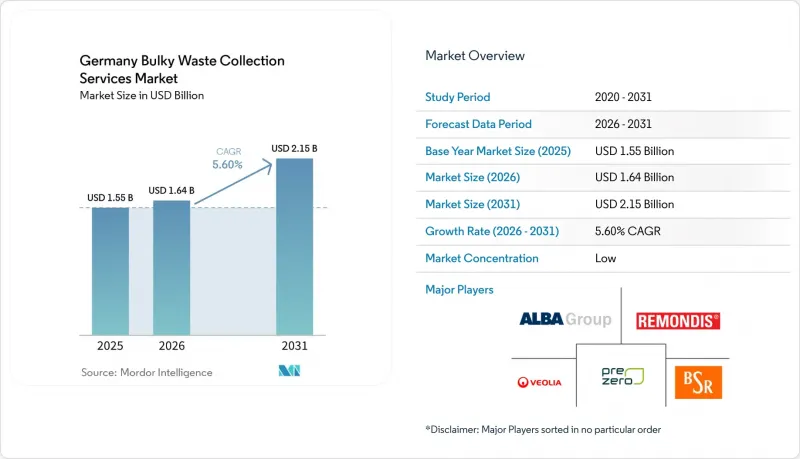
This report is Segmented by Collection Model (Curbside, On-Demand, Hybrid, Contracted B2B, and Others), by Source (Residential, Commercial, Industrial, Municipal, and Others), and by Waste Type (Furniture & Upholstery, Metal & Scrap Items, White Goods/Appliances, Construction & Demolition, and Others). The Market Forecasts are Provided in Terms of Value (USD) and Volume (Tons).
Germany Bulky Waste Collection Services Market Trends and Insights
Circular Economy Act Mandating Separate Bulky Waste Collection
Germany's Kreislaufwirtschaftsgesetz requires public waste authorities to provide separate bulky waste collection that enables preparation for reuse and component-level recycling. This mandate clarifies operational expectations for tenders and strengthens the case for investments in pre-sorting and documentation. The 2025 expansion of separate collection obligations for textiles under EU waste rules further normalizes source-separated flows that interact with bulky waste logistics at municipal depots. Clear compliance pathways and sanctioning tools reduce planning risk for municipal operators and private contractors that invest in reuse and recycling infrastructure. Public reporting requirements and federal oversight increase transparency across the Germany bulky waste collection services market, helping align municipal service levels with diversion goals. The regulatory alignment across federal and EU levels supports stable growth planning for route design, depot capacity, and reuse partnerships.
Digitalization of Sperrmull Booking Through Municipal Apps and Online Portals
Municipal apps and peer-to-peer integrations are reshaping booking behavior by letting residents choose collection slots, verify handovers, and receive confirmations. Berlin's cooperation with Tiptapp enables paid on-demand pickups that close the loop with disposal proof, which shortens response times compared with fixed quarterly rounds. Hamburg's Stadtreinigung app streamlines access to collection calendars, site navigation, and guidance on waste types, reducing call-center backlogs and improving scheduling accuracy. Timestamped bookings and address-level data flow into municipal systems and support route optimization that matches daily demand clusters. Digital channels also reduce incentives for curbside dumping because missed bookings can be rescheduled more quickly than waiting for the next fixed neighborhood day. The net effect is a steady migration in the Germany bulky waste collection services market toward dynamic capacity planning that favors operators with real-time dispatch and data governance credibility.
Sperrmull Collection Frequency Reductions in Cost-Pressured Municipalities
Wage increases set by IG BAU for 2025 and 2026 have raised operating costs for unionized operators, putting pressure on municipalities to adjust service models. Some smaller jurisdictions respond by reducing calendar-based bulky-waste rounds and shifting demand toward paid on-demand slots. When scheduled pick-ups are cut back, event-day volumes rise, straining crew capacity and risking interim overflow and resident dissatisfaction. Budget constraints also delay digital pilots in mid-sized municipalities, limiting the diffusion of IoT-enabled route optimization. The net effect is a patchwork of service frequency across the Germany bulky waste collection services market, with better-resourced cities moving faster than rural districts.
Other drivers and restraints analyzed in the detailed report include:
- Growing Urban Population Density in Berlin, Munich, and Hamburg
- EPR Expansion for Mattresses and Upholstered Furniture from 2025
- Illegal Dumping Competition from Schwarzentsorgung
For complete list of drivers and restraints, kindly check the Table Of Contents.
Segment Analysis
On-demand collection model led with a 67.21% of the Germany bulky waste collection services market share in 2025 and is projected to record the fastest growth at a 5.93% CAGR through 2031 as digital booking becomes the default in large cities. Residents can request service within short windows through municipal integrations, such as Berlin's cooperation with Tiptapp, which verifies proper drop-off with GPS-verified receipts. The Germany bulky waste collection services market has shifted toward this format because route planners can prioritize bookings by neighborhood clusters and reduce miles per pickup. Municipalities are pairing on-demand pickup with micro-collection assets such as e-cargobikes for dense cores and small loads that do not require a full truck. Hybrid strategies that mix neighborhood-day events and flexible routes are expanding in mid-sized cities that deploy container sensors to trigger demand-based service.
The curbside calendar model remains in rural and lower-digitized areas, yet it is losing share as smartphone adoption and municipal apps reduce booking friction. Contracted B2B frameworks also support on-demand logic because property managers and commercial estates require prioritized windows and confirmations. The Germany bulky waste collection services market benefits from on-demand data streams that enable continuous improvements in crew assignment and trip planning. EPR-related reimbursements for mattresses starting in 2025 add financial stability to models that can deliver high-quality segregated items. Taken together, these elements make on-demand both the largest and fastest-growing format in the Germany bulky waste collection services market.
List of Companies Covered in this Report:
- Remondis SE & Co. KG
- PreZero Stiftung & Co. KG
- ALBA Group
- Veolia Environnement SA
- Berliner Stadtreinigung (BSR)
- HCS A/S
- Gemidan
- SUEZ S.A.
- Stadtreinigung Hamburg
- AWM Munchen (Abfallwirtschaftsbetrieb Munchen)
- Entsorgungsgesellschaft Westmunsterland (EGW)
- FES Frankfurter Entsorgungs and Service GmbH
- Redooo GmbH
- Eggersmann GmbH
- Weg Werk
- Mucvibes
- Aflex
- S&D Recycler
- WeGreen
- Stadtwerke Offenbach
Additional Benefits:
- The market estimate (ME) sheet in Excel format
- 3 months of analyst support
TABLE OF CONTENTS
1 Introduction
- 1.1 Study Assumptions & Market Definition
- 1.2 Scope of the Study
2 Research Methodology
3 Executive Summary
4 Market Landscape
- 4.1 Market Overview
- 4.2 Market Drivers
- 4.2.1 Circular Economy Act Mandating Separate Bulky Waste Collection
- 4.2.2 Digitalization of Sperrmull Booking Through Municipal Apps and Online Portals
- 4.2.3 Growing Urban Population Density in Berlin, Munich, and Hamburg
- 4.2.4 EPR Expansion for Mattresses and Upholstered Furniture from 2025
- 4.2.5 Renovation Boom in Altbau Buildings Driving Collection Demand
- 4.2.6 Dual System Deutschland (DSD) Standards Pushing Collection Efficiency
- 4.3 Market Restraints
- 4.3.1 Sperrmull Collection Frequency Reductions in Cost-Pressured Municipalities
- 4.3.2 Illegal Dumping Competition from Schwarzentsorgung
- 4.3.3 Driver Shortages in Eastern German States
- 4.3.4 High Labor Costs Under IG BAU Collective Agreements
- 4.4 Value / Supply-Chain Analysis
- 4.4.1 Collection scheduling systems
- 4.4.2 Route optimization methods
- 4.4.3 Dispatch and logistics framework
- 4.5 Regulatory Landscape
- 4.6 Technological Outlook
- 4.7 Porter's Five Forces
- 4.7.1 Threat of New Entrants
- 4.7.2 Bargaining Power of Suppliers
- 4.7.3 Bargaining Power of Buyers
- 4.7.4 Threat of Substitutes
- 4.7.5 Industry Rivalry
- 4.8 Impact of GenAI-Powered Waste Collection on Service Providers' Revenue Growth
5 Market Size & Growth Forecasts
- 5.1 By Collection Model
- 5.1.1 Curbside
- 5.1.2 On-Demand
- 5.1.3 Hybrid
- 5.1.4 Contracted B2B
- 5.1.5 Others
- 5.2 By Source
- 5.2.1 Residential
- 5.2.2 Commercial
- 5.2.3 Industrial
- 5.2.4 Municipal/Government
- 5.2.5 Others (Religious Institutions, Temporary Disaster Relief Camps, Film/TV Production Sets)
- 5.3 By Waste Type
- 5.3.1 Furniture & Upholstery
- 5.3.2 Metal & Scrap Items
- 5.3.3 White Goods/Appliances
- 5.3.4 Construction & Demolition
- 5.3.5 Others (Event-specific Waste, Biomedical/Institutional)
6 Competitive Landscape
- 6.1 Market Concentration
- 6.2 Strategic Moves
- 6.3 Market Share Analysis
- 6.4 Company Profiles {(includes Global level Overview, Market level overview, Core Segments, Financials as available, Strategic Information, Products & Services, and Recent Developments)}
- 6.4.1 Remondis SE & Co. KG
- 6.4.2 PreZero Stiftung & Co. KG
- 6.4.3 ALBA Group
- 6.4.4 Veolia Environnement SA
- 6.4.5 Berliner Stadtreinigung (BSR)
- 6.4.6 HCS A/S
- 6.4.7 Gemidan
- 6.4.8 SUEZ S.A.
- 6.4.9 Stadtreinigung Hamburg
- 6.4.10 AWM Munchen (Abfallwirtschaftsbetrieb Munchen)
- 6.4.11 Entsorgungsgesellschaft Westmunsterland (EGW)
- 6.4.12 FES Frankfurter Entsorgungs and Service GmbH
- 6.4.13 Redooo GmbH
- 6.4.14 Eggersmann GmbH
- 6.4.15 Weg Werk
- 6.4.16 Mucvibes
- 6.4.17 Aflex
- 6.4.18 S&D Recycler
- 6.4.19 WeGreen
- 6.4.20 Stadtwerke Offenbach
7 Market Opportunities & Future Outlook
- 7.1 Smart Cities & IoT Integration
- 7.2 Producer Responsibility Expansion

