PUBLISHER: Mordor Intelligence | PRODUCT CODE: 2063742

PUBLISHER: Mordor Intelligence | PRODUCT CODE: 2063742
South America Low-Density Polyethylene (LDPE) - Market Share Analysis, Industry Trends & Statistics, Growth Forecasts (2026 - 2031)
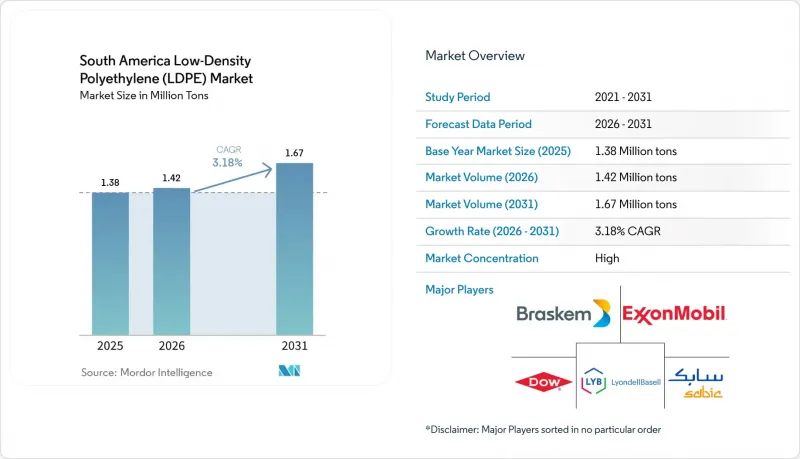
According to Mordor Intelligence, the south america low-Density polyethylene market size is projected to expand from 1.38 Million tons in 2025 and 1.42 Million tons in 2026 to 1.67 Million tons by 2031, registering a CAGR of 3.18% between 2026 to 2031.
This report is Segmented by Product Type (Sheets and Films, Blow-Molded, Injection-Molded, Extrusion Coating, and Other Product Types), End-User Industry (Packaging, Agriculture, Automotive, Electrical and Electronics, and More), and Geography (Brazil, Argentina, Colombia, Chile, Peru, and Rest of South America). The Market Forecasts are Provided in Terms of Volume (Tons).
South America Low-Density Polyethylene (LDPE) Market Trends and Insights
Implementation of Government Incentives for Lightweight Plastic Adoption in Automotive
Brazil's Programa Mover injects BRL 3.5-4.1 billion each year into technologies that cut vehicle weight, mandating recyclability thresholds and differentiated taxation for compliant models. Automakers are substituting metal and glass with LDPE-based interior films, reducing curb weight by 5%-8% and improving fuel economy by as much as 5%. RadiciGroup's 17,000 m2 plant opened in March 2025 to localize polymer-compound supply for tier-one suppliers. Argentine original equipment manufacturer (OEM) platforms are preparing to align with comparable standards by 2027, extending demand beyond Brazil. The 2-to-4-year horizon reflects vehicle-platform redesign cycles and validation protocols.
Expansion of Flexible-Packaging Converters in Brazil
Brazilian converters are installing high-output lines to preempt demand from rapid e-commerce and food-delivery growth. Bomplastic's Comexi F2 MB press contributes 350 tons per month of high-barrier film, while COEXPAN-EMSUR's Jundiai plant went on-stream in 2024, strengthening supply in the southeast corridor. Oben Group's purchase of Vitopel intensifies contest for sealant-layer business by adding a strong BOPP portfolio. Sheets and films already claim nearly half of South American LDPE volume, and rapid line ramp-ups usually reach nameplate in 12-18 months, underscoring the short-term boost to the South America Low-Density Polyethylene (LDPE) market.
Substitution by LLDPE and Emerging Biodegradable Films
Film processors prefer Linear Low-Density Polyethylene (LLDPE) for puncture resistance and downgauging; automated pallet-wrappers in Brazil's warehouses have already cut LDPE usage in stretch-hood films by about 15%. Biodegradable polylactic acid (PLA) and polyhydroxyalkanoate (PHA) structures are gaining traction in premium single-use food packaging, especially in Chilean retail pilots, but high resin premiums and scarce composting infrastructure keep volumes marginal. Converter re-tooling typically takes two years, explaining the medium-term drag on the South America Low-Density Polyethylene (LDPE) market.
Other drivers and restraints analyzed in the detailed report include:
- Infrastructure Upgrades Opening New Pipe-Coating Demand Corridors
- E-Commerce Boom Accelerating Stretch-Film Consumption
- Feedstock (Ethylene) Price Volatility Linked to Regional Naphtha Differentials
For complete list of drivers and restraints, kindly check the Table Of Contents.
Segment Analysis
Sheets and films captured 48.37% of regional LDPE volume in 2025 and are forecast to rise at a 3.46% CAGR through 2031. Bomplastic's 350 tons per month line and COEXPAN-EMSUR's ramp-up feed Brazil's southeast, where fulfillment centers dictate demand for high-clarity overwraps. Agricultural mulch films in Brazil's Cerrado and Argentina's Pampas also contribute to the South America Low-Density Polyethylene (LDPE) market size for this segment. Blow-molded bottles trail because brand owners shift squeezable formats to (High-Density Polyethylene) for cost reasons, while collapsible cosmetic tubes keep a foothold for LDPE's flexibility and soft-touch feel.
Oben Group's Vitopel takeover escalates competition as Biaxially Oriented Polypropylene (BOPP) producers pursue LDPE sealant layers given the latter's unmatched hot-tack range. Injection-molding grades, only 7% of demand, face polypropylene substitution amid end-user cost discipline, but still thrive in premium closures that need secure tamper evidence. Extrusion-coating remains steady in liquid cartons, though Polyethylene Terephthalate (PET)-based laminates grow in shelf-stable dairy. Together these dynamics keep the South America Low-Density Polyethylene (LDPE) market share for sheets and films firmly ahead through 2031.
List of Companies Covered in this Report:
- ALPA Group
- Borealis AG
- Braskem SA
- Chevron Phillips Chemical Company
- Dow
- Exxon Mobil Corporation
- INEOS
- LyondellBasell Industries Holdings B.V.
- Mitsui Chemicals Inc.
- Osterman Company
- SABIC
- Sasol
Additional Benefits:
- The market estimate (ME) sheet in Excel format
- 3 months of analyst support
TABLE OF CONTENTS
1 Introduction
- 1.1 Study Assumptions and Market Definition
- 1.2 Scope of the Study
2 Research Methodology
3 Executive Summary
4 Market Landscape
- 4.1 Market Overview
- 4.2 Market Drivers
- 4.2.1 Implementation of government incentives for lightweight plastic adoption in automotive
- 4.2.2 Expansion of flexible-packaging converters in Brazil
- 4.2.3 Infrastructure upgrades opening new pipe-coating demand corridors
- 4.2.4 E-commerce boom accelerating stretch-film consumption
- 4.2.5 Bio-LDPE capacity build-out at Braskem's Triunfo complex
- 4.3 Market Restraints
- 4.3.1 Substitution by LLDPE and emerging biodegradable films
- 4.3.2 Feed-stock (ethylene) price volatility linked to regional naphtha differentials
- 4.3.3 PCR-content limits above 20% degrading mechanical properties
- 4.4 Value Chain Analysis
- 4.5 Porter's Five Forces
- 4.5.1 Bargaining Power of Suppliers
- 4.5.2 Bargaining Power of Consumers
- 4.5.3 Threat of New Entrants
- 4.5.4 Threat of Substitute Products and Services
- 4.5.5 Degree of Competition
5 Market Size and Growth Forecasts (Volume)
- 5.1 By Product Type
- 5.1.1 Sheets and Films
- 5.1.2 Blow-Molded
- 5.1.3 Injection-Molded
- 5.1.4 Extrusion Coating
- 5.1.5 Other Product Types
- 5.2 By End-user Industry
- 5.2.1 Packaging
- 5.2.2 Agriculture
- 5.2.3 Automotive
- 5.2.4 Electrical and Electronics
- 5.2.5 Construction
- 5.2.6 Healthcare
- 5.2.7 Other End-user Industries
- 5.3 By Geography
- 5.3.1 Brazil
- 5.3.2 Argentina
- 5.3.3 Colombia
- 5.3.4 Chile
- 5.3.5 Peru
- 5.3.6 Rest of South America
6 Competitive Landscape
- 6.1 Market Concentration
- 6.2 Strategic Moves
- 6.3 Market Share (%)/Ranking Analysis
- 6.4 Company Profiles (includes Global level Overview, Market level overview, Core Segments, Financials as available, Strategic Information, Products and Services, and Recent Developments)
- 6.4.1 ALPA Group
- 6.4.2 Borealis AG
- 6.4.3 Braskem SA
- 6.4.4 Chevron Phillips Chemical Company
- 6.4.5 Dow
- 6.4.6 Exxon Mobil Corporation
- 6.4.7 INEOS
- 6.4.8 LyondellBasell Industries Holdings B.V.
- 6.4.9 Mitsui Chemicals Inc.
- 6.4.10 Osterman Company
- 6.4.11 SABIC
- 6.4.12 Sasol
7 Market Opportunities and Future Outlook
- 7.1 White-space and Unmet-Need Assessment

