
PUBLISHER: Mordor Intelligence | PRODUCT CODE: 2063860

PUBLISHER: Mordor Intelligence | PRODUCT CODE: 2063860
China GPU Liquid Cooling - Market Share Analysis, Industry Trends & Statistics, Growth Forecasts (2026 - 2031)
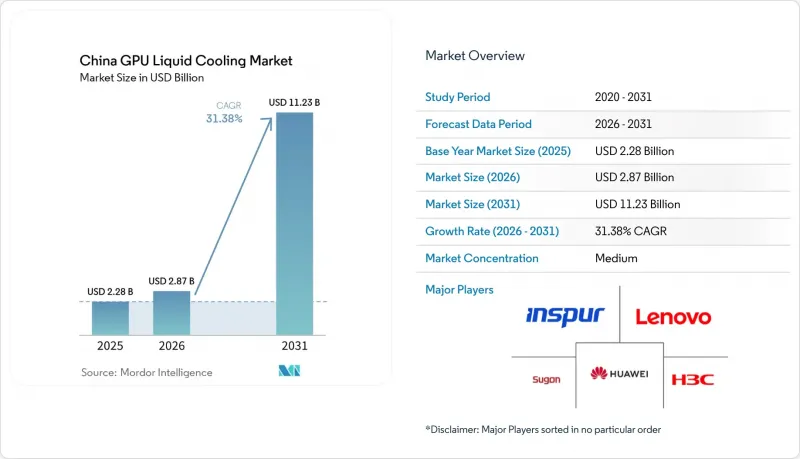
According to Mordor Intelligence, the china gPU liquid cooling market size was valued at USD 2.28 billion in 2025 and estimated to grow from USD 2.87 billion in 2026 to reach USD 11.23 billion by 2031, at a CAGR of 31.38% during the forecast period (2026-2031).
This report is Segmented by Cooling Type (Single-Phase Liquid Cooling, and Two-Phase Liquid Cooling), Cooling Level (Component-Level Cooling, and Server/Rack-Level Cooling), Deployment (Hyperscale/Cloud, Enterprise, Government and Research HPC, and Edge AI), GPU Power Density (Below 300W, 300W-700W, and Above 700W), and Geography. The Market Forecasts are Provided in Terms of Value (USD).
China GPU Liquid Cooling Market Trends and Insights
Surging Adoption of AI Training Workloads in Chinese Hyperscale Data Centers
Chinese hyperscalers are scaling clusters from tens to hundreds of petaflops, and liquid cooling keeps junction temperatures stable even when utilization exceeds 80%. Alibaba Cloud's USD 52.7 billion, three-year infrastructure plan places cold-plate racks at the center of next-generation language-model training, preventing fan energy from eroding overall PUE. Baidu is retrofitting legacy facilities after thermal loads quadrupled, while Tencent doubled AI capex to USD 5 billion for 2026, deploying immersion tanks that sustain 100-200 kW per rack. Sustained demand for sovereign AI models ensures continuous GPU utilization that only liquid cooling can support.
Rising GPU Power Densities Beyond 700 W Necessitating Liquid Cooling
NVIDIA's Vera Rubin family arrives in H2 2026 with liquid cooling as standard and board power at or above 1,000 W, eliminating air systems for flagship AI training racks. Delta Electronics already offers 1.5 MW coolant distribution units sized for fifteen 100 kW NVL72 racks, while Huawei's liquid-cooled 800 G switches prevent thermal throttling in fabric elements. Economics also favor liquid cooling-higher density allows smaller footprints and lowers HVAC overhead.
High Upfront CAPEX Compared With Air Cooling Retrofits
Cold-plate assemblies, quick connectors, and CDUs can lift initial budgets 40-60%, discouraging operators below the 50 kW per rack threshold. Component costs are concentrated in metallurgy and precision machining, areas where scale economies are still maturing. Intel's comparative TCO study, however, shows breakeven in under five years once racks top 100 kW, thanks to lower HVAC bills and higher space utilization. Manufacturers such as Midea are investing USD 138 million in high-volume CDU plants to reduce unit pricing by up to 30% before 2028, easing this barrier.
Other drivers and restraints analyzed in the detailed report include:
- Rapid Build-Out of Provincial AI Computing Clusters Aligned With "East Data West Compute
- Export Restrictions on Advanced GPUs Accelerating Domestic Liquid-Cooled Accelerator R&D
- Supply Chain Dependency on Imported Dielectric Fluids Amid Geopolitical Tensions
For complete list of drivers and restraints, kindly check the Table Of Contents.
Segment Analysis
Single-phase architectures captured the largest China GPU liquid cooling market share at 73.20% in 2025, buoyed by compatibility with standard 42U racks and relatively simple maintenance. Delta's 4 RU and 6 RU in-rack CDUs connect quick-release hoses to Neptune-enabled Lenovo servers that cool H100 and H200 GPUs without plumbing changes to facility loops. This segment still wins most retrofit projects where operators migrate cabinets gradually to liquid. In contrast, two-phase immersion is already the preferred choice for megawatt-class AI training halls: Sugon's C8000 V3.0 tanks achieve 900 kW per rack, shaving PUE to 1.04 and freeing floor space for denser network fabrics. Because power envelopes for Vera Rubin exceed 1 kW per device, the above-700 W density band will tilt procurement toward two-phase systems despite their higher fluid budgets. ODM and hyperscale pilots in H2 2026 will determine the pace at which immersion replaces cold plates for greenfield builds across the China GPU liquid cooling market.
Adoption patterns indicate that roughly 22% of new Chinese data centers commissioned in 2026 integrated some form of liquid cooling, of which two-phase immersion accounted for only 4%. The gap arises from training inertia and the higher cost of fluorinated fluids, yet hyperscalers value immersion's ability to eliminate cold plates from maintenance schedules. Intel and Alibaba Cloud validated single-phase immersion to 100 kW racks at 1.09 PUE, demonstrating a mid-step that could blur boundaries between cold-plate and immersion approaches. As GPU wattage climbs, two-phase systems will absorb the fastest growth slice, reinforcing their role in the future mix of the China GPU liquid cooling market.
Component-level cooling held 55.45% of 2025 spending, mainly because GPU vendors ship reference designs with integrated cold plates. Upgrades on a node-by-node basis simplify billing for enterprises and allow operators to target only mission-critical racks. Tier-1 automotive heat-exchange companies like Yinlun Co. have adapted microchannel plates achieving 98% batch-to-batch consistency, boosting trust among hyperscale buyers. However, rack-level systems, featuring integrated manifolds and in-line CDUs, are growing at a 31.76% CAGR and gaining share of the China GPU liquid cooling market size as hyperscalers chase 150 kW-plus cabinets. XFusion's FusionPoD eliminates hot aisles, delivering pPUE of 1.06 across 144 CPUs plus GPUs, and H3C's 800 G liquid-cooled switch ties the network into the same fluid loop, removing air gaps.
Rack solutions bundle plumbing, leak detection, and monitoring, which lowers engineering time on the data-hall floor. These all-inclusive racks, often shipped in ISO containers, can be craned into bare shells at provincial AI hubs, shortening time-to-compute. For operators retrofitting downtown Beijing or Shanghai colocation, component cold plates remain favored because they avoid cutting concrete for new facility loops. Therefore, both levels will coexist; yet the strongest revenue delta to 2031 sits with racks, adding scale to the China GPU liquid cooling market size.
List of Companies Covered in this Report:
- Inspur Group
- Lenovo Group Limited
- Huawei Technologies Co., Ltd.
- Sugon Information Industry Co., Ltd.
- H3C Technologies Co., Ltd.
- Tencent Holdings Ltd.
- Alibaba Group Holding Limited
- Baidu, Inc.
- Giga Computing Technology Co., Ltd.
- ASUSTeK Computer Inc.
- Super Micro Computer, Inc.
- NVIDIA Corporation
- CoolIT Systems Inc.
- Asetek A/S
- LiquidStack Holding Limited
- Submer Technologies SL
- Envicool Technology Co., Ltd.
- Delta Electronics, Inc.
- Phytium Technology Co., Ltd.
- China Mobile Limited
Additional Benefits:
- The market estimate (ME) sheet in Excel format
- 3 months of analyst support
TABLE OF CONTENTS
1 INTRODUCTION
- 1.1 Study Assumptions and Market Definition
- 1.2 Scope of the Study
2 RESEARCH METHODOLOGY
3 EXECUTIVE SUMMARY
4 MARKET LANDSCAPE
- 4.1 Market Overview
- 4.2 Market Drivers
- 4.2.1 Surging Adoption of AI Training Workloads in Chinese Hyperscale Data Centers
- 4.2.2 Government Incentives for Energy Efficient Data Center Cooling
- 4.2.3 Rising GPU Power Densities Beyond 700W Necessitating Liquid Cooling
- 4.2.4 Rapid Build-Out of Provincial AI Computing Clusters Aligned With "East Data West Compute" Program
- 4.2.5 Growing Preference for Immersion-Ready GPU Reference Designs by ODM Server Makers
- 4.2.6 Export Restrictions on Advanced GPUs Accelerating Domestic Liquid-Cooled Accelerator R&D
- 4.3 Market Restraints
- 4.3.1 High Upfront CAPEX Compared With Air Cooling Retrofits
- 4.3.2 Limited Standardization Across Component-Level Cold Plate Solutions
- 4.3.3 Stringent Cybersecurity Approval Processes for Liquid-Cooled Cloud Deployments in Government Workloads
- 4.3.4 Supply Chain Dependency on Imported Dielectric Fluids Amid Geopolitical Tensions
- 4.4 Industry Value Chain Analysis
- 4.5 Regulatory Landscape
- 4.6 Technological Outlook
- 4.7 Porter's Five Forces Analysis
- 4.7.1 Competitive Rivalry
- 4.7.2 Threat of New Entrants
- 4.7.3 Bargaining Power of Suppliers
- 4.7.4 Bargaining Power of Buyers
- 4.7.5 Threat of Substitutes
- 4.8 Impact of Macroeconomic Factors on the Market
5 MARKET SIZE AND GROWTH FORECASTS (VALUE)
- 5.1 By Cooling Type
- 5.1.1 Single-Phase Liquid Cooling
- 5.1.2 Two-Phase Liquid Cooling
- 5.2 By Cooling Level
- 5.2.1 Component-Level Cooling
- 5.2.2 Server / Rack-Level Cooling
- 5.3 By Deployment
- 5.3.1 Hyperscale / Cloud
- 5.3.2 Enterprise
- 5.3.3 Government and Research (HPC)
- 5.3.4 Edge AI
- 5.4 By GPU Power Density
- 5.4.1 Below 300W
- 5.4.2 300W - 700W
- 5.4.3 Above 700W
6 COMPETITIVE LANDSCAPE
- 6.1 Market Concentration
- 6.2 Strategic Moves
- 6.3 Market Share Analysis
- 6.4 Company Profiles (includes Global Level Overview, Market Level Overview, Core Segments, Financials as available, Strategic Information, Market Rank/Share, Products and Services, Recent Developments)
- 6.4.1 Inspur Group
- 6.4.2 Lenovo Group Limited
- 6.4.3 Huawei Technologies Co., Ltd.
- 6.4.4 Sugon Information Industry Co., Ltd.
- 6.4.5 H3C Technologies Co., Ltd.
- 6.4.6 Tencent Holdings Ltd.
- 6.4.7 Alibaba Group Holding Limited
- 6.4.8 Baidu, Inc.
- 6.4.9 Giga Computing Technology Co., Ltd.
- 6.4.10 ASUSTeK Computer Inc.
- 6.4.11 Super Micro Computer, Inc.
- 6.4.12 NVIDIA Corporation
- 6.4.13 CoolIT Systems Inc.
- 6.4.14 Asetek A/S
- 6.4.15 LiquidStack Holding Limited
- 6.4.16 Submer Technologies SL
- 6.4.17 Envicool Technology Co., Ltd.
- 6.4.18 Delta Electronics, Inc.
- 6.4.19 Phytium Technology Co., Ltd.
- 6.4.20 China Mobile Limited
7 MARKET OPPORTUNITIES AND FUTURE OUTLOOK
- 7.1 Whitespace and Unmet Need Assessment

