PUBLISHER: Mordor Intelligence | PRODUCT CODE: 2063876

PUBLISHER: Mordor Intelligence | PRODUCT CODE: 2063876
AI In Personalized Nutrition - Market Share Analysis, Industry Trends & Statistics, Growth Forecasts (2026 - 2031)
According to Mordor Intelligence, the aI in personalized nutrition market size is expected to increase from USD 1.66 billion in 2025 to USD 2.12 billion in 2026 and reach USD 7.35 billion by 2031, growing at a CAGR of 28.15% over 2026-2031.
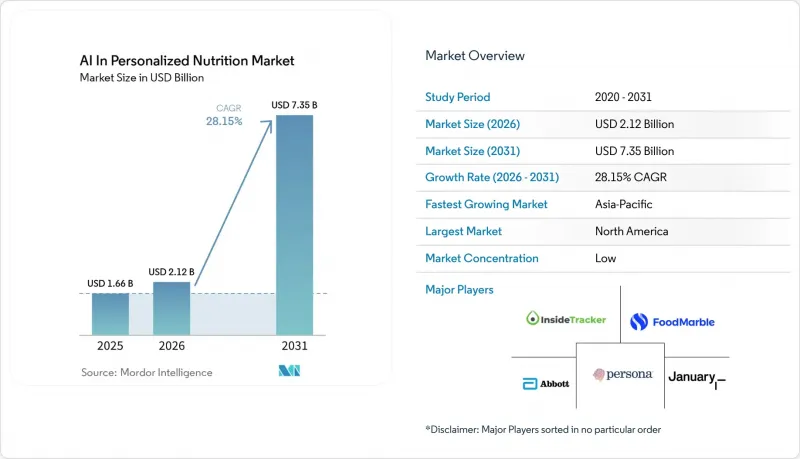
This report is Segmented by AI Technology (ML, Deep Learning, NLP, Computer Vision), Application (Meal Planning, Nutrient Analysis, and More), End User (Individuals, Fitness & Wellness, Healthcare Providers, Employers), Delivery Model (Mobile Apps, On-Premise, Wearables, Hybrid), and Geography (North America, Europe, Asia-Pacific, MEA, South America). Forecasts in Value (USD).
Global AI In Personalized Nutrition Market Trends and Insights
Rising Chronic-Disease and Metabolic-Health Burden
Non-communicable diseases account for 71% of global deaths and create an annual economic burden of USD 1.3 trillion. Population-level dietary guidelines often fail to address individual variations in post-meal glucose responses. However, AI models using data on glucose levels, sleep, activity, and gut microbiomes now provide personalized meal recommendations to stabilize blood sugar. A 2026 study demonstrated that the GluFormer foundation model, trained on 10 million glucose readings, predicted cardiovascular mortality more effectively than HbA1c, identifying 69% of events in the highest risk quartile. Integrated into consumer apps, these predictive tools elevate precision nutrition from lifestyle advice to reimbursable clinical services. Healthcare systems managing GLP-1 drug budgets are aligning dietary guidance with pharmacotherapy adherence, driving demand for AI-driven personalization in chronic disease management.
GLP-1 Nutrition Support and Lean-Mass Preservation Demand
By late 2025, one in eight U.S. adults was using GLP-1 therapy, doubling in 18 months. Medical guidelines recommend 80-120 g of daily protein intake for GLP-1 users to prevent lean-mass loss, but automation of this requirement remains limited. AI-powered meal planning tools can identify protein-rich options, adjust micronutrient goals, and suggest strength-training exercises based on wearable activity data. Employer insurance plans increasingly pair dietitian-supervised AI tools with GLP-1 prescriptions, as claims data shows a 23% reduction in diet-related expenses when precision nutrition complements drug therapy. Early data indicate that users combining GLP-1s with AI-driven dietitian services achieve 33% more weight loss and fewer side effects, presenting a strong ROI case for enterprises.
Data Privacy and Compliance Complexity for Genomic and Biometric Data
Effective April 2025, U.S. restrictions will prohibit the export of bulk genomic data involving anonymized sequences of over 100 individuals to specific countries of concern. Indiana's HB 1521 and Montana's SB 163 require explicit consent and deletion rights for genetic data, complicating DNA-based onboarding processes. The EU Artificial Intelligence Act categorizes nutrition advice based on sensitive biometric data as high-risk, necessitating mandatory compliance assessments. These overlapping regulations demand jurisdiction-specific data storage, increasing costs for multinational operations. Smaller vendors face challenges in building the necessary legal frameworks, giving larger, well-funded platforms a competitive edge.
Other drivers and restraints analyzed in the detailed report include:
- Expansion of Wearables, CGMs, and At-Home Biomarker Testing
- Payor and Employer Food-as-Medicine Pilots
- Western-Food Dataset Bias Limiting Accuracy Across Cuisines
For complete list of drivers and restraints, kindly check the Table Of Contents.
Segment Analysis
In 2025, machine learning captured 45.50% of the AI-driven personalized nutrition market. Its success stems from the effectiveness of gradient-boosted trees and ensemble forests in predicting glycemic responses from limited lab and lifestyle data. Clinical deployments prioritize SHAP value explanations, which simplify feature weights into actionable nutrition goals for patients. By 2026, model compression advancements reduced inference latency to under 300 milliseconds on smartphones, enabling apps to deliver meal scores instantly. Platform strategies now focus on federated-learning updates, ensuring genomic data remains on-device while syncing only model gradients to the cloud. This approach addresses privacy concerns and enhances sample diversity.
Computer vision is projected to achieve a 29.00% CAGR through 2031, driven by global smartphone penetration exceeding 6.8 billion active devices. January AI's extensive food ontology demonstrates the scalability of image recognition, maintaining high recall rates even for low-frequency ethnic dishes.
In 2025, meal planning and recommendation engines accounted for 41.35% of the revenue. This growth was supported by low biological-testing thresholds and viral sharing loops that transformed user-generated recipe libraries into effective marketing tools. Engagement rates exceeded 40% when push notifications aligned with CGM-flagged glucose spikes, sustaining user retention beyond the typical 90-day churn period. Collaborations with national grocers enhanced the appeal by offering shoppable meal plans with same-day ingredient delivery, creating a self-sustaining e-commerce model supporting freemium tiers.
Personalized supplement recommendations are expected to grow at a 29.45% CAGR through 2031, driven by declining costs of RNA, microbiome, and blood-spot assays, now below USD 150 per kit. Viome's multi-omic SKU customizes probiotic, prebiotic, and vitamin packs based on individual inflammatory markers and provides bulk-capsule manufacturing as a private-label service for other apps.
Geography Analysis
In 2025, North America commanded a dominant 41.50% share of the AI-driven personalized nutrition market. This growth is attributed to the region's strong venture ecosystem, widespread adoption of over-the-counter continuous glucose monitors (CGMs), and a mature reimbursement framework treating food as medicine. January AI's inclusion in the CMS Medicare App Library in April 2026 allows millions of Medicare beneficiaries to access an approved app for glucose prediction and meal coaching, highlighting federal recognition of AI in healthcare. U.S. employers are scaling precision-nutrition initiatives, with a claims analysis from 48 self-insured firms showing an annual saving of USD 3,012 per member when digital nutrition therapies complement standard care. This has drawn board-level attention, accelerating procurement cycles.
Asia-Pacific is poised to be the fastest-growing region, with a projected 29.25% CAGR from 2026 to 2031, driven by domestic tech giants entering chronic disease management. In 2025, China's Meinian Health reported AI-related revenues of CNY 370 million (approximately USD 51 million), with plans to expand precision nutrition. Major players like Ant Group, Tencent, and ByteDance are integrating diet-scoring features into super-apps, leveraging social interactions to gather biometric data at scale. Japan's Asken maintains strong user engagement, while Singapore's Health Promotion Board is piloting CGM-subsidized meal vouchers, indicating that public policies can enhance private-sector efforts. South America and the GCC, though in early stages, offer potential for metabolic health interventions due to high obesity rates. However, fragmented data rights and limited lab networks may hinder short-term adoption.
- Abbott Laboratories
- DayTwo
- DNAfit (Prenetics / CircleDNA)
- EatLove
- FoodMarble
- GenoPalate
- Habit
- InsideTracker
- January AI
- Levels Health
- Lumen
- Nourished
- Nutrigenomix
- Nutrisense
- Persona Nutrition
- Rootine
- Season Health
- Suggestic
- Viome
- ZOE
Additional Benefits:
- The market estimate (ME) sheet in Excel format
- 3 months of analyst support
TABLE OF CONTENTS
1 Introduction
- 1.1 Study Assumptions & Market Definition
- 1.2 Scope of the Study
2 Research Methodology
3 Executive Summary
4 Market Landscape
- 4.1 Market Overview
- 4.2 Market Drivers
- 4.2.1 Rising Chronic-Disease and Metabolic-Health Burden
- 4.2.2 Expansion of Wearables, CGMs, and At-Home Biomarker Testing
- 4.2.3 Consumer Shift Toward Preventive and Personalized Wellness
- 4.2.4 AI Advances in Multimodal Nutrition Data Fusion
- 4.2.5 GLP-1 Nutrition Support and Lean-Mass Preservation Demand
- 4.2.6 Payer and Employer Food-As-Medicine Pilots
- 4.3 Market Restraints
- 4.3.1 Data Privacy and Compliance Complexity for Genomic and Biometric Data
- 4.3.2 Limited Clinical Validation and Explainability
- 4.3.3 Western-Food Dataset Bias Limiting Accuracy Across Cuisines
- 4.3.4 Fragmented Data Rights Across Labs, Grocers, Restaurants, and Wearables
- 4.4 Value/supply Chain Analysis
- 4.5 Regulatory Landscape
- 4.6 Technological Outlook
- 4.7 Porter's Five Forces Analysis
- 4.7.1 Threat of New Entrants
- 4.7.2 Bargaining Power of Suppliers
- 4.7.3 Bargaining Power of Buyers
- 4.7.4 Threat of Substitutes
- 4.7.5 Industry Rivalry
5 Market Size & Growth Forecasts (Value, USD)
- 5.1 By AI Technology
- 5.1.1 Machine Learning
- 5.1.2 Deep Learning
- 5.1.3 Natural Language Processing
- 5.1.4 Computer Vision
- 5.2 By Application
- 5.2.1 Meal Planning & Recommendations
- 5.2.2 Nutrient & Micronutrient Analysis
- 5.2.3 Personalized Supplement Recommendations
- 5.2.4 Allergen & Food Sensitivity Identification
- 5.2.5 Health & Metabolic Monitoring
- 5.3 By End User
- 5.3.1 Individuals / Consumers
- 5.3.2 Fitness & Wellness Organizations
- 5.3.3 Healthcare Providers
- 5.3.4 Employers & Enterprises
- 5.4 By Delivery & Deployment Model
- 5.4.1 Mobile Apps & Cloud-Based Platforms
- 5.4.2 On-Premise / Private-Cloud Enterprise Deployments
- 5.4.3 Wearable Device-Integrated Platforms
- 5.4.4 Hybrid App + Dietitian / Coach Models
- 5.5 By Geography
- 5.5.1 North America
- 5.5.1.1 United States
- 5.5.1.2 Canada
- 5.5.1.3 Mexico
- 5.5.2 Europe
- 5.5.2.1 Germany
- 5.5.2.2 United Kingdom
- 5.5.2.3 France
- 5.5.2.4 Italy
- 5.5.2.5 Spain
- 5.5.2.6 Rest of Europe
- 5.5.3 Asia-Pacific
- 5.5.3.1 China
- 5.5.3.2 India
- 5.5.3.3 Japan
- 5.5.3.4 South Korea
- 5.5.3.5 Australia
- 5.5.3.6 Rest of Asia-Pacific
- 5.5.4 Middle East & Africa
- 5.5.4.1 GCC
- 5.5.4.2 South Africa
- 5.5.4.3 Rest of Middle East and Africa
- 5.5.5 South America
- 5.5.5.1 Brazil
- 5.5.5.2 Argentina
- 5.5.5.3 Rest of South America
- 5.5.1 North America
6 Competitive Landscape
- 6.1 Market Concentration
- 6.2 Market Share Analysis
- 6.3 Company Profiles {(includes Global level Overview, Market level overview, Core Segments, Financials as available, Strategic Information, Market Rank/Share for key companies, Products & Services, and Recent Developments)}
- 6.3.1 Abbott Laboratories
- 6.3.2 DayTwo
- 6.3.3 DNAfit (Prenetics / CircleDNA)
- 6.3.4 EatLove
- 6.3.5 FoodMarble
- 6.3.6 GenoPalate
- 6.3.7 Habit
- 6.3.8 InsideTracker
- 6.3.9 January AI
- 6.3.10 Levels Health
- 6.3.11 Lumen
- 6.3.12 Nourished
- 6.3.13 Nutrigenomix
- 6.3.14 Nutrisense
- 6.3.15 Persona Nutrition
- 6.3.16 Rootine
- 6.3.17 Season Health
- 6.3.18 Suggestic
- 6.3.19 Viome
- 6.3.20 ZOE
7 Market Opportunities & Future Outlook
- 7.1 White-space & unmet-need assessment

