PUBLISHER: Mordor Intelligence | PRODUCT CODE: 2063898

PUBLISHER: Mordor Intelligence | PRODUCT CODE: 2063898
Drill Collar - Market Share Analysis, Industry Trends & Statistics, Growth Forecasts (2026 - 2031)
According to Mordor Intelligence, the drill collar market size is projected to be USD 1.44 billion in 2025, USD 1.51 billion in 2026, and reach USD 1.91 billion by 2031, growing at a CAGR of 4.81% from 2026 to 2031.
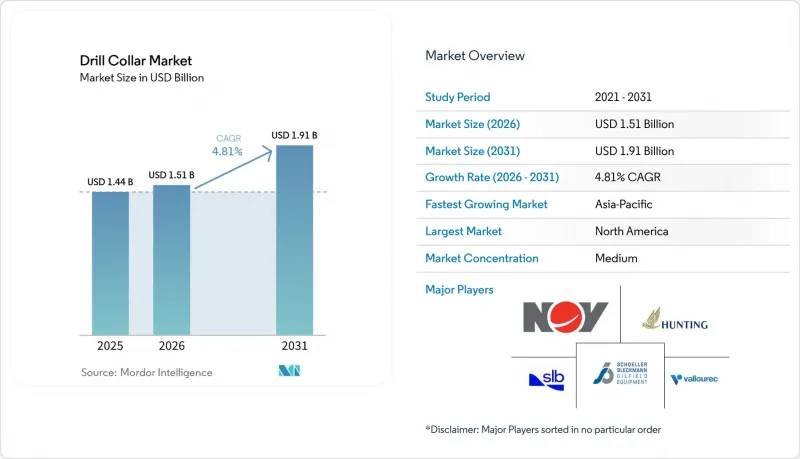
This report is Segmented by Type (Standard Steel Drill Collar, Non-Magnetic Drill Collar), Material Grade (4145H Mod Steel, 4330V Steel, Non-Magnetic 14Cr-MoV Stainless), Deployment (Onshore, Offshore), Application (Land Rigs, HPHT Wells, Directional and Horizontal Drilling), and Geography (North America, Europe, Asia-Pacific, South America, Middle East and Africa). Market Forecasts are Provided in Value (USD).
Global Drill Collar Market Trends and Insights
Recovery in Global Rig Counts Post 2025
International rig activity found a floor in early 2026 with 1,058 units working, including 229 offshore rigs, after several years of attrition. ADNOC Drilling reinforced the upward trend by ordering two premium jack-ups valued at USD 1.15 billion in January 2026. India's regulator outlined a USD 100 billion upstream target that includes 40 deepwater wildcats, each demanding dedicated drill-collar strings. Reactivated eighth-generation drillships employ hybrid power that cuts fuel use by as much as 30%, yet the deeper wells they target require heavier collars to deliver weight-on-bit at 2,000 m water depth. As a result, demand is migrating from high-volume, low-spec replacements to lower-volume, high-spec upgrades.
Growth of Deep- & Ultra-Deepwater Drilling Projects
Petrobras approved SEAP I and SEAP II in early 2025, earmarking more than USD 12 billion for 32 wells in reservoirs beyond 2,000 m depth, with pressures above 15,000 psi that mandate 4330V or 14Cr-MoV collars. Beacon Offshore Energy's Shenandoah field surpassed 100,000 bpd under 20,000 psi conditions, underscoring the shift toward extreme environments. Equinor allocated NOK 140 billion (USD 13.1 billion) for 2026 projects such as Johan Sverdrup Phase 2, where Arctic temperatures demand NORSOK-certified collars. Ultra-deepwater economics depend on avoiding stuck-pipe events that cost USD 1 million per day, so operators invest in collars forged for high yield strength and paired with real-time fatigue models. These technical thresholds are pushing the drill collar market toward premium metallurgy and digital support services.
Crude-Oil Price Volatility Dampens E&P CAPEX
The U.S. Energy Information Administration noted a 14% decline in upstream capital spending during 2024 and a 9% slide in cash flow among public producers, squeezing discretionary drilling budgets. Chevron disclosed a USD 18-19 billion 2026 capital plan but tied any upside to Brent benchmarks stabilizing above USD 70 per barrel. Operators can quickly defer completions or idle rigs without near-term production loss, causing sporadic demand swings for drill collars. Such pullbacks typically hit standard steel orders first, compressing plant utilization and eroding margins. In regions where breakeven prices hover near global benchmarks, procurement teams delay high-alloy purchases, slowing unit growth in the drill collar market.
Other drivers and restraints analyzed in the detailed report include:
- Rapid Adoption of Directional & Horizontal Drilling
- OEM-Led Collar Weight Optimization to Cut Rig Emissions
- Availability of Substitute Down-Hole Weight Solutions
For complete list of drivers and restraints, kindly check the Table Of Contents.
Segment Analysis
Standard steel accounted for 65.1% of 2025 volume, reflecting its low cost and readiness for vertical wells. Non-magnetic collars, however, are expanding at 5.5% CAGR because high-frequency sensors cannot tolerate magnetic permeability above 1.01. The drill collar market size for non-magnetic variants is projected to expand from 2026 through 2031 as subsalt and long-reach laterals proliferate. Halliburton's EarthStar 3DX now specifies this metallurgy on every HPHT BHA, validating the premium.
Manufacturers exploit the pricing headroom: Schoeller-Bleckmann's 2024 EBIT margin reached 15.0% on stronger alloy demand. Standard steel continues to dominate U.S. shale where vertical sections exceed 1,500 m and operators recycle inventory aggressively. Yet as wired pipe migrates into land operations, sensor density rises and the non-magnetic share of the drill collar market rises alongside.
4145H modified steel secured 44.9% of 2025 shipments thanks to its API acceptance and balanced cost. Non-magnetic 14Cr-MoV stainless is the fastest-growing grade at 5.8% CAGR, supported by pre-salt wells with high CO2 and H2S exposure. Drill collar market size growth in this grade is most noticeable in the U.S. Gulf of Mexico's 20,000 psi projects.
4330V provides a higher-strength middle ground for Arctic and ultra-deepwater applications. Equinor employs it in Johan Sverdrup Phase 2 where seabed temperatures hover near 4 °C. Premium connections such as Tenaris Dopeless reduce galling risk, extending reuse cycles and shielding operators from volatile alloy prices.
Geography Analysis
North America commanded 38.5% share in 2025 on the back of Gulf of Mexico deepwater and U.S. shale intensity, though regional rig counts slipped to 548 units by April 2026. Chevron still directs roughly USD 7 billion of its 2026 budget to Gulf projects, maintaining a floor for non-magnetic and HPHT-rated demand. Canada's modest 54 working rigs grapple with takeaway constraints, tempering collar consumption but supporting niche suppliers skilled in cold-weather metallurgy.
Asia-Pacific is forecast to grow at 6.2% CAGR through 2031, the fastest pace among regions. India's Directorate General of Hydrocarbons is steering USD 100 billion toward upstream work that includes 40 deepwater wildcats, each requiring dedicated drill-collar strings. ONGC's USD 385.5 million contract for Krishna-Godavari drilling places early orders for HPHT-ready alloys. CNOOC's Wenchang 16-2 adds regional pull, relying on domestic mills for shorter lead times.
Europe growth is anchored by Norway. Equinor's NOK 140 billion 2026 plan keeps Johan Sverdrup on plateau and moves Breidablikk toward 140,000 bpd, both certified under Arctic drilling codes. Norway's sharp CO2 price encourages hybrid rigs that paradoxically need stiffer, heavier collars to manage deeper wells. In the Middle East and Africa, ADNOC Drilling's USD 3.6 billion award slate confirms prolonged appetite for premium BHAs.
- Hunting plc
- SLB N.V.
- NOV Inc.
- SBO AG
- China Vigor Drilling Oil Tools and Equipment Co., Ltd.
- International Drilling Services Ltd. (IDS)
- Zhong Yuan Special Steel Co., Ltd.
- American Oilfield Tools, Inc.
- Workstrings International Ltd.
- Texas Steel Conversion, Inc.
- Challenger International, Inc.
- Vallourec S.A.
- Weatherford International plc
- Tenaris S.A.
- Jiangsu Shuguang Huayang Drilling Tool Co., Ltd.
- Superior Drillpipe Manufacturing, Inc.
- Tejas Tubular Products, Inc.
- Drill Collars & Drill Pipe, Inc.
- Ramco Tubular Services, Inc.
- Drill Collar USA, Inc.
Additional Benefits:
- The market estimate (ME) sheet in Excel format
- 3 months of analyst support
TABLE OF CONTENTS
1 Introduction
- 1.1 Study Assumptions & Market Definition
- 1.2 Scope of the Study
2 Research Methodology
3 Executive Summary
4 Market Landscape
- 4.1 Market Overview
- 4.2 Market Drivers
- 4.2.1 Recovery in global rig counts post-2025
- 4.2.2 Growth of deep- & ultra-deep-water drilling projects
- 4.2.3 Rapid adoption of directional & horizontal drilling
- 4.2.4 OEM-led collar weight optimisation to cut rig emissions
- 4.2.5 Surging demand for non-magnetic collars for high-freq MWD/LWD
- 4.2.6 Digital-twin based fatigue-life prediction extends service life
- 4.3 Market Restraints
- 4.3.1 Crude-oil price volatility dampens E&P CAPEX
- 4.3.2 Availability of substitute down-hole weight solutions
- 4.3.3 Supply crunch in low-permeability non-magnetic alloys
- 4.3.4 Stricter drilling-waste regulations shortening collar cycles
- 4.4 Supply-Chain Analysis
- 4.5 Regulatory Landscape
- 4.6 Technological Outlook
- 4.7 Porter's Five Forces
- 4.7.1 Bargaining Power of Suppliers
- 4.7.2 Bargaining Power of Buyers
- 4.7.3 Threat of New Entrants
- 4.7.4 Threat of Substitutes
- 4.7.5 Intensity of Competitive Rivalry
5 Market Size & Growth Forecasts
- 5.1 By Type
- 5.1.1 Standard Steel Drill Collar
- 5.1.2 Non-magnetic Drill Collar
- 5.2 By Material Grade
- 5.2.1 4145H Mod Steel
- 5.2.2 4330V Steel
- 5.2.3 Non-magnetic 14Cr-MoV Stainless
- 5.3 By Deployment
- 5.3.1 Onshore
- 5.3.2 Offshore
- 5.4 By Application
- 5.4.1 Land Rigs
- 5.4.2 High-Pressure High-Temperature (HPHT) Wells
- 5.4.3 Directional and Horizontal Drilling
- 5.5 By Geography
- 5.5.1 North America
- 5.5.1.1 United States
- 5.5.1.2 Canada
- 5.5.1.3 Mexico
- 5.5.2 Europe
- 5.5.2.1 Norway
- 5.5.2.2 United Kingdom
- 5.5.2.3 Russia
- 5.5.2.4 Netherlands
- 5.5.2.5 Germany
- 5.5.2.6 Rest of Europe
- 5.5.3 Asia Pacific
- 5.5.3.1 China
- 5.5.3.2 India
- 5.5.3.3 Japan
- 5.5.3.4 South Korea
- 5.5.3.5 ASEAN Countries
- 5.5.3.6 Australia
- 5.5.3.7 Rest of Asia Pacific
- 5.5.4 South America
- 5.5.4.1 Brazil
- 5.5.4.2 Argentina
- 5.5.4.3 Colombia
- 5.5.4.4 Rest of South America
- 5.5.5 Middle East and Africa
- 5.5.5.1 Saudi Arabia
- 5.5.5.2 United Arab Emirates
- 5.5.5.3 Iran
- 5.5.5.4 Nigeria
- 5.5.5.5 South Africa
- 5.5.5.6 Rest of Middle East and Africa
- 5.5.1 North America
6 Competitive Landscape
- 6.1 Market Concentration
- 6.2 Strategic Moves (M&A, Partnerships, PPAs)
- 6.3 Market Share Analysis (Market Rank/Share for key companies)
- 6.4 Company Profiles (includes Global level Overview, Market level overview, Core Segments, Financials as available, Strategic Information, Products & Services, and Recent Developments)
- 6.4.1 Hunting plc
- 6.4.2 SLB N.V.
- 6.4.3 NOV Inc.
- 6.4.4 SBO AG
- 6.4.5 China Vigor Drilling Oil Tools and Equipment Co., Ltd.
- 6.4.6 International Drilling Services Ltd. (IDS)
- 6.4.7 Zhong Yuan Special Steel Co., Ltd.
- 6.4.8 American Oilfield Tools, Inc.
- 6.4.9 Workstrings International Ltd.
- 6.4.10 Texas Steel Conversion, Inc.
- 6.4.11 Challenger International, Inc.
- 6.4.12 Vallourec S.A.
- 6.4.13 Weatherford International plc
- 6.4.14 Tenaris S.A.
- 6.4.15 Jiangsu Shuguang Huayang Drilling Tool Co., Ltd.
- 6.4.16 Superior Drillpipe Manufacturing, Inc.
- 6.4.17 Tejas Tubular Products, Inc.
- 6.4.18 Drill Collars & Drill Pipe, Inc.
- 6.4.19 Ramco Tubular Services, Inc.
- 6.4.20 Drill Collar USA, Inc.
7 Market Opportunities & Future Outlook
- 7.1 White-space & Unmet-Need Assessment

