PUBLISHER: Mordor Intelligence | PRODUCT CODE: 2063914

PUBLISHER: Mordor Intelligence | PRODUCT CODE: 2063914
Ice-Cream Freezers - Market Share Analysis, Industry Trends & Statistics, Growth Forecasts (2026 - 2031)
According to Mordor Intelligence, the ice-cream freezers market size is expected to increase from USD 12.05 billion in 2025 to USD 12.64 billion in 2026 and reach USD 16.95 billion by 2031, growing at a CAGR of 6.04% over 2026-2031.
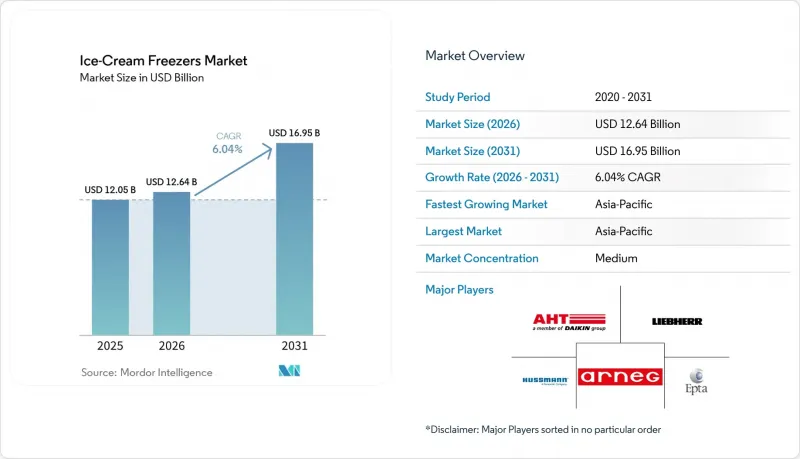
This report is Segmented by Product Type (Chest, Upright, Dipping, Countertop, and Island/Multideck), Cooling Technology (Static, Ventilated, Hybrid, and Glycol/Waterloop), Capacity (≤300L, 301-600L, and >600L), End User (Supermarkets, C-Stores, Ice-Cream Parlors, Horeca, and Bars), Sales Channel (Distributors and Direct OEM), and Geography. Market Forecasts in Value (USD).
Global Ice-Cream Freezers Market Trends and Insights
HFC Phase-Down and Efficiency Mandates Creating Structural Replacement Demand
The ice-cream freezer market is entering a structural replacement phase because the European Union F-Gas Regulation (EU) 2024/573 banned fluorinated gases with a GWP of 150 or more in new self-contained commercial refrigeration equipment from January 1, 2025, directly affecting legacy R134a and R404A freezer fleets. In the United States, the AIM Act requires new stand-alone commercial refrigeration units to shift to refrigerants with a GWP below 150 on the same date, while the HFC allowance cap for 2024-2028 fell to 60% of baseline . European Union HFC consumption in 2024 was already 60% below Montreal Protocol targets, which shows how quickly the available refrigerant pool has tightened for owners of legacy systems. That change matters for the ice-cream freezers market because operators who keep older equipment in service face higher servicing exposure due to virgin HFC supply contracts. The result is that replacement decisions are increasingly being justified by total ownership cost and compliance risk rather than by simple end-of-life timing.
Retail Footprint Expansion and Modernization in Asia-Pacific
Asia-Pacific combines the largest current base with the fastest growth path, giving the ice-cream freezers market a stronger structural demand base than in regions where growth depends on replacement. India's ice-cream business was valued at INR 30,000 crore (USD 3.5 billion) in 2023, and the category is expected to grow at 13%-15% as organized retail expands and per-capita consumption rises. That retail build-out is not limited to large-format hypermarkets, because neighborhood grocery and convenience formats are also widening frozen-food capacity across China, India, and Southeast Asia. Those smaller stores usually need plug-in cabinets rather than centralized systems, so demand tilts toward the ≤300L and 301-600L bands in the ice-cream freezers market. The practical effect is that store-count growth in warm-climate urban corridors converts directly into new cabinet demand, especially where impulse purchases still dominate frozen dessert sales.
Technician Skill Gaps and Safety Code Compliance for HC/CO2
The ice-cream freezers market faces a conversion bottleneck because the move to R290 and CO2 systems depends on a technician base that is still catching up with new safety and handling requirements. European Union F-Gas Regulation (EU) 2024/573 requires member states to establish certification programs for natural-refrigerant technicians, and implementing rules began to appear through 2025. The gap between certification timelines and workforce capacity can cause installation and fleet conversion to lag even when buyers are ready to spend. Smaller operators are particularly cautious because improper handling of hydrocarbon systems can raise insurance concerns and trigger building code violations. As a result, the ice-cream freezers market may see demand remain healthy while actual installation velocity is constrained by labor availability and compliance risk.
Other drivers and restraints analyzed in the detailed report include:
- Natural Refrigerant Adoption Enabling Higher-Efficiency Plug-in Units
- Growth of Supermarkets, Convenience Formats, and Premium Gelato Outlets
- High Upfront Costs Amid Energy Price Volatility
For complete list of drivers and restraints, kindly check the Table Of Contents.
Segment Analysis
Chest/Deep Freezers held 34.23% of the ice-cream freezer market share in 2025, reflecting their deep entrenchment in branded freezer programs across Asia-Pacific, Africa, and South America. Their position remains strong because multinational ice-cream brands continue to place chest units with independent retailers under exclusive or semi-exclusive distribution arrangements. That installed base is replaced on a cycle shaped more by refrigerant compliance than by merchandising obsolescence. The ice-cream freezers market still relies on chest formats in impulse-heavy locations where low cost, durability, and simple maintenance matter more than visual presentation. This keeps chest units highly relevant in roadside retail, kiosks, and neighborhood outlets where frozen dessert turnover is steady, but floor area is limited.
Upright/Glass-Door Freezers are projected to grow at a 6.18% CAGR through 2031, the fastest rate among product types, as organized retail shifts toward vertical visibility and clearer product comparisons. European Union energy rules have reinforced that shift, as ice-cream freezers had to meet an EEI threshold of 50% or less from September 1, 2023, favoring newer vertical designs in regulated markets . Dipping Cabinets and Scooping Freezers are gaining more addressable demand as gelato and premium dessert formats expand into markets where they previously had little formal presence. Island/Multideck Freezers remain tied to larger supermarket floor displays and are being refreshed on lower-GWP platforms as store fleets modernize. Countertop Ice-Cream Freezers remain the smallest sub-segment, yet they benefit from cafe, QSR, and dessert menu expansion, which gives the ice-cream freezers industry a specialist product layer beyond mainstream retail.
Static cooling systems accounted for 44.92% of 2025 revenues, underscoring how much the ice-cream freezers market still relies on low-cost plug-in cabinets used in branded fleets and small-format retail. Their staying power is linked to simplicity, lower acquisition costs, and a long history of installation in impulse channels. Static systems have also remained viable because compliance pressure has pushed manufacturers to optimize familiar platforms rather than abandon them. In practice, many operators prefer an improved static unit that is easy to service and install. That dynamic helps explain why the base of the ice-cream freezers market remains broad even as advanced technologies gain attention.
Remote Glycol/Waterloop (SPI) systems are growing at 6.88% through 2031, the fastest pace among cooling technologies, because they address both refrigerant compliance and store-layout flexibility. AHT Cooling Systems deployed its VENTO SPI waterloop system in Thailand in 2025. They reported a 12% reduction in annual energy use against an R404A rack system, along with a 97% reduction in refrigerant charge. A hybrid R290 plug-in water-loop installation in Germany also cut total supermarket energy use by 8.8% and reduced air-conditioning load by up to 40% in warmer months. Charge-limit rules under EN IEC 60335-2-89:2022 have further strengthened the case for distributed architectures by spreading refrigerant across smaller sealed circuits rather than a single large, centralized charge. In the ice-cream freezers market, which means waterloop systems are shaping the future of technology, even as static units continue to dominate the installed base.
Geography Analysis
Asia-Pacific held 37.13% of the ice-cream freezer market share in 2025 and is also forecast to post the fastest regional CAGR of 7.23% through 2031. That rare combination points to structural demand rather than a short replacement spike. The region benefits from rising frozen dessert consumption, rapid retail formalization, and climate conditions that sustain year-round demand for visible commercial freezer placement. India adds a strong long-term layer because organized retail expansion is improving cold-chain reach while per-capita consumption continues to rise from a low base. The region also offers an early commercial case for waterloop and semi plug-in systems because high ambient temperatures make heat rejection a more immediate store-level issue than in many temperate markets.
Europe is projected to grow at 3.50% through 2031, which is slower than Asia-Pacific but still supported by a clear compliance-led replacement cycle. The region's installed base is large and mature, so equipment refresh depends more on regulations, efficiency, and technology upgrades than on the creation of new outlets. European Union Ecodesign and EPREL rules have made product comparison more transparent, and the European Union F-Gas Regulation (EU) 2024/573 has accelerated pressure on legacy HFC fleets. North America is forecast to grow at 4.50% through 2031, supported by the AIM Act and by demand for premium and artisan frozen dessert formats. In both regions, the ice-cream freezers market is moving toward better-specified, lower-GWP, and more data-visible equipment rather than simply toward higher unit volumes.
South America is projected to grow at 5.00% through 2031, while Western Asia is expected to expand in the 5%-6% range and Africa in the 4% range, from lower bases. These regions are at an earlier stage of development, so retail modernization and cold-chain investment matter more than regulation-driven replacement in the near term. The Kigali framework remains important because it pulls developing economies onto the HFC phase-down path and supports a gradual shift away from legacy refrigerants. As store networks and foodservice formats modernize, the ice-cream freezers market in these geographies should expand through a mix of first-time installations and selective upgrades, rather than solely through broad fleet conversion.
- AHT Cooling Systems (Daikin)
- Epta Group (IARP/Eurocryor)
- Arneg Group
- ISA S.p.A.
- Liebherr Professional
- Hussmann (Panasonic)
- Carrier Commercial Refrigeration
- Beverage-Air (Ali Group)
- Turbo Air
- Master-Bilt
- Nor-Lake
- Sanden Intercool
- Blue Star (India)
- Western Refrigeration (India)
- Rockwell Industries
- Vestfrost Solutions
- TEFCOLD
- Jordao
- Maxx Cold
- Avantco
Additional Benefits:
- The market estimate (ME) sheet in Excel format
- 3 months of analyst support
TABLE OF CONTENTS
1 Introduction
- 1.1 Study Assumptions & Market Definition
- 1.2 Scope of the Study
2 Research Methodology
3 Executive Summary
4 Market Landscape
- 4.1 Market Overview
- 4.2 Market Drivers
- 4.2.1 HFC phase-down and efficiency mandates driving replacement cycles
- 4.2.2 Retail footprint expansion and modernization in Asia-Pacific
- 4.2.3 Natural refrigerants (R290/CO2) adoption enabling higher-efficiency plug-ins
- 4.2.4 Growth of supermarkets/convenience formats and premium gelato outlets
- 4.2.5 Energy labeling and procurement transparency (EU) accelerating upgrades
- 4.2.6 Waterloop/semi plug-in architectures enabling heat recovery and flexible layouts
- 4.3 Market Restraints
- 4.3.1 Technician skill gaps and safety code compliance for HC/CO2
- 4.3.2 High upfront costs amid energy price volatility
- 4.3.3 Hydrocarbon charge/room-size limits restricting some sites
- 4.3.4 EU market surveillance and conformity burdens elongating purchase cycles
- 4.4 Industry Value Chain Analysis
- 4.5 Porter's Five Forces
- 4.5.1 Competitive Rivalry
- 4.5.2 Supplier Power
- 4.5.3 Buyer Power
- 4.5.4 Threat of Substitutes
- 4.5.5 Threat of New Entrants
- 4.6 Insights into the Latest Trends and Innovations in the Industry
- 4.7 Insights into the Recent Developments (New Product Launches, Strategic Initiatives, Investments, Partnerships, JVs, Expansion, M&As, Etc.) in the Industry
- 4.8 Insights into Commercial End Users' Buying Behavior and Key Selection Criteria for Icecream Freezers
5 Market Size & Growth Forecasts
- 5.1 By Product Type
- 5.1.1 Chest/Deep Freezers
- 5.1.2 Upright/Glass-Door Freezers
- 5.1.3 Dipping Cabinets/Scooping Freezers
- 5.1.4 Countertop Ice-Cream Freezers
- 5.1.5 Island/Multideck Freezers for Ice-Cream
- 5.2 By Cooling Technology
- 5.2.1 Static
- 5.2.2 Ventilated/Forced-Air
- 5.2.3 Hybrid
- 5.2.4 Remote Glycol/Waterloop (SPI)
- 5.3 By Capacity (Liters)
- 5.3.1 <=300 L
- 5.3.2 301-600 L
- 5.3.3 >600 L
- 5.4 By End User
- 5.4.1 Supermarkets/Hypermarkets
- 5.4.2 Convenience Stores/Gas Stations
- 5.4.3 Ice-Cream Parlors & Gelaterias
- 5.4.4 HoReCa (Restaurants, Cafes, QSRs)
- 5.4.5 Bars & Clubs
- 5.5 By Sales Channel
- 5.5.1 Distributors/Dealers
- 5.5.2 Direct OEM/Key Accounts
- 5.6 By Geography
- 5.6.1 North America
- 5.6.1.1 United States
- 5.6.1.2 Canada
- 5.6.1.3 Mexico
- 5.6.2 South America
- 5.6.2.1 Brazil
- 5.6.2.2 Peru
- 5.6.2.3 Chile
- 5.6.2.4 Argentina
- 5.6.2.5 Rest of South America
- 5.6.3 Europe
- 5.6.3.1 United Kingdom
- 5.6.3.2 Germany
- 5.6.3.3 France
- 5.6.3.4 Spain
- 5.6.3.5 Italy
- 5.6.3.6 BENELUX (Belgium, Netherlands, Luxembourg)
- 5.6.3.7 NORDICS (Denmark, Finland, Iceland, Norway, Sweden)
- 5.6.3.8 Rest of Europe
- 5.6.4 Asia-Pacific
- 5.6.4.1 India
- 5.6.4.2 China
- 5.6.4.3 Japan
- 5.6.4.4 Australia
- 5.6.4.5 South Korea
- 5.6.4.6 South East Asia (Singapore, Malaysia, Thailand, Indonesia, Vietnam, Philippines)
- 5.6.4.7 Rest of Asia-Pacific
- 5.6.5 Middle East And Africa
- 5.6.5.1 United Arab Emirates
- 5.6.5.2 Saudi Arabia
- 5.6.5.3 South Africa
- 5.6.5.4 Nigeria
- 5.6.5.5 Rest of Middle East And Africa
- 5.6.1 North America
6 Competitive Landscape
- 6.1 Market Concentration
- 6.2 Strategic Moves
- 6.3 Market Share Analysis
- 6.4 Company Profiles {(includes Global level Overview, Market level overview, Core Segments, Financials as available, Strategic Information, Market Rank/Share for key companies, Products & Services, and Recent Developments)}
- 6.4.1 AHT Cooling Systems (Daikin)
- 6.4.2 Epta Group (IARP/Eurocryor)
- 6.4.3 Arneg Group
- 6.4.4 ISA S.p.A.
- 6.4.5 Liebherr Professional
- 6.4.6 Hussmann (Panasonic)
- 6.4.7 Carrier Commercial Refrigeration
- 6.4.8 Beverage-Air (Ali Group)
- 6.4.9 Turbo Air
- 6.4.10 Master-Bilt
- 6.4.11 Nor-Lake
- 6.4.12 Sanden Intercool
- 6.4.13 Blue Star (India)
- 6.4.14 Western Refrigeration (India)
- 6.4.15 Rockwell Industries
- 6.4.16 Vestfrost Solutions
- 6.4.17 TEFCOLD
- 6.4.18 Jordao
- 6.4.19 Maxx Cold
- 6.4.20 Avantco
7 Market Opportunities & Future Outlook
- 7.1 Digital energy-and-compliance procurement (EPREL + API telemetry) bundles for ice-cream fleets
- 7.2 Tropicalized hydrocarbon semi plug-in (waterloop) retrofits with heat recovery for small-format stores

