PUBLISHER: Mordor Intelligence | PRODUCT CODE: 2064018

PUBLISHER: Mordor Intelligence | PRODUCT CODE: 2064018
Asia-Pacific Automotive LED Package - Market Share Analysis, Industry Trends & Statistics, Growth Forecasts (2026 - 2031)
According to Mordor Intelligence, the asia-Pacific automotive LED package market size is expected to grow from USD 1.36 billion in 2025 to USD 1.44 billion in 2026 and is forecast to reach USD 1.98 billion by 2031 at a 6.60% CAGR over 2026-2031.
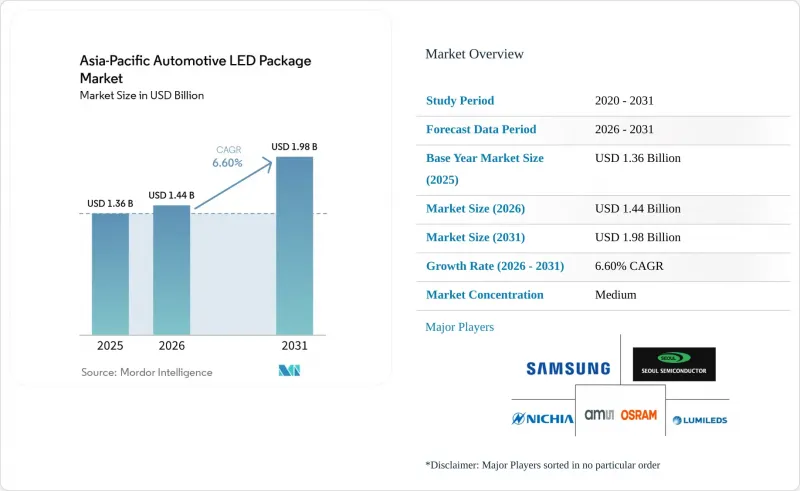
This report is Segmented by Package Architecture (SMD, CSP, Flip-Chip LED Packages, COB), Power Class (Low Power, Mid Power, and High Power ), Application (Exterior Lighting, Interior Lighting, Sensing/IR Applications, and More), Vehicle Type (Passenger Vehicles, and Commercial Vehicles), and Country (China, Japan, India, and More). Market Forecasts are Provided in Terms of Value (USD).
Asia-Pacific Automotive LED Package Market Trends and Insights
Increasing Demand for Energy-Efficient Automotive Lighting
Electric vehicle programs across Asia-Pacific center on maximizing range, so every watt shaved from lighting subsystems translates directly into extra driving kilometers. China's 12.86 million new-energy vehicles built in 2024 created a large installed base that values LED packages delivering 30-50% lower power draw than halogens, translating to 5-10 kilometer range gains in compact battery-electric cars. Hybrid platforms also benefit when alternator load falls, improving fuel-economy scores used for subsidy qualification in India and Thailand. Efficacy gains projected by the U.S. Department of Energy, reaching 249 lumens per watt by 2035, underpin future package roadmaps. Reliability advantages, with lifetimes of 25,000-50,000 hours compared with 1,000-2,000 hours for halogens, cut warranty risk for fleet operators in Southeast Asia where service networks are sparse.
Growing Penetration of LED Headlamps in Passenger Vehicles
Packaged LED cost fell below USD 0.50 per kilolumen in 2025, allowing automakers to list LED headlamps as standard equipment on mid-tier sedans and sport-utility vehicles. Seoul Semiconductor's WICOP chip-scale devices underpin more than 100 passenger models, validating cost targets for mass production. India's Bharat NCAP protocol attaches higher safety scores to daytime-running-lamp equipped cars, nudging OEMs toward full LED headlamp-DRL bundles. China's passenger car production exceeded 20 million units in 2024, with LED headlamp penetration crossing 60% as domestic suppliers matched Japanese peers on luminance and thermal performance while pricing 20-30% below incumbent quotes.
High Initial Cost Compared to Halogen Solutions
Entry-level cars in India and cost-sensitive ASEAN markets still rely on halogen assemblies costing USD 5-8 each, whereas a basic LED headlamp bill of materials sits in the USD 15-25 range. For compact sedans retailing at roughly USD 10,000-12,000, the extra USD 10 per lamp materially erodes automaker margin. Although mid-power surface-mount LED prices are now under USD 0.50 per kilolumen, drivers, heat sinks, and optics push full-system cost three-to-four times higher than halogen. Two-wheel EVs, despite energy-efficiency gains, continue opting for single-chip LEDs or halogens because unit economics dominate purchase decisions.
Other drivers and restraints analyzed in the detailed report include:
- Stringent Automotive Lighting Safety Regulations
- Rapid Expansion of Electric Vehicle Production in Asia-Pacific
- Thermal Management Challenges in High-Power LED Packages
For complete list of drivers and restraints, kindly check the Table Of Contents.
Segment Analysis
Surface-mount devices captured 43.39% of the Asia-Pacific automotive LED package market share in 2025, maintaining leadership in rear lamps, license-plate illumination, and dome lights where proven reliability and entrenched supply chains matter most. Yet chip-scale packages, expanding at a 7.06% CAGR, are redefining headlamp styling by trimming total optical height to as low as 10 millimeters. Seoul Semiconductor's WICOP structure bonds the bare die directly to the circuit board, eliminating substrates and ceramic frames. The Asia-Pacific automotive LED package market size attached to chip-scale devices is set to accelerate as OEMs in China and Japan seek razor-thin lamp designs that lower drag and enable distinct daytime signatures.
Flip-chip formats ride the same trend, leveraging gold-pad bonding to improve thermal conductivity and current spreading for adaptive driving beam arrays. Patent crossfire is intensifying; Everlight's February 2026 U.S. filing against Seoul Semiconductor alleges infringement on flip-chip electrode geometry, signaling legal friction as CSP demand grows. Chip-on-board remains a niche for auxiliary spot lamps in commercial vehicles where clustering multiple dies on a single aluminum substrate gives high lumen density. Combined, these dynamics indicate that chip-scale and flip-chip will keep eroding legacy SMD share as local Chinese suppliers scale wafer-level packaging lines.
High-power packages above 1 watt delivered 57.89% of 2025 revenue, mirroring rapid uptake of adaptive driving beam systems that require 200-plus cd mm-2 luminance for glare-free high beam. The Asia-Pacific automotive LED package market size attributable to this class will expand alongside pixelated headlights entering mid-tier sedans by 2028. Mid-power devices fill daytime running lamp and interior RGB roles where thermal constraints are modest. Low-power indicators are commoditizing as Chinese vendors quote sub-USD 0.10 per part, squeezing margins and prompting consolidation.
Nichia's µPLS micro-LED light engine shows the trajectory: 16,384 high-power micro-LEDs, each at 50-100 mW, combine for over 1,000 lumens while enabling road-surface projections. Regulatory glare-control requirements in GB 4599-2021 and UNECE R112 push OEMs toward such arrays. Mid-power RGB usage is surging in electric-vehicle cabins where 50-100 addressable LEDs handle mood, navigation, and state-of-charge alerts. The high-power segment will continue to dominate value as each vehicle adds 100-300 pixels for smart headlights.
List of Companies Covered in this Report:
- Nichia Corporation
- OSRAM GmbH (Ams-OSRAM AG)
- Seoul Semiconductor Co., Ltd.
- Lumileds Holding B.V.
- Samsung Electronics Co., Ltd.
- Cree LED (SGH Group)
- LG Innotek Co., Ltd.
- Everlight Electronics Co., Ltd.
- Lite-On Technology Corporation
- Dominant Opto Technologies Sdn. Bhd.
- Stanley Electric Co., Ltd.
- Rohinni LLC
- Lextar Electronics Corporation
- Toyoda Gosei Co., Ltd.
- EPISTAR Corporation
- TOSPO Lighting Co., Ltd.
- Refond Optoelectronics Co., Ltd.
- ProLight Opto Technology Corporation
- MLS Co., Ltd. (Forest Lighting)
- Lumens Co., Ltd.
Additional Benefits:
- The market estimate (ME) sheet in Excel format
- 3 months of analyst support
TABLE OF CONTENTS
1 INTRODUCTION
- 1.1 Study Assumptions And Market Definition
- 1.2 Scope Of The Study
2 RESEARCH METHODOLOGY
3 EXECUTIVE SUMMARY
4 MARKET LANDSCAPE
- 4.1 Market Overview
- 4.2 Market Drivers
- 4.2.1 Increasing Demand For Energy-Efficient Automotive Lighting
- 4.2.2 Growing Penetration Of LED Headlamps In Passenger Vehicles
- 4.2.3 Stringent Automotive Lighting Safety Regulations
- 4.2.4 Rapid Expansion Of Electric Vehicle Production In Asia-Pacific
- 4.2.5 Localized Supply Chains Reducing LED Package Costs In ASEAN
- 4.2.6 Integration Of Smart Pixel LED Arrays For Advanced Driver Assistance Systems (ADAS)
- 4.3 Market Restraints
- 4.3.1 High Initial Cost Compared To Halogen Solutions
- 4.3.2 Thermal Management Challenges In High-Power LED Packages
- 4.3.3 Volatility In Automotive Sales Due To Macroeconomic Uncertainties
- 4.3.4 Patent Litigation Risks Limiting New Entrant Innovation
- 4.4 Industry Supply-Chain Analysis
- 4.5 Regulatory Landscape
- 4.6 Technological Outlook
- 4.7 Impact Of Macroeconomic Factors On The Market
- 4.8 Porter's Five Forces Analysis
- 4.8.1 Bargaining Power Of Suppliers
- 4.8.2 Bargaining Power Of Buyers
- 4.8.3 Threat Of New Entrants
- 4.8.4 Threat Of Substitutes
- 4.8.5 Intensity Of Competitive Rivalry
5 MARKET SIZE AND GROWTH FORECASTS (VALUE)
- 5.1 By Package Architecture
- 5.1.1 SMD (Surface Mount Device)
- 5.1.2 CSP (Chip Scale Package)
- 5.1.3 Flip-Chip LED Packages
- 5.1.4 COB (Chip-On-Board)
- 5.2 By Power Class
- 5.2.1 Low Power ( Less Than 0.5 W)
- 5.2.2 Mid Power (0.5 to 1 W)
- 5.2.3 High Power (More Than 1 W)
- 5.3 By Application
- 5.3.1 Exterior Lighting
- 5.3.2 Interior Lighting
- 5.3.3 Sensing / IR Applications
- 5.3.4 Others - Applications
- 5.4 By Vehicle Type
- 5.4.1 Passenger Vehicles
- 5.4.2 Commercial Vehicles
- 5.5 By Country
- 5.5.1 China
- 5.5.2 Japan
- 5.5.3 India
- 5.5.4 Southeast Asia
- 5.5.5 Rest Of Asia-Pacific
6 COMPETITIVE LANDSCAPE
- 6.1 Market Concentration
- 6.2 Strategic Moves
- 6.3 Market Share Analysis
- 6.4 Company Profiles (includes Global Level Overview, Market Level Overview, Core Segments, Financials As Available, Strategic Information, Market Rank/Share, Products And Services, Recent Developments)
- 6.4.1 Nichia Corporation
- 6.4.2 OSRAM GmbH (Ams-OSRAM AG)
- 6.4.3 Seoul Semiconductor Co., Ltd.
- 6.4.4 Lumileds Holding B.V.
- 6.4.5 Samsung Electronics Co., Ltd.
- 6.4.6 Cree LED (SGH Group)
- 6.4.7 LG Innotek Co., Ltd.
- 6.4.8 Everlight Electronics Co., Ltd.
- 6.4.9 Lite-On Technology Corporation
- 6.4.10 Dominant Opto Technologies Sdn. Bhd.
- 6.4.11 Stanley Electric Co., Ltd.
- 6.4.12 Rohinni LLC
- 6.4.13 Lextar Electronics Corporation
- 6.4.14 Toyoda Gosei Co., Ltd.
- 6.4.15 EPISTAR Corporation
- 6.4.16 TOSPO Lighting Co., Ltd.
- 6.4.17 Refond Optoelectronics Co., Ltd.
- 6.4.18 ProLight Opto Technology Corporation
- 6.4.19 MLS Co., Ltd. (Forest Lighting)
- 6.4.20 Lumens Co., Ltd.
7 MARKET OPPORTUNITIES AND FUTURE OUTLOOK
- 7.1 White-Space And Unmet-Need Assessment

