PUBLISHER: Mordor Intelligence | PRODUCT CODE: 2064343

PUBLISHER: Mordor Intelligence | PRODUCT CODE: 2064343
4G/5G Cellular Router - Market Share Analysis, Industry Trends & Statistics, Growth Forecasts (2026 - 2031)
According to Mordor Intelligence, the 4G/5G cellular router market size is expected to grow from USD 15.72 billion in 2025 to USD 17.43 billion in 2026 and is forecast to reach USD 34.34 billion by 2031 at a 14.53% CAGR over 2026-2031.
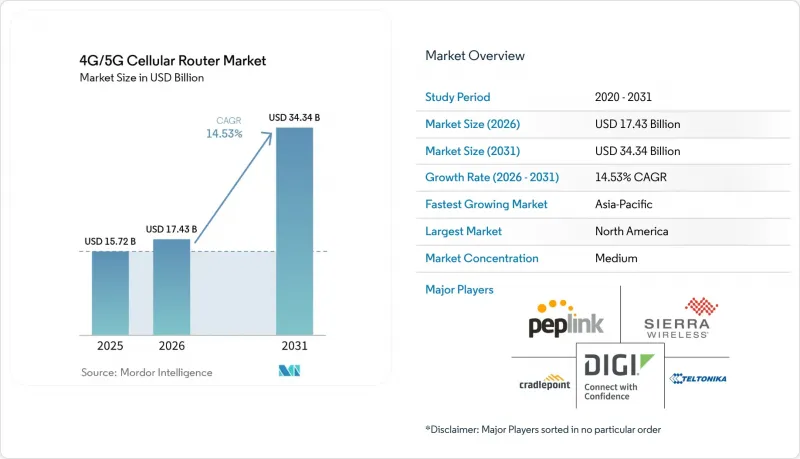
This report is Segmented by Technology Generation (4G LTE Routers, 5G Routers, and More), End-User Industry (Manufacturing, Energy and Utilities, and More), Application (Fixed Wireless Access, Industrial Automation and SCADA, and More), Form Factor (Indoor CPE Routers, Outdoor Rugged Routers, Mobile Routers, and More), and Geography. The Market Forecasts are Provided in Terms of Value (USD).
Global 4G/5G Cellular Router Market Trends and Insights
Soaring Private 5G Network Deployments in Manufacturing
Manufacturers are deploying private 5G networks to achieve deterministic latency for robotic assembly lines, automated guided vehicles, and augmented reality work instructions. Industrial-grade routers supporting network slicing and IEEE 802.1AS time synchronization now anchor these deployments, ensuring round-trip latency below 10 milliseconds. Jaguar Land Rover's Halewood plant connected more than 200 devices over a private 5G network, validating time-sensitive networking for real-time quality inspection. NTT DATA and Celanese implemented multi-site private 5G deployments, prioritizing edge compute routers capable of running anomaly-detection models locally to reduce reliance on backhaul. Cargill plans to equip 50 food processing plants with private 5G by 2027, using dual SIM routers with LTE fallback for redundancy. Standards evolution, such as IEC 61158, now incorporates time-sensitive networking over 5G, accelerating integration of sub-microsecond clock synchronization in routers.
Rising Demand for Fixed Wireless Access in Rural Broadband
Fixed wireless access has emerged as the lowest-cost path to universal broadband when fiber construction costs exceed USD 100 per meter. U.S. operators AT&T and Verizon served a combined 8 million fixed wireless access subscribers by early 2026, delivering a median throughput of 200 to 300 Mbps through mid-band spectrum aggregation. India's BharatNet connected more than 214,000 gram panchayats, yet relies on 5G routers to bridge the final 500 to 1,000 meters in sparsely populated villages. Brazil has mandated 80% population coverage by the end of 2026, compelling carriers to deploy outdoor rugged routers that withstand tropical humidity and temperatures. Zain KSA's introduction of an eSIM-capable Nokia FastMile router illustrates how remote provisioning reduces operational costs in hard-to-reach areas.
High Initial Investment and Total Cost of Ownership
Enterprise-grade 5G routers with edge-compute modules can cost over USD 2,000 each, a barrier for small and medium enterprises operating on capital-expenditure budgets below USD 50,000. A mid-sized logistics fleet needs 50 routers, costing up to USD 150,000 in hardware and USD 30,000 annually for cloud-management subscriptions. Dual-carrier SIM plans add USD 40-60 per device each month, swelling operational expenses. Router-as-a-service models that amortize hardware over multi-year contracts exist, yet penetration remains below 20 percent outside North America and Western Europe.
Other drivers and restraints analyzed in the detailed report include:
- Edge-Compute Enabled Routers for Predictive Maintenance
- Dual-SIM Fail-over Becoming Mandatory for Business Continuity
- Fragmented Spectrum Regulations Across Regions
For complete list of drivers and restraints, kindly check the Table Of Contents.
Segment Analysis
4G LTE held a 45.32% share of the 4G/5G cellular router market in 2025, reflecting its strong price-performance balance for fixed wireless access, fleet management, and point-of-sale applications. Multi-mode devices that fall back to LTE remain essential in regions like India and Brazil, where rural 5G coverage is inconsistent. Sierra Wireless's RV55 Industrial LTE-M model, introduced at a bill-of-materials cost under USD 100, highlights the continuing relevance of 4G for ultra-low-power deployments.
5G routers are projected to grow at an 18.44% CAGR through 2031 as enterprises adopt network slicing and ultra-reliable low-latency communication. Cradlepoint's X35 5G-Advanced unit aggregates six component carriers to exceed 5 Gbps, making 5G viable for uncompressed machine-vision streams. The Release 18 specification for reduced-capability devices will further compress silicon costs, extending 5G economics into cost-sensitive verticals. As a result, the 4G/5G cellular router market tied to 5G deployments is set to expand most rapidly in manufacturing and public safety segments.
Manufacturing accounted for 32.84% of the 4G/5G cellular router market in 2025, led by automotive and chemical sites that require deterministic latency for robotics. Ericsson's installation at Jaguar Land Rover validated 5G routers for closed-loop quality control on body shops. Energy and utilities are deploying routers that translate DNP3 and IEC 61850 traffic, improving substation visibility without requiring dedicated MPLS.
Public safety and emergency services are advancing at a 16.21% CAGR through 2031, supported by FirstNet mandates requiring mission-critical devices to support priority and preemption signaling. Nextivity's SHIELD MegaFi 2 Certified router highlights demand for Band 14 capable hardware, while Semtech's XR80 and XR90 add network slicing to separate body-camera video from situational-awareness telemetry. Together, these investments illustrate how the 4G/5G cellular router market is diversifying beyond manufacturing into life-critical applications.
Geography Analysis
North America captured 34.89% of the 4G/5G cellular router market in 2025, driven by AT&T and Verizon surpassing 8 million fixed wireless subscribers and FirstNet enforcing Band 14 support in public-safety routers. Edge-compute adoption is rising in Michigan's automotive plants, while Canadian utilities deploy 5G routers for substation telemetry. The market is shifting from subscriber acquisition to upselling premium tiers that bundle security analytics and cloud management.
Asia-Pacific is forecast to grow at a 17.84% CAGR through 2031, propelled by China's 4.958 million 5G base stations operational by March 2026 and its commercial launch of 5G-Advanced in 330 cities. India's BharatNet Phase 3 awarded Tejas Networks up to 60,000 TJ1400 routers, highlighting cellular backhaul for last-mile connectivity. Japan and South Korea prioritize private 5G networks in automotive and electronics plants, accelerating the adoption of ruggedized edge-compute routers with TSN profiles.
Europe leverages EU Chips Act incentives to localize semiconductor supply and router production, with EUR 80 billion (USD 94 billion) in plant approvals by 2025. Germany's 3.4-3.7 GHz auction stimulates multi-vendor private 5G ecosystems, while France's discrete 2.6 GHz vertical band forces custom SKUs. South America pursues rural connectivity, with Brazil's 80% coverage target by end-2026 driving the adoption of pole-mounted rugged routers. The Middle East invests in smart-city mega-projects, with Saudi Arabia's stc extending 5G coverage to 75 cities and ADNOC valuing its private 5G network at USD 1.5 billion. Africa remains nascent but rapidly adopts fixed wireless access, led by South Africa, Nigeria, and Kenya, where trenching costs and terrain favor cellular deployments.
- Cradlepoint, Inc.
- Sierra Wireless, Inc.
- Digi International Inc.
- Teltonika Networks UAB
- Peplink International Limited
- Robustel Technologies Co., Ltd.
- InHand Networks Co., Ltd.
- Advantech Co., Ltd.
- Moxa Inc.
- Antaira Technologies LLC
- Milesight IoT Co., Ltd.
- Red Lion Controls, Inc.
- SATEL Oy
- Westermo Network Technologies AB
- E-Lins Technology Co., Ltd.
- Shenzhen Wlink Technology Co., Ltd.
- Four-Faith Smart Power Technology Co., Ltd.
- Perle Systems Limited
- Juniper Networks, Inc.
- Casa Systems, Inc.
Additional Benefits:
- The market estimate (ME) sheet in Excel format
- 3 months of analyst support
TABLE OF CONTENTS
1 INTRODUCTION
- 1.1 Study Assumptions and Market Definition
- 1.2 Scope of the Study
2 RESEARCH METHODOLOGY
3 EXECUTIVE SUMMARY
4 MARKET LANDSCAPE
- 4.1 Market Overview
- 4.2 Market Drivers
- 4.2.1 Soaring Private 5G Network Deployments in Manufacturing
- 4.2.2 Rising Demand for Fixed Wireless Access in Rural Broadband
- 4.2.3 Edge-Compute Enabled Routers for Predictive Maintenance
- 4.2.4 Dual-SIM Fail-over Becoming Mandatory for Business Continuity
- 4.2.5 Government Incentives for Domestic Router Production
- 4.2.6 AI-Based Traffic Optimisation Enhancing Router Value Proposition
- 4.3 Market Restraints
- 4.3.1 High Initial Investment and Total Cost of Ownership
- 4.3.2 Fragmented Spectrum Regulations Across Regions
- 4.3.3 Cyber-Security and Data-Privacy Concerns
- 4.3.4 Skilled Workforce Shortage for 5G Networking
- 4.4 Impact of Macroeconomic Factors on the Market
- 4.5 Industry Supply-Chain Analysis
- 4.6 Regulatory Landscape
- 4.7 Technological Outlook
- 4.8 Porter's Five Forces Analysis
- 4.8.1 Threat of New Entrants
- 4.8.2 Bargaining Power of Suppliers
- 4.8.3 Bargaining Power of Buyers
- 4.8.4 Threat of Substitutes
- 4.8.5 Intensity of Competitive Rivalry
5 MARKET SIZE AND GROWTH FORECASTS (VALUE)
- 5.1 By Technology Generation
- 5.1.1 4G LTE Routers
- 5.1.2 5G Routers
- 5.1.3 Multi-Mode (4G/5G) Routers
- 5.2 By End-User Industry
- 5.2.1 Manufacturing
- 5.2.2 Energy and Utilities
- 5.2.3 Transportation and Logistics
- 5.2.4 Retail and Payments
- 5.2.5 Public Safety and Emergency Services
- 5.3 By Application
- 5.3.1 Fixed Wireless Access
- 5.3.2 Industrial Automation and SCADA
- 5.3.3 Fleet and Mobile Connectivity
- 5.3.4 Smart Cities and Infrastructure
- 5.3.5 Remote Monitoring and Surveillance
- 5.4 By Form Factor
- 5.4.1 Indoor CPE Routers
- 5.4.2 Outdoor Rugged Routers
- 5.4.3 Mobile Routers
- 5.4.4 Embedded / Module Routers
- 5.4.5 Edge-Compute Routers
- 5.5 By Geography
- 5.5.1 North America
- 5.5.1.1 United States
- 5.5.1.2 Canada
- 5.5.1.3 Mexico
- 5.5.2 South America
- 5.5.2.1 Brazil
- 5.5.2.2 Argentina
- 5.5.2.3 Rest of South America
- 5.5.3 Europe
- 5.5.3.1 Germany
- 5.5.3.2 United Kingdom
- 5.5.3.3 France
- 5.5.3.4 Italy
- 5.5.3.5 Spain
- 5.5.3.6 Rest of Europe
- 5.5.4 Asia-Pacific
- 5.5.4.1 China
- 5.5.4.2 Japan
- 5.5.4.3 India
- 5.5.4.4 South Korea
- 5.5.4.5 Australia
- 5.5.4.6 Rest of Asia-Pacific
- 5.5.5 Middle East
- 5.5.5.1 Saudi Arabia
- 5.5.5.2 United Arab Emirates
- 5.5.5.3 Turkey
- 5.5.5.4 Rest of Middle East
- 5.5.6 Africa
- 5.5.6.1 South Africa
- 5.5.6.2 Nigeria
- 5.5.6.3 Kenya
- 5.5.6.4 Rest of Africa
- 5.5.1 North America
6 COMPETITIVE LANDSCAPE
- 6.1 Market Concentration
- 6.2 Strategic Moves
- 6.3 Market Share Analysis
- 6.4 Company Profiles (includes Global Level Overview, Market Level Overview, Core Segments, Financials as available, Strategic Information, Market Rank/Share, Products and Services, Recent Developments)
- 6.4.1 Cradlepoint, Inc.
- 6.4.2 Sierra Wireless, Inc.
- 6.4.3 Digi International Inc.
- 6.4.4 Teltonika Networks UAB
- 6.4.5 Peplink International Limited
- 6.4.6 Robustel Technologies Co., Ltd.
- 6.4.7 InHand Networks Co., Ltd.
- 6.4.8 Advantech Co., Ltd.
- 6.4.9 Moxa Inc.
- 6.4.10 Antaira Technologies LLC
- 6.4.11 Milesight IoT Co., Ltd.
- 6.4.12 Red Lion Controls, Inc.
- 6.4.13 SATEL Oy
- 6.4.14 Westermo Network Technologies AB
- 6.4.15 E-Lins Technology Co., Ltd.
- 6.4.16 Shenzhen Wlink Technology Co., Ltd.
- 6.4.17 Four-Faith Smart Power Technology Co., Ltd.
- 6.4.18 Perle Systems Limited
- 6.4.19 Juniper Networks, Inc.
- 6.4.20 Casa Systems, Inc.
7 MARKET OPPORTUNITIES AND FUTURE OUTLOOK
- 7.1 White-Space and Unmet-Need Assessment

