
PUBLISHER: Mordor Intelligence | PRODUCT CODE: 2064357

PUBLISHER: Mordor Intelligence | PRODUCT CODE: 2064357
Grape Seed Extract In Pet Food Application - Market Share Analysis, Industry Trends & Statistics, Growth Forecasts (2026 - 2031)
According to Mordor Intelligence, the grape seed extract in pet food application market size is anticipated to increase from USD 236.0 million in 2025 to USD 253.5 million in 2026 and reach USD 418.0 million by 2031, growing at a CAGR of 10.5% over 2026-2031.
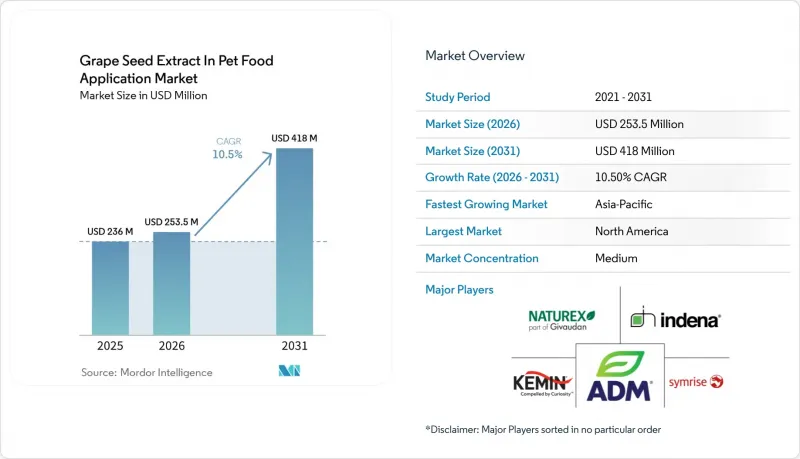
This report is Segmented by Form (Powder, Oil, and Other Forms), by Pet Type (Dogs, Cats, Birds, and Other Companion Animals), by Distribution Channel (Offline Retail, and Online), and by Geography (North America, South America, Europe, Asia-Pacific, Middle East, and Africa). The Market Forecasts are Provided in Terms of Value (USD).
Global Grape Seed Extract In Pet Food Application Market Trends and Insights
Rising Demand for Natural Antioxidants in Premium Pet Food
Premium food accounted for the majority share of United States dog kibble sales in 2025, and the American Pet Products Association projects the pet food and treats category to grow from USD 68.3 billion in 2024 to USD 69.7 billion in 2026. Formulators are replacing butylated hydroxyanisole and butylated hydroxytoluene with tocopherols and polyphenols, a shift supported by Kemin Industries, Inc. data showing botanical systems match synthetic oxidation control without bioaccumulation risks. Higher omega-3 inclusion rates in modern recipes increase the oxidative burden, underscoring the need for synergistic botanical blends that stabilize lipids at extrusion temperatures above 120 degrees Celsius. Recent studies and surveys of consumers in 2025 found that the majority are willing to pay more for supplements backed by clinical evidence, owing to rising safety concerns. As a result, the grape seed extract market in pet food applications gains volume and pricing power despite grape price volatility.
Humanization of Pets Boosting Functional Ingredient Adoption
As per American Pet Products Association, Pet ownership reached 95 million households in the United States in 2025, with Millennials and Generation Z accounting for the steepest growth in spending on functional nutrition. As per the International Trade Administration, online pet food sales in China has shown a rapid growth in 2025. In addition, South Africa reported a significant rise in pet food turnover between 2021 and 2025, even amid macroeconomic headwinds, indicating that emotionally driven categories are less prone to cyclical slowdowns. Across markets, consumers value clinically validated claims that translate human health concepts, such as antioxidant defense and microbiome support, into companion animal diets. This social shift elevates the entire grape seed extract market for pet food applications, which aligns closely with perceptions of naturalness and functional efficacy.
Cost Volatility Due to Seasonal Grape Yield Fluctuation
The International Organisation of Vine and Wine (OIV) pegged 2024 world wine output between 227 and 235 million hectoliters, roughly 13% below the ten-year average and possibly the lowest since 1961. France fell 23% to 36.9 million hectoliters due to compounded climate stress, whereas Argentina bounced 23% to 10.9 million hectoliters following frost recovery, amplifying global supply swings. Turkey's average dried-grape export price climbed 24.7% year over year to EUR 1.96 (USD 2.14) per kilogram in 2024, according to data from the International Organisation of Vine and Wine, reflecting tighter by-product streams. Ingredient buyers often renegotiate contracts annually, so sudden price jumps compress manufacturer margins until reformulation or pass-through catches up. These gyrations introduce earnings volatility for companies operating in the grape seed extract in pet food application market.
Other drivers and restraints analyzed in the detailed report include:
- Regulatory Push for Clean-Label Additives in North America and Europe
- Supply-Chain Integration by Large Ingredient Suppliers
- Limited Clinical Evidence on Long-Term Efficacy in Felines
For complete list of drivers and restraints, kindly check the Table Of Contents.
Segment Analysis
Powder captured the largest 57.3% share of the grape seed extract in pet food application market size in 2025 because legacy extrusion systems integrate dry blends more easily than liquids. Contract manufacturers appreciate powders for long ambient shelf life and straightforward inclusion in vitamin-mineral premixes. Research on weaned lambs in 2024 confirmed that powder-based grape seed extract elevates antioxidant status when processed into pellets, reinforcing its efficacy during high-temperature feed manufacturing. Cost efficiency and plant hygiene further entrench powder as the incumbent format, though particle size control remains critical to minimize segregation in bulk silos. With most regional co-packers yet to invest in liquid dosing, the powder segment will retain scale advantages through at least the medium term, 2026-2031.
Still, oil-based formulations are the fastest-growing, with a 9.8% CAGR over 2026-2031, and will steadily chip away at the powder lead. Liquid suspensions protect polyphenols from degradation during extrusion at temperatures above 120 degrees Celsius while reducing workplace dust. Upgraded equipment also enables precision with micro-ingredients, aligning with personalized nutrition trends in subscription services. Encapsulated formats occupy a niche for freeze-dried raw diets and soft chews where targeted release justifies higher costs. As the market for grape seed extract in pet food applications grows, suppliers will diversify formats, yet robust powder economics ensure the segment retains the largest volume through 2031.
Geography Analysis
North America held the largest 34.8% of the grape seed extract in pet food application market size in 2025, anchored by the United States pet industry, as according to the American Pet Products Association, the United States pet industry has reached USD 158 billion in 2025 and is tracking toward USD 165 billion in 2026. Premium food penetration above 55% and FDA regulatory clarity following Guidance 293 and 294 ease botanical approvals, making the region a natural launchpad for new antioxidant systems. California's 2025 ban on select dyes accelerates nationwide reformulation despite resistance from price-sensitive segments. Canada's January 2025 recognition of grape seed extract as a human supplement with antioxidant claims signals convergence that simplifies North American cross-border ingredient logistics. Mexico leverages its proximity to United States manufacturing clusters, yet faces consumer affordability constraints that limit super-premium penetration, capping near-term growth.
Asia-Pacific is the fastest-growing region at an 11.4% CAGR for 2026-2031, propelled by China's USD 6.2 billion online pet food channel and India's double-digit category expansion. E-commerce accounts for more than 25% of organized Indian pet food sales, enabling premium brands to overcome brick-and-mortar limitations in tier-two cities. Japan's labeling trends away from synthetic preservatives and toward "no additives" validate regional consumer readiness for botanical solutions. South Korea and Australia enforce strict feed safety codes that prioritize documented natural antioxidants, positioning the grape seed extract in pet food application market for steady premiumization. Rising disposable incomes, urban pet lifestyles, and mobile commerce ecosystems converge to replicate the North American premium trajectory in a compressed timeframe.
Europe will grow at a significant CAGR during 2026-2031, as the European Commission's April 2024 authorization of rosemary extract underscores institutional support for plant-based preservation. Mature Western markets already feature high clean-label awareness, yet Eastern Europe offers incremental upside as disposable income climbs. Wine output across the European Union totaled 139 million hectoliters in 2024, down 3% from the year before, ensuring ongoing pomace availability despite localized droughts. France's output tumble underscores sourcing risk, advantaging suppliers diversifying harvest origins. Combined with stringent European Food Safety Authority reviews, these factors create a regulatory-driven yet stable growth runway for the grape seed extract in pet food application market.
- Kemin Industries, Inc.
- Naturex SA (Givaudan SA)
- Symrise Pet Food (Symrise AG)
- Archer Daniels Midland Company
- Silvateam S.p.A.
- Grap'Sud SCA
- Prinova US LLC (Nagase and Co., Ltd.)
- Alltech, Inc.
- Nexira SAS
- Indena S.p.A.
- Bio-Botanica, Inc.
- Martin Bauer Group GmbH and Co. KG
- Sabinsa Corporation (Sami-Sabinsa Group Ltd.)
- Phytosynthese SAS (Adisseo France SAS)
Additional Benefits:
- The market estimate (ME) sheet in Excel format
- 3 months of analyst support
TABLE OF CONTENTS
1 Introduction
- 1.1 Study Assumptions and Market Definition
- 1.2 Scope of the Study
2 Research Methodology
3 Executive Summary
4 Market Landscape
- 4.1 Market Overview
- 4.2 Market Drivers
- 4.2.1 Rising demand for natural antioxidants in premium pet food
- 4.2.2 Humanization of pets boosting functional ingredient adoption
- 4.2.3 Regulatory push for clean-label additives in North America and Europe
- 4.2.4 Supply-chain integration by large ingredient suppliers
- 4.2.5 Growing use of grape pomace up-cycling in wineries
- 4.2.6 Expansion of veterinary nutraceutical recommendations
- 4.3 Market Restraints
- 4.3.1 Cost volatility due to seasonal grape yield fluctuation
- 4.3.2 Limited clinical evidence on long-term efficacy in felines
- 4.3.3 Competition from synthetic antioxidants such as BHA/BHT
- 4.3.4 Allergenicity concerns in niche pet segments
- 4.4 Regulatory Landscape
- 4.5 Technological Outlook
- 4.6 Porter's Five Forces Analysis
- 4.6.1 Threat of New Entrants
- 4.6.2 Bargaining Power of Suppliers
- 4.6.3 Bargaining Power of Buyers
- 4.6.4 Threat of Substitutes
- 4.6.5 Intensity of Competitive Rivalry
5 Market Size and Growth Forecasts
- 5.1 By Form
- 5.1.1 Powder
- 5.1.2 Oil
- 5.1.3 Other Forms
- 5.2 By Pet Type
- 5.2.1 Dogs
- 5.2.2 Cats
- 5.2.3 Birds
- 5.2.4 Other Companion Animals
- 5.3 By Distribution Channel
- 5.3.1 Offline Retail
- 5.3.2 Online
- 5.4 By Geography
- 5.4.1 North America
- 5.4.1.1 United States
- 5.4.1.2 Canada
- 5.4.1.3 Mexico
- 5.4.1.4 Rest of North America
- 5.4.2 South America
- 5.4.2.1 Brazil
- 5.4.2.2 Argentina
- 5.4.2.3 Rest of South America
- 5.4.3 Europe
- 5.4.3.1 Germany
- 5.4.3.2 United Kingdom
- 5.4.3.3 France
- 5.4.3.4 Italy
- 5.4.3.5 Spain
- 5.4.3.6 Russia
- 5.4.3.7 Rest of Europe
- 5.4.4 Asia-Pacific
- 5.4.4.1 China
- 5.4.4.2 Japan
- 5.4.4.3 India
- 5.4.4.4 Australia
- 5.4.4.5 New Zealand
- 5.4.4.6 South Korea
- 5.4.4.7 Rest of Asia-Pacific
- 5.4.5 Middle East
- 5.4.5.1 Saudi Arabia
- 5.4.5.2 United Arab Emirates
- 5.4.5.3 Rest of Middle East
- 5.4.6 Africa
- 5.4.6.1 South Africa
- 5.4.6.2 Egypt
- 5.4.6.3 Rest of Africa
- 5.4.1 North America
6 Competitive Landscape
- 6.1 Market Concentration
- 6.2 Strategic Moves
- 6.3 Market Share Analysis
- 6.4 Company Profiles (Includes Global Level Overview, Market Level Overview, Core Segments, Financials as Available, Strategic Information, Market Rank/Share for Key Companies, Products and Services, and Recent Developments)
- 6.4.1 Kemin Industries, Inc.
- 6.4.2 Naturex SA (Givaudan SA)
- 6.4.3 Symrise Pet Food (Symrise AG)
- 6.4.4 Archer Daniels Midland Company
- 6.4.5 Silvateam S.p.A.
- 6.4.6 Grap'Sud SCA
- 6.4.7 Prinova US LLC (Nagase and Co., Ltd.)
- 6.4.8 Alltech, Inc.
- 6.4.9 Nexira SAS
- 6.4.10 Indena S.p.A.
- 6.4.11 Bio-Botanica, Inc.
- 6.4.12 Martin Bauer Group GmbH and Co. KG
- 6.4.13 Sabinsa Corporation (Sami-Sabinsa Group Ltd.)
- 6.4.14 Phytosynthese SAS (Adisseo France SAS)
7 Market Opportunities and Future Outlook

