
PUBLISHER: Mordor Intelligence | PRODUCT CODE: 2064364

PUBLISHER: Mordor Intelligence | PRODUCT CODE: 2064364
United States Dietary Supplements - Market Share Analysis, Industry Trends & Statistics, Growth Forecasts (2026 - 2031)
According to Mordor Intelligence, the united states dietary supplements market size is expected to grow from USD 39.28 billion in 2025 to USD 41.57 billion in 2026 and is forecast to reach USD 55.16 billion by 2031 at 5.82% CAGR over 2026-2031.
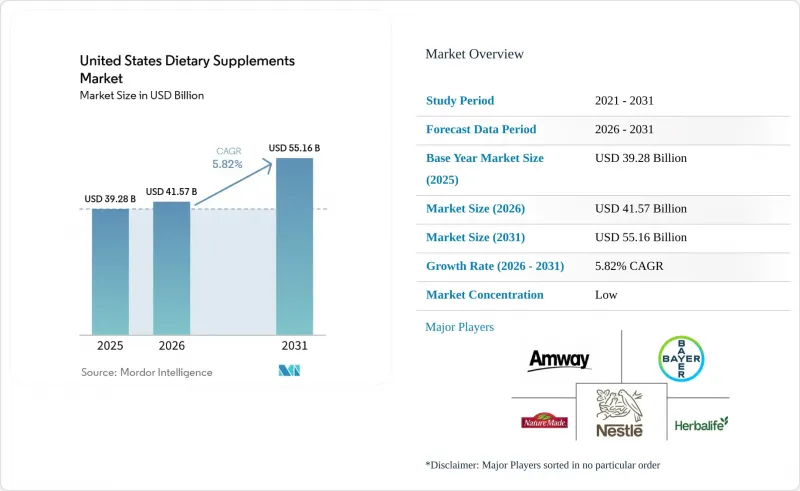
This report is Segmented by Product Type (Vitamins and Minerals, Collagen, Herbal, and More), Form (Tablets, Powders, and More), Consumer Group (Adults and Children), Health Application (General Health and Wellness, Bone and Joint Health, and More), and Distribution Channel (Supermarkets/Hypermarkets, Specialty Stores, and More). The Market Forecasts are in Value (USD) and Volume (Tons).
United States Dietary Supplements Market Trends and Insights
Rising consumer prioritization of preventive health and daily wellness management
In the United States, a cultural shift toward preventive health and daily wellness management is driving the growth of the dietary supplements market. Consumers are increasingly incorporating dietary supplements into their daily regimens, transitioning from viewing them as occasional remedies to essential components of their wellness routines. This trend is supported by widespread nutrient deficiencies, particularly in vitamin D and calcium, which establish a consistent baseline demand for supplementation. Additionally, advancements in product innovation are expanding the range of consumer needs addressed by supplements. Beyond traditional areas such as immunity support, emerging categories like gut health, energy enhancement, and stress/mood management are becoming key growth drivers. A survey conducted by NOW Foods in January 2026 indicated that 44% of respondents increased their dietary supplement usage in 2025 compared to 2024. These trends collectively highlight the proactive approach of United States consumers in leveraging dietary supplements to support long-term health objectives, mitigate chronic disease risks, and improve overall daily well-being.
Supplements targeting women consumers fueling growth
In the United States dietary supplements market, companies are increasingly focusing on women-centric innovation. These organizations are developing products tailored to address various physiological stages in women, ranging from fertility and premenstrual syndrome (PMS) to perimenopause. Young women represent the fastest-growing consumer segment in this market. Their primary demand centers around beauty-related supplements, particularly for hair, skin, and nail health, while there is also a notable interest in products supporting sleep and mental health. Clinical research highlights substantial nutrient deficiencies in iron and calcium among women and adolescent females, driving the need for targeted formulations. Additionally, supplements addressing mood and stress, such as Withania somnifera (commonly known as ashwagandha), have gained significant traction among female consumers, emphasizing the growing importance of hormonal and emotional wellness. In a strategic development, Herbalife acquired Bioniq in April 2026. Bioniq, a platform specializing in blood-biomarker personalization, enables Herbalife to meet the increasing demand for customized hormonal health solutions across various life stages. These market dynamics underscore the alignment of demographic demand, identified nutritional deficiencies, and the advancement of personalized innovation, establishing women-specific supplementation as a key growth driver in the United States market.
Complex and evolving regulatory environment
In the United States dietary supplements market, a complex and continuously evolving regulatory framework presents a significant challenge. Federal and state-level initiatives contribute to uncertainty and increase compliance costs, particularly impacting smaller manufacturers. The United States Food and Drug Administration's (FDA) Human Foods Program has prioritized finalizing the New Dietary Ingredient (NDI) guidance and advancing Generally Recognized as Safe (GRAS) reform. These developments signal potential changes in regulatory oversight not seen since the introduction of Good Manufacturing Practices (GMP) regulations. Additionally, new legislative proposals, such as the Dietary Supplement Listing Act of 2026 and efforts to preempt state-level restrictions, add further complexity to the regulatory environment. Concurrently, the United States Department of Health and Human Services (HHS) Office of Inspector General is intensifying audits of supplement facilities, while the Federal Trade Commission (FTC) is increasing enforcement actions through civil penalties and substantiation warning campaigns. Collectively, these overlapping regulatory measures are reshaping the compliance landscape in the United States, underscoring the critical importance of transparency and adherence to evolving standards for maintaining credibility and driving growth.
Other drivers and restraints analyzed in the detailed report include:
- Increasing prevalence of chronic health conditions
- Rapid growth of personalized nutrition solutions
- Growing consumer concerns around product safety, adulteration, and side effect risks
For complete list of drivers and restraints, kindly check the Table Of Contents.
Segment Analysis
In 2025, vitamins and minerals dominated the United States dietary supplements market, holding a 45.36% share. Their leading position was supported by widespread nutrient deficiencies across the population and strong recommendations from healthcare professionals, positioning multivitamins as the primary choice for many consumers. These supplements not only served as the initial entry point for consumers exploring multi-product combinations but also expanded into related categories. These included collagen, which is popular for beauty and joint health, and herbal supplements such as ashwagandha and green tea, which address adaptogenic and mood-enhancing needs. Due to their wide range of applications and clinical importance, vitamins and minerals continue to act as the structural backbone of the United States market.
Conversely, enzymes are projected to be the fastest-growing segment, with a CAGR of 7.86% forecasted for the period 2026-2031. This anticipated growth highlights a significant shift in consumer demand. Increasing awareness of gut health and the straightforward digestive support enzymes provide has positioned them as a preferred solution for many consumers. Their growth trajectory is further strengthened by advancements in multi-enzyme blends and the expanding adoption of prebiotics and probiotics, emphasizing digestion as a critical area for innovation in the supplement industry. As enzymes are expected to outpace all other product types in growth, they are well-positioned to reshape the competitive landscape by appealing to consumers seeking targeted, clinically validated solutions for digestive wellness.
In 2025, tablets dominated the United States dietary supplements market, accounting for a 40.39% share. Their popularity was driven by precise dosing, endorsements from healthcare professionals, and institutional purchasing trends, which established them as the preferred format for essential supplementation. Leading industry players reinforced this position through strategic investments in manufacturing capabilities and extensive product portfolios, ensuring tablets remained the cornerstone of supplement consumption. While capsules and softgels addressed the needs of oil-based actives, and powders and liquids gained niche relevance due to their flexibility and rapid absorption, tablets retained their entrenched position as the most widely used format in the United States market.
Conversely, gummies are expected to reshape consumer purchasing behaviors as the fastest-growing format, with a CAGR of 8.12% projected for the period 2026-2031. Their growth is attributed to their appealing taste, convenience, and ability to transform supplementation into an enjoyable daily routine, making them particularly attractive to younger demographics and lifestyle-focused consumers. Initially confined to vitamin products, gummies are now expanding into clinically significant categories such as probiotics and immunity boosters. This expansion is supported by advancements in encapsulation technologies, which enable the effective delivery of sensitive active ingredients. These developments position gummies as a key growth driver, redefining consumer expectations and compelling manufacturers to adapt their innovation pipelines to meet evolving demand in the United States market.
List of Companies Covered in this Report:
- NOW Foods
- Thorne
- Amway
- Nordiac Naturals
- Nature Made
- Swanson
- Vitafusion
- Enzymedica
- Herbalife Nutrition
- Rexall Sundown Inc
- Glanbia plc
- GlaxoSmithKline (GSK)
- Bayer AG
- Garden of Life
- Vital Proteins
- Thorne HealthTech
- Nestle S.A.
- USANA Health Sciences
- Life Extension
- Metagenics
Additional Benefits:
- The market estimate (ME) sheet in Excel format
- 3 months of analyst support
TABLE OF CONTENTS
1 INTRODUCTION
- 1.1 Study Assumptions and Market Definition
- 1.2 Scope of the Study
2 RESEARCH METHODOLOGY
3 EXECUTIVE SUMMARY
4 MARKET LANDSCAPE
- 4.1 Market Overview
- 4.2 Market Drivers
- 4.2.1 Rising Consumer Prioritization of Preventive Health and Daily Wellness Management
- 4.2.2 Supplements Targeting Women Consumers Fueling Growth
- 4.2.3 Shift towards Natural and Organic Supplements
- 4.2.4 Increasing Prevalence of Chronic Health Conditions
- 4.2.5 Rapid Growth of Personalized Nutrition Solutions
- 4.2.6 Strengthening Fitness and Sports Nutrition Culture
- 4.3 Market Restraints
- 4.3.1 Complex and Evolving Regulatory Environment
- 4.3.2 Growing Consumer Concerns Around Product Safety, Adulteration, and Side-Effect Risks
- 4.3.3 Intense Market Saturation Creating High Competition
- 4.3.4 Ingredient Quality and Supply Chain Challenges
- 4.4 Consumer Behaviour Analysis
- 4.5 Regulatory Outlook
- 4.6 Porter's Five Forces
- 4.6.1 Threat of New Entrants
- 4.6.2 Bargaining Power of Buyers/Consumers
- 4.6.3 Bargaining Power of Suppliers
- 4.6.4 Threat of Substitute Products
- 4.6.5 Intensity of Competitive Rivalry
5 MARKET SIZE AND GROWTH FORECASTS (VALUE AND VOLUME)
- 5.1 Product Type
- 5.1.1 Vitamins and Minerals
- 5.1.2 Collagen
- 5.1.3 Fatty Acids
- 5.1.4 Herbal Supplements
- 5.1.5 Enzymes
- 5.1.6 Prebiotics and Probiotics
- 5.1.7 Other Product Type
- 5.2 Form
- 5.2.1 Tablets
- 5.2.2 Capsules and Soft gels
- 5.2.3 Powder
- 5.2.4 Gummies
- 5.2.5 Liquids
- 5.2.6 Other Forms
- 5.3 By Consumer Group
- 5.3.1 Adults
- 5.3.2 Children
- 5.4 By Health Applications
- 5.4.1 General Health and Wellness
- 5.4.2 Bone and Joint Health
- 5.4.3 Energy and Weight Management
- 5.4.4 Gastrointestinal and Gut Health
- 5.4.5 Immunity Enhancement
- 5.4.6 Cardiovascular Health
- 5.4.7 Diabetes Management
- 5.4.8 Cognitive and Mental Health
- 5.4.9 Skin, Hair and Nail Care
- 5.4.10 Eye Health
- 5.4.11 Other Health Applications
- 5.5 Distribution Channel
- 5.5.1 Supermarkets/Hypermarkets
- 5.5.2 Specialty Stores
- 5.5.3 Online Retail Stores
- 5.5.4 Direct Selling Stores
- 5.5.5 Other Distribution Channels
6 COMPETITIVE LANDSCAPE
- 6.1 Market Concentration
- 6.2 Strategic Moves
- 6.3 Market Share Analysis
- 6.4 Company Profiles (includes Global-level Overview, Market-level Overview, Core Segments, Financials (if available), Strategic Information, Market Rank/Share, Products and Services, Recent Developments)
- 6.4.1 NOW Foods
- 6.4.2 Thorne
- 6.4.3 Amway
- 6.4.4 Nordiac Naturals
- 6.4.5 Nature Made
- 6.4.6 Swanson
- 6.4.7 Vitafusion
- 6.4.8 Enzymedica
- 6.4.9 Herbalife Nutrition
- 6.4.10 Rexall Sundown Inc
- 6.4.11 Glanbia plc
- 6.4.12 GlaxoSmithKline (GSK)
- 6.4.13 Bayer AG
- 6.4.14 Garden of Life
- 6.4.15 Vital Proteins
- 6.4.16 Thorne HealthTech
- 6.4.17 Nestle S.A.
- 6.4.18 USANA Health Sciences
- 6.4.19 Life Extension
- 6.4.20 Metagenics
7 MARKET OPPORTUNITIES AND FUTURE OUTLOOK

