
PUBLISHER: Mordor Intelligence | PRODUCT CODE: 2066372

PUBLISHER: Mordor Intelligence | PRODUCT CODE: 2066372
Dietary Supplements - Market Share Analysis, Industry Trends & Statistics, Growth Forecasts (2026 - 2031)
According to Mordor Intelligence, the dietary supplements market size is expected to grow from USD 145.59 billion in 2025 to USD 151.82 billion in 2026 and is forecast to reach USD 187.21 billion by 2031 at 4.28% CAGR over 2026-2031.
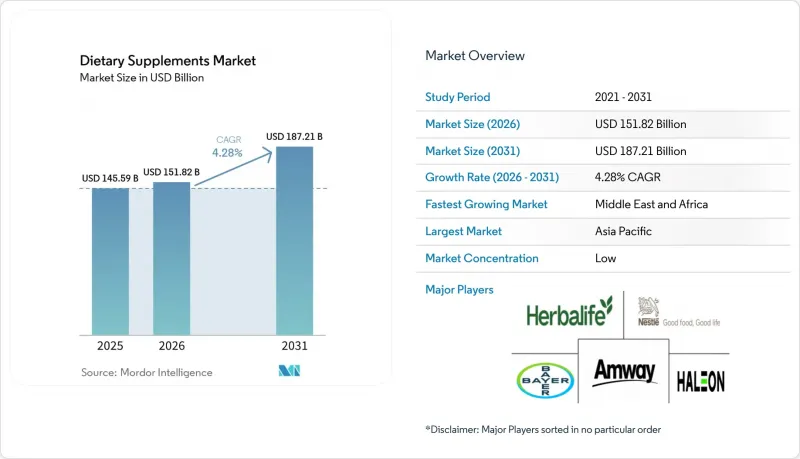
This report is Segmented Into Product Type (Vitamins, Minerals, Enzymes, and More), Form (Tablets, Powder, and More), Source (Plant-Based, Animal-Based, and More), Consumer Group (Men, Women, and More), Health Application (General Health and Wellness, Eye Health, and More), Distribution Channel (Supermarkets/Hypermarkets, and More), and Geography. The Market Forecasts are Provided in Terms of Value (USD)
Global Dietary Supplements Market Trends and Insights
Increased Focus on Preventive Healthcare
Preventive healthcare has shifted from being a wellness trend to a key purchasing factor. This change is particularly evident among millennials and Generation Z consumers, who are now prioritizing supplements even before any symptoms appear. In 2025, the World Health Organization highlighted a concerning trend: non-communicable diseases were responsible for 74% of global deaths. In response, governments and insurers have introduced measures such as tax credits and employer wellness programs, which subsidize supplement purchases. This broader societal shift has created opportunities for multivitamin and mineral blends, now seen as essential daily safeguards against micronutrient deficiencies. Additionally, telemedicine platforms are enhancing their services by including supplement recommendations during virtual consultations. This innovation has created a seamless ecosystem where diagnosis, prescription, and fulfillment are completed digitally within a short timeframe. In the United States, the Dietary Supplement Health and Education Act, along with the European Union's Food Supplements Directive, serve as key regulatory frameworks. These not only legitimize the dietary supplement category but also allow for structure-function claims, appealing directly to prevention-focused consumers.
Market analysis shows a growing preference among consumers for supplements designed to address specific health needs. These include strengthening the immune system, managing stress, and improving sleep quality. As global healthcare systems increasingly adopt preventive measures to reduce long-term medical costs, the dietary supplement market is well-positioned for sustained growth and deeper market penetration.
Supplements Targeting Women Consumers Fueling Growth
The women's health supplements market is experiencing significant growth within the broader dietary supplements industry. Moving beyond traditional prenatal products, the market now offers a wide array of solutions designed to meet the specific health needs of women. These include specialized formulations aimed at addressing menopause management, supporting hormonal balance, and enhancing reproductive health. Recent developments in product innovation emphasize multifunctional supplements that not only help manage stress but also provide beauty-enhancing benefits, while simultaneously supporting hormonal regulation and boosting energy levels. Since women often play a central role in making healthcare decisions for their families, their preferences in supplements are a key driver of market trends. The Women's Health Innovation Opportunity Map Progress Report for 2026 highlights that, despite progress through increased funding and the establishment of innovation centers, global healthcare research and development funding for female-specific conditions outside of oncology remains minimal.
Presence of Counterfeit Products Hampering the growth
Counterfeit supplements are infiltrating supply chains, primarily through third-party e-commerce sellers and unregulated cross-border shipments. This not only erodes consumer trust but also exposes buyers to potentially harmful adulterated ingredients or subpotent formulations. Recently, the United States Food and Drug Administration issued several warning letters targeting products with undeclared pharmaceutical ingredients. This included sildenafil, commonly found in male-enhancement supplements, and sibutramine, often used in weight-loss formulas. Both substances pose significant cardiovascular risks and breach drug-approval mandates. The Asia-Pacific region sees the highest prevalence of counterfeits. Here, fragmented distribution networks and limited enforcement resources allow rogue manufacturers to easily mimic branded packaging.
A report from the World Health Organization highlighted that a significant portion of supplements sold through informal channels in Southeast Asia failed authenticity tests. In response, brand owners are turning to blockchain-enabled track-and-trace systems. For instance, Nestle Health Science has a QR-code verification program. This initiative lets consumers authenticate a product's origin with a smartphone scan, leading to a notable drop in return rates in the markets where it was piloted. Despite these efforts, achieving regulatory harmonization remains a challenge. The European Union's Falsified Medicines Directive, for example, mandates serialization for medicinal products. However, it excludes supplements, leaving a gap that counterfeiters are quick to exploit.
Other drivers and restraints analyzed in the detailed report include:
- Growing Preference for Clean-label, Plant-based, and Vegan Formulas
- Healthy-Ageing Focus Accelerating Multivitamin Uptake Among Consumers
- Tighter Regulations on Dietary Supplements and Borderline Products
For complete list of drivers and restraints, kindly check the Table Of Contents.
Segment Analysis
In 2025, vitamins accounted for 27.11% of the market share, establishing themselves as the leading segment by type. This dominance is attributed to the proven effectiveness of vitamins and their consistent endorsement by healthcare professionals. Multivitamin supplements continue to act as the primary entry point for new consumers exploring dietary supplements. At the same time, individual vitamins, particularly Vitamin D and Vitamin C, are experiencing increased demand due to their well-recognized immune-boosting properties, which are highly valued across the dietary supplements industry.
Between 2026 and 2031, the prebiotics and probiotics segment is anticipated to grow at a compound annual growth rate (CAGR) of 9.61%, surpassing the overall market growth rate. This expansion is driven by growing scientific evidence highlighting the connection between gut health and brain function, as well as the critical role of the microbiome in maintaining overall health. These supplements are widely recognized for their benefits in improving gastrointestinal health, enhancing immune function, and addressing various medical conditions. When prebiotics and probiotics are combined as synbiotics, they deliver enhanced benefits, including improved gut health and potential applications in managing obesity, diabetes, and mental health conditions. Additionally, minerals, fatty acids, and protein supplements maintain a stable presence in the market. Herbal supplements exhibit varying growth trends across regions, influenced by local traditional medicine practices. Enzyme supplements primarily target digestive health, while blended formulations are gaining traction for offering multiple health benefits in a single product.
In 2025, capsules and softgels are expected to hold a dominant 38.00% market share. This leadership position is primarily due to their ability to protect sensitive ingredients from degradation and deliver precise dosing, which is critical for maintaining product efficacy. These formats continue to be widely used in pharmaceutical-adjacent sectors, where ensuring ingredient stability and enabling controlled release are essential for achieving desired outcomes. On the other hand, the gummies segment is projected to experience remarkable growth, with a compound annual growth rate (CAGR) of 12.01% forecasted for the period from 2026 to 2031. This growth is driven by increasing consumer preference for more enjoyable and palatable consumption methods, as well as the format's effectiveness in masking the bitter taste of certain ingredients, particularly in the dietary supplements industry.
The vitamin gummies market demonstrates significant growth potential, fueled by rising health awareness among consumers and an increasing demand for functional foods that offer additional health benefits. While tablets remain a cost-effective and efficient option for manufacturers, they face challenges related to consumer perceptions about their slower dissolution rates. Similarly, powders continue to play a vital role in sports nutrition and protein supplements due to their flexibility in dosage customization. Liquid formats are also gaining popularity, particularly in applications that require rapid absorption, and among specific consumer groups such as the elderly and children, who often find it difficult to consume pills.
Geography Analysis
The Asia-Pacific region dominated with a 49.48% of the market share in 2025. This dominance was fueled by several factors, including the rising disposable incomes of the middle class in China and India, rapid urbanization that has encouraged greater adoption of dietary supplements, and government-led initiatives aimed at promoting preventive healthcare. A notable development in India was the introduction of mandatory third-party testing for imported supplements by the Food Safety and Standards Authority of India (FSSAI). While this regulation extended clearance timelines by 60 to 90 days, it significantly enhanced consumer confidence in the quality of these products. In Japan, the aging population has been a key driver of demand for multivitamins and bone-health supplements. Government-subsidized health screenings have played a pivotal role in identifying nutritional deficiencies, with physicians frequently recommending specific supplements to address these gaps.
The Middle East and Africa region demonstrated the highest growth rate with a 7.83% CAGR through 2031. This growth is largely attributed to Gulf nations' efforts to diversify their economies beyond hydrocarbons and invest in sectors such as wellness tourism and domestic nutraceutical manufacturing. The United Arab Emirates (UAE) has been at the forefront of this transformation, establishing free zones that offer tax incentives and streamlined licensing processes for supplement manufacturers. These initiatives have successfully attracted foreign direct investment from European and North American brands, which are increasingly viewing the region as a strategic hub for production and distribution.
North America and Europe represent mature markets characterized by moderate growth. These regions have reached saturation in terms of multivitamin penetration, with innovation now focusing on condition-specific formulations and advanced delivery systems. In Europe, the European Food Safety Authority (EFSA) has implemented a rigorous review process for novel ingredients, which often delays the market entry of innovative products. However, this stringent regulatory framework ensures consumer safety and provides an advantage to established brands with expertise in navigating these complex requirements. This dynamic has allowed such brands to maintain a competitive edge in these highly regulated markets.
- Amway Corporation
- Herbalife Ltd.
- Nestle S.A.
- Bayer AG
- Haleon plc
- Abbott Laboratories
- Suntory Holdings Ltd.
- Otsuka Holdings Co. Ltd.
- Glanbia PLC
- Church and Dwight Co. Inc.
- Now Health Group Inc.
- Vitabiotics Ltd.
- H&H Group (Swisse)
- Reckitt Benckiser Group PLC
- Vital Health Foods (Pty) Ltd
- 21st Century HealthCare, Inc.
- Kirin Holdings Company, Limited.
- Jamieson Wellness Inc.
- Harbin Pharmaceutical Group
- Dr. Willmar Schwabe GmbH & Co. KG
Additional Benefits:
- The market estimate (ME) sheet in Excel format
- 3 months of analyst support
TABLE OF CONTENTS
1 INTRODUCTION
- 1.1 Study Assumptions and Market Definition
- 1.2 Scope of the Study
2 RESEARCH METHODOLOGY
3 EXECUTIVE SUMMARY
4 MARKET LANDSCAPE
- 4.1 Market Overview
- 4.2 Market Drivers
- 4.2.1 Increased Focus on Preventive Healthcare
- 4.2.2 Supplements Targeting Women Consumers Fueling Growth
- 4.2.3 Growing Preference for Clean-label, Plant-based and Vegan Formulas
- 4.2.4 Healthy-ageing Focus Accelerating Multivitamin Uptake Among Consumers
- 4.2.5 E-commerce Growth Enhances Supplement Accessibility and Market Reach
- 4.2.6 Research and Development Investments Drive Innovative Product Development and Targeted Solutions
- 4.3 Market Restraints
- 4.3.1 Presence of Counterfeit Products Hampering the Growth
- 4.3.2 Rising Consumer Scepticism Toward Synthetic Additives and Mega-dose Safety Concerns
- 4.3.3 Tighter Regulations on Dietary Supplements and Borderline Products
- 4.3.4 Price Wars from Local Producers Reduce Profit Margins
- 4.4 Regulatory Outlook
- 4.5 Technological Outlook
- 4.6 Porter's Five Forces Analysis
- 4.6.1 Threat of New Entrants
- 4.6.2 Bargaining Power of Buyers
- 4.6.3 Bargaining Power of Suppliers
- 4.6.4 Threat of Substitute Products
- 4.6.5 Intensity of Competitive Rivalry
5 MARKET SIZE AND GROWTH FORECASTS (VALUE, USD BILLION)
- 5.1 By Product Type
- 5.1.1 Vitamins
- 5.1.1.1 Vitamin A
- 5.1.1.2 Vitamin C
- 5.1.1.3 Vitamin D
- 5.1.1.4 Vitamin B (Includes B6, B7 / Biotin, B9/ Folic, B12, etc.)
- 5.1.1.5 Other Vitamin Supplements
- 5.1.1.6 Multivitamin Supplements
- 5.1.2 Minerals
- 5.1.2.1 Iron Supplements
- 5.1.2.2 Calcium Supplements
- 5.1.2.3 Magnesium and Zinc Supplements
- 5.1.2.4 Multi-Mineral Supplements
- 5.1.2.5 Other Minerals
- 5.1.3 Fatty Acids
- 5.1.4 Protein and Amino Acids
- 5.1.5 Prebiotic and Probiotic Supplements
- 5.1.6 Herbal Supplements
- 5.1.7 Enzymes
- 5.1.8 Blended Supplements
- 5.1.9 Others
- 5.1.1 Vitamins
- 5.2 By Form
- 5.2.1 Tablets
- 5.2.2 Capsules and Softgels
- 5.2.3 Powders
- 5.2.4 Gummies
- 5.2.5 Liquids
- 5.2.6 Others
- 5.3 By Source
- 5.3.1 Plant-based
- 5.3.2 Animal-based
- 5.3.3 Synthetic/Fermentation-derived
- 5.4 By Consumer Group
- 5.4.1 Men
- 5.4.2 Women
- 5.4.3 Kids/Children
- 5.5 By Health Application
- 5.5.1 General Health and Wellness
- 5.5.2 Bone and Joint Health
- 5.5.3 Energy and Weight Management
- 5.5.4 Gastrointestinal and Gut Health
- 5.5.5 Immunity Enhancement
- 5.5.6 Cardiovascular Health
- 5.5.7 Diabetes Management
- 5.5.8 Cognitive and Mental Health
- 5.5.9 Skin, Hair and Nail Care
- 5.5.10 Eye Health
- 5.5.11 Other Health Applications
- 5.6 By Distribution Channel
- 5.6.1 Supermarkets/Hypermarkets
- 5.6.2 Specialty Stores
- 5.6.3 Online Retail Channels
- 5.6.4 Direct Selling
- 5.6.5 Other Distribution Channels
- 5.7 By Geography
- 5.7.1 North America
- 5.7.1.1 United States
- 5.7.1.2 Canada
- 5.7.1.3 Mexico
- 5.7.1.4 Rest of North America
- 5.7.2 Europe
- 5.7.2.1 Germany
- 5.7.2.2 France
- 5.7.2.3 United Kingdom
- 5.7.2.4 Spain
- 5.7.2.5 Netherlands
- 5.7.2.6 Italy
- 5.7.2.7 Sweden
- 5.7.2.8 Poland
- 5.7.2.9 Belgium
- 5.7.2.10 Rest of Europe
- 5.7.3 Asia-Pacific
- 5.7.3.1 China
- 5.7.3.2 India
- 5.7.3.3 Japan
- 5.7.3.4 Australia
- 5.7.3.5 South Korea
- 5.7.3.6 Indonesia
- 5.7.3.7 Thailand
- 5.7.3.8 Singapore
- 5.7.3.9 Rest of Asia-Pacific
- 5.7.4 South America
- 5.7.4.1 Brazil
- 5.7.4.2 Argentina
- 5.7.4.3 Chile
- 5.7.4.4 Colombia
- 5.7.4.5 Peru
- 5.7.4.6 Rest of South America
- 5.7.5 Middle East and Africa
- 5.7.5.1 United Arab Emirates
- 5.7.5.2 South Africa
- 5.7.5.3 Nigeria
- 5.7.5.4 Saudi Arabia
- 5.7.5.5 Egypt
- 5.7.5.6 Morocco
- 5.7.5.7 Turkey
- 5.7.5.8 Rest of Middle East and Africa
- 5.7.1 North America
6 COMPETITIVE LANDSCAPE
- 6.1 Market Concentration
- 6.2 Strategic Moves
- 6.3 Market Share Analysis
- 6.4 Company Profiles (includes Global level Overview, Market level overview, Core Segments, Financials as available, Strategic Information, Products and Services, and Recent Developments)
- 6.4.1 Amway Corporation
- 6.4.2 Herbalife Ltd.
- 6.4.3 Nestle S.A.
- 6.4.4 Bayer AG
- 6.4.5 Haleon plc
- 6.4.6 Abbott Laboratories
- 6.4.7 Suntory Holdings Ltd.
- 6.4.8 Otsuka Holdings Co. Ltd.
- 6.4.9 Glanbia PLC
- 6.4.10 Church and Dwight Co. Inc.
- 6.4.11 Now Health Group Inc.
- 6.4.12 Vitabiotics Ltd.
- 6.4.13 H&H Group (Swisse)
- 6.4.14 Reckitt Benckiser Group PLC
- 6.4.15 Vital Health Foods (Pty) Ltd
- 6.4.16 21st Century HealthCare, Inc.
- 6.4.17 Kirin Holdings Company, Limited.
- 6.4.18 Jamieson Wellness Inc.
- 6.4.19 Harbin Pharmaceutical Group
- 6.4.20 Dr. Willmar Schwabe GmbH & Co. KG
7 MARKET OPPORTUNITIES AND FUTURE OUTLOOK

