PUBLISHER: Mordor Intelligence | PRODUCT CODE: 2064378

PUBLISHER: Mordor Intelligence | PRODUCT CODE: 2064378
Europe Mechanical, Electrical, And Plumbing (MEP) Services - Market Share Analysis, Industry Trends & Statistics, Growth Forecasts (2026 - 2031)
According to Mordor Intelligence, the europe mechanical, electrical, and plumbing services market size was valued at USD 48.95 billion in 2025 and is estimated to grow from USD 52.20 billion in 2026 to reach USD 73.65 billion by 2031, at a CAGR of 7.10% during the forecast period (2026-2031).
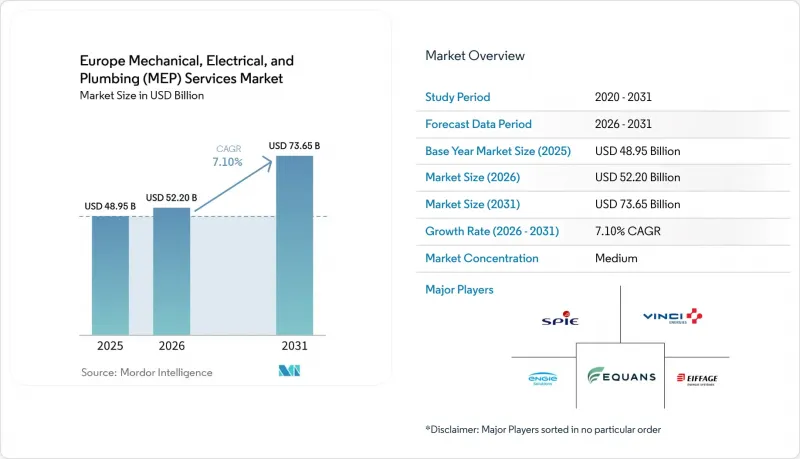
This report is Segmented by Type (Mechanical, Electrical, Plumbing, Integrated MEP), Service Type (Design & Engineering, Installation & Commissioning, Maintenance & Retrofit, Managed Services), End-User (Residential, Commercial, Infrastructure), and Geography (Germany, UK, France, Spain, Italy, Netherlands, Sweden, Denmark, Norway, Rest of Europe). Forecasts are Provided in Terms of Value (USD).
Europe Mechanical, Electrical, And Plumbing (MEP) Services Market Trends and Insights
EPBD Recast and Minimum Energy Performance Standards
The recast EPBD remains the strongest policy driver for the Europe Mechanical, Electrical, and Plumbing (MEP) Services market in the current cycle. It requires renovating the worst-performing 16% of non-residential buildings by 2030 and 26% by 2033, while residential buildings must reduce average primary energy use by 16% by 2030 and by 20% to 22% by 2035. Member states were required to submit draft National Building Renovation Plans by December 31, 2025, and final plans are due by December 31, 2026, providing contractors and engineering firms with clearer visibility into future workloads. The rule set is more targeted than earlier policy cycles because it directs countries toward the worst-performing part of the stock first, creating a concentrated pool of buildings requiring deep MEP intervention. EU energy efficiency funding also expanded sharply for 2021 to 2027, with EUR 144.7 billion (USD 156.3 billion) allocated and EUR 79.4 billion (USD 85.8 billion) of Recovery and Resilience Facility funding directed to buildings, which improves project bankability across the region. This makes the Europe Mechanical, Electrical, and Plumbing (MEP) Services market less dependent on short new-build cycles and more dependent on compliance-led upgrades across existing assets.
Electrification Replacing Fossil Boiler-Led Retrofits
Electrification is reshaping the Europe Mechanical, Electrical, and Plumbing (MEP) Services market because financial support for stand-alone fossil fuel boilers ended from January 1, 2025 under Article 17(15) of the recast EPBD. Heat pump sales in the EU recovered to 2.34 million units in 2025 from 2.11 million units in 2024, and preliminary data from 13 EU member states pointed to 11% market growth in 2025. This shift changes the nature of retrofit scopes because contractors now need electrical upgrades, hydraulic balancing, controls integration, and commissioning rather than simple boiler replacements. Germany's planned GModG framework adds another layer by tightening modernization rules and expanding obligations for low-emission buildings, which keeps retrofit activity active even as technology choices evolve. The EU Heat Pump Accelerator Platform and the future ETS2 regime for buildings add further policy support to this direction of travel. For the Europe Mechanical, Electrical, and Plumbing (MEP) Services market, this means demand is shifting toward more complex, higher-value retrofit packages.
Shortage of Certified Retrofit Technicians
Labor availability remains the clearest delivery constraint for the Europe Mechanical, Electrical, and Plumbing (MEP) Services market. The European Commission estimates that at least 750,000 additional heat pump installers are needed, and at least 50% of current installers will need reskilling for heat pump work. The same policy framework also recognizes skills barriers and one-stop-shop gaps as material obstacles to renovation delivery, indicating that the constraint is both institutional and operational. Shortages matter more now because retrofit scopes increasingly combine electrical, mechanical, wet-services, automation, and controls work in a single project. Qualification schemes also narrow the eligible contractor base, thereby improving technical quality but reducing the number of firms that can bid for complex compliance-led projects. This keeps demand intact but slows conversion of policy demand into booked revenue across the Europe Mechanical, Electrical, and Plumbing (MEP) Services market.
Other drivers and restraints analyzed in the detailed report include:
- Building Automation and Digital EPC Rollout
- District and One-Stop-Shop Renovation Programs
- High Capex Across Fragmented Legacy Building Stock
For complete list of drivers and restraints, kindly check the Table Of Contents.
Segment Analysis
Mechanical Services held 37% of the Europe Mechanical, Electrical, and Plumbing (MEP) Services market share in 2025, which made it the largest type segment in the region. This lead reflects HVAC replacement cycles, heat pump adoption, and district heating retrofit work that are all moving higher under the current policy mix. Electrical Services and Plumbing Services remain important adjacent volumes because most energy upgrades now involve power upgrades, controls wiring, hydraulic balancing, and wet-services work in the same package. Plumbing Services also benefits from the move toward heat pump and low-temperature system redesign, where water-side optimization becomes part of the core engineering scope. This keeps the Europe Mechanical, Electrical, and Plumbing (MEP) Services market firmly tied to whole-system retrofits rather than isolated equipment replacements.
Integrated MEP Services is projected to grow at a 9.09% CAGR through 2031, and the Europe Mechanical, Electrical, and Plumbing (MEP) Services market size for this segment is expanding faster because buyers want single-point responsibility for design, installation, automation, and commissioning. Within the Europe Mechanical, Electrical, and Plumbing (MEP) Services industry, this shift is most visible in data centers, life sciences, and technically demanding public projects where interface risk is costly. Germany's modernization framework is also increasing the need for bundled scopes that combine automation, balancing, and performance compliance in the same contract. VINCI Energies' 2025 acquisitions of Zimmer & Halbig and R+S in Germany show how major players are building deeper integrated delivery capacity rather than relying on single-trade expansion.
List of Companies Covered in this Report:
- SPIE
- VINCI Energies
- Equans
- ENGIE Solutions
- Eiffage Energie Systemes
- Bilfinger
- Exyte
- Ramboll
- Cundall
- Arup
- WSP
- AtkinsRealis
- AECOM
- Jacobs
- Mott MacDonald
- Stantec
- Mercury Engineering
- Dornan
- Bouygues Energies & Services
- Hochtief Engineering
- Arcadis
Additional Benefits:
- The market estimate (ME) sheet in Excel format
- 3 months of analyst support
TABLE OF CONTENTS
1 Introduction
- 1.1 Study Assumptions & Market Definition
- 1.2 Scope of the Study
2 Research Methodology
3 Executive Summary
4 Market Landscape
- 4.1 Market Overview
- 4.2 Market Drivers
- 4.2.1 EPBD Recast and Minimum Energy Performance Standards
- 4.2.2 Electrification Replacing Fossil Boiler-Led Retrofits
- 4.2.3 Building Automation and Digital EPC Rollout
- 4.2.4 District And One-Stop-Shop Renovation Programs
- 4.2.5 Smart Readiness Upgrades in Large Tertiary Buildings
- 4.2.6 Whole-Life Carbon Reporting Driving System Redesign
- 4.3 Market Restraints
- 4.3.1 Shortage of Certified Retrofit Technicians
- 4.3.2 High Capex Across Fragmented Legacy Building Stock
- 4.3.3 Split Incentives Between Landlords and Tenants
- 4.3.4 Data and Interoperability Compliance Burden for BACS
- 4.4 Value / Supply-Chain Analysis
- 4.5 Regulatory Landscape
- 4.6 Technological Outlook
- 4.7 Industry Attractiveness - Porter's Five Forces Analysis
- 4.7.1 Threat of New Entrants
- 4.7.2 Bargaining Power of Buyers
- 4.7.3 Bargaining Power of Suppliers
- 4.7.4 Threat of Substitute Products
- 4.7.5 Intensity of Competitive Rivalry
- 4.8 Cost Structure Analysis
5 Market Size & Growth Forecasts (Value, In USD Billion)
- 5.1 By Type
- 5.1.1 Mechanical Services
- 5.1.2 Electrical Services
- 5.1.3 Plumbing Services
- 5.1.4 Integrated MEP Services
- 5.2 By Service Type
- 5.2.1 Design & Engineering
- 5.2.2 Installation, Testing, and Commissioning
- 5.2.3 Maintenance, Repair, and Retrofit
- 5.2.4 Managed / Performance-based Services
- 5.3 By End-User Industry
- 5.3.1 Residential
- 5.3.2 Commercial
- 5.3.3 Infrastructure
- 5.4 By Geography
- 5.4.1 Germany
- 5.4.2 United Kingdom
- 5.4.3 France
- 5.4.4 Spain
- 5.4.5 Italy
- 5.4.6 Netherlands
- 5.4.7 Sweden
- 5.4.8 Denmark
- 5.4.9 Norway
- 5.4.10 Rest of Europe
6 Competitive Landscape
- 6.1 Market Concentration
- 6.2 Strategic Moves
- 6.3 Market Share Analysis
- 6.4 Company Profiles (includes Global level Overview, Market level overview, Core Segments, Financials as available, Strategic Information, Market Rank/Share for key companies, Products & Services, and Recent Developments)
- 6.4.1 SPIE
- 6.4.2 VINCI Energies
- 6.4.3 Equans
- 6.4.4 ENGIE Solutions
- 6.4.5 Eiffage Energie Systemes
- 6.4.6 Bilfinger
- 6.4.7 Exyte
- 6.4.8 Ramboll
- 6.4.9 Cundall
- 6.4.10 Arup
- 6.4.11 WSP
- 6.4.12 AtkinsRealis
- 6.4.13 AECOM
- 6.4.14 Jacobs
- 6.4.15 Mott MacDonald
- 6.4.16 Stantec
- 6.4.17 Mercury Engineering
- 6.4.18 Dornan
- 6.4.19 Bouygues Energies & Services
- 6.4.20 Hochtief Engineering
- 6.4.21 Arcadis
7 Market Opportunities & Future Outlook
- 7.1 White-space & Unmet-Need Assessment

