
PUBLISHER: Mordor Intelligence | PRODUCT CODE: 2064431

PUBLISHER: Mordor Intelligence | PRODUCT CODE: 2064431
Cream Cheese - Market Share Analysis, Industry Trends & Statistics, Growth Forecasts (2026 - 2031)
According to Mordor Intelligence, the global cream cheese market was valued at USD 26.44 billion in 2025, reached USD 28.06 billion in 2026, and is projected to attain USD 38.68 billion by 2031, growing at a CAGR of 6.63% during the forecast period.
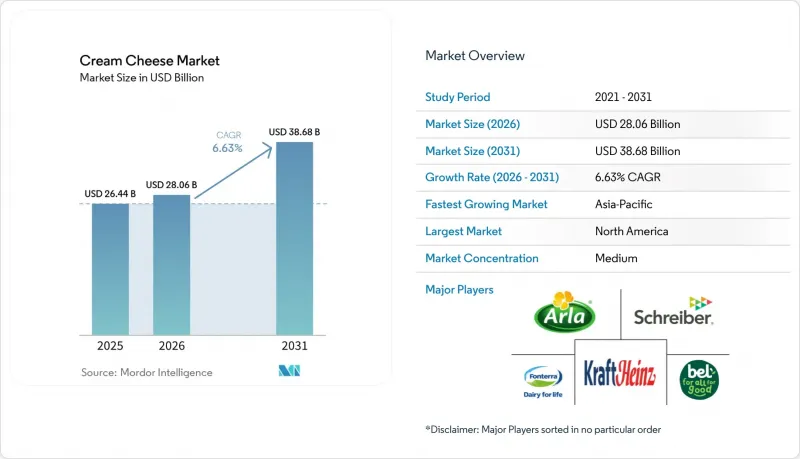
This report is Segmented by Product Type (Low-Fat and Fat-Free Cream Cheese, Full-Fat Cream Cheese, and More), Source (Dairy and Dairy-Free), Flavor (Plain and Flavored), Distribution Channel (Industrial, Commercial, and Retail), and Geography (North America, Europe, Asia-Pacific, South America, Middle East and Africa). The Market Forecasts are Provided in Both Value (USD) and Volume (Tons).
Global Cream Cheese Market Trends and Insights
Increasing demand for clean-label and natural dairy products
The rising demand for clean-label and natural dairy products is a significant driver of the global cream cheese market. Consumers are increasingly prioritizing transparency, minimal processing, and recognizable ingredients in their food choices. They seek dairy products that are fresh, authentic, preservative-free, and made with simple ingredient compositions. This shift is prompting manufacturers to reformulate cream cheese products with cleaner labels and a more natural positioning. According to the International Food Information Council (IFIC), around 36% of Americans prefer foods labeled as natural, organic, or healthy, highlighting the growing trend toward wellness-focused purchasing behavior . In response, cream cheese producers are introducing products made with natural cultures, hormone-free milk, reduced additives, and organic dairy ingredients to enhance consumer trust and premium appeal.
Growth of Western-style fast food and cafe culture globally
The global growth of Western-style fast food and cafe culture is significantly driving the demand for cream cheese, as it has become a key ingredient in modern quick-service dining, premium cafe offerings, and convenience-focused food trends. The expansion of cafes, bakery chains, quick-service restaurants, and casual dining establishments has led to increased use of cream cheese in food formats that highlight creamy textures, indulgent flavors, and premium dairy experiences. Younger demographics, in particular, are adopting Western-inspired eating habits and cafe-based social dining, fueling the demand for dairy-rich products associated with comfort, convenience, and premium quality. In response, manufacturers are developing cream cheese products with improved texture stability, spreadability, and flavor consistency to meet the requirements of commercial food preparation environments.
Short shelf life and refrigeration dependency
Short shelf life and refrigeration dependency are key challenges for the global cream cheese market. Cream cheese products are highly perishable, requiring consistent cold-chain management across production, transportation, storage, and retail distribution. The high moisture content and dairy-based composition make cream cheese particularly susceptible to spoilage, texture degradation, and microbial contamination when exposed to temperature fluctuations. These factors pose significant logistical and operational difficulties for manufacturers, distributors, and retailers, especially in regions with inadequate refrigeration infrastructure or unreliable cold-chain systems. Ensuring optimal storage temperatures increases transportation complexity, warehousing demands, and energy consumption, thereby impacting operational efficiency and product handling.
Other drivers and restraints analyzed in the detailed report include:
- Increasing innovation in flavored and specialty cream cheese variants
- Growth in demand for low-fat, lactose-free, and plant-based cream cheese alternatives
- Stringent food safety and dairy processing regulations
For complete list of drivers and restraints, kindly check the Table Of Contents.
Segment Analysis
Full-Fat Cream Cheese accounted for 48.52% of the global cream cheese market in 2025, driven by its superior texture, rich mouthfeel, creamy consistency, and authentic dairy flavor. These attributes align closely with evolving consumer taste preferences. Manufacturers are increasingly focusing on full-fat formulations as consumers associate higher fat content with premium quality, indulgence, freshness, and enhanced sensory performance. This segment benefits from the rising demand for minimally processed dairy products, as full-fat variants are often perceived as more natural and less altered compared to reduced-fat alternatives, which may require stabilizers, gums, or texture-enhancing additives. This perception supports purchasing behavior among consumers seeking clean-label and traditional dairy experiences.
Low-Fat and Fat-Free Cream Cheese variants are projected to grow at a CAGR of 6.71% through 2031, driven by the global shift toward health-conscious and calorie-aware dietary preferences. Increasing awareness of obesity management, cardiovascular health, cholesterol reduction, and balanced nutrition is prompting consumers to choose dairy products with reduced fat content while maintaining familiar taste and texture. Manufacturers are advancing this segment through innovations in formulation technologies that enhance creaminess, spreadability, and mouthfeel in low-fat products, addressing traditional concerns about texture and taste compromises.
The Dairy segment's projected 87.21% market share in 2025 highlights the strong integration of dairy cream cheese into global consumer preferences, manufacturing processes, and traditional dairy consumption patterns. Dairy-based cream cheese maintains its dominance due to its authentic flavor, naturally rich texture, smooth mouthfeel, and functional properties that are challenging to replicate with alternative formulations. Consumers associate dairy cream cheese with attributes such as freshness, indulgence, quality, and traditional culinary experiences, ensuring its continued acceptance in everyday consumption. Manufacturers are advancing this segment through innovations in milk processing, culturing techniques, texture optimization, and product stabilization technologies. These advancements enhance consistency, creaminess, and shelf life while preserving the sensory characteristics expected from dairy products.
The Dairy-Free sub-segment's forecasted CAGR of 7.89% through 2031 reflects the growing shift in consumer dietary preferences toward plant-based, allergen-friendly, and wellness-focused food options. Increasing awareness of lactose intolerance, dairy sensitivities, digestive health, and ethical food consumption is driving demand for non-dairy cream cheese alternatives. Manufacturers are fostering growth in this segment through innovations in plant-based ingredient technologies, utilizing almonds, cashews, oats, soy, coconut, and blended plant proteins to replicate the creamy texture, spreadability, and flavor traditionally associated with dairy cream cheese. Advances in formulation science are addressing earlier challenges related to taste, consistency, and mouthfeel, making dairy-free cream cheese products increasingly competitive with conventional options.
Geography Analysis
North America held a dominant 33.21% share of the global cream cheese market in 2025, supported by its well-established dairy industry, mature cold-chain infrastructure, and strong consumer preference for creamy dairy-based products. The region benefits from advanced milk processing capabilities, robust dairy farming systems, and the widespread availability of high-quality cream cheese across retail and commercial channels. Cream cheese consumption remains structurally strong due to the region's familiarity with dairy-rich diets and its integration into everyday food consumption patterns. Additionally, North America maintains a competitive advantage as cream cheese production primarily relies on cow's milk and cream, both of which are abundantly available through the region's large-scale dairy production ecosystem.
Asia-Pacific is projected to achieve a forecast CAGR of 7.59% through 2031, making it the most dynamic region in the global cream cheese market. This growth is driven by the modernization of dairy consumption habits, the expansion of foodservice industries, and the increasing acceptance of Western-style dairy products. The region is witnessing significant growth in dairy processing capabilities and milk production, creating a favorable supply environment for cream cheese manufacturers. According to the Ministry of Fisheries, Animal Husbandry & Dairying, milk production in India reached over 239.3 million metric tons in fiscal year 2024, up from 230.5 million metric tons in the previous year, underscoring the rapid expansion of the regional dairy sector . The growing availability of cow's milk and cream is enabling increased local production of cream cheese and strengthening regional supply chains.
Europe continues to hold a strong position in the global cream cheese market due to its long-standing dairy traditions, advanced cheese manufacturing expertise, and strong consumer preference for premium dairy products. The region benefits from highly developed dairy farming systems, strict quality standards, and growing demand for artisanal and clean-label cream cheese varieties. The Middle East and South America are emerging as steadily growing regions in the cream cheese market, supported by improving dairy processing infrastructure, expanding organized retail sectors, and rising consumer demand for premium dairy-based foods. Manufacturers in these regions are increasingly investing in product diversification, refrigeration networks, and premium dairy innovations to enhance long-term market penetration and consumer engagement.
- The Kraft Heinz Company
- Arla Foods amba
- Schreiber Foods Inc.
- Saputo Inc.
- Fonterra Co-operative Group
- Bel Group
- Daiya Foods
- Tofutti Brands Inc.
- Danone S.A.
- Lactalis Group
- Goloka Farms
- Groupe Savencia
- Royal FrieslandCampina N.V.
- Murray Goulburn
- Alouette Cheese USA LLC
- Megmilk Snow Brand Co., Ltd.
- Almarai Company
- Valio Ltd
- Franklin Foods, Inc.
- Britannia Industries Limited
Additional Benefits:
- The market estimate (ME) sheet in Excel format
- 3 months of analyst support
TABLE OF CONTENTS
1 INTRODUCTION
- 1.1 Study Assumptions and Market Definition
- 1.2 Scope of the Study
2 RESEARCH METHODOLOGY
3 EXECUTIVE SUMMARY
4 MARKET LANDSCAPE
- 4.1 Market Overview
- 4.2 Market Drivers
- 4.2.1 Increasing demand for clean-label and natural dairy products
- 4.2.2 Growth of Western-style fast food and cafe culture globally
- 4.2.3 Increasing innovation in flavored and specialty cream cheese variants
- 4.2.4 Growth in demand for low-fat, lactose-free, and plant-based cream cheese alternatives
- 4.2.5 Consumer preference for high-protein and dairy-based foods
- 4.2.6 Rising popularity of premium and artisanal cheese products
- 4.3 Market Restraints
- 4.3.1 Short shelf life and refrigeration dependency
- 4.3.2 Stringent food safety and dairy processing regulations
- 4.3.3 Intense competition from alternative spreads and dairy products
- 4.3.4 Volatility in raw milk supply and dairy ingredient quality
- 4.4 Consumer Behaviour Analysis
- 4.5 Regulatory Landscape
- 4.6 Technological Outlook
- 4.7 Porter's Five Forces Analysis
- 4.7.1 Threat of New Entrants
- 4.7.2 Bargaining Power of Buyers
- 4.7.3 Bargaining Power of Suppliers
- 4.7.4 Threat of Substitutes
- 4.7.5 Intensity of Competitive Rivalry
5 MARKET SIZE AND GROWTH FORECASTS (VALUE AND VOLUME)
- 5.1 By Product Type
- 5.1.1 Low-Fat and Fat-Free Cream Cheese
- 5.1.2 Full-Fat Cream Cheese
- 5.1.3 Whipped Cream Cheese
- 5.1.4 Cream Cheese Blend
- 5.2 By Source
- 5.2.1 Dairy
- 5.2.2 Dairy-Free (Vegan & Lactose-Free)
- 5.3 By Flavor
- 5.3.1 Plain
- 5.3.2 Flavored
- 5.4 By Distribution Channel
- 5.4.1 Industrial (Food Processing)
- 5.4.2 Commercial
- 5.4.2.1 Hotels and Catering
- 5.4.2.2 Restaurants
- 5.4.2.3 Full-Service Restaurants
- 5.4.2.4 Bakeries
- 5.4.2.5 Cafes
- 5.4.2.6 Other Restaurants
- 5.4.3 Retail
- 5.4.3.1 Supermarkets/Hypermarkets
- 5.4.3.2 Convenience/Grocery Stores
- 5.4.3.3 Online Retail Stores
- 5.4.3.4 Other Retail Channels
- 5.5 By Geography
- 5.5.1 North America
- 5.5.1.1 United States
- 5.5.1.2 Canada
- 5.5.1.3 Mexico
- 5.5.1.4 Rest of North America
- 5.5.2 Europe
- 5.5.2.1 United Kingdom
- 5.5.2.2 Germany
- 5.5.2.3 France
- 5.5.2.4 Italy
- 5.5.2.5 Spain
- 5.5.2.6 Netherlands
- 5.5.2.7 Poland
- 5.5.2.8 Belgium
- 5.5.2.9 Sweden
- 5.5.2.10 Rest of Europe
- 5.5.3 Asia-Pacific
- 5.5.3.1 China
- 5.5.3.2 Japan
- 5.5.3.3 India
- 5.5.3.4 Australia
- 5.5.3.5 Indonesia
- 5.5.3.6 South Korea
- 5.5.3.7 Thailand
- 5.5.3.8 Singapore
- 5.5.3.9 Rest of Asia-Pacific
- 5.5.4 South America
- 5.5.4.1 Brazil
- 5.5.4.2 Argentina
- 5.5.4.3 Colombia
- 5.5.4.4 Chile
- 5.5.4.5 Peru
- 5.5.4.6 Rest of South America
- 5.5.5 Middle East and Africa
- 5.5.5.1 South Africa
- 5.5.5.2 Saudi Arabia
- 5.5.5.3 United Arab Emirates
- 5.5.5.4 Nigeria
- 5.5.5.5 Egypt
- 5.5.5.6 Morocco
- 5.5.5.7 Turkey
- 5.5.5.8 Rest of Middle East and Africa
- 5.5.1 North America
6 COMPETITIVE LANDSCAPE
- 6.1 Market Concentration
- 6.2 Strategic Moves
- 6.3 Market Share Analysis
- 6.4 Company Profiles (includes Global level Overview, Market level overview, Core Segments, Financials as available, Strategic Information, Market Rank/Share for key companies, Products and Services, and Recent Developments)
- 6.4.1 The Kraft Heinz Company
- 6.4.2 Arla Foods amba
- 6.4.3 Schreiber Foods Inc.
- 6.4.4 Saputo Inc.
- 6.4.5 Fonterra Co-operative Group
- 6.4.6 Bel Group
- 6.4.7 Daiya Foods
- 6.4.8 Tofutti Brands Inc.
- 6.4.9 Danone S.A.
- 6.4.10 Lactalis Group
- 6.4.11 Goloka Farms
- 6.4.12 Groupe Savencia
- 6.4.13 Royal FrieslandCampina N.V.
- 6.4.14 Murray Goulburn
- 6.4.15 Alouette Cheese USA LLC
- 6.4.16 Megmilk Snow Brand Co., Ltd.
- 6.4.17 Almarai Company
- 6.4.18 Valio Ltd
- 6.4.19 Franklin Foods, Inc.
- 6.4.20 Britannia Industries Limited
7 MARKET OPPORTUNITIES AND FUTURE OUTLOOK

