PUBLISHER: Mordor Intelligence | PRODUCT CODE: 2073186

PUBLISHER: Mordor Intelligence | PRODUCT CODE: 2073186
United States Cheese - Market Share Analysis, Industry Trends & Statistics, Growth Forecasts (2026 - 2031)
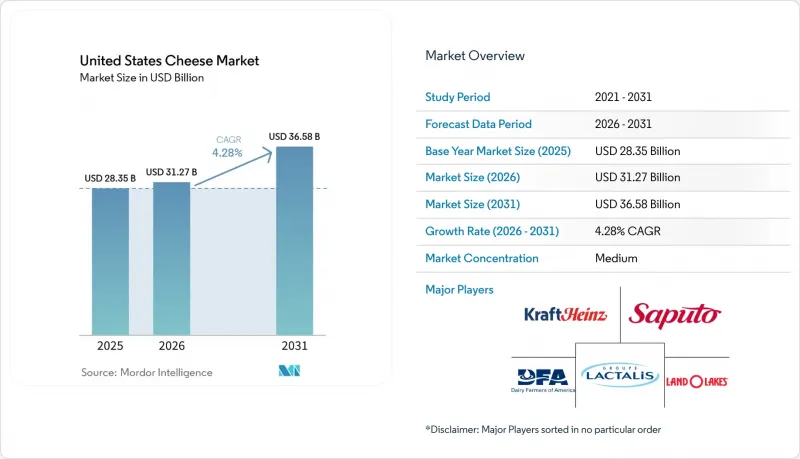
According to Mordor Intelligence, the united states cheese market size was valued at USD 28.35 billion in 2025 and is estimated to grow from USD 31.27 billion in 2026 to reach USD 36.58 billion by 2031, at a CAGR of 4.28% during the forecast period (2026-2031).
This report is Segmented by Type (Natural Cheese and Processed Cheese), Milk Source (Cow, Buffalo, and Others), Format (Blocks/Wheels, Slices, Shredded and Grated, Spreads, Cubes and Sticks, and Others), and Distribution Channel (Foodservice and Retail). The Market Forecasts are Provided in Terms of Value (USD).
United States Cheese Market Trends and Insights
Increasing Popularity of Specialty and Artisanal Cheeses
Specialty and artisanal varieties are changing the revenue mix of the United States cheese market, even when total category volume does not move at the same pace. Deli cheese generated USD 9.1 billion in the 52 weeks ending April 2026, and household buying penetration reached 79.8%, which shows that specialty cheese buying is already broad rather than niche. That scale gives retailers a strong reason to protect shelf space and deli counter presence for premium cheeses. The demand pattern also suggests that consumers are using specialty cheese more often in routine meals, snacks, and entertaining, which supports a better price mix across the United States cheese market. Margin pressure on smaller creameries is still present, so larger cooperatives and processors have a clearer path to add differentiated products through acquisition or brand partnerships.
Growing Demand From Pizza and Fast-Food Industries
Foodservice remains one of the most dependable demand bases for the United States cheese market because pizza chains and quick-service operators buy large volumes of mozzarella and processed blends on a repeat basis. The United States had 75,736 pizzerias in 2025, while Italian-type cheese production reached 6.3 billion pounds and mozzarella alone accounted for 5.0 billion pounds, or 79.1% of Italian-type output. Parmesan production also rose 17.9% in 2025, which shows that restaurant use is extending beyond pizza into pasta, appetizers, and dressings. These procurement patterns give the United States cheese market a stable volume floor that is less exposed to short-term shifts in household sentiment. The same trend is also favoring large processors that can meet product specification, consistency, and logistics requirements across national chain networks.
Growing Competition From Plant-Based Cheese Alternatives
Plant-based cheese alternatives remain small in value terms, but they still create a meaningful competitive challenge for the United States cheese market in premium retail and natural grocery channels. In the most recent full tracking year, plant-based cheese dollar sales fell 10%, and unit sales fell 8%, yet household penetration still stood at 4% and dollar share remained near 1% of the total cheese category. That level does not threaten the full United States cheese market today, but it is large enough to keep shelf space pressure elevated in sliced and shredded formats. Commodity-oriented processors face the greatest exposure because those are the formats where plant-based offerings have advanced the most. The longer-term risk is less about total substitution and more about losing younger, convenience-driven shoppers in channels where discovery and trial happen quickly.
Other drivers and restraints analyzed in the detailed report include:
- Product Innovation in New Cheese Formats
- Rising Consumption of Natural and Lactose-Free Cheese
- Emerging Impact of Weight-Loss and Reduced-Calorie Diet Trends
For complete list of drivers and restraints, kindly check the Table Of Contents.
Segment Analysis
Natural cheese held 85.28% of the United States cheese market share in 2025, which shows how strongly the category aligns with demand for simpler and more familiar dairy products. Mozzarella remained the largest production variety within natural cheese, with 5.0 billion pounds of output in 2025, and this kept Italian styles central to the United States cheese market across both retail and foodservice. Parmesan production rose 17.9% in 2025, which points to broader menu use and stronger household cooking demand beyond pizza alone. Natural cheese also benefits from stronger premium positioning, which helps branded and specialty players defend price even as private label gains share in mainstream supermarket shelves.
Feta, ricotta, cream cheese, and other everyday natural varieties continue to widen the category base because they serve cooking, snacking, and deli use at the same time. The United States cheese industry is also seeing higher value concentration in natural cheese because consumers are more willing to trade up on provenance, texture, and perceived freshness than they are in more processed formats. Processed cheese still remains important, and it is forecast to grow at a 6.25% CAGR through 2031, making it the fastest-growing type segment in the user supplied draft. That growth is being supported by reformulation, especially products that preserve melt performance while moving closer to natural ingredient expectations, as shown by Sargento's January 2026 launch activity.
Cow milk accounted for 45.73% of the United States cheese market size in 2025, and it remains the foundation of large-scale cheddar, mozzarella, and American cheese production. That leadership rests on the processing base in Wisconsin and California, which continues to anchor the highest output volumes in the country. Buffalo milk holds a meaningful niche in Italian-style specialties, with California's processing network supporting domestic supply for mozzarella di bufala-style applications and related premium offerings. The structure of this segment still favors cow milk because the United States cheese market depends on scale, consistent milk availability, and established procurement systems.
Goat milk is projected to grow at a 6.68% CAGR through 2031, making it the fastest-growing milk source in the user-supplied draft. Growth is tied to specialty grocers, farm-to-table menus, and direct-to-consumer channels that give smaller premium products a wider audience. Vermont Creamery, part of the Land O'Lakes portfolio, remains a relevant example because it shows how branded goat cheese can scale through authenticity and regional identity. The United States cheese industry is likely to see goat milk remain supply constrained relative to demand, which supports premium pricing but also limits how fast this segment can move into wider mass-market distribution.
Complete Report Scope:
- By Type
- Natural Cheese
- Mozzarella
- Feta
- Ricotta
- Cottage
- Cream
- Parmesan
- Others
- Processed Cheese
- Natural Cheese
- By Milk Source
- Cow
- Buffalo
- Others
- By Format
- Blocks/Wheels
- Slices
- Shredded and Grated
- Spreads
- Cubes and Sticks
- Others
- By Distribution Channel
- Foodservice (HoReCa)
- Retail
- Supermarkets and Hypermarkets
- Convenience Stores
- Specialist Retailers
- Online Retail
- Others
List of Companies Covered in this Report:
- The Kraft Heinz Company
- Dairy Farmers of America
- Saputo Inc.
- Schreiber Foods, Inc.
- Sargento Foods Inc.
- Bel Brands USA, Inc.
- Tillamook County Creamery Association
- Cabot Creamery Cooperative
- Land O'Lakes, Inc.
- Leprino Foods Company
- Lactalis USA
- Organic Valley
- Hilmar Cheese Company, Inc.
- Grande Cheese Company
- President Cheese
- Frigo Cheese Heads
- Crystal Farms
- Murray's Cheese
- Wisconsin Cheese Group
- Borden Dairy Company
Additional Benefits:
- The market estimate (ME) sheet in Excel format
- 3 months of analyst support
TABLE OF CONTENTS
1 INTRODUCTION
- 1.1 Study Assumptions and Market Definition
- 1.2 Scope of the Study
2 RESEARCH METHODOLOGY
3 EXECUTIVE SUMMARY
4 MARKET LANDSCAPE
- 4.1 Market Overview
- 4.2 Market Drivers
- 4.2.1 Increasing Popularity of Specialty and Artisanal Cheeses
- 4.2.2 Growth of Home Cooking and Gourmet Meal Preparation
- 4.2.3 Growing Demand from Pizza and Fast-Food Industries
- 4.2.4 Product Innovation in New Cheese Formats
- 4.2.5 Long shelf life & convenient single-serve formats
- 4.2.6 Rising Consumption of Natural and Lactose-Free Cheese
- 4.3 Market Restraints
- 4.3.1 Growing Competition from Plant-Based Cheese Alternatives
- 4.3.2 Lactose intolerance & milk allergies affecting 30-50 million Americans
- 4.3.3 Emerging Impact of Weight-Loss and Reduced-Calorie Diet Trends
- 4.3.4 Volatility in Milk Prices
- 4.4 Consumer Behavior Analysis
- 4.5 Regulatory Landscape
- 4.6 Technological Outlook
- 4.7 Porter's Five Forces
- 4.7.1 Bargaining Power of Suppliers
- 4.7.2 Bargaining Power of Buyers
- 4.7.3 Threat of New Entrants
- 4.7.4 Threat of Substitutes
- 4.7.5 Competitive Rivalry
5 MARKET SIZE AND GROWTH FORECASTS (VALUE)
- 5.1 By Type
- 5.1.1 Natural Cheese
- 5.1.1.1 Mozzarella
- 5.1.1.2 Feta
- 5.1.1.3 Ricotta
- 5.1.1.4 Cottage
- 5.1.1.5 Cream
- 5.1.1.6 Parmesan
- 5.1.1.7 Others
- 5.1.2 Processed Cheese
- 5.1.1 Natural Cheese
- 5.2 By Milk Source
- 5.2.1 Cow
- 5.2.2 Buffalo
- 5.2.3 Others
- 5.3 By Format
- 5.3.1 Blocks/Wheels
- 5.3.2 Slices
- 5.3.3 Shredded and Grated
- 5.3.4 Spreads
- 5.3.5 Cubes and Sticks
- 5.3.6 Others
- 5.4 By Distribution Channel
- 5.4.1 Foodservice (HoReCa)
- 5.4.2 Retail
- 5.4.2.1 Supermarkets and Hypermarkets
- 5.4.2.2 Convenience Stores
- 5.4.2.3 Specialist Retailers
- 5.4.2.4 Online Retail
- 5.4.2.5 Others
6 COMPETITIVE LANDSCAPE
- 6.1 Market Concentration
- 6.2 Strategic Moves
- 6.3 Market Ranking Analysis
- 6.4 Company Profiles (Includes Global-level Overview, Market-level Overview, Core Segments, Financials, Strategic Info, Market Rank/Share, Products & Services, Recent Developments)
- 6.4.1 The Kraft Heinz Company
- 6.4.2 Dairy Farmers of America
- 6.4.3 Saputo Inc.
- 6.4.4 Schreiber Foods, Inc.
- 6.4.5 Sargento Foods Inc.
- 6.4.6 Bel Brands USA, Inc.
- 6.4.7 Tillamook County Creamery Association
- 6.4.8 Cabot Creamery Cooperative
- 6.4.9 Land O'Lakes, Inc.
- 6.4.10 Leprino Foods Company
- 6.4.11 Lactalis USA
- 6.4.12 Organic Valley
- 6.4.13 Hilmar Cheese Company, Inc.
- 6.4.14 Grande Cheese Company
- 6.4.15 President Cheese
- 6.4.16 Frigo Cheese Heads
- 6.4.17 Crystal Farms
- 6.4.18 Murray's Cheese
- 6.4.19 Wisconsin Cheese Group
- 6.4.20 Borden Dairy Company
7 MARKET OPPORTUNITIES AND FUTURE OUTLOOK

