PUBLISHER: Mordor Intelligence | PRODUCT CODE: 2064437

PUBLISHER: Mordor Intelligence | PRODUCT CODE: 2064437
Wireless Display - Market Share Analysis, Industry Trends & Statistics, Growth Forecasts (2026 - 2031)
According to Mordor Intelligence, the wireless display market size was valued at USD 7.09 billion in 2025 and estimated to grow from USD 8.34 billion in 2026 to reach USD 16.87 billion by 2031, at a CAGR of 15.13% during the forecast period (2026-2031).
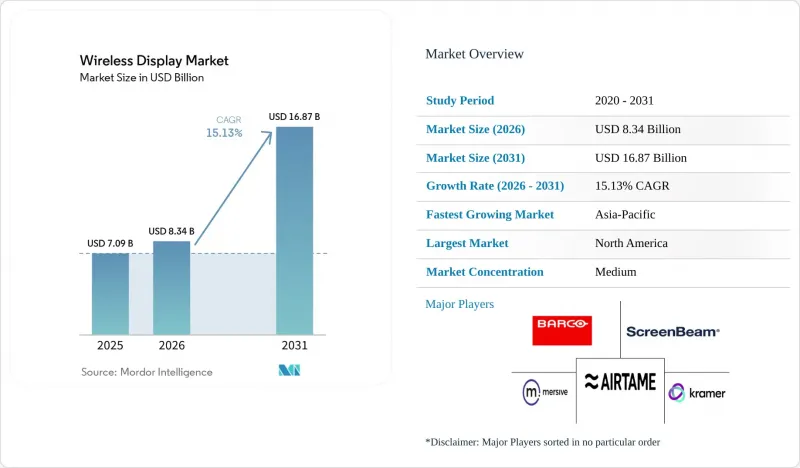
This report is Segmented by Offering (Hardware, and Software and Services), Technology Protocol (AirPlay, Miracast, Google Cast, Wireless HDMI and Wireless HD, and More), End-User (Residential, and Commercial), Application (Consumer Entertainment and Streaming, Enterprise Presentation and Collaboration, Education and Training, and More), and Geography. The Market Forecasts are Provided in Terms of Value (USD).
Global Wireless Display Market Trends and Insights
Hybrid Work and BYOD Adoption Reshaping Enterprise Wireless Infrastructure
Permanent hybrid work arrangements have pushed the wireless display market deeper into enterprise workflows, as meeting rooms now need to support many personal devices rather than a fixed room computer. Cisco reported that 55% of wireless leaders cited BYOD and user mobility as the main drivers of rising dependence on wireless networks in its November 2025 survey across 30 markets. The same study found that 80% of organizations increased wireless infrastructure spending over the five years before the survey, indicating that this demand is tied to long-term network investment rather than short-term room upgrades. Enterprises are therefore accepting higher unit costs for systems that can support AirPlay, Miracast, and Google Cast in a single room because mixed device fleets create a real compatibility problem. This change is also shifting revenue toward software and services because device management, analytics, and subscription support are becoming part of the standard enterprise purchase.
Wi-Fi 6E And Infrastructure Upgrades Removing The Latency Ceiling
The wireless display market is benefiting from a broader access point refresh cycle, as Wi-Fi 6E provides access to 1,200 MHz of unlicensed 6 GHz spectrum in the United States and has since gained support across several major countries and regions. Cisco recorded a 23% year-over-year increase in Wi-Fi 6E and Wi-Fi 7 access point deployments across its managed networks in the second half of 2025, indicating that enterprise migration is already underway at a meaningful scale. It also reported a 60% year-over-year increase in 6 GHz clients activated across 5 million managed networks in 2025, indicating stronger endpoint readiness for advanced casting use cases. Earlier 5 GHz deployments often struggled in dense classrooms and office environments, but 6 GHz capacity improves conditions for multi-source, high-resolution sharing. Enterprises that refresh access points on three-to-four-year cycles are likely to align wireless presentation purchases with this network transition between 2026 and 2029, which supports unit demand during the forecast window.
Protocol Fragmentation Complicating Enterprise Procurement Decisions
The wireless display market still faces a real interoperability problem because AirPlay, Miracast, Google Cast, and proprietary stacks do not deliver a consistent experience across mixed device fleets. Buyers can either pay a higher price for multi-protocol hardware or accept compatibility gaps that frustrate users in shared rooms. This issue becomes harder in regulated environments because security design now matters as much as simple screen sharing. A March 2026 research note from the Cloud Security Alliance identified vulnerabilities in Wi-Fi client isolation that affect both WPA2 and WPA3 networks and stem from the IEEE 802.11 standard itself, meaning vendor patching alone does not fully eliminate the risk. When protocol complexity and security reviews occur simultaneously, procurement approval cycles lengthen, and some organizations delay refresh decisions until better alignment emerges.
Other drivers and restraints analyzed in the detailed report include:
- Smart TV and Interactive Flat Panel Expansion Creating Embedded Display Demand
- Classroom and Meeting Room Digitalization Programs Sustaining Structural Demand
- Wired Connectivity Retaining a Performance Advantage in Bandwidth-Intensive Applications
For complete list of drivers and restraints, kindly check the Table Of Contents.
Segment Analysis
Hardware retained 54.32% of the wireless display market size in 2025, supported by the large installed base of adapters, integrated presentation systems, and embedded modules across homes and commercial venues. That lead still reflects how much prior spending in the wireless display industry went into physical room hardware and display endpoints. The segment remains important because many buyers still need dedicated receivers, smart meeting room devices, or display-integrated modules to support reliable casting across multiple users. At the same time, the composition of hardware demand is changing as enterprise buyers prefer bundled systems that combine room control, device connectivity, and cloud administration instead of single-function dongles.
Software and services are projected to grow at a 15.53% CAGR from 2026 to 2031, making it the fastest-growing segment of the wireless display market. This growth is tied to subscription-based screen-sharing, device-management, and analytics platforms that help enterprises manage usage policies and fleet performance. Airtame introduced Airtame 3 in December 2025 with a Wi-Fi 6E chipset and a licensing model priced at USD 120 per device per year for core features and USD 300 per device per year for full hybrid conferencing, demonstrating how recurring revenue is built into the product stack. Managed services also have room to expand, as IT teams handling multi-vendor deployments and zero-trust integration may prefer external support for firmware management, security policy, and ongoing administration.
AirPlay held 32.56% share of the wireless display market in 2025 because Apple devices already route screen mirroring through a mature native ecosystem across iPhone, iPad, and MacBook users. That installed base gave AirPlay an advantage in both residential use and business settings where Apple endpoints are common. Miracast still keeps a place in commercial environments because Windows-based fleets remain important across enterprise, education, and public institutions. Wireless HDMI and WirelessHD continue to serve narrower needs where throughput matters more than broad protocol flexibility, while Intel WiDi keeps losing relevance as legacy endpoints cycle out of use.
Google Cast is forecast to grow at a 16.33% CAGR from 2026 to 2031, which makes it the fastest-growing protocol group in the wireless display market. Its momentum comes from deep integration across Android and Chrome OS, as well as wider availability on Google-certified TVs and meeting room hardware. These conditions are pushing buyers toward software-defined receivers that support multiple protocols from a single endpoint, rather than forcing a room to rely on a single device ecosystem. That direction matters because buyers increasingly want broad compatibility, policy control, and simpler deployment instead of protocol-specific room hardware.
Geography Analysis
North America held 34.58% of the wireless display market share in 2025, making it the largest regional market. The region benefited from mature enterprise wireless infrastructure, active device refresh cycles in education, and the presence of many platform vendors and solution integrators. USB-C adoption across commercial notebooks removed a practical barrier to cable-free room workflows by 2025, which made wireless presentation easier to support at scale. Compliance rules such as FERPA in education and HIPAA in healthcare also favored enterprise-grade systems over consumer-grade products, as policy control and security were key considerations in institutional buying. Crestron reinforced this direction in January 2026, when it introduced Collab Compute, a collaboration hardware core built on an Intel Core Ultra processor with an integrated NPU for AI-assisted meeting room deployments.
Asia-Pacific is projected to grow at a 16.04% CAGR from 2026 to 2031, making it the fastest-growing region in the wireless display market. Demand is being supported by smart classroom rollouts in China and India, new corporate campus construction, and the rapid pace of 6 GHz authorization across major APAC markets. This regional pattern differs from North America because greenfield education and institutional projects can adopt wireless room connectivity as the default standard instead of replacing legacy wired systems. South Korea, Japan, and Australia also benefit from the wider regulatory shift toward Wi-Fi 6E, which helps align access point upgrades with wireless presentation purchases.
Europe remains a mature yet continually refreshing wireless display market, with the United Kingdom and Germany as key centers of enterprise demand. The EU's spectrum harmonization reduced the timing gap with North America for Wi-Fi 6E deployment, which improved the conditions for next-generation casting infrastructure. Barco, headquartered in Belgium, reported EUR 947 million in sales in 2024, equivalent to USD 1,024.65 million, and strengthened its regional position in June 2025 with the launch of ClickShare Hub on Microsoft's Device Ecosystem Platform. The Middle East and Africa remain the smallest contributors but are benefiting from smart building programs in the UAE and Saudi Arabia, while South America is still at an early stage, with Brazil and Argentina leading commercial adoption as real estate investment stabilizes.
- Barco NV
- Airtame ApS
- ScreenBeam Inc.
- Mersive Technologies, Inc.
- Kramer Electronics Ltd.
- WolfVision GmbH
- Kindermann GmbH
- Crestron Electronics, Inc.
- RGB Systems, Inc. dba Extron Electronics
- TEKVOX, Inc.
- SMART Technologies ULC
- Promethean Limited
- Legamaster International B.V.
- Squirrels LLC
- Splashtop Inc.
- DisplayNote Technologies Limited
- Avocor Technologies
- Yealink Network Technology Co., Ltd.
- Vivitek Corporation
- Newline Interactive Inc.
Additional Benefits:
- The market estimate (ME) sheet in Excel format
- 3 months of analyst support
TABLE OF CONTENTS
1 INTRODUCTION
- 1.1 Study Assumptions and Market Definition
- 1.2 Scope of the Study
2 RESEARCH METHODOLOGY
3 EXECUTIVE SUMMARY
4 MARKET LANDSCAPE
- 4.1 Market Overview
- 4.2 Market Drivers
- 4.2.1 Hybrid Work and BYOD Collaboration Normalization
- 4.2.2 Rising Installed Base of Smart TVs, Interactive Flat Panels, and Connected Projectors
- 4.2.3 Wi-Fi 6, Wi-Fi 6E, and 5G Upgrades Improving Low-Latency Casting
- 4.2.4 Classroom and Meeting Room Digitalization Programs
- 4.2.5 USB-C Laptop Transition Accelerating Demand for Cable-Free Room Workflows
- 4.2.6 Security-Certified Native Casting and Guest Network Segmentation Becoming Procurement Differentiators
- 4.3 Market Restraints
- 4.3.1 Protocol Fragmentation Across AirPlay, Miracast, Google Cast, and Proprietary Stacks
- 4.3.2 HDMI and USB-C Cable Reliability Still Outperform Wireless in High-Bandwidth Use Cases
- 4.3.3 Smart TV Native Casting Reducing Incremental Demand for Standalone Receivers in Consumer Settings
- 4.3.4 Enterprise RF Congestion and Zero-Trust Network Policies Extending Deployment Cycles
- 4.4 Impact of Macroeconomic Factors on the Market
- 4.5 Industry Value Chain Analysis
- 4.6 Regulatory Landscape
- 4.7 Technological Outlook
- 4.8 Porter's Five Forces Analysis
- 4.8.1 Bargaining Power of Suppliers
- 4.8.2 Bargaining Power of Buyers
- 4.8.3 Threat of New Entrants
- 4.8.4 Threat of Substitutes
- 4.8.5 Intensity of Competitive Rivalry
5 MARKET SIZE AND GROWTH FORECASTS (VALUE)
- 5.1 By Offering
- 5.1.1 Hardware
- 5.1.1.1 Wireless Display Adapters and Dongles
- 5.1.1.2 Integrated Wireless Presentation Systems
- 5.1.1.3 Embedded Wireless Display in Smart TVs and Interactive Flat Panels
- 5.1.2 Software and Services
- 5.1.2.1 Screen Mirroring and Casting Software
- 5.1.2.2 Device Management and Analytics Software
- 5.1.1 Hardware
- 5.2 By Technology Protocol
- 5.2.1 Professional and Managed Services
- 5.2.2 AirPlay
- 5.2.3 Miracast
- 5.2.4 Google Cast
- 5.2.5 Wireless HDMI and WirelessHD
- 5.2.6 Intel WiDi Legacy Installed Base
- 5.2.7 Other Technology Protocols
- 5.3 By End-User
- 5.3.1 Residential
- 5.3.2 Commercial
- 5.4 By Application
- 5.4.1 Consumer Entertainment and Streaming
- 5.4.2 Enterprise Presentation and Collaboration
- 5.4.3 Education and Training
- 5.4.4 Healthcare Visualization and Collaboration
- 5.4.5 Digital Signage and Public Information
- 5.4.6 Government and Defense
- 5.4.7 Industrial and Control Room Visualization
- 5.5 By Geography
- 5.5.1 North America
- 5.5.1.1 United States
- 5.5.1.2 Canada
- 5.5.1.3 Mexico
- 5.5.2 South America
- 5.5.2.1 Brazil
- 5.5.2.2 Argentina
- 5.5.2.3 Rest of South America
- 5.5.3 Europe
- 5.5.3.1 United Kingdom
- 5.5.3.2 Germany
- 5.5.3.3 France
- 5.5.3.4 Italy
- 5.5.3.5 Rest of Europe
- 5.5.4 Asia-Pacific
- 5.5.4.1 China
- 5.5.4.2 Japan
- 5.5.4.3 India
- 5.5.4.4 Spain
- 5.5.4.5 South Korea
- 5.5.4.6 Rest of Asia-Pacific
- 5.5.5 Middle East and Africa
- 5.5.5.1 Middle East
- 5.5.5.1.1 United Arab Emirates
- 5.5.5.1.2 Saudi Arabia
- 5.5.5.1.3 Rest of Middle East
- 5.5.5.2 Africa
- 5.5.5.2.1 South Africa
- 5.5.5.2.2 Egypt
- 5.5.5.2.3 Rest of Africa
- 5.5.5.1 Middle East
- 5.5.1 North America
6 COMPETITIVE LANDSCAPE
- 6.1 Market Concentration
- 6.2 Strategic Moves
- 6.3 Market Share Analysis
- 6.4 Company Profiles (includes Global Level Overview, Market Level Overview, Core Segments, Financials as available, Strategic Information, Market Rank/Share, Products and Services, Recent Developments)
- 6.4.1 Barco NV
- 6.4.2 Airtame ApS
- 6.4.3 ScreenBeam Inc.
- 6.4.4 Mersive Technologies, Inc.
- 6.4.5 Kramer Electronics Ltd.
- 6.4.6 WolfVision GmbH
- 6.4.7 Kindermann GmbH
- 6.4.8 Crestron Electronics, Inc.
- 6.4.9 RGB Systems, Inc. dba Extron Electronics
- 6.4.10 TEKVOX, Inc.
- 6.4.11 SMART Technologies ULC
- 6.4.12 Promethean Limited
- 6.4.13 Legamaster International B.V.
- 6.4.14 Squirrels LLC
- 6.4.15 Splashtop Inc.
- 6.4.16 DisplayNote Technologies Limited
- 6.4.17 Avocor Technologies
- 6.4.18 Yealink Network Technology Co., Ltd.
- 6.4.19 Vivitek Corporation
- 6.4.20 Newline Interactive Inc.
7 MARKET OPPORTUNITIES AND FUTURE OUTLOOK
- 7.1 White-Space and Unmet-Need Assessment

