PUBLISHER: Mordor Intelligence | PRODUCT CODE: 2064462

PUBLISHER: Mordor Intelligence | PRODUCT CODE: 2064462
Germany GPU - Market Share Analysis, Industry Trends & Statistics, Growth Forecasts (2026 - 2031)
According to Mordor Intelligence, the germany gPU market size is expected to increase from USD 5.88 billion in 2025 to USD 6.65 billion in 2026 and reach USD 14.32 billion by 2031, growing at a CAGR of 16.58% over 2026-2031.
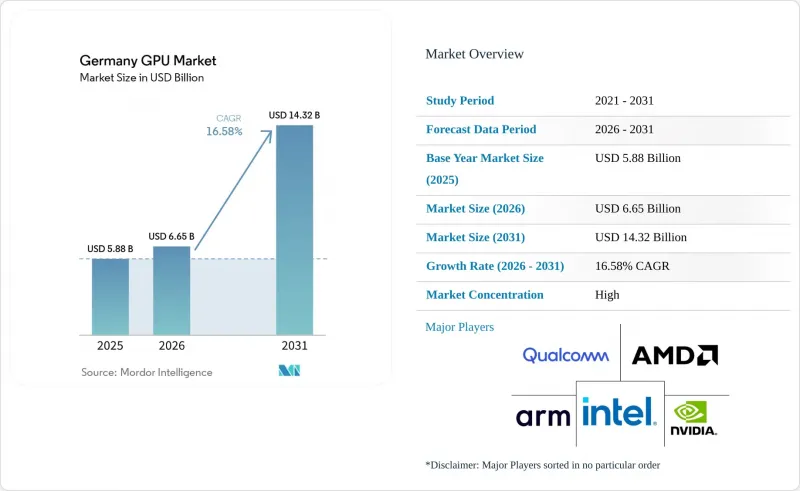
This report is Segmented by Integration Type (Integrated GPUs, Discrete GPUs) and Device Application (Mobile Devices and Tablets, Pcs and Workstations, Servers and Datacenter Accelerators, Gaming Consoles and Handhelds, Automotive/ADAS, Other Embedded and Edge Devices). The Market Forecasts are Provided in Terms of Value (USD).
Germany GPU Market Trends and Insights
Rapid Growth of AI and HPC Workloads
German enterprises are prioritizing on-premises GPU clusters to comply with the EU AI Act and avoid extraterritorial data requests. Deutsche Telekom's Industrial AI Cloud in Munich, operational since February 2026 with 10,000 NVIDIA Blackwell GPUs, has pre-sold more than one-third of its capacity to anchor tenants that include Siemens and EY. The Schwarz Group earmarked EUR 11 billion (USD 12.65 billion) for sovereign AI infrastructure, while national subsidies under the IPCEI Microelectronics program lower capital costs by 20-30%. Research centers inside the Gauss Center for Supercomputing are concurrently upgrading to the latest NVIDIA and AMD accelerators, underscoring how high-bandwidth-memory designs are now indispensable for climate modeling, drug discovery, and materials science.
Esports Expansion Driving High-End Gaming GPUs
Germany's recognition of esports as an official sport has unlocked public funding for arenas and training facilities, institutionalizing GPU-intensive infrastructure. More than 45 million active gamers drive steady refresh cycles for discrete graphics cards capable of 240 Hz output and real-time ray tracing. Professional teams, G2 Esports, Berlin International Gaming, and SK Gaming, run training centers equipped with NVIDIA GeForce RTX 5080 and AMD Radeon RX 9070 XT boards that deliver sub-10-millisecond latency. Streaming creators often use dual-GPU setups for 4K60 encoding while maintaining 144-plus frame rates, reinforcing the market for high-end add-in-boards.
Semiconductor Supply-Chain Disruptions
TSMC's fully booked CoWoS advanced-packaging lines extend GPU lead times beyond 12 months, delaying German deployments slated for early 2026. Shortfalls in HBM3e modules raise spot prices and compel enterprises to ration allocations among hyperscaler contracts, automotive projects, and sovereign AI clusters. Although the EU Chips Act commits EUR 43 billion to onshore fabs, new facilities will not come online before 2027, leaving near-term supply tight.
Other drivers and restraints analyzed in the detailed report include:
- Automotive OEM Adoption for ADAS Visualization
- Aerospace and Defence Simulation Workloads
- Escalating Average Selling Prices of dGPUs
For complete list of drivers and restraints, kindly check the Table Of Contents.
Segment Analysis
Discrete GPUs held 65.73% of the Germany GPU market share in 2025 and remain the workhorse for large-language-model training clusters. The Germany GPU market size for discrete accelerators benefits from Deutsche Telekom's 10,000-GPU Munich installation and the Schwarz Group's multi-site build-out, each designed to meet EU data-sovereignty rules. Integrated GPUs are nonetheless gaining ground in power-constrained automotive cockpits and Copilot+ laptops that rely on Qualcomm, AMD, and Intel SoCs delivering up to 80 TOPS on die.
Gaming and content-creation workloads reinforce discrete demand, as enthusiasts prioritize larger frame buffers and certified drivers. Conversely, sustained loads expose thermal throttling in integrated solutions, trimming real-world throughput. Integrated devices shine where energy budgets are fixed, yet for multi-hour ray-traced sequences or AI inference on 7-billion-parameter models, discrete cards still carry the performance edge.
List of Companies Covered in this Report:
- NVIDIA Corporation
- Advanced Micro Devices, Inc.
- Intel Corporation
- Qualcomm Technologies, Inc.
- Arm Ltd.
- Imagination Technologies Ltd.
- Samsung Electronics Co., Ltd.
- Apple Inc.
- ASUSTeK Computer Inc.
- Giga-Byte Technology Co., Ltd.
- Micro-Star International Co., Ltd. (MSI)
- Zotac Technology Limited
- Sapphire Technology Limited
- Tenstorrent, Inc.
- PowerColor (TUL Corporation)
- ASRock Inc.
- InnoVision Multimedia Ltd. (Inno3D)
- Matrox Electronic Systems Ltd.
- Huawei Technologies Co., Ltd.
Additional Benefits:
- The market estimate (ME) sheet in Excel format
- 3 months of analyst support
TABLE OF CONTENTS
1 INTRODUCTION
- 1.1 Study Assumptions and Market Definition
- 1.2 Scope of the Study
2 RESEARCH METHODOLOGY
3 EXECUTIVE SUMMARY
4 MARKET LANDSCAPE
- 4.1 Market Overview
- 4.2 Market Drivers
- 4.2.1 Rapid Growth of AI and HPC Workloads
- 4.2.2 Esports Expansion Driving High-End Gaming GPUs
- 4.2.3 Automotive OEM Adoption for ADAS Visualization
- 4.2.4 Aerospace and Defence Simulation Workloads
- 4.2.5 Renewable-Energy Digital-Twin Simulations
- 4.2.6 German R&D Tax Incentives for Semiconductor IP
- 4.3 Market Restraints
- 4.3.1 Semiconductor Supply-Chain Disruptions
- 4.3.2 Escalating Average Selling Prices of dGPUs
- 4.3.3 Energy-Efficiency Caps on Datacentre Hardware
- 4.3.4 Talent Shortage in GPU Software Optimisation
- 4.4 Industry Value / Supply-Chain Analysis
- 4.5 Impact of Macroeconomic Factors on the Market
- 4.6 Regulatory Landscape
- 4.7 Technological Outlook
- 4.8 Porter's Five Forces Analysis
- 4.8.1 Threat of New Entrants
- 4.8.2 Bargaining Power of Suppliers
- 4.8.3 Bargaining Power of Buyers
- 4.8.4 Threat of Substitutes
- 4.8.5 Competitive Rivalry
5 MARKET SIZE AND GROWTH FORECASTS
- 5.1 By Integration Type
- 5.1.1 Integrated GPUs (iGPU)
- 5.1.2 Discrete GPUs (dGPU)
- 5.2 By Device Application
- 5.2.1 Mobile Devices and Tablets
- 5.2.2 PCs and Workstations
- 5.2.3 Servers and Datacentre Accelerators
- 5.2.4 Gaming Consoles and Handhelds
- 5.2.5 Automotive / ADAS
- 5.2.6 Other Embedded and Edge Devices
6 COMPETITIVE LANDSCAPE
- 6.1 Market Concentration
- 6.2 Strategic Moves
- 6.3 Market Share Analysis
- 6.4 Company Profiles (includes Global Level Overview, Market Level Overview, Core Segments, Financials as available, Strategic Information, Market Rank/Share, Products and Services, Recent Developments)
- 6.4.1 NVIDIA Corporation
- 6.4.2 Advanced Micro Devices, Inc.
- 6.4.3 Intel Corporation
- 6.4.4 Qualcomm Technologies, Inc.
- 6.4.5 Arm Ltd.
- 6.4.6 Imagination Technologies Ltd.
- 6.4.7 Samsung Electronics Co., Ltd.
- 6.4.8 Apple Inc.
- 6.4.9 ASUSTeK Computer Inc.
- 6.4.10 Giga-Byte Technology Co., Ltd.
- 6.4.11 Micro-Star International Co., Ltd. (MSI)
- 6.4.12 Zotac Technology Limited
- 6.4.13 Sapphire Technology Limited
- 6.4.14 Tenstorrent, Inc.
- 6.4.15 PowerColor (TUL Corporation)
- 6.4.16 ASRock Inc.
- 6.4.17 InnoVision Multimedia Ltd. (Inno3D)
- 6.4.18 Matrox Electronic Systems Ltd.
- 6.4.19 Huawei Technologies Co., Ltd.
7 MARKET OPPORTUNITIES AND FUTURE OUTLOOK
- 7.1 White-Space and Unmet-Need Assessment

