
PUBLISHER: Mordor Intelligence | PRODUCT CODE: 2064468

PUBLISHER: Mordor Intelligence | PRODUCT CODE: 2064468
Cone Rod Dystrophy - Market Share Analysis, Industry Trends & Statistics, Growth Forecasts (2026 - 2031)
According to Mordor Intelligence, the cone rod dystrophy market size is expected to increase from USD 160.96 million in 2025 to USD 168.24 million in 2026 and reach USD 209.85 million by 2031, growing at a CAGR of 4.52% over 2026-2031.
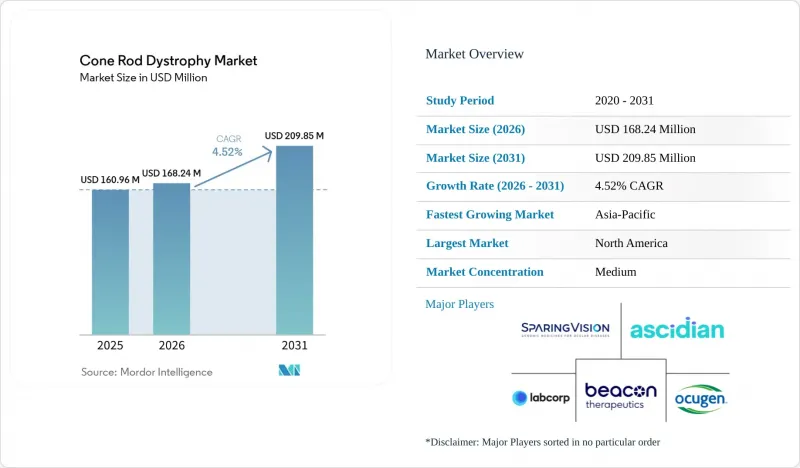
This report is Segmented by Modality (Diagnosis [Molecular Diagnosis, and More], Treatment [Retinal Implant and Neurostimulation, and More]), Inheritance Pattern (Autosomal Recessive, Autosomal Dominant, X-Linked), End User (Hospitals, Ophthalmology Specialty Centers, and More), and Geography (North America, Europe, Asia-Pacific, and More). The Market Forecasts are Provided in Terms of Value (USD).
Global Cone Rod Dystrophy Market Trends and Insights
Gene Therapy Progress and Orphan Drug Incentives Are Reshaping CRD Development Economics
The market is seeing a different development path because orphan incentives have made small retinal programs easier to finance. In the United States, Orphan Drug Designation offers 7 years of market exclusivity, major fee waivers, and potential review-related value that can justify late-stage spending even with a limited patient base. Beacon Therapeutics has already secured RMAT and Fast Track designations from the FDA and PRIME status from the EMA for laru-zova, and its VISTA trial completed enrollment in June 2025. This combination lowers funding risk for companies entering the cone rod dystrophy market from nearby retinal indications. It also raises the odds that the first approved therapy will shape pricing and reimbursement expectations for the rest of the field.
Wider Molecular Diagnosis and Multimodal Retinal Imaging Are Expanding the Diagnosable Patient Pool
The cone rod dystrophy market is expanding its diagnosable pool because panel-based sequencing and better imaging now reach patients earlier in the disease course. In optimized academic settings, inherited retinal disease diagnostic yield has moved from the earlier 40% to 50% range toward 60% to 80%. That shift matters because a confirmed molecular diagnosis extends the window for gene-specific treatment decisions and genetic counseling within the cone rod dystrophy market. OCT and fundus autofluorescence have also emerged as useful progression markers in natural history work, which reduces reliance on functional measures alone. Japan still shows a diagnosis gap, with a reported 40% molecular diagnosis rate and 12 designated genetic testing facilities, which points to persistent regional access inequalities. Japan also approved the PrismGuide IRD Panel System in 2023, and the panel includes the RPGR ORF15 region that is relevant to X-linked cone rod dystrophy.
Tiny Fragmented Patient Pools Constrain Trial Power and Commercial Returns
The cone rod dystrophy market remains constrained by a very small and genetically split patient population. Prevalence estimates of 1 in 30,000 to 1 in 40,000, combined with more than 30 causative genes, make the field behave like many ultra-rare markets rather than one large pool. This fragmentation raises recruitment cost because developers often need multi-country enrollment to reach statistical power in the cone rod dystrophy market. Molecular diagnosis still resolves only 50% to 75% of cases in clinical settings, so many patients cannot enter mutation-specific programs. Concentrated cohorts can exist in consanguineous populations, as shown by the 2025 Pakistani dataset where autosomal recessive inheritance represented 95.9% of solved cases, but regulators may not treat these data equally across regions.
Other drivers and restraints analyzed in the detailed report include:
- Genotype Prescreening and Natural-History Cohorts Are Enabling More Efficient CRD Trials
- Mutation-Agnostic Retinal Therapies Are Shifting the Addressable Market Boundary
- One-Time Therapy Pricing and Reimbursement Uncertainty Depress Near-Term Uptake
For complete list of drivers and restraints, kindly check the Table Of Contents.
Segment Analysis
Diagnostics is projected to grow at a 6.38% CAGR in the cone rod dystrophy market through 2031, which makes it the fastest-growing modality segment. This rise reflects wider use of NGS panels, growing ERG capacity in ophthalmology specialty centers, and more routine use of OCT with fundus autofluorescence for monitoring. ERG remains the clinical standard because it shows cone dysfunction exceeding rod loss and helps distinguish the condition from retinitis pigmentosa. Structural measures such as ellipsoid zone width are now used alongside ERG because they offer a quantifiable view of photoreceptor integrity.
Treatment represented 58.31% of the cone rod dystrophy market share in 2025 because trial administration, retinal implant procedures, neurostimulation, and pharmacologic care still account for most spending. Retinal implants and neurostimulation form a more mature treatment pocket, while supportive care and low-vision aids are picking up as options for patients who remain genetically unresolved in the cone rod dystrophy industry. Pharmacologic and nutraceutical approaches, including visual cycle modulation and antioxidant regimens, appeal to a broad patient group because they do not depend on advanced gene therapy delivery infrastructure. This mix keeps treatment larger today, even though diagnostics is gaining faster in the cone rod dystrophy market.
Geography Analysis
North America held 38.24% of the cone rod dystrophy market share in 2025, which made it the largest regional segment. The region benefits from a dense ophthalmology specialty network, active inherited retinal disease research support, and a concentration of treatment delivery centers that can support advanced retinal interventions. The United States also remains central to developer financing, as Opus Genetics secured up to USD 155 million in April 2026 to advance 3 more gene therapy programs, including OPGx-RDH12, into clinical testing. Canada and Mexico add smaller contributions, while the United States is likely to stay dominant through the forecast period as inherited retinal gene therapy filings move closer to commercialization.
Europe is the second-largest regional block in the cone rod dystrophy market, led by Germany, the United Kingdom, and France for diagnostics and trial participation. Beacon's laru-zova holds EMA PRIME status, which gives the program accelerated regulatory support that is similar in purpose to FDA RMAT. Europe also demonstrated first-in-human capability through the Phase 1 and Phase 2 AAV8-RLBP1 study run across Swedish and EU centers with Swedish regulatory approvals. Access still varies by country because health technology assessment timing and reimbursement pathways differ across national systems.
Asia-Pacific is projected to grow at a 6.92% CAGR through 2031 in the cone rod dystrophy market, which makes it the fastest-growing region. Japan has already established an ophthalmic gene therapy access pathway, and 1-year Phase 3 outcomes for voretigene neparvovec were published in 2025 as Asia's first Phase 3 inherited retinal gene therapy trial. Japan also opened its first optogenetics trial in February 2025 through Restore Vision and Keio University Hospital for patients with photoreceptor loss regardless of genetic cause. China is strengthening its role through cohort studies that map local mutation patterns and through published work on CRISPR applications for inherited retinal disease. South Korea, Australia, India, the Middle East and Africa, and South America contribute smaller volumes, while GCC trial funding and rare disease registries in Brazil and Argentina provide incremental support.
- 4D Molecular Therapeutics
- Ascidian Therapeutics
- Beacon Therapeutics
- Biogen
- Blueprint Genetics
- Fulgent Genetics
- GenSight Biologics
- Invitae
- jCyte
- Johnson & Johnson Innovative Medicine
- LabCorp
- MeiraGTx
- Ocugen
- Opus Genetics
- PreventionGenetics
- ProQR Therapeutics
- Santen Pharmaceutical
- SparingVision
Additional Benefits:
- The market estimate (ME) sheet in Excel format
- 3 months of analyst support
TABLE OF CONTENTS
1 Introduction
- 1.1 Study Assumptions & Market Definition
- 1.2 Scope of the Study
2 Research Methodology
3 Executive Summary
4 Market Landscape
- 4.1 Market Overview
- 4.2 Market Drivers
- 4.2.1 Gene Therapy Progress and Orphan Incentives
- 4.2.2 Wider Molecular Diagnosis and Multimodal Retinal Imaging
- 4.2.3 Rising Supportive-Care and Low-Vision Technology Adoption
- 4.2.4 Genotype Prescreening and Natural-History Cohorts
- 4.2.5 Mutation-Agnostic Retinal Therapies
- 4.3 Market Restraints
- 4.3.1 Tiny Fragmented Patient Pools
- 4.3.2 One-Time Therapy Pricing and Reimbursement Uncertainty
- 4.3.3 Weak Endpoint and Biomarker Standardization
- 4.4 Value Chain Analysis
- 4.5 Regulatory Landscape
- 4.6 Technological Outlook
- 4.7 Porter's Five Forces
- 4.7.1 Threat of new entrants
- 4.7.2 Bargaining power of suppliers
- 4.7.3 Bargaining power of buyers
- 4.7.4 Threat of substitutes
- 4.7.5 Intensity of rivalry
5 Market Size & Growth Forecasts (Value, USD)
- 5.1 By Modality
- 5.1.1 Diagnosis
- 5.1.1.1 Molecular diagnosis
- 5.1.1.2 Electroretinography
- 5.1.1.3 OCT and fundus autofluorescence
- 5.1.2 Treatment
- 5.1.2.1 Retinal implant and neurostimulation
- 5.1.2.2 Pharmacological and nutraceutical therapy
- 5.1.2.3 Supportive care and low-vision aids
- 5.1.1 Diagnosis
- 5.2 By Inheritance Pattern
- 5.2.1 Autosomal recessive cone rod dystrophy
- 5.2.2 Autosomal dominant cone rod dystrophy
- 5.2.3 X-linked cone rod dystrophy
- 5.3 By End User
- 5.3.1 Hospitals
- 5.3.2 Ophthalmology specialty centers
- 5.3.3 Academic and research institutes
- 5.3.4 Home-based low-vision rehabilitation
- 5.4 By Geography
- 5.4.1 North America
- 5.4.1.1 United States
- 5.4.1.2 Canada
- 5.4.1.3 Mexico
- 5.4.2 Europe
- 5.4.2.1 Germany
- 5.4.2.2 United Kingdom
- 5.4.2.3 France
- 5.4.2.4 Italy
- 5.4.2.5 Spain
- 5.4.2.6 Rest of Europe
- 5.4.3 Asia-Pacific
- 5.4.3.1 China
- 5.4.3.2 India
- 5.4.3.3 Japan
- 5.4.3.4 South Korea
- 5.4.3.5 Australia
- 5.4.3.6 Rest of Asia-Pacific
- 5.4.4 Middle East and Africa
- 5.4.4.1 GCC
- 5.4.4.2 South Africa
- 5.4.4.3 Rest of Middle East and Africa
- 5.4.5 South America
- 5.4.5.1 Brazil
- 5.4.5.2 Argentina
- 5.4.5.3 Rest of South America
- 5.4.1 North America
6 Competitive Landscape
- 6.1 Market Concentration
- 6.2 Market Share Analysis
- 6.3 Company Profiles {(includes Global level Overview, Market level overview, Core Segments, Financials as available, Strategic Information, Market Rank/Share for key companies, Products & Services, and Recent Developments)}
- 6.3.1 4D Molecular Therapeutics
- 6.3.2 Ascidian Therapeutics
- 6.3.3 Beacon Therapeutics
- 6.3.4 Biogen
- 6.3.5 Blueprint Genetics
- 6.3.6 Fulgent Genetics
- 6.3.7 GenSight Biologics
- 6.3.8 Invitae
- 6.3.9 jCyte
- 6.3.10 Johnson & Johnson Innovative Medicine
- 6.3.11 Labcorp
- 6.3.12 MeiraGTx
- 6.3.13 Ocugen
- 6.3.14 Opus Genetics
- 6.3.15 PreventionGenetics
- 6.3.16 ProQR Therapeutics
- 6.3.17 Santen Pharmaceutical
- 6.3.18 SparingVision
7 Market Opportunities & Future Outlook
- 7.1 White-space & unmet-need assessment

