
PUBLISHER: Mordor Intelligence | PRODUCT CODE: 2064474

PUBLISHER: Mordor Intelligence | PRODUCT CODE: 2064474
Luxury Wines And Spirits - Market Share Analysis, Industry Trends & Statistics, Growth Forecasts (2026 - 2031)
According to Mordor Intelligence, the luxury wines and spirits market size is expected to increase from USD 298.5 billion in 2025 to USD 311.9 billion in 2026 and reach USD 429.8 billion by 2031, growing at a CAGR of 6.6% over 2026-2031.
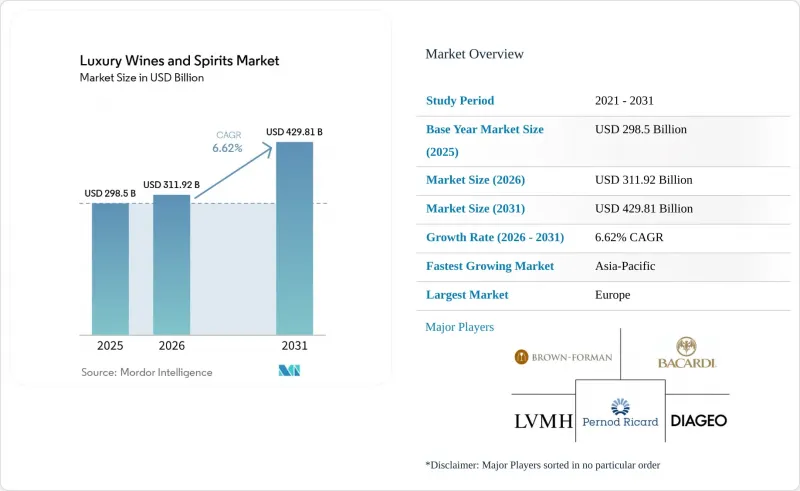
This report is Segmented by Product Type (Luxury Wines: Still Wines and Sparkling Wines; Luxury Spirits: Whisky, Cognac, Rum, Tequila and Mezcal, Vodka, and Liqueurs), End User (Men and Women), Distribution Channel (On-Trade and Off-Trade), and Geography (North America, Europe, Asia-Pacific, South America, Middle East and Africa). The Market Forecasts are Provided in Terms of Value (USD).
Luxury Wines And Spirits Market Trends and Insights
Growing High-Net-Worth Individual (HNWI) Population and Wealth Expansion
The growing concentration of wealth among high-net-worth individuals (HNWIs) is significantly strengthening demand for luxury wines and spirits, as affluent consumers increasingly prioritize exclusivity, provenance, and premium drinking experiences. According to the U.S. Federal Reserve's Distributional Financial Accounts, the top 1% of Americans controlled nearly 31% of total household wealth in 2025, reflecting an unprecedented concentration of disposable capital toward ultra-premium consumption categories. This wealth accumulation has accelerated premiumization trends across the alcohol industry, with luxury wine houses and spirits producers expanding high-end portfolios targeted at affluent consumers in metropolitan markets such as New York, Miami, and Los Angeles. Product innovation further demonstrates this shift. For instance, in 2024, Treasury Wine Estates strengthened its luxury positioning through strategic investments and the expansion of premium vineyards. In 2025, the company launched "Treasury Collective," a dedicated global premium wine division focused on luxury-led growth and consumer-centric innovation. By 2026, luxury portfolio performance from brands such as Penfolds and DAOU continued driving revenue growth, highlighting resilient demand for prestige wines despite broader market moderation.
Premiumization and Trading-Up Trends Among Affluent Millennials
In 2025, millennials led the way in luxury spending, outpacing all other generational cohorts. Their mantra of "drink better, less often" is not just curbing volume but significantly boosting the value of each transaction. This shift is evident in the surging popularity of ultra-premium cask programs and aged expressions, which are now favored over standard SKUs. Wealth management research highlights this trend, noting that 50% of next-gen high-net-worth individuals (HNWIs) are making passion investments, blending personal interests with anticipated financial gains. Take, for example, Gordon & MacPhail's Connoisseurs Choice Heritage Collection, debuting in March 2026 at GBP 18,000 for a set of five single malts. Additionally, Artisan Casks rolled out entire maturing casks in May 2026, starting at GBP 60,000. Such price tags, once deemed niche just five years prior, now attract a wave of younger collectors. This millennial trading-up trend is reshaping the market, creating a barbell demand structure that favors brands with distinct positioning at either end.
Counterfeit and Illicit Trade Affecting Brand Integrity
Counterfeit and illicit trade are undermining the global luxury wines and spirits market, eroding brand integrity, diminishing consumer trust, and exposing premium beverage companies to both revenue losses and reputational harm. Premium labels, with their high resale value, are prime targets for counterfeiters. These nefarious actors employ tactics like bottle refilling, falsified packaging, smuggling, and leveraging illegal distribution networks. The Organization for Economic Co-operation and Development notes that organized crime is increasingly drawn to the illicit alcohol trade, lured by its high profit margins and the low risk of detection. Alarmingly, counterfeit alcohol is making its way into legitimate retail and hospitality sectors. Further underscoring the gravity of the situation, the OECD reported in 2025 that counterfeit and pirated goods constituted nearly 2.3% of global trade, posing significant threats to premium consumer industries, notably luxury spirits. In a bid to counter these challenges, industry bodies like TRACIT advocated for ethanol-control frameworks and bolstered customs enforcement in 2024. By 2025, luxury spirits brands were not just on the defensive; they actively integrated anti-counterfeit technologies. Innovations like QR-enabled authentication, tamper-proof closures, and invisible packaging security systems were deployed to safeguard their premium whisky, cognac, and champagne portfolios. Looking ahead to 2026, the industry was set to embrace even more sophisticated measures. Advanced authentication technologies, including AI-driven track-and-trace systems and through-bottle spectroscopy, were being rolled out to bolster authenticity verification and enhance supply-chain transparency in the high-stakes luxury spirits arena.
Other drivers and restraints analyzed in the detailed report include:
- Rising Demand in Emerging Asian Markets
- Expansion of Luxury Travel Retail Channels
- Stringent Excise Taxation and Import Duties
For complete list of drivers and restraints, kindly check the Table Of Contents.
Segment Analysis
Spirits held 55.7% of the luxury wines and spirits market size in 2025, while the luxury wines segment is forecast to grow at a 6.8% CAGR through 2031. Spirits dominate the market due to strong global demand for premium whisky, tequila, cognac, and vodka, supported by cocktail culture, travel retail expansion, and higher margins in ultra-premium categories. The Distilled Spirits Council of the United States reported that premium-and-above spirits continued outperforming standard categories in 2025, particularly tequila and American whiskey exports. In 2024, Diageo reopened the Port Ellen distillery in Scotland to strengthen luxury Scotch production, while in 2025 it formed the Diageo Luxury Group to accelerate premium portfolio expansion.
Luxury wines are the fastest-growing segment due to rising demand for collectible vintages, luxury wine tourism, premium dining experiences, and affluent consumers seeking provenance-driven brands. The International Organization of Vine and Wine highlighted continued resilience in premium wine consumption despite broader volume moderation globally. In 2024, Treasury Wine Estates expanded investments in premium winemaking and luxury-focused operations, including its high-end production facilities and Penfolds portfolio. During 2025, the company accelerated acquisitions and divestments to prioritize luxury labels, while in 2026, demand for Penfolds in China and Asia surged significantly, with Treasury Wine reporting double-digit regional depletion growth supported by premium red wine demand and expanded Asia-focused regional operations.
List of Companies Covered in this Report:
- LVMH Moet Hennessy Louis Vuitton
- Pernod Ricard SA
- Diageo plc
- Bacardi Limited
- Brown-Forman Corporation
- Remy Cointreau SA
- Davide Campari-Milano NV (Campari Group)
- Beam Suntory Inc.
- Edrington Group (The Macallan)
- Treasury Wine Estates Ltd.
- Constellation Brands Inc.
- E.&J. Gallo Winery (Luxury Labels)
- Maison Martell (Pernod Ricard)
- Hennessy (Moet Hennessy)
- Glenfiddich (William Grant & Sons)
- Moet & Chandon (Moet Hennessy)
- Veuve Clicquot (Moet Hennessy)
- Krug (Moet Hennessy)
- Chateau Lafite Rothschild
- Chateau Margaux SAS
Additional Benefits:
- The market estimate (ME) sheet in Excel format
- 3 months of analyst support
TABLE OF CONTENTS
1 INTRODUCTION
- 1.1 Study Assumptions and Market Definition
- 1.2 Scope of the Study
2 RESEARCH METHODOLOGY
3 EXECUTIVE SUMMARY
4 MARKET LANDSCAPE
- 4.1 Market Overview
- 4.2 Market Drivers
- 4.2.1 Growing high-net-worth individual (HNWI) population and wealth expansion
- 4.2.2 Premiumization and trading-up trends among affluent millennials
- 4.2.3 Rising demand in emerging Asian markets
- 4.2.4 Expansion of luxury travel retail channels
- 4.2.5 Sustainability-driven "rare cask" programs boosting ultra-premium pricing
- 4.2.6 "Experiential" luxury and tourism
- 4.3 Market Restraints
- 4.3.1 Counterfeit and illicit trade affecting brand integrity
- 4.3.2 Stringent excise taxation and import duties
- 4.3.3 Climate change impact on ultra-premium vineyard yields
- 4.3.4 Rising sober-curious movement in developed markets
- 4.4 Consumer Behaviour Analysis
- 4.5 Regulatory Landscape
- 4.6 Technological Outlook
- 4.7 Porter's Five Forces
- 4.7.1 Threat of New Entrants
- 4.7.2 Bargaining Power of Buyers
- 4.7.3 Bargaining Power of Suppliers
- 4.7.4 Threat of Substitutes
- 4.7.5 Intensity of Competitive Rivalry
5 MARKET SIZE AND GROWTH FORECASTS (VALUE)
- 5.1 Product Type
- 5.1.1 Wines
- 5.1.1.1 Still Wines
- 5.1.1.2 Sparkling Wines
- 5.1.2 Spirits
- 5.1.2.1 Whisky
- 5.1.2.2 Cognac
- 5.1.2.3 Rum
- 5.1.2.4 Tequila and Mezcal
- 5.1.2.5 Vodka
- 5.1.2.6 Liqueurs
- 5.1.2.7 Other Luxury Spirits
- 5.1.1 Wines
- 5.2 End User
- 5.2.1 Men
- 5.2.2 Women
- 5.3 Distribution Channel
- 5.3.1 On-Trade
- 5.3.2 Off-Trade
- 5.3.2.1 Specialty/Liquor Stores
- 5.3.2.2 Other Off-Trade Channels
- 5.4 Geography
- 5.4.1 North America
- 5.4.1.1 United States
- 5.4.1.2 Canada
- 5.4.1.3 Mexico
- 5.4.1.4 Rest of North America
- 5.4.2 Europe
- 5.4.2.1 United Kingdom
- 5.4.2.2 Germany
- 5.4.2.3 France
- 5.4.2.4 Italy
- 5.4.2.5 Spain
- 5.4.2.6 Sweden
- 5.4.2.7 Belgium
- 5.4.2.8 Poland
- 5.4.2.9 Netherlands
- 5.4.2.10 Rest of Europe
- 5.4.3 Asia-Pacific
- 5.4.3.1 China
- 5.4.3.2 Japan
- 5.4.3.3 India
- 5.4.3.4 Thailand
- 5.4.3.5 Singapore
- 5.4.3.6 Indonesia
- 5.4.3.7 South Korea
- 5.4.3.8 Australia
- 5.4.3.9 Rest of Asia-Pacific
- 5.4.4 South America
- 5.4.4.1 Brazil
- 5.4.4.2 Argentina
- 5.4.4.3 Colombia
- 5.4.4.4 Peru
- 5.4.4.5 Chile
- 5.4.4.6 Rest of South America
- 5.4.5 Middle East and Africa
- 5.4.5.1 United Arab Emirates
- 5.4.5.2 South Africa
- 5.4.5.3 Saudi Arabia
- 5.4.5.4 Nigeria
- 5.4.5.5 Egypt
- 5.4.5.6 Morocco
- 5.4.5.7 Turkey
- 5.4.5.8 Rest of Middle East and Africa
- 5.4.1 North America
6 COMPETITIVE LANDSCAPE
- 6.1 Market Concentration
- 6.2 Strategic Moves
- 6.3 Market Ranking Analysis
- 6.4 Company Profiles
- 6.4.1 LVMH Moet Hennessy Louis Vuitton
- 6.4.2 Pernod Ricard SA
- 6.4.3 Diageo plc
- 6.4.4 Bacardi Limited
- 6.4.5 Brown-Forman Corporation
- 6.4.6 Remy Cointreau SA
- 6.4.7 Davide Campari-Milano NV (Campari Group)
- 6.4.8 Beam Suntory Inc.
- 6.4.9 Edrington Group (The Macallan)
- 6.4.10 Treasury Wine Estates Ltd.
- 6.4.11 Constellation Brands Inc.
- 6.4.12 E.&J. Gallo Winery (Luxury Labels)
- 6.4.13 Maison Martell (Pernod Ricard)
- 6.4.14 Hennessy (Moet Hennessy)
- 6.4.15 Glenfiddich (William Grant & Sons)
- 6.4.16 Moet & Chandon (Moet Hennessy)
- 6.4.17 Veuve Clicquot (Moet Hennessy)
- 6.4.18 Krug (Moet Hennessy)
- 6.4.19 Chateau Lafite Rothschild
- 6.4.20 Chateau Margaux SAS
7 MARKET OPPORTUNITIES AND FUTURE OUTLOOK

