PUBLISHER: Mordor Intelligence | PRODUCT CODE: 2064500

PUBLISHER: Mordor Intelligence | PRODUCT CODE: 2064500
United States Electronic Health Records - Market Share Analysis, Industry Trends & Statistics, Growth Forecasts (2026 - 2031)
According to Mordor Intelligence, the united states electronic health records market size was valued at USD 13.39 billion in 2025 and is estimated to grow from USD 13.98 billion in 2026 to reach USD 17.65 billion by 2031, at a CAGR of 4.78% during the forecast period (2026-2031).
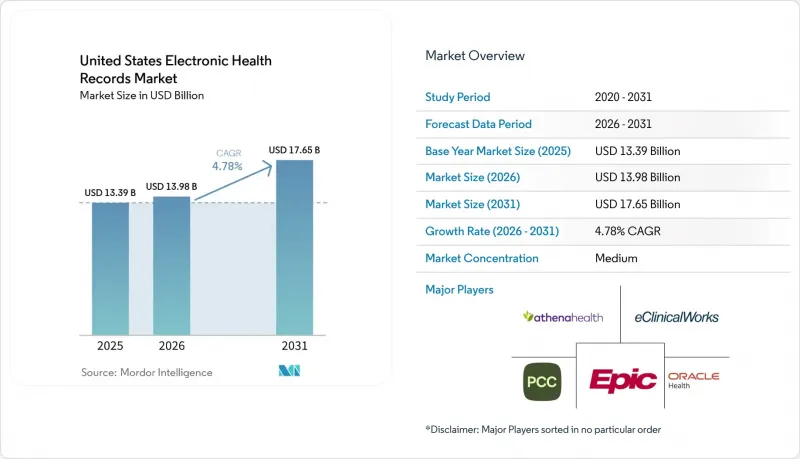
This report is Segmented by Product (Web/Cloud-based EHR, On-Premise EHR), Type (Acute EHR, Ambulatory EHR, Post-Acute EHR), Solution (EHR Software, Services), and End Use (Hospitals, Physician Offices and Specialty Clinics, Ambulatory Surgical Centers, Diagnostic Centers). The Market Forecasts are Provided in Terms of Value (USD).
United States Electronic Health Records Market Trends and Insights
Federal Interoperability and Prior-Authorization Mandates
The United States electronic health records market is moving through a certification reset as USCDI v1 expired on January 1, 2026, and ONC requirements moved the active baseline to newer data standards. USCDI v3 expanded the required structured data set well beyond the earlier version, adding fields such as social determinants of health and insurance data that force vendors to rework data architecture, testing, and exchange workflows. ONC then published USCDI v6 in July 2025 and released draft USCDI v7 on January 29, 2026, which keeps the United States electronic health records market on an annual upgrade cycle instead of allowing vendors to treat compliance as a one-time exercise. CMS has added a second deadline through the Interoperability and Prior Authorization Final Rule, with Prior Authorization APIs required to go live on January 1, 2027, which shortens development windows for every certified vendor serving affected workflows. HHS also stated that the HTI-4 Final Rule is expected to generate USD 19.2 billion in administrative savings over 10 years by allowing providers to manage prior authorization more fully inside certified systems, which raises the operating value of compliance-ready platforms. As a result, platform selection in the United States electronic health records market is now closely tied to whether a vendor can show an active certification roadmap, not just a stable installed base.
Cloud And Web-Based Migration Economics
Cloud migration has become a practical operating decision in the United States electronic health records market because providers now have visible examples of cost savings, performance gains, and simpler upgrade paths after moving major EHR workloads off local infrastructure. Microsoft stated in March 2026 that Epic deployments on Azure delivered strong financial returns for migrating organizations, which helped shift cloud discussions from IT modernization into board-level capital planning. Microsoft also said Franciscan Health saved USD 45 million over 5 years after its Azure migration, while cutting infrastructure costs by one-third and improving application response time by 50%, which gives providers a concrete case for moving away from older hosting models. That matters because cloud delivery converts large hardware cycles into steadier operating expenses and makes it easier to support analytics, API exposure, and ongoing compliance upgrades from a common environment. It also supports the direction of the United States electronic health records market, where interoperability, certification updates, and AI features all require more frequent product changes than many on-premise footprints were designed to handle. The commercial logic is therefore reinforcing the policy logic, which is why cloud delivery leads on both scale and growth in this market.
Cybersecurity, Ransomware, and Privacy Exposure
Cybersecurity remains the clearest downside risk in the United States electronic health records market because the financial and operational impact of an incident can move quickly from IT recovery into care delivery and executive oversight. IBM reported average healthcare breach recovery costs of USD 7.42 million per incident in 2025, which kept healthcare at the highest cost level among critical infrastructure sectors. The American Hospital Association also reported in its 2025 year-in-review that more than 90% of breached health records were taken from systems outside the core EHR, including clearinghouses, revenue cycle systems, and third-party connectors, which means risk now sits across the broader application network rather than inside the record alone. That raises the difficulty of vendor selection because health systems must assess the security posture of API partners and adjacent workflow tools, not only the main EHR application. It also explains why HIPAA compliance and SOC 2 Type II controls are now basic contract expectations rather than points of product differentiation. For the United States electronic health records market, that security burden can slow purchase decisions, extend implementation review cycles, and raise the cost of platform expansion into more connected workflows.
Other drivers and restraints analyzed in the detailed report include:
- Outpatient Care Expansion and Multisite Coordination Needs
- AI-Enabled Documentation and Workflow Automation
- High Switching Costs and Implementation Disruption
For complete list of drivers and restraints, kindly check the Table Of Contents.
Segment Analysis
Web/cloud-based EHR held 81.79% of the United States electronic health records market size in 2025 and is also forecast to post the fastest CAGR at 6.30% through 2031. That combination shows that the United States electronic health records market is not splitting between equal deployment models, but is moving more firmly toward cloud as the default operating base. The shift is reinforced by federal interoperability and certification demands, since frequent standards updates and API requirements are easier to manage in environments built for continuous releases. It is also reinforced by provider economics, because cloud-hosted records can reduce local infrastructure burden and simplify performance upgrades across large clinical networks.
On-premise EHR accounted for the remaining 18.21% in 2025, which shows that a smaller but durable installed base still remains in the United States electronic health records market. That base is concentrated in organizations with tighter control requirements, older infrastructure decisions, or slower capital planning cycles, including some rural and public-sector settings. Even so, the product roadmap balance has shifted toward web and cloud delivery because TEFCA participation, API exposure, and embedded automation all favor platforms that can be updated more quickly across distributed users. This leaves on-premise vendors under pressure to defend existing contracts while cloud-first vendors capture a larger share of upgrade and replacement activity in the United States electronic health records industry.
Acute EHR led the type mix with 45.23% in 2025, while post-acute EHR is expected to record the fastest CAGR at 6.07% through 2031. Acute care still anchors the United States electronic health records market because hospitals remain the center of large enterprise contracts, major integration budgets, and the strictest interoperability demands. Post-acute growth is rising because patient acuity in skilled nursing and home health settings is increasing, and providers in those settings need better continuity of records as transitions from hospital care become more clinically complex. The result is a broader push for the United States electronic health records market to support the full care path rather than only the hospital stay.
Ambulatory EHR remains a large middle layer in this structure because care volume continues to move out of inpatient settings and into physician offices, specialty clinics, and multisite organizations. eClinicalWorks' March 2025 integration with the PointClickCare marketplace showed how ambulatory vendors are trying to close the long-standing record gap between physician workflows and long-term or post-acute settings. That kind of connection matters because weak handoffs across care settings can hurt documentation quality, follow-up planning, and reimbursement continuity. Vendors with stronger post-acute and ambulatory bridge tools are therefore better positioned in the United States electronic health records industry than vendors that still treat those settings as side markets.
List of Companies Covered in this Report:
- AdvancedMD
- Altera Digital Health
- Amazing Charts
- athenahealth
- CareCloud
- Curemd Healthcare
- DrChrono
- Elation Health
- eClinicalWorks
- Epic Systems
- Greenway Health
- Medhost
- Meditech
- ModMed
- NextGen Healthcare
- Oracle Health
- PointClickCare
- Practice Fusion
- RXNT
- TruBridge
- Veradigm
Additional Benefits:
- The market estimate (ME) sheet in Excel format
- 3 months of analyst support
TABLE OF CONTENTS
1 Introduction
- 1.1 Study Assumptions & Market Definition
- 1.2 Scope of the Study
2 Research Methodology
3 Executive Summary
4 Market Landscape
- 4.1 Market Overview
- 4.2 Market Drivers
- 4.2.1 Federal Interoperability and Prior-Authorization Mandates
- 4.2.2 Cloud And Web-Based Migration Economics
- 4.2.3 Outpatient Care Expansion and Multisite Coordination Needs
- 4.2.4 AI-Enabled Documentation and Workflow Automation
- 4.2.5 TEFCA Network Effects Favor Exchange-Ready Platforms
- 4.2.6 USCDI And Certification Roadmap-Driven Upgrade Cycles
- 4.3 Market Restraints
- 4.3.1 Cybersecurity, Ransomware, and Privacy Exposure
- 4.3.2 High Switching Costs and Implementation Disruption
- 4.3.3 Uneven API And FHIR Readiness Across Smaller Providers
- 4.3.4 Vendor Lock-In from Concentrated Platform Ecosystems
- 4.4 Value / Supply-Chain Analysis
- 4.5 Regulatory Landscape
- 4.6 Technological Outlook
- 4.7 Porter's Five Forces Analysis
- 4.7.1 Threat of New Entrants
- 4.7.2 Bargaining Power of Suppliers
- 4.7.3 Bargaining Power of Buyers
- 4.7.4 Threat of Substitutes
- 4.7.5 Industry Rivalry
5 Market Size & Growth Forecasts
- 5.1 By Product
- 5.1.1 Web / Cloud-based EHR
- 5.1.2 On-premise EHR
- 5.2 By Type
- 5.2.1 Acute EHR
- 5.2.2 Ambulatory EHR
- 5.2.3 Post-acute EHR
- 5.3 By Solution
- 5.3.1 EHR Software
- 5.3.1.1 Cloud-based
- 5.3.1.2 On-premise
- 5.3.2 Services
- 5.3.2.1 Consulting
- 5.3.2.2 Implementation & Integration
- 5.3.2.3 Support & Maintenance
- 5.3.1 EHR Software
- 5.4 By End Use
- 5.4.1 Hospitals
- 5.4.2 Physician Offices and Specialty Clinics
- 5.4.3 Ambulatory Surgical Centers
- 5.4.4 Diagnostic Centers
6 Competitive Landscape
- 6.1 Market Concentration
- 6.2 Market Share Analysis
- 6.3 Company Profiles (includes Global Level Overview, Market-Level Overview, Core Segments, Financials, Strategic Information, Market Rank/Share, Products & Services, Recent Developments)
- 6.3.1 AdvancedMD
- 6.3.2 Altera Digital Health
- 6.3.3 Amazing Charts
- 6.3.4 athenahealth
- 6.3.5 CareCloud
- 6.3.6 CureMD
- 6.3.7 DrChrono
- 6.3.8 Elation Health
- 6.3.9 eClinicalWorks
- 6.3.10 Epic Systems Corporation
- 6.3.11 Greenway Health
- 6.3.12 MEDHOST
- 6.3.13 MEDITECH
- 6.3.14 ModMed
- 6.3.15 NextGen Healthcare
- 6.3.16 Oracle Health
- 6.3.17 PointClickCare
- 6.3.18 Practice Fusion
- 6.3.19 RXNT
- 6.3.20 TruBridge
- 6.3.21 Veradigm
7 Market Opportunities & Future Outlook
- 7.1 White-space & Unmet-need Assessment

