PUBLISHER: Mordor Intelligence | PRODUCT CODE: 2064528

PUBLISHER: Mordor Intelligence | PRODUCT CODE: 2064528
Workforce Management (WFM) In Manufacturing - Market Share Analysis, Industry Trends & Statistics, Growth Forecasts (2026 - 2031)
According to Mordor Intelligence, the workforce management (WFM) market in the manufacturing industry was USD 1.52 billion in 2025 and is forecast to reach USD 2.59 billion by 2031, at a CAGR of 9.44% during 2026-2031.
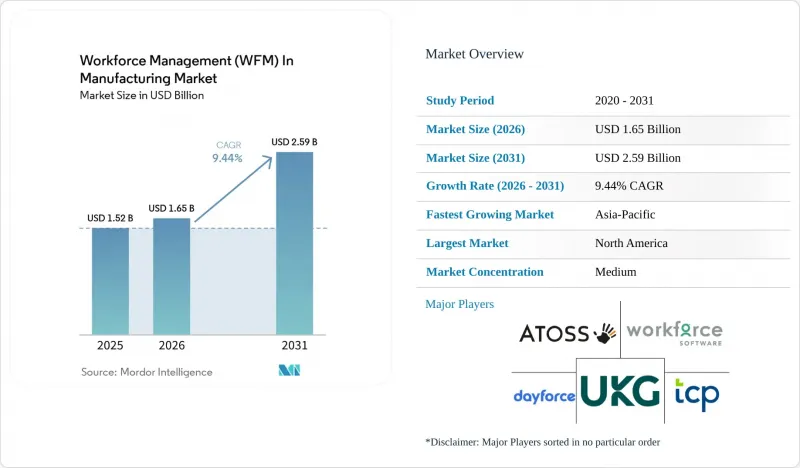
This report is Segmented by Offering (Software and Services), Deployment Mode (Cloud, On-Premise, and Hybrid), End-User Enterprise Size (Large Enterprises and Small and Medium-Sized Enterprises), End-User Industry (Automotive, Electronics and Semiconductors, Industrial Machinery and Equipment, and More), and Geography. The Market Forecasts are Provided in Terms of Value (USD).
Global Workforce Management (WFM) In Manufacturing Market Trends and Insights
Skilled Labor Shortages and Aging Shop-Floor Workforce
In the workforce management (WFM) in the manufacturing market, labor scarcity is pushing workforce planning closer to daily production control. Manufacturers are facing a long replacement cycle for skilled roles, and it is projected that 3.8 million positions will open in U.S. manufacturing through 2033, with 1.9 million potentially unfilled. That pressure makes skill mapping, shift coverage visibility, and cross-training workflows more valuable because plants cannot rely on informal scheduling decisions when critical roles are hard to backfill. In the workforce management in the manufacturing market, these tools are increasingly used to show who is qualified, who is available, and where single-point skill gaps sit before they disrupt production. The need is strongest in multi-shift operations where every uncovered position raises overtime risk and puts output stability under pressure. This is why the WFM in manufacturing market is being drawn deeper into continuity planning, retention efforts, and plant-level risk control, rather than remaining limited to back-office administration.
Industry 4.0 Programs Requiring Dynamic Labor Orchestratio
In the manufacturing workforce management (WFM) market, smart-factory investments are driving demand for labor systems that can respond to machine and production signals in real time. When IIoT data, line events, or edge alerts indicate a disruption, digital scheduling tools can move qualified labor faster than spreadsheet-based planning. Research published in 2025 showed that AI-driven scheduling on cloud-edge infrastructure reduced the recharging frequency of industrial mobile equipment by up to 31.35%, demonstrating how better orchestration can eliminate wasted time in complex production settings.A lighthouse factory workforce management solution was also launched, built around IIoT, AI, big data, and cloud computing for real-time labor scheduling in manufacturing environments. In the workforce management market for manufacturing, that linkage is driving buyer interest in platforms that combine labor availability, certification status, and production change signals into a single operating layer. It also supports the growing interest in hybrid architectures, as many manufacturers seek to run analytics and user access in the cloud while keeping parts of operational control close to the plant.
Legacy Plant Systems and Difficult Integrations
In the manufacturing workforce management market, integration remains the biggest barrier to adoption because many plants still operate across disconnected ERP, MES, and local attendance systems. In 2025, it was reported that 75% of manufacturing enterprises still relied on manual scheduling methods, with data fragmentation across systems leading to a 30% rework rate when plans changed after production events. That problem increases project costs because vendors often need custom interfaces, data cleanup, and staged deployments before a site can trust automated scheduling outputs. In the manufacturing workforce management market, the hardest environments are usually the most complex plants, since they offer the greatest optimization upside but also the most fragmented technology estates. Buyers often delay wider rollouts until payroll rules, production events, and skill records are aligned across sites, which lengthens implementation cycles and slows revenue conversion for vendors. This restraint also explains why services are growing faster than software in the workforce management market for manufacturing, because integration and configuration work remain essential for real deployment success.
Other drivers and restraints analyzed in the detailed report include:
- Tighter Overtime, Break, Fatigue and Payroll Compliance
- Demand for Real-Time Labor Visibility and Cost Control
- High Change-Management Burden in Unionized Multisite Plants
For complete list of drivers and restraints, kindly check the Table Of Contents.
Segment Analysis
Software accounted for 72.18% of the workforce management (WFM) in manufacturing market share in 2025, keeping it at the center of purchasing decisions across factories. Time and attendance management was the largest software sub-segment at 28.31% of total software revenue, reflecting that payroll auditability and attendance control remain the first pain points many manufacturers seek to address. In workforce management in the manufacturing market, this layer is often funded first because it affects every shift, every employee record, and every payroll cycle. Overtime rules, break tracking, and fatigue-related controls have also made core time systems more important in regulated manufacturing settings. Once this base is in place, manufacturers usually expand into employee scheduling, forecasting, absence management, workforce analytics, task management, and self-service communication, as these functions work more effectively when they share a single labor data backbone.
Services are projected to grow at a 13.12% CAGR through 2031, making it the fastest-growing offering type in the workforce management in manufacturing market. That growth reflects the implementation complexity in older plants, where software alone cannot address connector design, plant-rule configuration, union logic, or change-management needs. In the workforce management in the manufacturing market, vendors that can pair software with manufacturing-specific service teams are better placed to reduce deployment risk and improve time to value. An October 2024 acquisition underlined this point by strengthening coverage for deskless, hourly, unionized, and multi-site workforces that usually require deeper configuration support. This is also where workforce management in manufacturing industry rewards providers that combine product capability with plant-ready execution rather than selling a light implementation model that works only in simpler service environments.
Cloud deployment accounted for 61.47% of the market in 2025, indicating that SaaS-based delivery is now the primary route for new workforce management (WFM) in manufacturing market rollouts. Manufacturers are drawn to cloud systems because they simplify compliance updates, mobile access, employee self-service, and centralized oversight across multiple sites. Cloud and subscription revenues grew 30% year over year to EUR 44.1 million, or USD 47.6 million, in H1 2025, while cloud's share of total software revenue increased from 39% to 48% over 12 months. That result shows that recurring cloud revenue is becoming increasingly important even as customers remain cautious about broader enterprise technology spending. In the manufacturing workforce management market, cloud also helps vendors deliver consistent rules, employee-facing tools, and analytics across geographically dispersed operations.
Hybrid deployment is projected to grow at a 14.37% CAGR through 2031, the fastest among deployment modes in the WFM in manufacturing market. Its appeal lies in balance: manufacturers can keep sensitive workflow logic or local data processing near the plant while using the cloud for self-service, dashboards, and broader planning access. This model fits plants that cannot fully retire on-premise systems but still want to modernize workforce control and user experience. In the manufacturing industry, hybrid adoption often signals a maturity phase in which buyers seek modern operating flexibility without sacrificing local governance over critical processes.
Geography Analysis
North America held 39.12% of the workforce management in manufacturing market share in 2025, making it the largest regional contributor. The region benefits from labor scarcity, strict wage-and-hour enforcement, and a mature base of digital manufacturing investment. U.S. manufacturing continues to face open roles, with projections showing that 3.8 million positions will open through 2033, and 1.9 million of those positions may remain unfilled. That keeps the workforce management (WFM) in manufacturing market relevant not only for payroll accuracy but also for coverage planning, cross-training visibility, and overtime control. South America remained smaller, but Brazil's automotive base still generated focused demand, driving multinational standards that pushed local suppliers toward stronger scheduling and labor governance practices.
Europe remained a structurally important region in the workforce management in the manufacturing market, led by Germany, the United Kingdom, and France. Strong cloud momentum was reported in 2025, with cloud and subscription revenues reaching EUR 44.1 million (USD 47.6 million) in H1 2025 and cloud's share of software revenue rising to 48%. European product design is also being shaped by tighter expectations for transparency and explainability in automated workforce decisions, favoring vendors with deeper local compliance. In the workforce management market for manufacturing, country-specific labor expertise and audit-ready rule engines are more important in Europe than a generic scheduling feature set alone.
Asia-Pacific is projected to expand at a 15.23% CAGR through 2031, making it the fastest-growing region in the WFM in manufacturing market. Growth is being driven by factory digitalization in China, industrial expansion in India, and demographic pressure in Japan and South Korea. In February 2026, it was reported that manufacturers using digital HR and attendance systems achieved more than 99% accuracy in employee data collection, which supports adoption in Japan's compliance-sensitive manufacturing base. Chinese vendors are also pushing innovation, with GaiaWorks launching a lighthouse factory workforce management solution that links IIoT, AI, big data, and cloud computing for real-time labor scheduling. The Middle East and Africa remain longer-horizon opportunities in the workforce management in the manufacturing market, where adoption is likely to follow factory build-outs and industrial expansion rather than lead them.
- UKG Inc.
- Dayforce, Inc.
- WorkForce Software, LLC
- ATOSS Software SE
- TimeClock Plus, LLC
- Humanforce Pty Ltd.
- Shiftboard, Inc.
- Deputy Corporation
- Connecteam Ltd.
- WorkJam Inc.
- SISQUAL Workforce Management, Lda.
- Worklinq A/S
- Flash Romeo Inc.
- Legion Technologies, Inc.
- Paycor HCM, Inc.
- Paylocity Holding Corporation
- isolved HCM, LLC
- Zellis UK Limited
- Ramco Systems Limited
- LumApps SAS
Additional Benefits:
- The market estimate (ME) sheet in Excel format
- 3 months of analyst support
TABLE OF CONTENTS
1 INTRODUCTION
- 1.1 Study Assumptions and Market Definition
- 1.2 Scope of the Study
2 RESEARCH METHODOLOGY
3 EXECUTIVE SUMMARY
4 MARKET LANDSCAPE
- 4.1 Market Overview
- 4.2 Market Drivers
- 4.2.1 Skilled Labor Shortages and Aging Shop-Floor Workforce
- 4.2.2 Industry 4.0 Programs Requiring Dynamic Labor Orchestration
- 4.2.3 Tighter Overtime, Break, Fatigue and Payroll Compliance
- 4.2.4 Demand for Real-Time Labor Visibility and Cost Control
- 4.2.5 Edge and IoT-Triggered Rescheduling from Production Events
- 4.2.6 Growth of Contractor, Agency and Cross-Trained Labor Pools
- 4.3 Market Restraints
- 4.3.1 Legacy Plant Systems and Difficult Integrations
- 4.3.2 High Change-Management Burden in Unionized Multisite Plants
- 4.3.3 Data Residency and Algorithmic Transparency Limits for AI Scheduling
- 4.3.4 Weak Digital Readiness in Mid-Market Plants
- 4.4 Industry Value-Chain Analysis
- 4.5 Regulatory Landscape
- 4.6 Technological Outlook
- 4.7 Porter's Five Forces Analysis
- 4.7.1 Bargaining Power of Suppliers
- 4.7.2 Bargaining Power of Buyers
- 4.7.3 Threat of New Entrants
- 4.7.4 Threat of Substitutes
- 4.7.5 Intensity of Competitive Rivalry
5 MARKET SIZE AND GROWTH FORECASTS (VALUE)
- 5.1 By Offering
- 5.1.1 Software
- 5.1.1.1 Employee Scheduling and Labor Optimization
- 5.1.1.2 Time and Attendance Management
- 5.1.1.3 Workforce Analytics and Forecasting
- 5.1.1.4 Leave and Absence Management
- 5.1.1.5 Task and Execution Management
- 5.1.1.6 Employee Self-service and Communication
- 5.1.2 Services
- 5.1.1 Software
- 5.2 By Deployment Mode
- 5.2.1 Cloud
- 5.2.2 On-premise
- 5.2.3 Hybrid
- 5.3 By End User Enterprise Size
- 5.3.1 Large Enterprises
- 5.3.2 Small and Medium-sized Enterprises
- 5.4 By End-user Industry
- 5.4.1 Automotive
- 5.4.2 Electronics and Semiconductors
- 5.4.3 Industrial Machinery and Equipment
- 5.4.4 Pharmaceuticals and Chemicals
- 5.4.5 Food and Beverage
- 5.4.6 Aerospace and Defense
- 5.5 By Geography
- 5.5.1 North America
- 5.5.1.1 United States
- 5.5.1.2 Canada
- 5.5.1.3 Mexico
- 5.5.2 South America
- 5.5.2.1 Brazil
- 5.5.2.2 Argentina
- 5.5.2.3 Chile
- 5.5.2.4 Rest of South America
- 5.5.3 Europe
- 5.5.3.1 Germany
- 5.5.3.2 United Kingdom
- 5.5.3.3 France
- 5.5.3.4 Italy
- 5.5.3.5 Spain
- 5.5.3.6 Rest of Europe
- 5.5.4 Asia-Pacific
- 5.5.4.1 China
- 5.5.4.2 Japan
- 5.5.4.3 India
- 5.5.4.4 South Korea
- 5.5.4.5 Australia
- 5.5.4.6 Rest of Asia-Pacific
- 5.5.5 Middle East
- 5.5.5.1 Saudi Arabia
- 5.5.5.2 United Arab Emirates
- 5.5.5.3 Rest of Middle East
- 5.5.6 Africa
- 5.5.6.1 South Africa
- 5.5.6.2 Egypt
- 5.5.6.3 Nigeria
- 5.5.6.4 Rest of Africa
- 5.5.1 North America
6 COMPETITIVE LANDSCAPE
- 6.1 Market Concentration
- 6.2 Strategic Moves
- 6.3 Market Share Analysis
- 6.4 Company Profiles (includes Global Level Overview, Market Level Overview, Core Segments, Financials as available, Strategic Information, Market Rank/Share, Products and Services, Recent Developments).
- 6.4.1 UKG Inc.
- 6.4.2 Dayforce, Inc.
- 6.4.3 WorkForce Software, LLC
- 6.4.4 ATOSS Software SE
- 6.4.5 TimeClock Plus, LLC
- 6.4.6 Humanforce Pty Ltd.
- 6.4.7 Shiftboard, Inc.
- 6.4.8 Deputy Corporation
- 6.4.9 Connecteam Ltd.
- 6.4.10 WorkJam Inc.
- 6.4.11 SISQUAL Workforce Management, Lda.
- 6.4.12 Worklinq A/S
- 6.4.13 Flash Romeo Inc.
- 6.4.14 Legion Technologies, Inc.
- 6.4.15 Paycor HCM, Inc.
- 6.4.16 Paylocity Holding Corporation
- 6.4.17 isolved HCM, LLC
- 6.4.18 Zellis UK Limited
- 6.4.19 Ramco Systems Limited
- 6.4.20 LumApps SAS
7 MARKET OPPORTUNITIES AND FUTURE OUTLOOK
- 7.1 White-space and Unmet-Need Assessment

