
PUBLISHER: Mordor Intelligence | PRODUCT CODE: 2064529

PUBLISHER: Mordor Intelligence | PRODUCT CODE: 2064529
Mental Health And EAP Technology Platform - Market Share Analysis, Industry Trends & Statistics, Growth Forecasts (2026 - 2031)
According to Mordor Intelligence, the mental health and EAP technology platform market was valued at USD 1.74 billion in 2025, USD 1.96 billion in 2026, and is forecast to reach USD 4.01 billion by 2031, growing at a CAGR of 15.39% from 2026 to 2031.
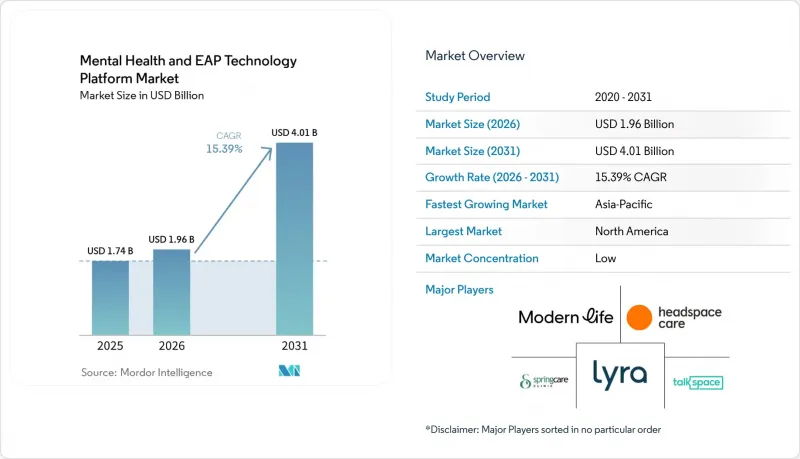
This report is Segmented by Platform Type (Mental Health Technology Platforms, and Employee Assistance Program Technology Platforms), Deployment Model (Cloud, On-Premises, and Hybrid), Enterprise Size (Large Enterprises, and Small and Medium-Sized Enterprises), End-User Industry (BFSI, IT and Telecom, and More), and Geography. The Market Forecasts are Provided in Terms of Value (USD).
Global Mental Health And EAP Technology Platform Market Trends and Insights
Rising Employer Spend on Workforce Mental Health and Retention
Employers have moved from optional wellness budgets to structured spending on behavioral health, and that shift is giving the mental health and EAP technology platform market a firmer demand base. A 2025 meta-analysis of 19 employer cohort studies found a pooled return of USD 2.30 for every USD 1 invested in enhanced behavioral health services, with net savings of USD 159 per member per month, and all 19 employers showed positive ROI. That level of proof supports contract renewals and wider deployment across enterprise workforces. It also changes the buying process, because outcome-backed mental health spending is moving beyond HR teams and receiving closer attention from finance and strategy leaders. As a result, vendors in the mental health and EAP technology platform market that can deliver auditable results are better placed to win larger, longer contracts.
AI-Powered Navigation and Stepped-Care Routing That Raises Utilization
Traditional EAP models have long suffered from low engagement, with global utilization typically sitting at 2-3%, leaving a large portion of employer demand unrealized. Spring Health reported that intelligent care navigation lifted utilization from 2% to 16% within 11 months at one health system, while enrollment rose by another 37% after session limits were expanded. A 2025 randomized controlled trial in NEJM AI found that Therabot produced statistically significant symptom reductions in major depressive disorder and generalized anxiety disorder, with effect sizes comparable to outpatient psychotherapy and average engagement above 6 hours. The practical effect is that AI routing now serves as a clinical bridge, identifying employees who would otherwise remain outside the care pathway. This supports the mental health and EAP technology platform market by rewarding platforms that improve both access and meaningful use, rather than just increasing digital sign-ups.
Confidentiality, Data Privacy, and Cybersecurity Concerns
Mental health information falls into one of the most sensitive categories of health data, making security and privacy a direct commercial issue for the mental health and EAP technology platform market. In September 2025, a ransomware attack on Richmond Behavioral Health Authority exposed records for 113,232 individuals, including Social Security numbers and mental health treatment data. Healthcare organizations handling behavioral health information must manage HIPAA obligations alongside stricter protections for substance use and related behavioral health records, which increases implementation complexity. The burden becomes heavier in multinational deployments, where GDPR treats mental health data as a special category and where certain healthcare AI use cases face extra review under the EU AI Act. This means that vendors in the mental health and EAP technology platform market increasingly need a strong security posture, governance controls, and compliance readiness to qualify for enterprise procurement.
Other drivers and restraints analyzed in the detailed report include:
- Expansion of Digital-First and Hybrid Care Delivery
- Demand for Measurable ROI and Reduced Productivity Loss
- Shortage of Licensed Behavioral Health Professionals
For complete list of drivers and restraints, kindly check the Table Of Contents.
Segment Analysis
Mental Health Technology Platforms held 34.47% of the mental health and EAP technology platform market in 2025, maintaining its lead due to its stronger clinical infrastructure, employer awareness, and established measurement-based care models. The segment has benefited from years of investment in therapy workflows, provider quality controls, and outcome tracking that employers can use in renewal discussions. A retrospective cohort study published in October 2025 examined 52,929 participants across 589 employers and found that 92.3% showed reliable symptom improvement in depression or anxiety, while depression effect sizes of 1.61 exceeded meta-analytic benchmarks. That kind of performance data explains why the mental health and EAP technology platform market still assigns premium value to clinical depth. It also reinforces the position of vendors that can show measurable symptom improvement rather than just offering broad content libraries.
EAP Technology Platforms are the fastest-growing platform type, with a 16.94% CAGR from 2026-2031, as employers move away from older counseling hotline contracts and toward integrated digital systems. In 2025, 77% of EAP referrals tracked by AllOne Health were for mental health counseling, showing that clinical demand now sits at the center of many EAP frameworks. This is pushing convergence across the mental health and EAP technology platform industry, because leading mental health vendors are adding work-life and guidance modules, while legacy EAP operators are licensing AI triage and digital therapeutic tools. Vendors that can move utilization above the historical 2-3% benchmark and into the 10% range or higher are in a stronger position to win multiyear contracts.
Cloud deployment accounted for 46.23% of the market in 2025, reflecting the default preference for scalability, faster implementation, and subscription-led commercial models across the mental health and EAP technology platform market. The segment also benefits from the availability of HIPAA-eligible cloud environments that support analytics, content delivery, and care coordination at enterprise scale. Lyra Health stated that its Lyra Empower platform supports more than 21.5 million users globally on cloud infrastructure, enabling the company to run predictive tools and connected workflows in real time. Cloud, therefore, remains the most practical option for employers that want rapid deployment across distributed workforces. It is especially well-suited to organizations that value central administration and lower upfront infrastructure burden.
On-premises deployments are projected to grow at a 17.86% CAGR through 2031, reflecting demand from regulated industries that require data residency, air-gapped environments, or local infrastructure control. This pattern may seem counterintuitive at first, but it aligns with the purchasing behavior of defense, government, and financial services buyers who face stricter governance requirements. The hybrid model is also gaining traction as multinational employers try to balance local compliance with a centralized user experience across the mental health and EAP technology platforms. A 2025 study available through PMC described an AI-driven platform built with federated learning and zero-trust architecture, showing how privacy-preserving design, GDPR alignment, ISO/IEC 27001, and HL7 FHIR are moving into the core architecture rather than being treated as later add-ons.
Geography Analysis
North America accounted for 39.83% of the mental health and EAP technology platform market in 2025, reflecting mature EAP infrastructure, stronger digital health funding conditions, and a more developed regulatory environment. The United States remains the largest contributor in the region because employer-sponsored benefits are more established, and enterprise buyers have shown greater willingness to pay for clinical outcome reporting and AI-enabled navigation. The MHPAEA 2024 Final Rule strengthened nonquantitative treatment limitation requirements and called for more formal data evaluation of access differences, which kept compliance and reporting high on employer agendas even after a May 2025 nonenforcement policy created temporary uncertainty around some newer provisions. Canada continues to act as a secondary growth node, and GreenShield's February 2026 acquisition of Kii Health's mental health services segment showed how regional players are using acquisitions to deepen clinician capacity and digital therapy reach. Together, these conditions keep North America at the center of current revenue generation in the mental health and EAP technology platform market.
Europe ranked second in 2025, with Germany, the United Kingdom, and the Netherlands serving as the main volume centers for the mental health and EAP technology platform market. The United Kingdom combines broad EAP access with utilization that still lags behind underlying coverage, leaving room for platforms to raise engagement through better navigation and simpler care journeys. Germany's workplace health framework and the EU Occupational Safety and Health Strategy have helped formalize psychosocial risk management, while France's 2025 EAP acquisition activity showed that operators are scaling to meet cross-market employer demand. The EU AI Act will add another layer of compliance work for AI-enabled vendors that want to scale across Europe from 2026 onward.
Asia-Pacific is the fastest-growing region, with the mental health and EAP technology platform market projected to rise at a 15.86% CAGR from 2026 to 2031 as it expands from a lower penetration base. A January 2025 cross-sectional study covering 15,302 employed adults across 6 Southeast Asian countries found that only 29.04% of employees reported access to employer-provided EAP services, with access ranging from 62.84% in the Philippines to 17.96% in Thailand. India, China, Japan, South Korea, and Australia and New Zealand remain the core growth markets, while Singapore and the Philippines are emerging as regional hubs for multinational deployments. Outside Asia-Pacific, the Middle East is advancing through workplace wellness programs in Saudi Arabia and the UAE; Africa is building around mobile-first models led by South Africa and Nigeria; and South America is seeing stronger demand from multinational employers, even though licensure and multilingual requirements still slow rollout.
- Lyra Health, Inc.
- Spring Care, Inc.
- Modern Life, Inc.
- Headspace Health
- Talkspace, Inc.
- BetterUp, Inc.
- Unmind Ltd
- Meru Health, Inc.
- Wysa Ltd
- The Intellect Company
- Calm.com, Inc.
- Twill Inc.
- OpenUp B.V.
- Kyan Health AG
- Nilo Health GmbH
- New Life Solution, Inc. d/b/a meQuilibrium
- CuraLinc, LLC d.b.a. CuraLinc Healthcare
- Rethink Autism, Inc.
- MCH International, LLC
- Here Hear AI PTE LTD
Additional Benefits:
- The market estimate (ME) sheet in Excel format
- 3 months of analyst support
TABLE OF CONTENTS
1 INTRODUCTION
- 1.1 Study Assumptions and Market Definition
- 1.2 Scope of the Study
2 RESEARCH METHODOLOGY
3 EXECUTIVE SUMMARY
4 MARKET LANDSCAPE
- 4.1 Market Overview
- 4.2 Market Drivers
- 4.2.1 Rising Employer Spend on Workforce Mental Health and Retention
- 4.2.2 Expansion of Digital-First and Hybrid Care Delivery
- 4.2.3 Tightening Workplace Mental Health and Parity Requirements
- 4.2.4 Demand for Measurable ROI and Reduced Productivity Loss
- 4.2.5 Global Workforce Localization and Multilingual Care Requirements
- 4.2.6 AI-Powered Navigation and Stepped-Care Routing That Raises Utilization
- 4.3 Market Restraints
- 4.3.1 Confidentiality, Data Privacy, and Cybersecurity Concerns
- 4.3.2 Shortage of Licensed Behavioral Health Professionals
- 4.3.3 Cross-Border Data Transfer and Clinical Licensure Friction
- 4.3.4 Evidence Scrutiny for AI-Enabled and Self-Guided Interventions
- 4.4 Industry Value Chain Analysis
- 4.5 Regulatory Landscape
- 4.6 Technological Outlook
- 4.7 Porter's Five Forces Analysis
- 4.7.1 Threat of New Entrants
- 4.7.2 Bargaining Power of Suppliers
- 4.7.3 Bargaining Power of Buyers
- 4.7.4 Threat of Substitutes
- 4.7.5 Intensity of Competitive Rivalry
- 4.8 Impact of Macroeconomic Factors on the Market
5 MARKET SIZE AND GROWTH FORECASTS (VALUE)
- 5.1 By Platform Type
- 5.1.1 Mental Health Technology Platforms
- 5.1.2 Employee Assistance Program (EAP) Technology Platforms
- 5.2 By Deployment Model
- 5.2.1 Cloud
- 5.2.2 On-Premises
- 5.2.3 Hybrid
- 5.3 By Enterprise Size
- 5.3.1 Large Enterprises
- 5.3.2 Small and Medium-Sized Enterprises
- 5.4 By End User Industry
- 5.4.1 BFSI
- 5.4.2 Healthcare and Life Sciences
- 5.4.3 Information Technology and Telecom
- 5.4.4 Retail and E-commerce
- 5.4.5 Industrial Manufacturing
- 5.4.6 Government and Public Sector
- 5.4.7 Other End-user Industries
- 5.5 By Geography
- 5.5.1 North America
- 5.5.1.1 United States
- 5.5.1.2 Canada
- 5.5.1.3 Mexico
- 5.5.2 South America
- 5.5.2.1 Brazil
- 5.5.2.2 Argentina
- 5.5.2.3 Rest of South America
- 5.5.3 Europe
- 5.5.3.1 Germany
- 5.5.3.2 United Kingdom
- 5.5.3.3 France
- 5.5.3.4 Italy
- 5.5.3.5 Spain
- 5.5.3.6 Russia
- 5.5.3.7 Netherlands
- 5.5.3.8 Rest of Europe
- 5.5.4 Asia-Pacific
- 5.5.4.1 China
- 5.5.4.2 Japan
- 5.5.4.3 India
- 5.5.4.4 South Korea
- 5.5.4.5 Australia and New Zealand
- 5.5.4.6 Rest of Asia-Pacific
- 5.5.5 Middle East
- 5.5.5.1 Saudi Arabia
- 5.5.5.2 United Arab Emirates
- 5.5.5.3 Rest of Middle East
- 5.5.6 Africa
- 5.5.6.1 South Africa
- 5.5.6.2 Nigeria
- 5.5.6.3 Rest of Africa
- 5.5.1 North America
6 COMPETITIVE LANDSCAPE
- 6.1 Market Concentration
- 6.2 Strategic Moves
- 6.3 Market Share Analysis
- 6.4 Company Profiles (includes Global Level Overview, Market Level Overview, Core Segments, Financials as available, Strategic Information, Market Rank/Share, Products and Services, Recent Developments).
- 6.4.1 Lyra Health, Inc.
- 6.4.2 Spring Care, Inc.
- 6.4.3 Modern Life, Inc.
- 6.4.4 Headspace Health
- 6.4.5 Talkspace, Inc.
- 6.4.6 BetterUp, Inc.
- 6.4.7 Unmind Ltd
- 6.4.8 Meru Health, Inc.
- 6.4.9 Wysa Ltd
- 6.4.10 The Intellect Company
- 6.4.11 Calm.com, Inc.
- 6.4.12 Twill Inc.
- 6.4.13 OpenUp B.V.
- 6.4.14 Kyan Health AG
- 6.4.15 Nilo Health GmbH
- 6.4.16 New Life Solution, Inc. d/b/a meQuilibrium
- 6.4.17 CuraLinc, LLC d.b.a. CuraLinc Healthcare
- 6.4.18 Rethink Autism, Inc.
- 6.4.19 MCH International, LLC
- 6.4.20 Here Hear AI PTE LTD
7 MARKET OPPORTUNITIES AND FUTURE OUTLOOK
- 7.1 White-Space and Unmet-Need Assessment

