PUBLISHER: Mordor Intelligence | PRODUCT CODE: 2065605

PUBLISHER: Mordor Intelligence | PRODUCT CODE: 2065605
United States Invisible Orthodontics - Market Share Analysis, Industry Trends & Statistics, Growth Forecasts (2026 - 2031)
According to Mordor Intelligence, the united states invisible orthodontics market size was valued at USD 3.17 billion in 2025 and is estimated to grow from USD 3.57 billion in 2026 to reach USD 6.51 billion by 2031, at a CAGR of 12.77% during the forecast period (2026-2031).
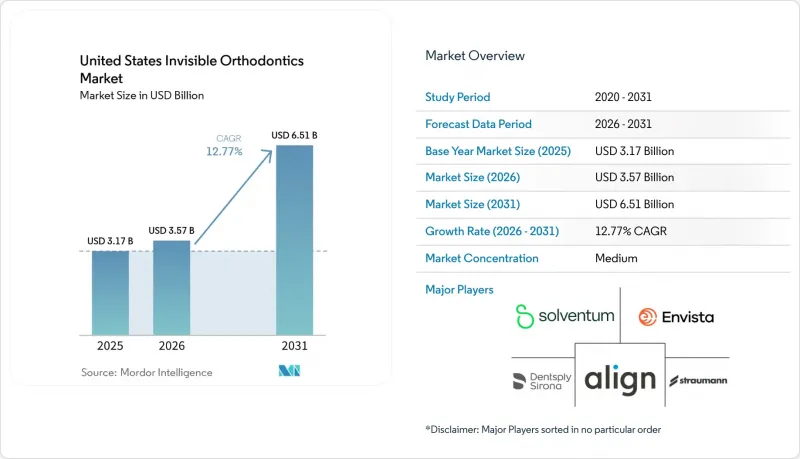
This report is Segmented by Product (Clear Aligners, Ceramic Braces, Lingual Braces, Retainers), Material (Polyurethane Films, PETG, Polycarbonate), Age Group (Adults, Teens, Children), Care Setting (Standalone, Group Practices/DSOs, Hospitals), Provider Type (Orthodontists, General Dentists), and Sales Channel (Offline, Online). The Market Forecasts are Provided in Terms of Value (USD).
United States Invisible Orthodontics Market Trends and Insights
Adult Malocclusion Burden and Aesthetics-Led Demand
The addressable patient base in the United States invisible orthodontics market is much larger than current treatment volumes. The AAO estimated 1.91 million adults were treated by AAO members in the United States in 2024, which confirms that adult care is already a large and active revenue pool. The AAO's 2024 Orthodontic Landscape Consumer Study also showed that orthodontists treated 64% of adult orthodontic patients, dentists treated 22%, and mail-order channels treated 14%, which points to continued strength in supervised care. Working adults are increasingly choosing less visible treatment, because appearance concerns now sit alongside convenience, schedule flexibility, and willingness to self-finance. A meaningful share of case starts is also coming from relapse patients who stopped retainer wear and later returned to treatment. That recurring pool supports steady case replenishment inside the United States invisible orthodontics market even when first-time patient acquisition becomes harder.
AI Planning, Intraoral Scanning, and Digital Workflows
Artificial intelligence is reducing one of the slowest steps in orthodontic care, which is the time required to build and review case setups. Align Technology stated that ClinCheck Live Plan can generate initial doctor-ready plans in as little as 15 minutes for eligible cases, which shortens the gap between scan capture and clinician review. A randomized controlled trial published in PLOS One in May 2026 found superior PAR score reductions for AI-assisted digital workflows versus conventional fixed appliances in 140 patients with Angle Class I malocclusion. Faster setup reduces the marginal labor required per case, and that matters most for multi-location groups trying to raise utilization without adding equal numbers of technicians and coordinators. Digital workflows also improve consistency across locations, which is valuable for DSOs that want repeatable treatment protocols. In the United States invisible orthodontics market, vendors with stronger software, scanner integration, and quality control are gaining an advantage that extends beyond the appliance itself.
High Out-of-Pocket Cost and Adult Coverage Gaps
Affordability remains the clearest demand constraint in the United States invisible orthodontics market. CMS finalized a rule that allows states to include adult dental services in 2027 EHB benchmark plans, but orthodontic coverage was not explicitly added to the benchmark categories, which leaves real uncertainty around future benefit design. Clear aligner treatment still routinely costs USD 3,000 to USD 8,000 out of pocket, which is far above the support offered by many supplemental dental plans. Lifetime orthodontic maximums of USD 1,000 to USD 2,000 leave most of the treatment bill with the patient, so financing often becomes the deciding factor rather than clinical need. That cost profile skews utilization toward households with stronger income and credit access, even though the addressable pool is much wider. Third-party financing and in-house installment plans help close some of the gap, but they do not remove the price barrier and can add repayment risk for both patients and practices.
Other drivers and restraints analyzed in the detailed report include:
- Hybrid Remote Monitoring Improves Case Throughput
- DSO and Group-Practice Scaling Accelerates Aligner Penetration
- Tighter Scrutiny of Mail-Order Aligners and In-Person Exam Requirements
For complete list of drivers and restraints, kindly check the Table Of Contents.
Segment Analysis
Clear aligners held 86.31% of the United States invisible orthodontics market share in 2025, which kept the category tightly centered on removable transparent appliances. Align Technology reported USD 3.2 billion in clear aligner revenue in 2025 and 2.6 million global case shipments, which confirmed the scale and maturity of the leading platform. In Q1 2026, Align shipped 685.7 thousand cases, up 6.7% year over year, while North American volumes remained stable. That pattern shows that U.S. expansion is now leaning more on deeper provider utilization and stronger case conversion than on simple network expansion. Across the United States invisible orthodontics market, the product story still begins with clear aligners because they define both patient expectations and competitive positioning.
Ceramic braces are projected to grow at a 15.38% CAGR from 2026 to 2031, which makes them the fastest-growing product sub-segment. Their role remains important in cases where clinicians want more direct torque control or force levels that fall outside predictable aligner performance. Ormco expanded digital bonding to more orthodontic bracket systems at AAO 2026, which showed that bracket manufacturers are modernizing workflow rather than giving ground to aligners. Lingual braces remain a small but premium option for adults who want maximum discretion and accept a higher cost and narrower provider base. Retainers also remain strategically important because every finished case can convert into repeat post-treatment revenue, which keeps product lifetime value higher than initial treatment revenue alone suggests.
Polyurethane and co-polyester multilayer films accounted for 75.24% of revenue in 2025, which kept the material base of the United States invisible orthodontics market tilted toward premium multilayer performance. Align Technology's SmartTrack platform helped establish that benchmark, and related multilayer polymer sheet constructions remain protected by patent coverage. Research published in Orthodontics and Craniofacial Research showed that PETG and thermoplastic polyurethane differ in stiffness behavior by tooth region and aligner thickness. That evidence supports the view that material selection is a treatment-performance decision rather than a simple sourcing choice. As a result, established multilayer systems still hold the clinical lead in the United States invisible orthodontics market.
PETG is projected to grow at a 15.52% CAGR from 2026 to 2031, driven by broader use among challenger brands that want a performance-value position. PETG offers a practical balance of transparency, processability, and cost, which makes it attractive for brands trying to widen access without moving fully downmarket. Direct-print resin materials are also starting to enter the discussion, because they could eventually remove the thermoforming step and support on-demand in-office production. FDA clearance for Primeprint Direct Aligner under K250739 in October 2025 and subsequent clinical evaluation activity in 2026 moved that concept closer to real use, even though it is still early. The United States invisible orthodontics industry is therefore moving toward a layered material structure with premium multilayer films at the top, PETG in the middle, and printed resins as a future in-house production option.
List of Companies Covered in this Report:
- Align Technology
- American Orthodontics Corporation
- Bausch Health Companies Inc. (OraFit)
- Candid Care Co.
- ClearPath Orthodontics
- Dentsply Sirona
- DynaFlex
- Envista Holdings Corporation (Ormco)
- G&H Orthodontics
- Great Lakes Dental Technologies
- Henry Schein
- Straumann Group
- OrthoFX, Inc.
- SCHEU-DENTAL GmbH
- Shanghai Smartee Denti-Technology Co., Ltd.
- Solventum Corporation
- TP Orthodontics
- Zendura Dental (Bay Materials LLC)
Additional Benefits:
- The market estimate (ME) sheet in Excel format
- 3 months of analyst support
TABLE OF CONTENTS
1 Introduction
- 1.1 Study Assumptions & Market Definition
- 1.2 Scope of the Study
2 Research Methodology
3 Executive Summary
4 Market Landscape
- 4.1 Market Overview
- 4.2 Market Drivers
- 4.2.1 Adult Malocclusion Burden and Aesthetics-Led Demand
- 4.2.2 AI Planning, Intraoral Scanning, and Digital Workflows
- 4.2.3 Hybrid Remote Monitoring Improves Case Throughput
- 4.2.4 Selective Expansion of Adult Orthodontic Benefits and Financing Access
- 4.2.5 DSO And Group-Practice Scaling Accelerates Aligner Penetration
- 4.2.6 Reduced-Wear-Time and Pediatric-Interceptive Innovations Expand Candidacy
- 4.3 Market Restraints
- 4.3.1 High Out-of-Pocket Costs and Adult Coverage Gaps
- 4.3.2 Tighter Scrutiny of Mail-Order Aligners and In-Person Exam Requirements
- 4.3.3 Challenger-Brand Churn Undermines Trust and Channel Stability
- 4.3.4 Staffing and Training Bottlenecks in In-House Digital Production
- 4.4 Supply-Chain Analysis
- 4.5 Regulatory Landscape
- 4.6 Technological Outlook
- 4.7 Porter's Five Forces
- 4.7.1 Threat of New Entrants
- 4.7.2 Bargaining Power of Buyers
- 4.7.3 Bargaining Power of Suppliers
- 4.7.4 Threat of Substitutes
- 4.7.5 Competitive Rivalry
5 Market Size & Growth Forecasts (Value, USD)
- 5.1 By Product
- 5.1.1 Clear Aligners
- 5.1.2 Ceramic Braces
- 5.1.3 Lingual Braces
- 5.1.4 Retainers
- 5.2 By Material
- 5.2.1 Polyurethane / co-polyester multilayer films
- 5.2.2 PETG
- 5.2.3 Polycarbonate
- 5.2.4 Other thermoplastics
- 5.3 By Age Group
- 5.3.1 Adults
- 5.3.2 Teens
- 5.3.3 Children and mixed dentition
- 5.4 By Care Setting
- 5.4.1 Standalone orthodontic practices
- 5.4.2 Group practices, DSOs, and OSOs
- 5.4.3 Hospitals and academic dental centers
- 5.4.4 Other dental clinics
- 5.5 By Provider Type
- 5.5.1 Orthodontists
- 5.5.2 General dentists
- 5.6 By Sales Channel
- 5.6.1 Offline
- 5.6.2 Online
6 Competitive Landscape
- 6.1 Market Concentration
- 6.2 Market Share Analysis
- 6.3 Company Profiles {(includes Global level Overview, Market level overview, Core Segments, Financials as available, Strategic Information, Market Rank/Share for key companies, Products & Services, and Recent Developments)}
- 6.3.1 Align Technology Inc.
- 6.3.2 American Orthodontics Corporation
- 6.3.3 Bausch Health Companies Inc. (OraFit)
- 6.3.4 Candid Care Co.
- 6.3.5 ClearPath Orthodontics
- 6.3.6 Dentsply Sirona Inc.
- 6.3.7 DynaFlex
- 6.3.8 Envista Holdings Corporation (Ormco)
- 6.3.9 G&H Orthodontics
- 6.3.10 Great Lakes Dental Technologies
- 6.3.11 Henry Schein, Inc.
- 6.3.12 Institut Straumann AG
- 6.3.13 OrthoFX, Inc.
- 6.3.14 SCHEU-DENTAL GmbH
- 6.3.15 Shanghai Smartee Denti-Technology Co., Ltd.
- 6.3.16 Solventum Corporation
- 6.3.17 TP Orthodontics, Inc.
- 6.3.18 Zendura Dental (Bay Materials LLC)
7 Market Opportunities & Future Outlook
- 7.1 White-Space & Unmet-Need Assessment

