PUBLISHER: Mordor Intelligence | PRODUCT CODE: 2072492

PUBLISHER: Mordor Intelligence | PRODUCT CODE: 2072492
Invisible Orthodontics - Market Share Analysis, Industry Trends & Statistics, Growth Forecasts (2026 - 2031)
According to Mordor Intelligence, the invisible orthodontics market size was valued at USD 7.72 billion in 2025 and is estimated to grow from USD 8.69 billion in 2026 to reach USD 15.66 billion by 2031, at a CAGR of 12.51% during the forecast period (2026-2031).
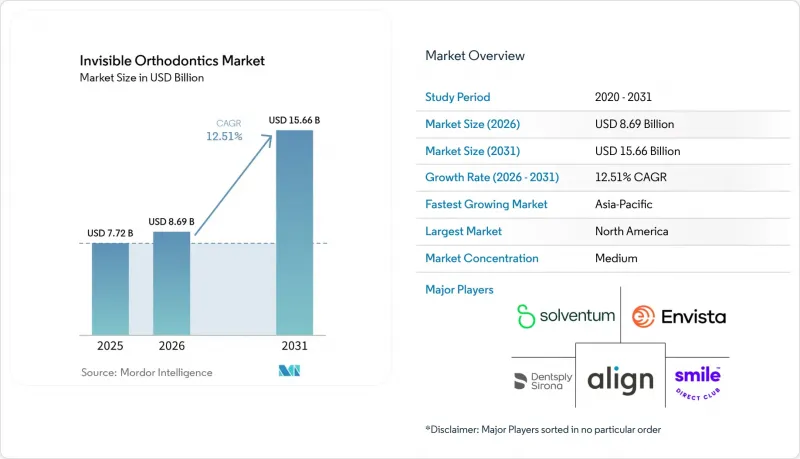
This report is Segmented by Product (Ceramic Braces, Clear Aligners, and More), Material (Thermoplastic Polyurethane (TPU), PETG, and More), Patient Group (Adult, Teenager, and Children), End User (Dental & Orthodontics Clinics, and More), Sales Channel (Dentist-Led In-Office and Mail-Order/Online), and Geography (North America, and More). The Market Sizes and Forecasts are Provided in Terms of Value (USD).
Global Invisible Orthodontics Market Trends and Insights
Prevalence of Malocclusion & Aesthetic Consciousness
More than half of the global population presents some form of malocclusion, with Class I at 51.9%, Class II at 23.8%, and Class III at 6.5%. Social-media visibility has reframed orthodontics as a lifestyle enhancement rather than solely a clinical intervention. In Australia, 31.7% of adolescents obtained orthodontic services in 2024, and 80.6% chose private clinics, illustrating a willingness to self-finance esthetic upgrades. Align Technology has treated over 20.1 million cumulative cases, and adult volume continues to climb as professionals seek discreet correction that blends into daily video calls. The preference for "stealth" solutions explains why clear aligners and lingual braces have displaced traditional metal brackets in many urban markets.
AI-Driven 3D Planning & Printing Accelerate Customization
Artificial-intelligence segmentation of cone-beam CT scans now achieves Dice similarity coefficients above 0.92, cutting manual landmarking time by up to 20% and raising throughput for small practices. Direct 3D printing of aligners from resins such as Tera Harz TC-85 eliminates thermoforming, slashing production from 10 days to 48 hours. LuxCreo and Angelalign unveiled ActiveMemory shape-recovery polymers in October 2025, claiming to trim required stages by nearly half. Such workflow economies free chair time, allowing clinics to accept more cases without proportional staff hires. Faster turnaround and greater precision reinforce patient satisfaction, thereby fueling repeat referrals and social-media endorsements.
High Treatment Cost & Limited Reimbursement
In North America, a typical clear-aligner program costs USD 3,000-8,000, leaving a significant gap for households below median income given that insurance caps still hover near USD 2,000. India and Indonesia face an even sharper affordability divide, where per-capita GDP rests under USD 4,000, relegating orthodontics to upper-income urban consumers. Zero-interest installment plans do exist but carry higher default risk when treatment exceeds 18 months. Broader access hinges on bringing per-case manufacturing costs below USD 1,500, which will require larger print farms, automation, and cheaper feedstocks.
Other drivers and restraints analyzed in the detailed report include:
- Expansion of Orthodontic Insurance Cover in OECD Markets
- Tele-Orthodontics & Remote Monitoring Broaden Access
- Shortage of Trained Orthodontists in Emerging Markets
For complete list of drivers and restraints, kindly check the Table Of Contents.
Segment Analysis
Clear aligners generated 70.56% of 2025 revenue, reinforcing the centrality of removable trays in the invisible orthodontics market. Lingual braces, however, are projected to log an 18.25% CAGR, the fastest among fixed appliances, as CAD/CAM customization reduces chair-side adjustments. Ceramic brackets hold a niche among teens who need durability but value some discretion, while vacuum-formed retainers rule post-treatment phases. The invisible orthodontics market size for lingual systems is poised to expand sharply as software-guided bracket placement lowers labor intensity. Direct 3D-printed ceramic brackets from LightForce shorten overall active treatment by 40%, appealing to practices focused on throughput.
Lingual systems also benefit from declining component costs as in-house milling becomes mainstream. Multi-layered aligner designs-stiff outer shells paired with softer inner layers-introduce better force distribution, improving predictability and reducing refinements. Retainers evolve too: bonded variants that remove patient-compliance risk are gaining adoption despite their higher upfront price. These shifts suggest that the invisible orthodontics market will no longer hinge on a single dominant modality but rather on a palette of custom-fit solutions.
Thermoplastic polyurethane occupied 47.53% share in 2025 because its elastic memory counters stress relaxation and maintains constant force delivery. PETG is forecast to surge at 20.85% CAGR owing to lower raw-material cost and superior thermoformability, making it attractive for large-scale print farms. Polycarbonate has ceded ground due to stiffness-related discomfort, while proprietary blends like Zendura FLX retain 92% of initial transparency over a 14-day wear cycle, outpacing generic PETG's 78%. The invisible orthodontics market size tied to PETG is projected to widen as factories seek scrap-rate reductions.
ActiveMemory polymers introduce shape-recovery mechanics that reset tray geometry at body temperature, effectively doubling force sustainability and potentially halving the number of stages. Direct-print resins still face cost and biocompatibility constraints, yet they enable same-day delivery for complex cases, a competitive edge for urban boutique clinics. As feedstock diversity widens, the invisible orthodontics market will segment further by wear-cycle length, optical clarity, and biocompatibility.
Complete Report Scope:
- By Product
- Clear Aligners
- Single-layer PETG
- Multi-layer TPU
- Ceramic Braces
- Poly-crystalline
- Mono-crystalline
- Lingual Braces
- CAD/CAM customised
- Standard brackets
- Retainers
- Vacuum-formed clear retainers
- Bonded retainers
- Clear Aligners
- By Material
- Thermoplastic Polyurethane (TPU)
- PETG
- Polycarbonate
- Others (PP, PVC, Co-polyesters)
- By Patient Group
- Adults
- Teenagers
- Children
- By End User
- Dental & Orthodontic Clinics
- Hospitals
- Direct-to-Consumer Platforms
- By Sales Channel
- Dentist-led in-office
- Mail-Order / Online
- Geography
- North America
- United States
- Canada
- Mexico
- Europe
- Germany
- United Kingdom
- France
- Italy
- Spain
- Rest of Europe
- Asia-Pacific
- China
- Japan
- India
- South Korea
- Australia
- Rest of Asia-Pacific
- Middle East & Africa
- GCC
- South Africa
- Rest of Middle East & Africa
- South America
- Brazil
- Argentina
- Rest of South America
- North America
Geography Analysis
North America generated 43.13% of 2025 revenue, buoyed by orthodontic penetration above 60% among adolescents and rising adult adoption in employer-funded plans. Align shipped over 642,000 cases globally in Q1 2025, and roughly 55% originated from this region, illustrating sustained maturity of invisibility-focused modalities. Recent publication of ADA standards for sequential aligners raises compliance costs for smaller labs, thus tilting supply toward well-capitalized manufacturers. Canada adds incremental growth through favorable insurance provisions, whereas U.S. cross-border dental tourism to Mexico boosts regional case volume.
Asia-Pacific is forecast to deliver a 21.81% CAGR, the highest globally, since orthodontic penetration remains under 5% in populous countries like China and India. Angelalign benefits from localized software and price points 30% below U.S. brands, growing its domestic share while also opening a U.S. facility to diversify revenue. Straumann noted brisk intraoral-scanner sales in China during Q3 2024, a leading indicator because digital scanning is the entry point for aligner treatment. Australia's market, valued at USD 147.01 million in 2024, demonstrates 28.67% CAGR potential, reflecting both strong insurance reimbursement and cultural emphasis on cosmetic dentistry.
Europe holds a mid-teen share, with Germany, the United Kingdom, and France dominating volumes. Public-private insurance hybrids subsidize adolescent cases, and adult uptake rises as flexible spending mechanisms become common. Straumann's divestiture of Dr.Smile in 2024 marked a pivot back toward professional channels amid MDR-driven compliance costs. Southern European markets like Spain and Italy show faster percentage growth from lower bases. Latin America and the Middle East each hold smaller slices but reveal pockets of strength: Brazil records roughly 1.4 million orthodontic case starts annually, and GCC nations sustain premium spending fueled by high disposable income.
- Align Technology
- American Orthodontics
- Angelalign Technology Inc.
- Avinent Group
- Byte by Dentsply Sirona
- Candid Co.
- ClearPath Orthodontics
- DB Orthodontics
- Dentsply Sirona
- Envista
- G&H Orthodontics
- Great Lakes Dental Technologies
- Henry Schein
- Straumann Group
- SCHEU-DENTAL GmbH
- Smartee Denti-Technology
- SmileDirectClub
- Solventum Corporation
- Sunshine Smile GmbH (DrSmile)
- TP Orthodontics
- WonderSmile
- Zendura Dental
Additional Benefits:
- The market estimate (ME) sheet in Excel format
- 3 months of analyst support
TABLE OF CONTENTS
1 Introduction
- 1.1 Study Assumptions & Market Definition
- 1.2 Scope of the Study
2 Research Methodology
3 Executive Summary
4 Market Landscape
- 4.1 Market Overview
- 4.2 Market Drivers
- 4.2.1 Prevalence of malocclusion & aesthetic consciousness
- 4.2.2 AI-driven 3-D planning & printing accelerate customisation
- 4.2.3 Expansion of orthodontic insurance cover in OECD markets
- 4.2.4 Tele-orthodontics & remote monitoring broaden access
- 4.2.5 Bio-resorbable & smart polymer aligners shorten wear cycles
- 4.2.6 Employer-funded dental benefits in EMs lift adult uptake
- 4.3 Market Restraints
- 4.3.1 High treatment cost & limited reimbursement
- 4.3.2 Shortage of trained orthodontists in EMs
- 4.3.3 Regulatory clamp-down on DTC aligner business models
- 4.3.4 Patent expiries driving price erosion & margin squeeze
- 4.4 Supply-Chain Analysis
- 4.5 Regulatory Landscape
- 4.6 Technological Outlook
- 4.7 Porter's Five Forces
- 4.7.1 Threat of New Entrants
- 4.7.2 Bargaining Power of Buyers
- 4.7.3 Bargaining Power of Suppliers
- 4.7.4 Threat of Substitutes
- 4.7.5 Competitive Rivalry
5 Market Size & Growth Forecasts (Value, USD)
- 5.1 By Product
- 5.1.1 Clear Aligners
- 5.1.1.1 Single-layer PETG
- 5.1.1.2 Multi-layer TPU
- 5.1.2 Ceramic Braces
- 5.1.2.1 Poly-crystalline
- 5.1.2.2 Mono-crystalline
- 5.1.3 Lingual Braces
- 5.1.3.1 CAD/CAM customised
- 5.1.3.2 Standard brackets
- 5.1.4 Retainers
- 5.1.4.1 Vacuum-formed clear retainers
- 5.1.4.2 Bonded retainers
- 5.1.1 Clear Aligners
- 5.2 By Material
- 5.2.1 Thermoplastic Polyurethane (TPU)
- 5.2.2 PETG
- 5.2.3 Polycarbonate
- 5.2.4 Others (PP, PVC, Co-polyesters)
- 5.3 By Patient Group
- 5.3.1 Adults
- 5.3.2 Teenagers
- 5.3.3 Children
- 5.4 By End User
- 5.4.1 Dental & Orthodontic Clinics
- 5.4.2 Hospitals
- 5.4.3 Direct-to-Consumer Platforms
- 5.5 By Sales Channel
- 5.5.1 Dentist-led in-office
- 5.5.2 Mail-Order / Online
- 5.6 Geography
- 5.6.1 North America
- 5.6.1.1 United States
- 5.6.1.2 Canada
- 5.6.1.3 Mexico
- 5.6.2 Europe
- 5.6.2.1 Germany
- 5.6.2.2 United Kingdom
- 5.6.2.3 France
- 5.6.2.4 Italy
- 5.6.2.5 Spain
- 5.6.2.6 Rest of Europe
- 5.6.3 Asia-Pacific
- 5.6.3.1 China
- 5.6.3.2 Japan
- 5.6.3.3 India
- 5.6.3.4 South Korea
- 5.6.3.5 Australia
- 5.6.3.6 Rest of Asia-Pacific
- 5.6.4 Middle East & Africa
- 5.6.4.1 GCC
- 5.6.4.2 South Africa
- 5.6.4.3 Rest of Middle East & Africa
- 5.6.5 South America
- 5.6.5.1 Brazil
- 5.6.5.2 Argentina
- 5.6.5.3 Rest of South America
- 5.6.1 North America
6 Competitive Landscape
- 6.1 Market Concentration
- 6.2 Market Share Analysis
- 6.3 Company Profiles (includes Global level Overview, Market level overview, Core Segments, Financials as available, Strategic Information, Market Rank/Share for key companies, Products & Services, and Recent Developments)
- 6.3.1 Align Technology Inc.
- 6.3.2 American Orthodontics
- 6.3.3 Angelalign Technology Inc.
- 6.3.4 Avinent Group
- 6.3.5 Byte by Dentsply Sirona
- 6.3.6 Candid Co.
- 6.3.7 ClearPath Orthodontics
- 6.3.8 DB Orthodontics
- 6.3.9 Dentsply Sirona
- 6.3.10 Envista Holdings (Ormco)
- 6.3.11 G&H Orthodontics
- 6.3.12 Great Lakes Dental Technologies
- 6.3.13 Henry Schein Inc.
- 6.3.14 Institut Straumann AG
- 6.3.15 SCHEU-DENTAL GmbH
- 6.3.16 Smartee Denti-Technology
- 6.3.17 SmileDirectClub
- 6.3.18 Solventum Corporation
- 6.3.19 Sunshine Smile GmbH (DrSmile)
- 6.3.20 TP Orthodontics
- 6.3.21 WonderSmile
- 6.3.22 Zendura Dental
7 Market Opportunities & Future Outlook
- 7.1 White-Space & Unmet-Need Assessment

