PUBLISHER: Mordor Intelligence | PRODUCT CODE: 2065611

PUBLISHER: Mordor Intelligence | PRODUCT CODE: 2065611
Europe Integrated GPU - Market Share Analysis, Industry Trends & Statistics, Growth Forecasts (2026 - 2031)
According to Mordor Intelligence, the europe integrated GPU market size is projected to be USD 7.63 billion in 2025, USD 8.62 billion in 2026, and reach USD 18.42 billion by 2031, growing at a CAGR of 16.41% from 2026 to 2031.
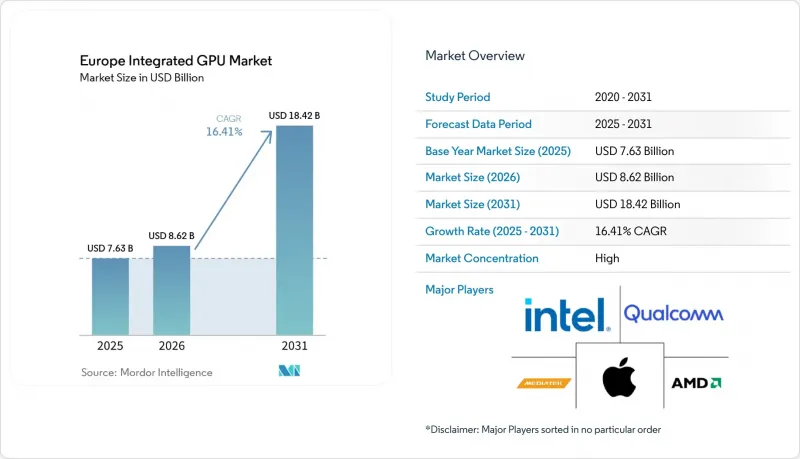
This report is Segmented by Device Category (Desktop and Laptop Processors, Mobile SoCs (Smartphones and Tablets), Embedded and Industrial SoCs, and Server and Data Center Processors With Integrated Graphics), Performance Tier (Entry-Level (Less Than USD 50), Mainstream (USD 50-USD 150), Performance (USD 150-USD 300), and More), and Geography. The Market Forecasts are Provided in Terms of Value (USD).
Europe Integrated GPU Market Trends and Insights
Rising AI-Capable Notebook Penetration Reshapes Integrated GPU Demand Mix
AI-capable notebooks have become a defined buying category across the Europe integrated GPU market as enterprises look for systems that can support local AI features over a full replacement cycle. Intel launched Panther Lake Core Ultra Series 3 at CES 2026 with up to 12 Xe3 GPU cores and a 50 TOPS NPU, making the platform a clear signal that graphics and AI now sit together in the same client computing conversation. The practical change is that the NPU and iGPU now share mixed workloads such as video enhancement, background segmentation, and document processing in everyday business use. That raises the graphics specification floor even in notebooks that were once treated as standard office machines. The Europe integrated GPU market is therefore benefiting not only from more units, but also from a stronger mix as AI-ready notebooks move from a niche class into mainstream enterprise demand.
Windows 11 Refresh and Windows 10 Retirement Drive Structural PC Hardware Replacement
Windows 10 reached its official end of support on October 14, 2025, and that created direct hardware replacement pressure across European device fleets that did not meet Windows 11 security minimums such as TPM 2.0 and Secure Boot. This matters for the Europe integrated GPU market because the refresh is hardware-led rather than software-led, which lifts processor shipments more strongly than a normal operating system transition. Many small and medium enterprises delayed upgrades through 2024, so a meaningful share of installed devices could not move forward without full replacement. Buyers are also tending to choose AI-capable platforms instead of minimum-spec compliant systems, and that supports stronger value across the Mainstream and Performance tiers. The Europe integrated GPU market is therefore seeing a larger uplift than earlier Windows sunsets would have suggested.
Advanced-Node Supply Competition From AI Accelerators and Premium Mobile SoCs Constrains Supply
The Europe integrated GPU market depends on advanced foundry capacity because premium notebooks and smartphones now need leading-edge nodes to deliver higher graphics capability within lower power limits. This creates a structural supply problem because AI accelerators and premium mobile processors are chasing the same 3nm-4nm class capacity. The issue is important for vendors such as AMD, MediaTek, and Qualcomm because they are effectively competing against their own higher-margin product lines for wafer starts. That can delay next-generation launches, raise pricing, or limit supply at the volume tier for European OEM customers. The Europe integrated GPU market therefore faces a real near-term brake even when end-user demand remains healthy.
Other drivers and restraints analyzed in the detailed report include:
- Premium Smartphone SoC Migration to Richer Graphics and Advanced Nodes Expands Mobile iGPU Value
- Demand for Power-Efficient Graphics in Thin-and-Light Devices Elevates Advanced-Node iGPU Design Spend
- High-End Creator and Gaming Workloads Sustain Discrete GPU Demand at the Top End
For complete list of drivers and restraints, kindly check the Table Of Contents.
Segment Analysis
Mobile SoCs held 49.45% of the Europe integrated GPU market share in 2025, making them the largest device category across the region's revenue mix. Their lead reflects Europe's dense premium smartphone base and the ongoing move of upper-mid and flagship Android devices toward richer integrated graphics blocks with hardware ray tracing, faster media engines, and stronger on-device AI support. Samsung's Exynos 1680 and MediaTek's Dimensity 9500 family show how the mobile layer of the Europe integrated GPU industry is moving toward higher graphics value at advanced nodes rather than relying only on unit growth. Desktop and Laptop Processors remained the second-largest category because the Windows 11 refresh cycle sustained replacement demand across enterprise notebooks and desktops in 2025 and into 2026.
Server and Data Center Processors with Integrated Graphics are projected to expand at a CAGR of 16.97% through 2031, which makes them the fastest-growing device category in the Europe integrated GPU market size outlook. European cloud operators and enterprise data centers are increasingly looking at unified processors that can handle compute, video transcoding, lightweight inference, and visualization without a dedicated add-in accelerator in every use case. Intel's preview of Xeon 6+ Clearwater Forest, expected in the first half of 2026, illustrates how advanced-node integrated graphics capability is moving into server-grade platforms at a speed that supports this shift. Embedded and Industrial SoCs are smaller in absolute value, but they are gaining strategic importance as edge AI expands in factories and industrial equipment across Germany, France, and Italy. NXP's i.MX 93W and Renesas' acquisition of Irida Labs show that the Europe integrated GPU industry is also shifting toward embedded platforms where graphics, AI, connectivity, and software differentiation now matter together in customer decisions.
List of Companies Covered in this Report:
- Intel Corporation
- Advanced Micro Devices, Inc.
- QUALCOMM Incorporated
- Apple Inc.
- MediaTek Inc.
- Samsung Electronics Co., Ltd.
- Arm Limited
- Imagination Technologies Limited
- NXP Semiconductors N.V.
- STMicroelectronics N.V.
- Texas Instruments Incorporated
- Renesas Electronics Corporation
- NVIDIA Corporation
- Broadcom Inc.
- UNISOC (Shanghai) Technologies Co., Ltd.
- Rockchip Electronics Co., Ltd.
- Amlogic Co., Ltd.
- Allwinner Technology Co., Ltd.
- Google LLC
- Socionext Inc.
Additional Benefits:
- The market estimate (ME) sheet in Excel format
- 3 months of analyst support
TABLE OF CONTENTS
1 INTRODUCTION
- 1.1 Study Assumptions and Market Definition
- 1.2 Scope of the Study
2 RESEARCH METHODOLOGY
3 EXECUTIVE SUMMARY
4 MARKET LANDSCAPE
- 4.1 Market Overview
- 4.2 Market Drivers
- 4.2.1 Windows 11 Refresh and Windows 10 Retirement
- 4.2.2 Rising AI-Capable Notebook Penetration
- 4.2.3 Demand for Power-Efficient Graphics in Thin-and-Light Devices
- 4.2.4 Premium Smartphone SoC Migration to Richer Graphics and Advanced Nodes
- 4.2.5 EU Ecodesign and Energy Labeling Pressure Favoring Lower-Power Designs
- 4.2.6 Industrial Edge AI Rollouts Expanding Embedded SoC Demand
- 4.3 Market Restraints
- 4.3.1 Advanced-Node Supply Competition From AI Accelerators and Premium Mobile SoCs
- 4.3.2 Memory and Storage Cost Inflation Limiting Replacement Budgets
- 4.3.3 Cyber Resilience Act Compliance Burden for Connected Embedded Platforms
- 4.3.4 High-End Creator and Gaming Workloads Still Pulling Demand Toward Discrete GPUs
- 4.4 Impact of Macroeconomic Factors on the Market
- 4.5 Industry Value Chain Analysis
- 4.6 Regulatory Landscape
- 4.7 Technological Outlook
- 4.8 Porter's Five Forces Analysis
- 4.8.1 Threat of New Entrants
- 4.8.2 Bargaining Power of Suppliers
- 4.8.3 Bargaining Power of Buyers
- 4.8.4 Threat of Substitutes
- 4.8.5 Intensity of Competitive Rivalry
5 MARKET SIZE AND GROWTH FORECASTS (VALUE)
- 5.1 By Device Category
- 5.1.1 Desktop and Laptop Processors
- 5.1.2 Mobile SoCs (Smartphones and Tablets)
- 5.1.3 Embedded and Industrial SoCs
- 5.1.4 Server and Data Center Processors with Integrated Graphics
- 5.2 By Performance Tier
- 5.2.1 Entry-Level (Less than USD 50)
- 5.2.2 Mainstream (USD 50 - USD 150)
- 5.2.3 Performance (USD 150 - USD 300)
- 5.2.4 High-Performance (Greater than USD 300)
- 5.3 By Country
- 5.3.1 Germany
- 5.3.2 United Kingdom
- 5.3.3 France
- 5.3.4 Italy
- 5.3.5 Spain
- 5.3.6 Rest of Europe
6 COMPETITIVE LANDSCAPE
- 6.1 Market Concentration
- 6.2 Strategic Moves
- 6.3 Market Share Analysis
- 6.4 Company Profiles (includes Global Level Overview, Market Level Overview, Core Segments, Financials as available, Strategic Information, Market Rank/Share, Products and Services, Recent Developments)
- 6.4.1 Intel Corporation
- 6.4.2 Advanced Micro Devices, Inc.
- 6.4.3 QUALCOMM Incorporated
- 6.4.4 Apple Inc.
- 6.4.5 MediaTek Inc.
- 6.4.6 Samsung Electronics Co., Ltd.
- 6.4.7 Arm Limited
- 6.4.8 Imagination Technologies Limited
- 6.4.9 NXP Semiconductors N.V.
- 6.4.10 STMicroelectronics N.V.
- 6.4.11 Texas Instruments Incorporated
- 6.4.12 Renesas Electronics Corporation
- 6.4.13 NVIDIA Corporation
- 6.4.14 Broadcom Inc.
- 6.4.15 UNISOC (Shanghai) Technologies Co., Ltd.
- 6.4.16 Rockchip Electronics Co., Ltd.
- 6.4.17 Amlogic Co., Ltd.
- 6.4.18 Allwinner Technology Co., Ltd.
- 6.4.19 Google LLC
- 6.4.20 Socionext Inc.
7 MARKET OPPORTUNITIES AND FUTURE OUTLOOK
- 7.1 White-Space and Unmet-Need Assessment

