PUBLISHER: Mordor Intelligence | PRODUCT CODE: 2065622

PUBLISHER: Mordor Intelligence | PRODUCT CODE: 2065622
South America Irrigation Pumps - Market Share Analysis, Industry Trends & Statistics, Growth Forecasts (2026 - 2031)
According to Mordor Intelligence, the south america irrigation pumps market size was valued at USD 4.52 billion in 2025 and is estimated to grow from USD 4.85 billion in 2026 to reach USD 6.87 billion by 2031, at a CAGR of 7.20% during the forecast period (2026-2031).
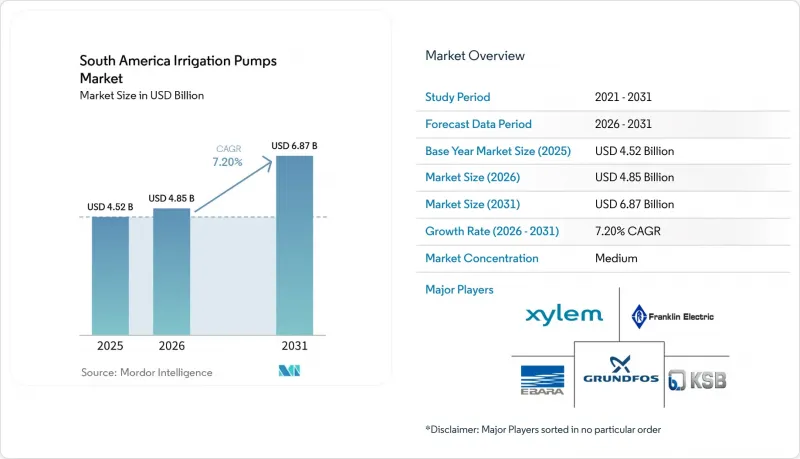
This report is Segmented by Product Typem(Centrifugal Pumps, Submersible Pumps, Positive Displacement Pumps, and Vortex Pumps), by Power Source (Grid-Electric Pumps, Diesel Pumps, Solar Pumps, and Hybrid Solar-Diesel and Solar-Battery Pumps), and by Geography (Brazil, Argentina, Chile, Peru, Colombia, and Rest of South America). The Market Forecasts are Provided in Terms of Value (USD).
South America Irrigation Pumps Market Trends and Insights
Irrigation Network Expansion and Modernization
Expansion of irrigated land remains the clearest growth driver for the South America irrigation pumps market because new canals, lift stations, and field systems require a broad mix of pump types from the start. The Food and Agriculture Organization (FAO) showed that South America sustained strong irrigated area growth over the last decade, which supports long planning cycles for irrigation equipment across row crops and export agriculture. Peru's government presented 22 irrigation projects in 2025 with total investment of USD 24 billion, a target of 1 million additional hectares, and a delivery model led mainly by public-private partnerships (PPPs). Brazil also expanded the institutional base for irrigation investment through new public programs and state-level frameworks, which makes pump procurement more repeatable across both commercial farms and smaller operations. Each new network also creates a long service cycle for station upgrades, controls, and replacement units, which gives vertically integrated suppliers a steadier aftermarket opportunity than firms focused only on first-time sales. That pattern is keeping the South America irrigation pumps market tied not only to greenfield projects, but also to recurring maintenance spending.
Water Scarcity Driving Demand for Irrigation Infrastructure
Water stress is shifting irrigation spending from a yield improvement choice into a risk management requirement for many farms, and that is changing the demand profile of the South America irrigation pumps market. According to Assessment Capacities Project (ACAPS), drought conditions affected 59% of Brazil during the 2023 to 2024 cycle, which underlines why producers are placing more weight on secure water access and installed pumping capacity. In Brazil, recurring drought from 2023 through 2025 pushed more farms in exposed states toward fully irrigated or partially irrigated production systems, which increased interest in borehole and submersible units. The same pressure is visible in Peru's coastal belts and in drier parts of Argentina, where dependable pumping is becoming central to crop planning rather than a backup option. A second effect is less favorable, because aquifer drawdown can reduce the working life of submersible installations and raise annual replacement demand. That means drought is supporting near-term equipment sales while also creating a harder operating environment for some pump assets.
High Upfront Capital Costs
High capital cost remains a clear brake on demand, especially where growers need high-head borehole systems or larger centrifugal units and do not qualify for subsidized financing. In practical terms, the issue is strongest for smallholders and medium farms in Colombia and Argentina, where pump investment often competes with working capital needs and seasonal cash flow pressure. The South America irrigation pumps market therefore does not convert all latent demand into purchases, even when water stress makes irrigation more necessary. This funding gap is less severe in parts of Brazil, where public credit programs are more developed, but it still limits adoption where borrowers exceed concessional program thresholds or cannot provide the supporting structure required by lenders. The result is a tiered regional pattern in which larger commercial farms upgrade sooner while smaller operators delay replacement and postpone new installations. That imbalance slows the broadening of the customer base even as demand from large farms remains resilient.
Other drivers and restraints analyzed in the detailed report include:
- Subsidized Government Pump Financing Programs
- Solar and Hybrid Pumping Adoption on Off-Grid Farms
- Rural Grid Limitations Constraining Electric Pump Deployment
For complete list of drivers and restraints, kindly check the Table Of Contents.
Segment Analysis
Centrifugal pumps held the largest market share at 49.9% in 2025, and that leadership reflects their fit with the surface irrigation systems and canal-linked layouts used across large grain and sugarcane areas in Brazil and Argentina. In the South America irrigation pumps market, end-suction and split-case centrifugal models remain the standard choice where high volumes and horizontal delivery matter more than compact installation. Vertical turbine units also hold an important place in Peru's coastal irrigation projects because those systems often need water lifted from river intakes or aquifers into canal networks. Submersible pumps are gaining use where groundwater development is expanding, especially in Peru's valleys and in drier parts of northeastern Brazil. Vortex pumps remain smaller in volume, but they retain relevance where water carries sediment and basic surface units face operating limits.
The South America irrigation pumps market size for positive displacement pumps is projected to grow at a 5.2% CAGR through 2031, making them the fastest product category over the forecast period. That growth is tied to fertigation, drip systems, and subsurface irrigation layouts where accurate flow control matters more than bulk transfer. Peru approved irrigation projects across 15 regions in 2025 with a technified irrigation focus, which supports demand for pump types suited to controlled application systems. Positive displacement equipment is also benefiting from export-oriented horticulture in Peru and Chile, where water efficiency supports the case for higher-value irrigation hardware. The South America irrigation pumps industry is therefore seeing faster growth in applications where water delivery precision is closely linked to crop quality and fertilizer management. International Organization for Standardization (ISO) 9906 compliance is also becoming more relevant in projects that favor certified hydraulic performance, which gives larger suppliers an advantage in specification-heavy tenders.
List of Companies Covered in this Report:
- Franklin Electric Co., Inc.
- KSB SE & Co. KGaA
- Grundfos Holding A/S
- Xylem Inc.
- Ebara Corporation
- Wilo SE
- Flowserve Corporation
- Sulzer Ltd
- ITT Inc.
- Jimenez Motores e Sistemas de Irrigacao Ltda
- Pentair plc
- Ruhrpumpen GmbH
- Dover Corporation
- IDEX Corporation
- Hidromecanica Germek Ltda.
Additional Benefits:
- The market estimate (ME) sheet in Excel format
- 3 months of analyst support
TABLE OF CONTENTS
1 Introduction
- 1.1 Study Assumptions and Market Definition
- 1.2 Scope of the Study
2 Research Methodology
3 Executive Summary
4 Market Landscape
- 4.1 Market Overview
- 4.2 Market Drivers
- 4.2.1 Irrigation network expansion and modernization
- 4.2.2 Water scarcity driving demand for irrigation infrastructure
- 4.2.3 Subsidized government pump financing programs
- 4.2.4 Solar and hybrid pumping adoption on off-grid farms
- 4.2.5 Diesel-to-solar pump transitions
- 4.2.6 PPP-led co-investment in rural water infrastructure
- 4.3 Market Restraints
- 4.3.1 High upfront capital costs
- 4.3.2 Rural grid limitations constraining electric pump deployment
- 4.3.3 Basin configuration and hydrology constraints
- 4.3.4 Water-right allocation and regulatory barriers
- 4.4 Regulatory Landscape
- 4.5 Technological Outlook
- 4.6 Porter's Five Forces Analysis
- 4.6.1 Bargaining Power of Suppliers
- 4.6.2 Bargaining Power of Buyers
- 4.6.3 Threat of New Entrants
- 4.6.4 Threat of Substitutes
- 4.6.5 Intensity of Competitive Rivalry
5 Market Size and Growth Forecasts (Value)
- 5.1 By Product Type
- 5.1.1 Centrifugal Pumps
- 5.1.2 Submersible Pumps
- 5.1.3 Positive Displacement Pumps
- 5.1.4 Vortex Pumps
- 5.2 By Power Source
- 5.2.1 Grid-electric Pumps
- 5.2.2 Diesel Pumps
- 5.2.3 Solar Pumps
- 5.2.4 Hybrid Solar-Diesel and Solar-Battery Pumps
- 5.3 By Geography
- 5.3.1 Brazil
- 5.3.2 Argentina
- 5.3.3 Chile
- 5.3.4 Peru
- 5.3.5 Colombia
- 5.3.6 Rest of South America
6 Competitive Landscape
- 6.1 Market Concentration
- 6.2 Strategic Moves
- 6.3 Market Share Analysis
- 6.4 Company Profiles (Includes Global Level Overview, Market Level Overview, Core Segments, Financials as Available, Strategic Information, Market Rank/Share for Key Companies, Products and Services, and Recent Developments)
- 6.4.1 Franklin Electric Co., Inc.
- 6.4.2 KSB SE & Co. KGaA
- 6.4.3 Grundfos Holding A/S
- 6.4.4 Xylem Inc.
- 6.4.5 Ebara Corporation
- 6.4.6 Wilo SE
- 6.4.7 Flowserve Corporation
- 6.4.8 Sulzer Ltd
- 6.4.9 ITT Inc.
- 6.4.10 Jimenez Motores e Sistemas de Irrigacao Ltda
- 6.4.11 Pentair plc
- 6.4.12 Ruhrpumpen GmbH
- 6.4.13 Dover Corporation
- 6.4.14 IDEX Corporation
- 6.4.15 Hidromecanica Germek Ltda.
7 Market Opportunities and Future Outlook

