PUBLISHER: Mordor Intelligence | PRODUCT CODE: 2099864

PUBLISHER: Mordor Intelligence | PRODUCT CODE: 2099864
North America Irrigation Pumps - Market Share Analysis, Industry Trends & Statistics, Growth Forecasts (2026 - 2031)
According to Mordor Intelligence, the North America irrigation pumps market size is projected to grow from USD 36.34 billion in 2025 and USD 38.48 billion in 2026 to USD 51.26 billion by 2031, registering a CAGR of 5.9% between 2026 and 2031.
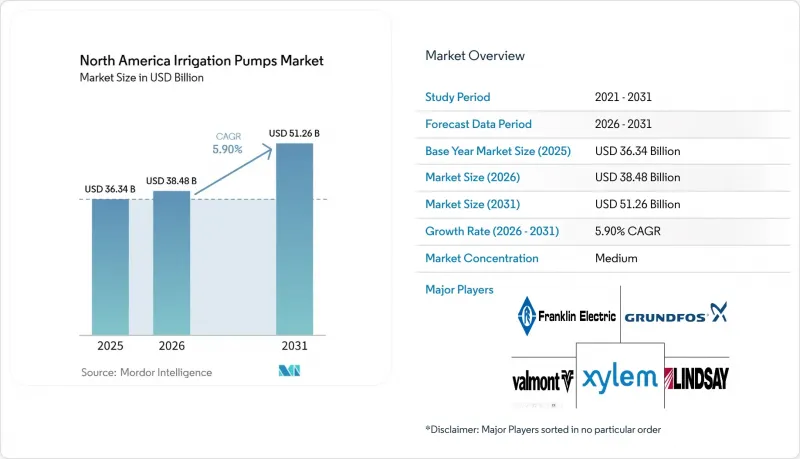
This report is Segmented by Product Type (Submersible Pump, Vortex Pump, Centrifugal Pump, and Other Product Types) and by Geography (United States, Canada, Mexico, and Rest of North America). The Market Forecasts are Provided in Terms of Value (USD).
North America Irrigation Pumps Market Trends and Insights
Expanding Precision Irrigation Retrofits in Water-Stressed Row Crop Operations
The demand for precision retrofit solutions is increasing rapidly in water-stressed row crop systems across the North America irrigation pumps market. This trend is driven by declining water tables, which are adding complexity to pumping operations. According to United States Geological Survey (USGS) monitoring, groundwater levels in certain areas of the High Plains Aquifer have dropped by over 100 feet, compelling growers in key irrigated states to upgrade their pumping systems to ensure stable water delivery at lower static water levels. The USDA has reported that its Water-Saving Commodities partnerships aim to conserve up to 50,000 acre-feet of water across 250,000 irrigated acres. This initiative connects infrastructure modernization with program participation. Additionally, a 2024 GAO report indicates that 68% of large-scale United States crop-producing farms are utilizing precision technologies, driving retrofit demand toward advanced commercial pump packages. Support programs such as EQIP WaterSMART, which facilitate variable-speed pump upgrades and canal automation, help reduce capital barriers. These programs provide a funding channel for the North America irrigation pumps market that operates independently of commodity cycles.
Replacement Cycle Acceleration from Aging Pump Fleets in Mature Agricultural Corridors
Replacement demand is emerging as a significant growth driver in the North America irrigation pumps market, particularly as mature irrigation districts transition beyond routine repairs. In December 2025, the Byron-Bethany Irrigation District announced plans to replace the century-old Wicklund Cut Pump Station following repeated breakdowns during the 2024-2025 irrigation season. Additionally, the United States Bureau of Reclamation allocated funding in 2025 for aging infrastructure projects, including the USD 4.77 million rehabilitation of the Helena Valley Irrigation District pumping plant in Montana. Many pump fleets installed in western agricultural corridors are now reaching a similar replacement phase, leading to concentrated procurement within a shorter timeframe. In this market, companies with local service teams and expertise in high-horsepower installations are well-positioned to meet this growing demand.
High Upfront Capital Cost for Efficient and Smart Pumping Systems
The high upfront capital cost continues to restrict the widespread adoption of efficient equipment in the North America irrigation pumps market. According to a 2024 GAO report, precision agriculture adoption remains lowest among the United States farms with gross cash farm income below USD 350,000, highlighting a financing gap that similarly impacts the purchase of advanced pump systems. This challenge is significant as many smaller and mid-sized growers focus on the initial list price of smart pump systems without fully considering available grants, rebates, or guaranteed lending options. As a result, there is underinvestment in premium configurations, even when the net installed cost could be more affordable after applying incentives. The North America irrigation pumps market is anticipated to experience faster adoption in scenarios where dealers integrate financing options, program guidance, and after-sales support into a streamlined purchasing process.
Other drivers and restraints analyzed in the detailed report include:
- Utility and State Incentive Programs for High-Efficiency Pumps
- Climate Volatility Increasing Demand for Flexible Irrigation Pressure Management
- Volatile Input Costs for Motors, Castings, and Power Electronics
For complete list of drivers and restraints, kindly check the Table Of Contents.
Segment Analysis
Centrifugal pumps accounted for 42.8% of the North America irrigation pumps market share in 2025, maintaining their leading position within the product mix. Their dominance is attributed to their extensive use in surface irrigation networks, main distribution pipelines, and flood-to-drip conversion projects across large commercial farms. Vortex pumps, on the other hand, serve a more specialized role in scenarios where water sources contain sediment, suspended solids, or field residue, particularly in canal-fed systems. Other product types, such as vertical turbine and positive-displacement pumps, remain significant in high-head well applications where standard centrifugal designs are less effective.
The North America irrigation pumps market size for submersible pumps is projected to grow at a 7.6% CAGR from 2026 to 2031, making them the fastest-growing product category. According to the December 2024 PCAST groundwater report, 70% of the United States groundwater withdrawals are used for irrigation, driving sustained demand for pump systems designed for deeper extraction conditions. The September 2025 launch of Franklin Electric's Cerus X-Drive highlights advancements in submersible systems, including higher horsepower capabilities and grid-compliant drive integration. Within the North America irrigation pumps market, the submersible segment is diverging into solar DC solutions for remote fields and variable-speed grid-tied systems for large commercial farms. This differentiation enables manufacturers to address varying field conditions while maintaining the core focus on efficient water delivery.
Complete Report Scope:
- By Product Type
- Submersible Pump
- Vortex Pump
- Centrifugal Pump
- Other Product Types
- By Geography
- North America
- United States
- Canada
- Mexico
- Rest of North America
- North America
List of Companies Covered in this Report:
- Valmont Industries, Inc.
- Xylem Inc.
- Franklin Electric Co., Inc.
- Lindsay Corporation
- Grundfos Holding A/S
- Jain Irrigation Systems Ltd.
- The Gorman-Rupp Company
- Pentair plc
- Ebara Corporation
- Netafim Ltd.
- BurCam Ltd.
- Davey Water Products Pty Ltd
- LEO Group Pump (Zhejiang) Co., Ltd.
- Zoeller Company
Additional Benefits:
- The market estimate (ME) sheet in Excel format
- 3 months of analyst support
TABLE OF CONTENTS
1 INTRODUCTION
- 1.1 Study Assumptions and Market Definition
- 1.2 Scope of the Study
2 RESEARCH METHODOLOGY
3 EXECUTIVE SUMMARY
4 MARKET LANDSCAPE
- 4.1 Market Overview
- 4.2 Market Drivers
- 4.2.1 Precision irrigation retrofits in water-stressed row crop operations
- 4.2.2 Solar-ready and hybrid pumping systems in off-grid farms
- 4.2.3 Replacement cycles from aging pump fleets in mature agricultural corridors
- 4.2.4 Utility and state incentive programs for high-efficiency pumps
- 4.2.5 Climate volatility and flexible irrigation pressure management
- 4.2.6 Digital controls, remote monitoring, and variable-speed optimization
- 4.3 Market Restraints
- 4.3.1 High upfront capital cost for efficient and smart pumping systems
- 4.3.2 Water rights and groundwater permit uncertainty
- 4.3.3 Service technician shortages in rural areas
- 4.3.4 Volatile input costs for motors, castings, and power electronics
- 4.4 Regulatory Landscape
- 4.5 Technological Outlook
- 4.6 Porter's Five Forces Analysis
- 4.6.1 Bargaining Power of Suppliers
- 4.6.2 Bargaining Power of Buyers
- 4.6.3 Threat of New Entrants
- 4.6.4 Threat of Substitutes
- 4.6.5 Industry Rivalry
5 MARKET SIZE AND GROWTH FORECASTS (VALUE)
- 5.1 By Product Type
- 5.1.1 Submersible Pump
- 5.1.2 Vortex Pump
- 5.1.3 Centrifugal Pump
- 5.1.4 Other Product Types
- 5.2 By Geography
- 5.2.1 North America
- 5.2.1.1 United States
- 5.2.1.2 Canada
- 5.2.1.3 Mexico
- 5.2.1.4 Rest of North America
- 5.2.1 North America
6 COMPETITIVE LANDSCAPE
- 6.1 Market Concentration
- 6.2 Strategic Moves
- 6.3 Market Share Analysis
- 6.4 Company Profiles (Includes Global Level Overview, Market Level Overview, Core Business Segments, Financials as Available, Key Information, Market Rank, Market Share, Products and Services, and Analysis of Recent Developments)
- 6.4.1 Valmont Industries, Inc.
- 6.4.2 Xylem Inc.
- 6.4.3 Franklin Electric Co., Inc.
- 6.4.4 Lindsay Corporation
- 6.4.5 Grundfos Holding A/S
- 6.4.6 Jain Irrigation Systems Ltd.
- 6.4.7 The Gorman-Rupp Company
- 6.4.8 Pentair plc
- 6.4.9 Ebara Corporation
- 6.4.10 Netafim Ltd.
- 6.4.11 BurCam Ltd.
- 6.4.12 Davey Water Products Pty Ltd
- 6.4.13 LEO Group Pump (Zhejiang) Co., Ltd.
- 6.4.14 Zoeller Company
7 MARKET OPPORTUNITIES AND FUTURE OUTLOOK

