PUBLISHER: Mordor Intelligence | PRODUCT CODE: 2065772

PUBLISHER: Mordor Intelligence | PRODUCT CODE: 2065772
Edge Data Center - Market Share Analysis, Industry Trends & Statistics, Growth Forecasts (2026 - 2031)
According to Mordor Intelligence, the edge data center market size was valued at USD 18.08 billion in 2025 and estimated to grow from USD 22.21 billion in 2026 to reach USD 62.18 billion by 2031, at a CAGR of 22.87% during the forecast period (2026-2031).
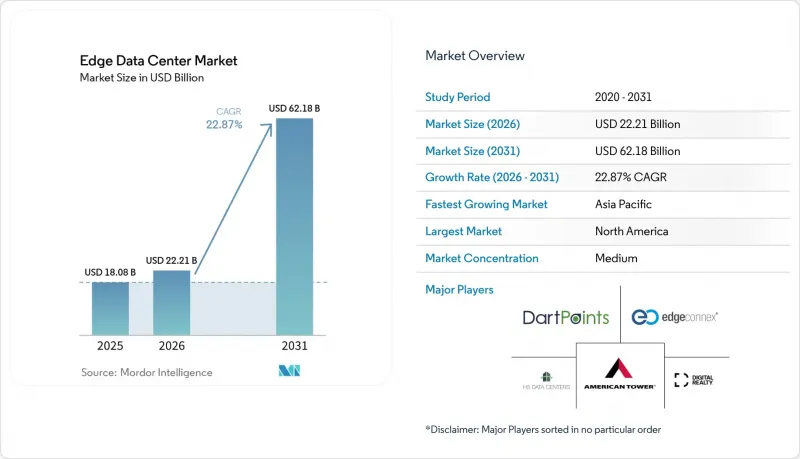
This report is Segmented by Component (Solution, Services), by Data Center Size (Small, Medium, and More), Tier Type (Tier 1 and 2, Tier 3, Tier 4), End User ( IT & Telecom, BFSI, and More) and Geography. The Market Forecasts are Provided in Terms of Value (USD).
Global Edge Data Center Market Trends and Insights
Proliferation of IoT & connected devices
More than 21.5 billion edge-connected endpoints will be active in 2025, overwhelming centralized clouds and driving procurement of localized compute nodes. Emirates NBD boosted transaction throughput by 42% after relocating analytics to regional nodes. 3M trimmed machine downtime by 35% using Azure SQL Edge on factory floors, highlighting the cost advantage once sites generate over 10 TB of monthly data. Las Vegas' smart-city partnership with Vapor IO and NVIDIA cut traffic-signal latencies from 200 ms to 20 ms.
Surge in video/5G-driven data traffic
Video already represents 82% of internet load, and 5G devices intensify pressure for sub-10 ms delivery. Verizon and NVIDIA are turning edge racks into AI-as-a-service hubs that monetize spectrum investments. BMW's factory streams 4K footage from 200+ cameras to nearby nodes for defect detection in 50 ms versus 2-3 s in cloud paths, saving 15-20X on transmission fees. Global carriers are channeling USD 50 billion into such deployments.
High capex for edge facility build-outs
Construction costs jumped 25-30% since 2024, driven by power-dense designs that run USD 8,000-12,000 per kW versus USD 4,000-6,000 in legacy halls. Vantage's USD 13 billion plan shows single sites now price at USD 50-80 million. Lead times for switch-gear stretch to two years, swelling inventory costs and quality risks.
Other drivers and restraints analyzed in the detailed report include:
- Latency-critical AR/VR & autonomous apps
- AI inferencing workloads moving to edge
- Interoperability & management gaps
For complete list of drivers and restraints, kindly check the Table Of Contents.
Segment Analysis
Solutions retained 62.80% of edge data center market share in 2025 as enterprises raced to install physical racks and orchestration software. The edge data center market will nevertheless see Services expand at a 23.96% CAGR, fueled by demand for managed operations that offset talent gaps. Outsourced monitoring can cut run-rate costs 30-40% versus in-house oversight, a fact underscored by Lumen's AI-driven portfolio that yields 40-50% margins.
The trend signals a pivot from capital expenditure toward outcome-based models. As deployments multiply across hundreds of rooftops and retail closets, clients value guaranteed SLAs more than asset ownership. EdgeConneX's Japan buildout exemplifies platforms engineered for service delivery over plain colocation.
Large campuses captured 54.10% of the edge data center market in 2025 by balancing capacity with proximity. Yet Mega facilities are on track to post a 25.8% CAGR through 2031 as hyperscalers transplant design playbooks to metro-adjacent parcels. Deploying a single 100-MW node often reduces cooling and power costs 20-25% relative to scattering smaller rooms.
Telecom operators still lean on Medium enclosures for 5G edge lattices, but cloud majors favor Mega cells for regional service planes. Scala's USD 500 million "AI City" in Brazil typifies the model, serving an urban region instead of a single district.
Geography Analysis
North America controlled 27.05% of edge data center market share in 2025 on the back of early 5G launches and mature fiber backbones. Growth is now tilting toward secondary metros where land is cheaper and grid headroom ample. Core Scientific's USD 4 billion plan to convert bitcoin farms in Texas shows how legacy assets can be reborn for AI inference. Developers still grapple with 25-35% higher construction costs compared with global norms and with acute technician shortages outside coastal hubs.
Asia-Pacific is forecast to log a 24.2% CAGR, making it the prime driver of edge data center market expansion. China's "New Infrastructure" and India's Digital India initiatives embed local-processing mandates in national strategies. Digital Edge secured USD 1.6 billion to scale regional footprints as Tokyo and Jakarta vie for hub status. Build budgets run 40-50% below North American equivalents, while vocational programs churn a growing cadre of certified engineers.
- American Tower Corporation
- DartPoints
- Digital Realty Trust
- EdgeConneX
- H5 Data Centers
- SBA Communications Corporation
- Iron Mountain Inc.
- Aligned Data Centers
- Microsoft Corporation
- Oracle Corporation
- Equinix
- Vertiv
- Schneider Electric
- Vapor IO
- Cyxtera Technologies
- EdgeMicro
- StackPath
- Compass Datacenters
- Switch Inc.
- Rackspace Technology
- Hewlett Packard Enterprise
- QTS Realty Trust
Additional Benefits:
- The market estimate (ME) sheet in Excel format
- 3 months of analyst support
TABLE OF CONTENTS
1 INTRODUCTION
- 1.1 Study Assumptions and Market Definition
- 1.2 Scope of the Study
2 RESEARCH METHODOLOGY
3 EXECUTIVE SUMMARY
4 MARKET LANDSCAPE
- 4.1 Market Overview
- 4.2 Market Drivers
- 4.2.1 Proliferation of IoT and connected devices
- 4.2.2 Surge in video/5G-driven data traffic
- 4.2.3 Latency-critical AR/VR and autonomous apps
- 4.2.4 Data-sovereignty regulations
- 4.2.5 AI inferencing workloads moving to edge
- 4.2.6 Renewable-energy micro-grids at edge sites
- 4.3 Market Restraints
- 4.3.1 High capex for edge facility build-outs
- 4.3.2 Interoperability and management gaps
- 4.3.3 Cyber and physical security risks
- 4.3.4 Skilled-labor shortage in tier-2/3 cities
- 4.4 Value / Supply-Chain Analysis
- 4.5 Regulatory Landscape
- 4.6 Technological Outlook
- 4.7 Porter's Five Forces
- 4.7.1 Bargaining Power of Suppliers
- 4.7.2 Bargaining Power of Buyers
- 4.7.3 Threat of New Entrants
- 4.7.4 Threat of Substitutes
- 4.7.5 Competitive Rivalry
- 4.8 Assessment of the Macroeconomic Factors on the Market
5 MARKET SIZE AND GROWTH FORECASTS (VALUE)
- 5.1 By Component
- 5.1.1 Solution
- 5.1.2 Services
- 5.2 By Data Center Size
- 5.2.1 Small
- 5.2.2 Medium
- 5.2.3 Large
- 5.2.4 Massive
- 5.2.5 Mega
- 5.3 By Tier Type
- 5.3.1 Tier 1 and 2
- 5.3.2 Tier 3
- 5.3.3 Tier 4
- 5.4 By End-user
- 5.4.1 IT and Telecom
- 5.4.2 BFSI
- 5.4.3 Government
- 5.4.4 Healthcare
- 5.4.5 Manufacturing
- 5.4.6 Others
- 5.5 By Geography
- 5.5.1 North America
- 5.5.1.1 United States
- 5.5.1.2 Canada
- 5.5.1.3 Mexico
- 5.5.2 South America
- 5.5.2.1 Brazil
- 5.5.2.2 Argentina
- 5.5.2.3 Rest of South America
- 5.5.3 Europe
- 5.5.3.1 Germany
- 5.5.3.2 United Kingdom
- 5.5.3.3 France
- 5.5.3.4 Netherlands
- 5.5.3.5 Rest of Europe
- 5.5.4 Asia-Pacific
- 5.5.4.1 China
- 5.5.4.2 Japan
- 5.5.4.3 India
- 5.5.4.4 South Korea
- 5.5.4.5 Australia and New Zealand
- 5.5.4.6 Rest of Asia-Pacific
- 5.5.5 Middle East and Africa
- 5.5.5.1 Middle East
- 5.5.5.1.1 United Arab Emirates
- 5.5.5.1.2 Saudi Arabia
- 5.5.5.1.3 Turkey
- 5.5.5.1.4 Rest of Middle East
- 5.5.5.2 Africa
- 5.5.5.2.1 South Africa
- 5.5.5.2.2 Egypt
- 5.5.5.2.3 Nigeria
- 5.5.5.2.4 Rest of Africa
- 5.5.5.1 Middle East
- 5.5.1 North America
6 COMPETITIVE LANDSCAPE
- 6.1 Market Concentration
- 6.2 Strategic Moves
- 6.3 Market Share Analysis
- 6.4 Company Profiles (includes Global level Overview, Market level overview, Core Segments, Financials as available, Strategic Information, Market Rank/Share for key companies, Products and Services, and Recent Developments)
- 6.4.1 American Tower Corporation
- 6.4.2 DartPoints
- 6.4.3 Digital Realty Trust
- 6.4.4 EdgeConneX
- 6.4.5 H5 Data Centers
- 6.4.6 SBA Communications Corporation
- 6.4.7 Iron Mountain Inc.
- 6.4.8 Aligned Data Centers
- 6.4.9 Microsoft Corporation
- 6.4.10 Oracle Corporation
- 6.4.11 Equinix
- 6.4.12 Vertiv
- 6.4.13 Schneider Electric
- 6.4.14 Vapor IO
- 6.4.15 Cyxtera Technologies
- 6.4.16 EdgeMicro
- 6.4.17 StackPath
- 6.4.18 Compass Datacenters
- 6.4.19 Switch Inc.
- 6.4.20 Rackspace Technology
- 6.4.21 Hewlett Packard Enterprise
- 6.4.22 QTS Realty Trust
7 MARKET OPPORTUNITIES AND FUTURE OUTLOOK
- 7.1 White-space and Unmet-Need Assessment

