PUBLISHER: Roots Analysis | PRODUCT CODE: 2088584

PUBLISHER: Roots Analysis | PRODUCT CODE: 2088584
Edge Data Center Market Till 2035: Distribution by Type of Component, Type of Facility, Type of Vertical, and Geographical Regions: Industry Trends and Global Forecasts
Edge Data Center Market Outlook
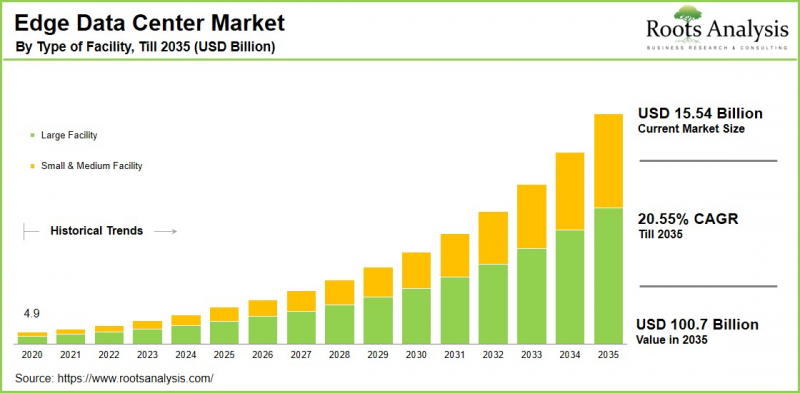
As per Roots Analysis, the global edge data center market size is estimated to grow from USD 15.54 billion in the current year to USD 100.7 billion by 2035, at a CAGR of 20.55% during the forecast period, till 2035.
An edge data center is a decentralized computing facility strategically deployed in close proximity to end users, connected devices, and data generation sources. By extending computing, storage, and networking capabilities to the edge of the network, these facilities enable faster data processing, significantly reduce latency and optimize bandwidth utilization. As a result, edge data centers play a critical role in facilitating low-latency services, enhancing user experiences, and supporting emerging technologies such as IoT, artificial intelligence, autonomous systems, and 5G-enabled applications.
The accelerating pace of digital transformation has significantly increased the demand for real-time data processing and ultra-low-latency computing, driving the adoption of edge computing technologies. By processing data closer to its source of generation, edge computing enhances operational efficiency, reduces network congestion, and enables faster decision-making. The rapid usage of Internet of Things (IoT) devices and the global shift towards 5G networks have further amplified the need for edge data center infrastructure. Additionally, growing emphasis on sustainability has elevated the importance of energy-efficient edge data centers, which leverage advanced cooling technologies and optimized power management systems to reduce operational costs and environmental impact.
Recognizing these opportunities, industry participants are actively investing in and expanding edge computing infrastructure. For instance, recently, Duos Edge AI launched its first Edge Data Center in the Region 16 Education Service Center in Texas. The initiative was designed to provide high-speed connectivity and advanced digital capabilities to educational institutions across the region. Overall, considering the above-mentioned factors, the edge data center market is expected to grow significantly during the forecast period.
Strategic Insights for Senior Leaders
Competitive Landscape: Companies Involved in Edge Data Center Market
The global edge data center market exhibits a moderately fragmented yet increasingly competitive landscape, with competition across infrastructure, connectivity, cloud integration, AI readiness, and geographic reach. The market is currently led by large colocation and interconnection providers such as Equinix and Digital Realty, which benefit from extensive global footprints, strong carrier-neutral ecosystems, and established enterprise customer bases.
Competition is increasingly being shaped by the growing demand for AI-enabled edge infrastructure. Hyperscale cloud providers such as AWS, Microsoft, and Google are expanding their edge offerings through hybrid cloud platforms, edge zones, and localized compute capabilities. While infrastructure vendors including Dell, HPE, Cisco, Huawei, Schneider Electric, and Vertiv are strengthening their positions through AI-ready hardware, modular data center solutions, advanced cooling technologies, and integrated edge management platforms. Strategic partnerships, acquisitions, and product innovations have become key competitive strategies as market participants seek to enhance geographic coverage, support AI inferencing workloads, and capitalize on emerging opportunities in Industry 4.0.
Edge Data Center Market: Key Drivers Propelling Growth
The edge data center market is experiencing robust growth, driven by the increasing adoption of artificial intelligence (AI), stringent data sovereignty requirements, and the growing need for distributed computing infrastructure. As organizations deploy AI-powered applications across industries, there is a rising demand for edge facilities capable of supporting real-time AI inferencing closer to end users, thereby reducing latency, and enhancing operational efficiency.
In addition, evolving data privacy regulations and localization mandates are compelling enterprises to process and store sensitive information within specific geographic regions, further accelerating investments in localized edge infrastructure. The market is also benefiting from the rapid expansion of Industry 4.0 initiatives, smart manufacturing systems, autonomous technologies, and data-intensive applications that require immediate processing capabilities.
Furthermore, the adoption of 5G networks, coupled with the proliferation of connected devices and digital transformation initiatives across multiple sectors, is strengthening the need for decentralized computing architectures. As a result, the market is increasingly transitioning from a traditional latency-focused model towards an AI-driven, distributed computing ecosystem, positioning edge data centers as a critical component of next-generation digital infrastructure.
Edge Data Center Evolution: Energy Resilience Driving Infrastructure Strategy
As edge deployments expand and AI workload increase computational intensity, energy infrastructure is becoming a key factor influencing site selection, operational scalability, and investment decisions. Data center operators are increasingly encountering constraints related to grid capacity, power reliability, and rising energy costs, particularly in high-growth digital markets. Simultaneously, governments, investors, and enterprise customers are placing greater emphasis on sustainability and carbon reduction objectives.
In response, industry participants are exploring alternative energy solutions, including renewable energy integration, microgrids, fuel-cell technologies, battery storage systems, and advanced power management platforms. For edge data center operators, the ability to secure reliable and scalable power resources is no longer merely an operational consideration; it has become a strategic differentiator that can influence customer acquisition, facility utilization rates, and long-term profitability. Senior executives should therefore evaluate energy resilience alongside traditional infrastructure metrics when assessing expansion opportunities, partnership strategies, and future investment priorities.
Key Market Opportunities: Where Should Decision Makers Invest Next?
The increasing adoption of IoT devices, 5G connectivity, AI-enabled applications, and digital transformation initiatives is accelerating demand for localized computing resources across secondary and emerging markets. While established data center hubs continue to attract significant investment, organizations are increasingly recognizing the strategic value of deploying infrastructure closer to underserved regions where latency-sensitive applications are gaining traction. This trend is particularly evident across sectors (such as healthcare, manufacturing, transportation, retail, and education), where real-time data processing can directly enhance operational efficiency and customer experience.
Further, government-led digitalization initiatives and investments in broadband infrastructure are expanding the addressable market for edge computing solutions. For senior decision makers, the emergence of regional edge ecosystems presents an opportunity to diversify geographic exposure, access new customer segments, and establish first-mover advantages in high-growth markets. Companies that develop scalable deployment models and sign partnerships with telecommunications providers, cloud platforms, and local enterprises are likely to be better positioned to capitalize on the next phase of edge infrastructure expansion.
Regional Analysis: North America to hold the Largest Share in the Market
According to our analysis, in the current year, North America captures the highest share of the global data center market. Meanwhile, Asia-Pacific is projected to be the fastest-growing regional market, registering a robust CAGR during the forecast period. This accelerated growth is primarily driven by widespread digital transformation initiatives, favorable government policies, and increasing investments in digital infrastructure across major economies such as China, India, South Korea, and Japan. Additionally, the expansion of 5G networks, growing investments in smart city development, and rising adoption of data-intensive applications are creating substantial opportunities for edge data center deployment.
Edge Data Center Market: Key Market Segmentation
Type of Component
- Solutions
- Cooling
- DCIM
- IT Racks and Enclosures
- Network Equipment
- Power
- Service
Type of Facility
- Large Facility
- Small & Medium Facility
Type of Vertical
- Automotive
- BFSI
- Gaming & Entertainment
- Government
- Healthcare
- IT & Telecom
- Manufacturing
- Retail & E-Commerce
- Others
Geographical Regions
- North America
- US
- Canada
- Mexico
- Other North American countries
- Europe
- Austria
- Belgium
- Denmark
- France
- Germany
- Ireland
- Italy
- Netherlands
- Norway
- Russia
- Spain
- Sweden
- Switzerland
- UK
- Other European countries
- Asia
- China
- India
- Japan
- Singapore
- South Korea
- Other Asian countries
- Latin America
- Brazil
- Chile
- Colombia
- Venezuela
- Other Latin American countries
- Middle East and North Africa
- Egypt
- Iran
- Iraq
- Israel
- Kuwait
- Saudi Arabia
- UAE
- Other MENA countries
- Rest of the World
- Australia
- New Zealand
- Other Countries
Example Players in Edge Data Center Market
- Acromove
- American Tower
- AtlasEdge Data Centers
- Cisco
- Compass Datacenters
- DataPoints
- DC BLOX
- Dell
- Digital Reality
- DXN
- Eaton
- EdgeConneX
- Fujitsu
- GPE
- IBM
- NVIDIA
- Oracle
- Proximity Data Centers
- Schneider
- Vertiv
- Zenlayer
Edge Data Center Market: Report Coverage
The report on the edge data center market features insights on various sections, including:
- Market Sizing and Opportunity Analysis: An in-depth analysis of the edge data center market, focusing on key market segments, including [A] type of component, [B] type of facility, [C] type of vertical, and [D] geographical regions.
- Competitive Landscape: A comprehensive analysis of the companies engaged in the edge data center market, based on several relevant parameters, such as [A] year of establishment, [B] company size, [C] location of headquarters and [D] ownership structure.
- Company Profiles: Elaborate profiles of prominent players engaged in the edge data center market, providing details on [A] location of headquarters, [B] company size, [C] company mission, [D] company footprint, [E] management team, [F] contact details, [G] financial information, [H] operating business segments, [I] portfolio, [J] recent developments, and an informed future outlook.
- Megatrends: An evaluation of ongoing megatrends in the edge data center industry.
- Patent Analysis: An insightful analysis of patents filed / granted in the edge data center domain, based on relevant parameters, including [A] type of patent, [B] patent publication year, [C] patent age and [D] leading players.
- Recent Developments: An overview of the recent developments made in the edge data center market, along with analysis based on relevant parameters, including [A] year of initiative, [B] type of initiative, [C] geographical distribution and [D] most active players.
- Porter's Five Forces Analysis: An analysis of five competitive forces prevailing in the edge data center market, including threats of new entrants, bargaining power of buyers, bargaining power of suppliers, threats of substitute products and rivalry among existing competitors.
- SWOT Analysis: An insightful SWOT framework, highlighting the strengths, weaknesses, opportunities and threats in the domain. Additionally, it provides Harvey ball analysis, highlighting the relative impact of each SWOT parameter.
- Value Chain Analysis: A comprehensive analysis of the value chain, providing information on the different phases and stakeholders involved in the edge data center market.
Key Questions Answered in this Report
- What is the current and future market size?
- Who are the leading companies in this market?
- What are the growth drivers that are likely to influence the evolution of this market?
- What are the key partnership and funding trends shaping this industry?
- Which region is likely to grow at higher CAGR till 2035?
- How is the current and future market opportunity likely to be distributed across key market segments?
Reasons to Buy this Report
- Detailed Market Analysis: The report provides a comprehensive market analysis, offering detailed revenue projections of the overall market and its specific sub-segments. This information is valuable to both established market leaders and emerging entrants.
- In-depth Analysis of Trends: Stakeholders can leverage the report to gain a deeper understanding of the competitive dynamics within the market. Each report maps ecosystem activity across partnerships, funding, and patent landscapes to reveal growth hotspots and white spaces in the industry.
- Opinion of Industry Experts: The report features extensive interviews and surveys with key opinion leaders and industry experts to validate market trends mentioned in the report.
- Decision-ready Deliverables: The report offers stakeholders with strategic frameworks (Porter's Five Forces, value chain, SWOT), and complimentary Excel / slide packs with customization support.
Additional Benefits
- Complimentary Dynamic Excel Dashboards for Analytical Modules
- Exclusive 15% Free Content Customization
- Personalized Interactive Report Walkthrough with Our Expert Research Team
- Free Report Updates for Versions Older than 6-12 Months
TABLE OF CONTENTS
1. PREFACE
- 1.1. Introduction
- 1.2. Market Share Insights
- 1.3. Key Market Insights
- 1.4. Report Coverage
- 1.5. Key Questions Answered
- 1.6. Chapter Outlines
2. RESEARCH METHODOLOGY
- 2.1. Chapter Overview
- 2.2. Research Assumptions
- 2.3. Database Building
- 2.3.1. Data Collection
- 2.3.2. Data Validation
- 2.3.3. Data Analysis
- 2.4. Project Methodology
- 2.4.1. Secondary Research
- 2.4.1.1. Annual Reports
- 2.4.1.2. Academic Research Papers
- 2.4.1.3. Company Websites
- 2.4.1.4. Investor Presentations
- 2.4.1.5. Regulatory Filings
- 2.4.1.6. White Papers
- 2.4.1.7. Industry Publications
- 2.4.1.8. Conferences and Seminars
- 2.4.1.9. Government Portals
- 2.4.1.10. Media and Press Releases
- 2.4.1.11. Newsletters
- 2.4.1.12. Industry Databases
- 2.4.1.13. Roots Proprietary Databases
- 2.4.1.14. Paid Databases and Sources
- 2.4.1.15. Social Media Portals
- 2.4.1.16. Other Secondary Sources
- 2.4.2. Primary Research
- 2.4.2.1. Introduction
- 2.4.2.2. Types
- 2.4.2.2.1. Qualitative
- 2.4.2.2.2. Quantitative
- 2.4.2.3. Advantages
- 2.4.2.4. Techniques
- 2.4.2.4.1. Interviews
- 2.4.2.4.2. Surveys
- 2.4.2.4.3. Focus Groups
- 2.4.2.4.4. Observational Research
- 2.4.2.4.5. Social Media Interactions
- 2.4.2.5. Stakeholders
- 2.4.2.5.1. Company Executives (CXOs)
- 2.4.2.5.2. Board of Directors
- 2.4.2.5.3. Company Presidents and Vice Presidents
- 2.4.2.5.4. Key Opinion Leaders
- 2.4.2.5.5. Research and Development Heads
- 2.4.2.5.6. Technical Experts
- 2.4.2.5.7. Subject Matter Experts
- 2.4.2.5.8. Scientists
- 2.4.2.5.9. Doctors and Other Healthcare Providers
- 2.4.2.6. Ethics and Integrity
- 2.4.2.6.1. Research Ethics
- 2.4.2.6.2. Data Integrity
- 2.4.3. Analytical Tools and Databases
- 2.4.1. Secondary Research
3. MARKET DYNAMICS
- 3.1. Forecast Methodology
- 3.1.1. Top-Down Approach
- 3.1.2. Bottom-Up Approach
- 3.1.3. Hybrid Approach
- 3.2. Market Assessment Framework
- 3.2.1. Total Addressable Market (TAM)
- 3.2.2. Serviceable Addressable Market (SAM)
- 3.2.3. Serviceable Obtainable Market (SOM)
- 3.2.4. Currently Acquired Market (CAM)
- 3.3. Forecasting Tools and Techniques
- 3.3.1. Qualitative Forecasting
- 3.3.2. Correlation
- 3.3.3. Regression
- 3.3.4. Time Series Analysis
- 3.3.5. Extrapolation
- 3.3.6. Convergence
- 3.3.7. Forecast Error Analysis
- 3.3.8. Data Visualization
- 3.3.9. Scenario Planning
- 3.3.10. Sensitivity Analysis
- 3.4. Key Considerations
- 3.4.1. Demographics
- 3.4.2. Market Access
- 3.4.3. Reimbursement Scenarios
- 3.4.4. Industry Consolidation
- 3.5. Robust Quality Control
- 3.6. Key Market Segmentations
- 3.7. Limitations
4. MACRO-ECONOMIC INDICATORS
- 4.1. Chapter Overview
- 4.2. Market Dynamics
- 4.2.1. Time Period
- 4.2.1.1. Historical Trends
- 4.2.1.2. Current and Forecasted Estimates
- 4.2.2. Currency Coverage
- 4.2.2.1. Overview of Major Currencies Affecting the Market
- 4.2.2.2. Impact of Currency Fluctuations on the Industry
- 4.2.3. Foreign Exchange Impact
- 4.2.3.1. Evaluation of Foreign Exchange Rates and Their Impact on Market
- 4.2.3.2. Strategies for Mitigating Foreign Exchange Risk
- 4.2.4. Recession
- 4.2.4.1. Historical Analysis of Past Recessions and Lessons Learnt
- 4.2.4.2. Assessment of Current Economic Conditions and Potential Impact on the Market
- 4.2.5. Inflation
- 4.2.5.1. Measurement and Analysis of Inflationary Pressures in the Economy
- 4.2.5.2. Potential Impact of Inflation on the Market Evolution
- 4.2.6. Interest Rates
- 4.2.6.1. Overview of Interest Rates and Their Impact on the Market
- 4.2.6.2. Strategies for Managing Interest Rate Risk
- 4.2.7. Commodity Flow Analysis
- 4.2.7.1. Type of Commodity
- 4.2.7.2. Origins and Destinations
- 4.2.7.3. Values and Weights
- 4.2.7.4. Modes of Transportation
- 4.2.8. Global Trade Dynamics
- 4.2.8.1. Import Scenario
- 4.2.8.2. Export Scenario
- 4.2.9. War Impact Analysis
- 4.2.9.1. Russian-Ukraine War
- 4.2.9.2. Israel-Hamas War
- 4.2.10. COVID Impact / Related Factors
- 4.2.10.1. Global Economic Impact
- 4.2.10.2. Industry-specific Impact
- 4.2.10.3. Government Response and Stimulus Measures
- 4.2.10.4. Future Outlook and Adaptation Strategies
- 4.2.11. Other Indicators
- 4.2.11.1. Fiscal Policy
- 4.2.11.2. Consumer Spending
- 4.2.11.3. Gross Domestic Product (GDP)
- 4.2.11.4. Employment
- 4.2.11.5. Taxes
- 4.2.11.6. R&D Innovation
- 4.2.11.7. Stock Market Performance
- 4.2.11.8. Supply Chain
- 4.2.11.9. Cross-Border Dynamics
- 4.2.1. Time Period
5. EXECUTIVE SUMMARY
6. INTRODUCTION
- 6.1. Chapter Overview
- 6.2. Overview of Edge Data Center Market
- 6.2.1. Type of Component
- 6.2.2. Type of Facility
- 6.2.3. Type of Vertical
- 6.3. Future Perspective
7. REGULATORY SCENARIO
8. COMPREHENSIVE DATABASE OF LEADING PLAYERS
9. COMPETITIVE LANDSCAPE
- 9.1. Chapter Overview
- 9.2. Edge Data Centers: Overall Market Landscape
- 9.2.1. Analysis by Year of Establishment
- 9.2.2. Analysis by Company Size
- 9.2.3. Analysis by Location of Headquarters
- 9.2.4. Analysis by Ownership Structure
10. WHITE SPACE ANALYSIS
11. COMPANY COMPETITIVENESS ANALYSIS
12. STARTUP ECOSYSTEM IN THE EDGE DATA CENTER MARKET
- 12.1. Edge Data Centers: Market Landscape of Startups
- 12.1.1. Analysis by Year of Establishment
- 12.1.2. Analysis by Company Size
- 12.1.3. Analysis by Company Size and Year of Establishment
- 12.1.4. Analysis by Location of Headquarters
- 12.1.5. Analysis by Company Size and Location of Headquarters
- 12.1.6. Analysis by Ownership Structure
- 12.2. Key Findings
13. COMPANY PROFILES
- 13.1. Chapter Overview
- 13.2. Acromove *
- 13.2.1. Company Overview
- 13.2.2. Company Mission
- 13.2.3. Company Footprint
- 13.2.4. Management Team
- 13.2.5. Contact Details
- 13.2.6. Financial Performance
- 13.2.7. Operating Business Segments
- 13.2.8. Service / Product Portfolio (project specific)
- 13.2.9. MOAT Analysis
- 13.2.10. Recent Developments and Future Outlook
- 13.3. American Tower
- 13.4. AtlasEdge Data Centers
- 13.5. Cisco
- 13.6. Compass Datacenters
- 13.7. DataPoints
- 13.8. DC BLOX
- 13.9. Dell
- 13.10. Digital Realty
- 13.11. DXN
- 13.12. Eaton
- 13.13. EdgeConneX
- 13.14. Fujitsu
- 13.15. IBM
- 13.16. NVIDIA
- 13.17. Oracle
- 13.18. Proximity Data Centers
- 13.19. Schneider
- 13.20. Vertiv
- 13.21. Zenlayer
14. MEGA TRENDS ANALYSIS
15. UNMET NEED ANALYSI
16. PATENT ANALYSIS
17. RECENT DEVELOPMENTS
- 17.1. Chapter Overview
- 17.2. Recent Funding
- 17.3. Recent Partnerships
- 17.4. Other Recent Initiatives
18. GLOBAL EDGE DATA CENTER MARKET
- 18.1. Chapter Overview
- 18.2. Key Assumptions and Methodology
- 18.3. Trends Disruption Impacting Market
- 18.4. Demand Side Trends
- 18.5. Supply Side Trends
- 18.6. Global Edge Data Center Market, Historical Trends (Since 2020) and Forecasted Estimates (Till 2035)
- 18.7. Multivariate Scenario Analysis
- 18.7.1. Conservative Scenario
- 18.7.2. Optimistic Scenario
- 18.8. Investment Feasibility Index
- 18.9. Key Market Segmentations
19. MARKET OPPORTUNITIES BASED ON TYPE OF COMPONENT
- 19.1. Chapter Overview
- 19.2. Key Assumptions and Methodology
- 19.3. Revenue Shift Analysis
- 19.4. Market Movement Analysis
- 19.5. Penetration-Growth (P-G) Matrix
- 19.6. Edge Data Center Market for Solution: Historical Trends (Since 2020) and Forecasted Estimates (Till 2035)
- 19.7. Edge Data Center Market for Service: Historical Trends (Since 2020) and Forecasted Estimates (Till 2035)
- 19.8. Data Triangulation and Validation
- 19.8.1. Secondary Sources
- 19.8.2. Primary Sources
- 19.8.3. Statistical Modeling
20. MARKET OPPORTUNITIES BASED ON TYPE OF FACILITY
- 20.1. Chapter Overview
- 20.2. Key Assumptions and Methodology
- 20.3. Revenue Shift Analysis
- 20.4. Market Movement Analysis
- 20.5. Penetration-Growth (P-G) Matrix
- 20.6. Edge Data Center Market for Large Facility: Historical Trends (Since 2020) and Forecasted Estimates (Till 2035)
- 20.7. Edge Data Center Market for Small & Medium Facility: Historical Trends (Since 2020) and Forecasted Estimates (Till 2035)
- 20.8. Data Triangulation and Validation
- 20.8.1. Secondary Sources
- 20.8.2. Primary Sources
- 20.8.3. Statistical Modeling
21. MARKET OPPORTUNITIES BASED ON TYPE OF VERTICAL
- 21.1. Chapter Overview
- 21.2. Key Assumptions and Methodology
- 21.3. Revenue Shift Analysis
- 21.4. Market Movement Analysis
- 21.5. Penetration-Growth (P-G) Matrix
- 21.6. Edge Data Center Market for Automotive: Historical Trends (Since 2020) and Forecasted Estimates (Till 2035)
- 21.7. Edge Data Center Market for BFSI: Historical Trends (Since 2020) and Forecasted Estimates (Till 2035)
- 21.8. Edge Data Center Market for Gaming & Entertainment: Historical Trends (Since 2020) and Forecasted Estimates (Till 2035)
- 21.9. Edge Data Center Market for Government: Historical Trends (Since 2020) and Forecasted Estimates (Till 2035)
- 21.10. Edge Data Center Market for Healthcare: Historical Trends (Since 2020) and Forecasted Estimates (Till 2035)
- 21.11. Edge Data Center Market for IT & Telecom: Historical Trends (Since 2020) and Forecasted Estimates (Till 2035)
- 21.12. Edge Data Center Market for Manufacturing: Historical Trends (Since 2020) and Forecasted Estimates (Till 2035)
- 21.13. Edge Data Center Market for Retail & E-Commerce: Historical Trends (Since 2020) and Forecasted Estimates (Till 2035)
- 21.14. Edge Data Center Market Others: Historical Trends (Since 2020) and Forecasted Estimates (Till 2035)
- 21.15. Data Triangulation and Validation
- 21.15.1. Secondary Sources
- 21.15.2. Primary Sources
- 21.15.3. Statistical Modeling
22. MARKET OPPORTUNITIES FOR EDGE DATA CENTER IN NORTH AMERICA
- 22.1. Chapter Overview
- 22.2. Key Assumptions and Methodology
- 22.3. Revenue Shift Analysis
- 22.4. Market Movement Analysis
- 22.5. Penetration-Growth (P-G) Matrix
- 22.6. Edge Data Center Market in North America: Historical Trends (Since 2020) and Forecasted Estimates (Till 2035)
- 22.6.1. Edge Data Center Market in the US: Historical Trends (Since 2020) and Forecasted Estimates (Till 2035)
- 22.6.2. Edge Data Center Market in Canada: Historical Trends (Since 2020) and Forecasted Estimates (Till 2035)
- 22.6.3. Edge Data Center Market in Mexico: Historical Trends (Since 2020) and Forecasted Estimates (Till 2035)
- 22.6.4. Edge Data Center Market in Other North American Countries: Historical Trends (Since 2020) and Forecasted Estimates (Till 2035)
- 22.7. Data Triangulation and Validation
23. MARKET OPPORTUNITIES EDGE DATA CENTER IN EUROPE
- 23.1. Chapter Overview
- 23.2. Key Assumptions and Methodology
- 23.3. Revenue Shift Analysis
- 23.4. Market Movement Analysis
- 23.5. Penetration-Growth (P-G) Matrix
- 23.6. Edge Data Center Market in Europe: Historical Trends (Since 2020) and Forecasted Estimates (Till 2035)
- 23.6.1. Edge Data Center Market in Austria: Historical Trends (Since 2020) and Forecasted Estimates (Till 2035)
- 23.6.2. Edge Data Center Market in Belgium: Historical Trends (Since 2020) and Forecasted Estimates (Till 2035)
- 23.6.3. Edge Data Center Market in Denmark: Historical Trends (Since 2020) and Forecasted Estimates (Till 2035)
- 23.6.4. Edge Data Center Market in France: Historical Trends (Since 2020) and Forecasted Estimates (Till 2035)
- 23.6.5. Edge Data Center Market in Germany: Historical Trends (Since 2020) and Forecasted Estimates (Till 2035)
- 23.6.6. Edge Data Center Market in Ireland: Historical Trends (Since 2020) and Forecasted Estimates (Till 2035)
- 23.6.7. Edge Data Center Market in Italy: Historical Trends (Since 2020) and Forecasted Estimates (Till 2035)
- 23.6.8. Edge Data Center Market in Netherlands: Historical Trends (Since 2020) and Forecasted Estimates (Till 2035)
- 23.6.9. Edge Data Center Market in Norway: Historical Trends (Since 2020) and Forecasted Estimates (Till 2035)
- 23.6.10. Edge Data Center Market in Russia: Historical Trends (Since 2020) and Forecasted Estimates (Till 2035)
- 23.6.11. Edge Data Center Market in Spain: Historical Trends (Since 2020) and Forecasted Estimates (Till 2035)
- 23.6.12. Edge Data Center Market in Sweden: Historical Trends (Since 2020) and Forecasted Estimates (Till 2035)
- 23.6.13. Edge Data Center Market in Switzerland: Historical Trends (Since 2020) and Forecasted Estimates (Till 2035)
- 23.6.14. Edge Data Center Market in the UK: Historical Trends (Since 2020) and Forecasted Estimates (Till 2035)
- 23.6.15. Edge Data Center Market in Other European Countries: Historical Trends (Since 2020) and Forecasted Estimates (Till 2035)
- 23.7. Data Triangulation and Validation
24. MARKET OPPORTUNITIES FOR EDGE DATA CENTER IN ASIA
- 24.1. Chapter Overview
- 24.2. Key Assumptions and Methodology
- 24.3. Revenue Shift Analysis
- 24.4. Market Movement Analysis
- 24.5. Penetration-Growth (P-G) Matrix
- 24.6. Edge Data Center Market in Asia: Historical Trends (Since 2020) and Forecasted Estimates (Till 2035)
- 24.6.1. Edge Data Center Market in China: Historical Trends (Since 2020) and Forecasted Estimates (Till 2035)
- 24.6.2. Edge Data Center Market in India: Historical Trends (Since 2020) and Forecasted Estimates (Till 2035)
- 24.6.3. Edge Data Center Market in Japan: Historical Trends (Since 2020) and Forecasted Estimates (Till 2035)
- 24.6.4. Edge Data Center Market in Singapore: Historical Trends (Since 2020) and Forecasted Estimates (Till 2035)
- 24.6.5. Edge Data Center Market in South Korea: Historical Trends (Since 2020) and Forecasted Estimates (Till 2035)
- 24.6.6. Edge Data Center Market in Other Asian Countries: Historical Trends (Since 2020) and Forecasted Estimates (Till 2035)
- 24.7. Data Triangulation and Validation
25. MARKET OPPORTUNITIES FOR EDGE DATA CENTER IN MIDDLE EAST AND NORTH AFRICA (MENA)
- 25.1. Chapter Overview
- 25.2. Key Assumptions and Methodology
- 25.3. Revenue Shift Analysis
- 25.4. Market Movement Analysis
- 25.5. Penetration-Growth (P-G) Matrix
- 25.6. Edge Data Center Market in Middle East and North Africa (MENA): Historical Trends (Since 2020) and Forecasted Estimates (Till 2035)
- 25.6.1. Edge Data Center Market in Egypt: Historical Trends (Since 2020) and Forecasted Estimates (Till 205)
- 25.6.2. Edge Data Center Market in Iran: Historical Trends (Since 2020) and Forecasted Estimates (Till 2035)
- 25.6.3. Edge Data Center Market in Iraq: Historical Trends (Since 2020) and Forecasted Estimates (Till 2035)
- 25.6.4. Edge Data Center Market in Israel: Historical Trends (Since 2020) and Forecasted Estimates (Till 2035)
- 25.6.5. Edge Data Center Market in Kuwait: Historical Trends (Since 2020) and Forecasted Estimates (Till 2035)
- 25.6.6. Edge Data Center Market in Saudi Arabia: Historical Trends (Since 2020) and Forecasted Estimates (Till 2035)
- 25.6.7. Neuromorphic Computing Marke in United Arab Emirates (UAE): Historical Trends (Since 2020) and Forecasted Estimates (Till 2035)
- 25.6.8. Edge Data Center Market in Other MENA Countries: Historical Trends (Since 2020) and Forecasted Estimates (Till 2035)
- 25.7. Data Triangulation and Validation
26. MARKET OPPORTUNITIES FOR EDGE DATA CENTER IN LATIN AMERICA
- 26.1. Chapter Overview
- 26.2. Key Assumptions and Methodology
- 26.3. Revenue Shift Analysis
- 26.4. Market Movement Analysis
- 26.5. Penetration-Growth (P-G) Matrix
- 26.6. Edge Data Center Market in Latin America: Historical Trends (Since 2020) and Forecasted Estimates (Till 2035)
- 26.6.1. Edge Data Center Market in Argentina: Historical Trends (Since 2020) and Forecasted Estimates (Till 2035)
- 26.6.2. Edge Data Center Market in Brazil: Historical Trends (Since 2020) and Forecasted Estimates (Till 2035)
- 26.6.3. Edge Data Center Market in Chile: Historical Trends (Since 2020) and Forecasted Estimates (Till 2035)
- 26.6.4. Edge Data Center Market in Colombia Historical Trends (Since 2020) and Forecasted Estimates (Till 2035)
- 26.6.5. Edge Data Center Market in Venezuela: Historical Trends (Since 2020) and Forecasted Estimates (Till 2035)
- 26.6.6. Edge Data Center Market in Other Latin American Countries: Historical Trends (Since 2020) and Forecasted Estimates (Till 2035)
- 26.7. Data Triangulation and Validation
27. ADJACENT MARKET ANALYSIS
28. KEY WINNING STRATEGIES
29. PORTER'S FIVE FORCES ANALYSIS
30. SWOT ANALYSIS
31. VALUE CHAIN ANALYSIS
32. ROOTS STRATEGIC RECOMMENDATIONS
33. INSIGHTS FROM PRIMARY RESEARCH
34. REPORT CONCLUSION
35. TABULATED DATA
36. LIST OF COMPANIES AND ORGANIZATIONS
37. CUSTOMIZATION OPPORTUNITIES
38. ROOTS SUBSCRIPTION SERVICES
39. AUTHOR DETAILS

