PUBLISHER: Mordor Intelligence | PRODUCT CODE: 2065779

PUBLISHER: Mordor Intelligence | PRODUCT CODE: 2065779
E-Commerce Fulfillment - Market Share Analysis, Industry Trends & Statistics, Growth Forecasts (2026 - 2031)
According to Mordor Intelligence, the e-commerce fulfillment market size is expected to grow from USD 138.25 billion in 2025 to USD 154.31 billion in 2026 and is forecast to reach USD 267.58 billion by 2031 at 11.62% CAGR over 2026-2031.
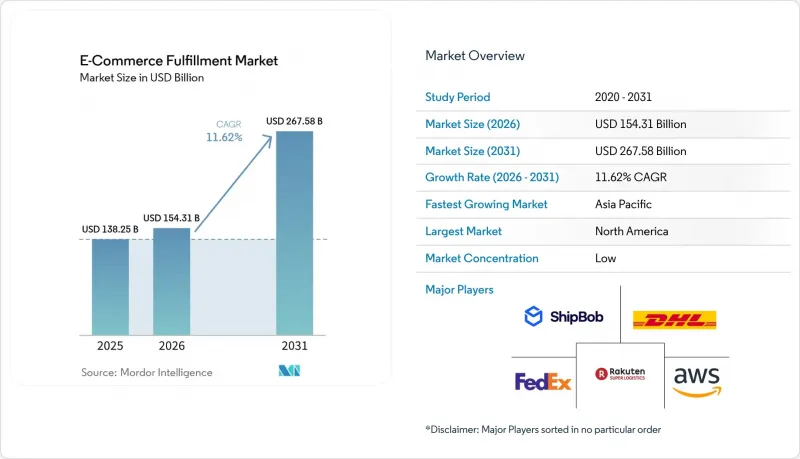
This report is Segmented by Service Type (Bundling Fulfilment Services, and More), Fulfilment Model (In-House Fulfilment, and More), Sales Channel (Direct-To-Consumer, Business-To-Consumer, and More), Enterprise Size (Small and Medium Enterprises, Large Enterprises), Application (Automotive, Beauty and Personal Care, and More), and Geography. The Market Forecasts are Provided in Terms of Value (USD).
Global E-Commerce Fulfillment Market Trends and Insights
SMEs outsourcing fulfillment to 3PLs in North America
Small and medium enterprises across the United States and Canada are reallocating capital away from in-house logistics toward external specialists to gain scalability and technology access. Robotics-enabled 3PL campuses provide 24-hour pick-and-pack operations, driving error rates below 1% and compressing order-to-ship windows from minutes to seconds. Freight consolidation services shorten transit lanes and enable zone-skipping strategies, which lower parcel costs and improve delivery predictability. The trend allows SMEs to match the service benchmarks of national retailers without heavy fixed investments, enhancing competitiveness within the e-commerce fulfillment market.
Cross-border Chinese sellers using EU bonded hubs
Chinese merchants are placing inventory inside European Union bonded warehouses to bypass customs delays and shorten delivery times to under three days for priority customers. The approach is reshaping European network design, triggering carrier diversification and real-time inventory allocation across regional micro-fulfillment sites. Established European retailers are accelerating integration of dynamic clearance tools and localized returns processing to defend share. Bonded hubs are also spurring demand for specialized last-mile partners capable of customs-compliant, low-touch hand-offs, reinforcing competitive intensity in the e-commerce fulfillment market.
Labor shortage and wage inflation in Inland Empire, US
Industrial vacancy increases and trucking deficits in southern California elevate wage expectations, lift cost-per-unit, and limit peak-season capacity. Operators accelerate deployment of autonomous forklifts and AMRs to sustain throughput with fewer staff and to hedge against churn. Asset-light network designs with multi-tenant hubs spread labor risk geographically, though real-estate costs rise as firms seek alternative nodes. These adjustments temporarily compress margins within the e-commerce fulfillment market.
Other drivers and restraints analyzed in the detailed report include:
- Social-commerce micro-fulfillment in Southeast Asia
- Same-day delivery automation in urban markets
- EU sustainability and packaging-waste regulations
For complete list of drivers and restraints, kindly check the Table Of Contents.
Segment Analysis
Shipping fulfillment services led with a 40.65% share in 2025, underlining their indispensable role in the e-commerce fulfillment market. Network densification, zone-skipping lanes, and dynamic carrier selection are optimizing delivery cost and reliability. The segment increasingly deploys predictive routing powered by real-time traffic and weather data to sustain on-time performance. Bundling fulfillment services, forecast to grow at 14.61% CAGR, package returns management, personalization, and customer care into a single invoice, enabling merchants to convert logistics from a cost center to a loyalty lever. Improved forecast accuracy and SKU rationalization within bundled contracts streamline inventory turns and boost gross margins.
Warehousing and storage fulfillment continues to modernize through robot-to-goods systems that expand cubic storage and compress travel paths, delivering a 20% productivity uplift. Other niche services, such as custom kitting and subscription box assembly, act as brand signature touchpoints, reinforcing customer engagement and extending lifetime value. Collectively, these services expand addressable revenue pools inside the e-commerce fulfillment market.
Third-party logistics providers captured 59.25% of 2025 revenues, validating outsourcing as the dominant configuration in the e-commerce fulfillment market. 3PLs leverage occupancy-based pricing and shared automation to drive down per-unit cost and provide capacity elasticity during promotional spikes. Dropshipping, set to rise at 22.46% CAGR, allows merchants to test assortments without inventory exposure and to penetrate micro-niches through supplier direct-ship models. Cloud-based storefront connectors automate order routing to manufacturers, shortening time-to-market for new SKUs. In-house fulfillment remains meaningful for brands requiring strict product stewardship or regulated handling, yet rising automation capital burdens constrain wider adoption. Hybrid models integrate store back-rooms, 3PLs, and manufacturer ship-from-source to balance speed, cost, and control across the e-commerce fulfillment market.
Geography Analysis
North America, accounting for 31.70% of global revenue in 2025, benefits from mature interstate transport corridors and high consumer spending power. Automation adoption mitigates wage inflation and worker scarcity in logistics clusters, while electric vehicle deployments reduce urban emissions. Canada's strategic positioning supports trans-Pacific and trans-Atlantic consolidation, creating cross-border synergies within the e-commerce fulfillment market.
Asia-Pacific is the fastest-growing region at a 14.76% CAGR, propelled by rising disposable incomes and mobile-commerce penetration. China's RMB 21.4 trillion cross-border e-commerce sector anchors regional outbound flows, while India's Grade-A warehousing incentives improve capacity quality and supply chain visibility. Southeast Asian nations leverage fast-fashion social commerce to deploy micro-fulfillment spokes, compressing lead times in dense urban settings. These dynamics expand service uptake across the e-commerce fulfillment market.
Europe demonstrates robust network modernization as bonded hubs and sustainability regulations reshape fulfillment strategies. The EU's regulatory push toward recyclable packaging and Scope 3 emissions reporting accelerates investment in right-sized packing automation and carbon-accounting platforms. United Kingdom, Germany, and France lead in omnichannel integration and zero-emission last-mile pilots, elevating operational standards. Meanwhile, Latin America and the Middle East and Africa register rapid e-commerce adoption, creating greenfield opportunities for providers skilled in navigating infrastructure constraints and customs complexity within the e-commerce fulfillment market.
- Amazon.com, Inc.
- FedEx Corporation
- United Parcel Service, Inc.
- DHL Supply Chain & Global Forwarding (Deutsche Post AG)
- Rakuten Group, Inc.
- Ingram Micro, Inc.
- ShipBob, Inc.
- Red Stag Fulfillment, LLC
- Shipfusion Inc.
- Xpert Fulfillment, LLC
- Sprocket Express, LLC
- eFulfillment Service, Inc.
- Shopify Inc.
- Alibaba Group Holding Ltd.
- JD Logistics, Inc.
- Flipkart Internet Pvt Ltd
- Royal Mail plc
- Aramex International LLC
- SF Holding Co., Ltd.
- ZTO Express (Cayman) Inc.
- Walmart Inc.
Additional Benefits:
- The market estimate (ME) sheet in Excel format
- 3 months of analyst support
TABLE OF CONTENTS
1 INTRODUCTION
- 1.1 Study Assumptions and Market Definition
- 1.2 Scope of the Study
2 RESEARCH METHODOLOGY
3 EXECUTIVE SUMMARY
4 MARKET LANDSCAPE
- 4.1 Market Overview
- 4.2 Market Drivers
- 4.2.1 Consumer SMEs' Outsourcing to 3PLs in North America
- 4.2.2 Cross-border Chinese Sellers Driving EU Bonded Hubs
- 4.2.3 Fast-Fashion Social Commerce Fuelling Micro-fulfilment in SE-Asia
- 4.2.4 Same-day Delivery Mandates Triggering Urban Automation in US and EU
- 4.2.5 Indian Grade-A Warehouse Parks Enabled by Government Incentives
- 4.2.6 Retail-media Data Monetisation Creating Fulfilment Analytics Revenue
- 4.3 Market Restraints
- 4.3.1 Labour Shortage and Wage Inflation in Inland Empire, US
- 4.3.2 EU CSRD and Packaging-waste Rules Inflating Compliance Costs
- 4.3.3 Port Congestion and Red-Sea Disruption Volatility
- 4.3.4 Air-Freight Carbon-reduction Pledges Limiting Express Options
- 4.4 Value Chain Analysis
- 4.5 Regulatory Outlook
- 4.6 Porter's Five Forces Analysis
- 4.6.1 Threat of New Entrants
- 4.6.2 Bargaining Power of Buyers/Consumers
- 4.6.3 Bargaining Power of Suppliers
- 4.6.4 Threat of Substitutes
- 4.6.5 Intensity of Competitive Rivalry
- 4.7 Pricing Analysis
- 4.8 Assessment of Macro Economic Trends on the Market
5 MARKET SIZE AND GROWTH FORECASTS (VALUES)
- 5.1 By Service Type
- 5.1.1 Warehousing and Storage Fulfilment Services
- 5.1.2 Bundling Fulfilment Services
- 5.1.3 Shipping Fulfilment Services
- 5.1.4 Other Niche / Value-added Services
- 5.2 By Fulfilment Model
- 5.2.1 In-house Fulfilment
- 5.2.2 Third-Party Fulfilment (3PL)
- 5.2.3 Dropshipping
- 5.2.4 Hybrid Fulfilment
- 5.3 By Sales Channel
- 5.3.1 Direct-to-Consumer (D2C)
- 5.3.2 Business-to-Consumer (B2C Marketplace)
- 5.3.3 Business-to-Business (B2B)
- 5.4 By Enterprise Size
- 5.4.1 Small and Medium Enterprises (SMEs)
- 5.4.2 Large Enterprises
- 5.5 By Application
- 5.5.1 Automotive
- 5.5.2 Beauty and Personal Care
- 5.5.3 Books and Stationery
- 5.5.4 Consumer Electronics
- 5.5.5 Healthcare
- 5.5.6 Clothing and Footwear
- 5.5.7 Home and Kitchen
- 5.5.8 Sports and Leisure
- 5.5.9 Other Applications
- 5.6 By Geography
- 5.6.1 North America
- 5.6.1.1 United States
- 5.6.1.2 Canada
- 5.6.1.3 Mexico
- 5.6.2 Europe
- 5.6.2.1 United Kingdom
- 5.6.2.2 Germany
- 5.6.2.3 France
- 5.6.2.4 Italy
- 5.6.2.5 Rest of Europe
- 5.6.3 Asia-Pacific
- 5.6.3.1 China
- 5.6.3.2 Japan
- 5.6.3.3 India
- 5.6.3.4 South Korea
- 5.6.3.5 Rest of Asia-Pacific
- 5.6.4 South America
- 5.6.4.1 Brazil
- 5.6.4.2 Argentina
- 5.6.4.3 Rest of South America
- 5.6.5 Middle East
- 5.6.5.1 United Arab Emirates
- 5.6.5.2 Saudi Arabia
- 5.6.5.3 Rest of Middle East
- 5.6.6 Africa
- 5.6.6.1 South Africa
- 5.6.6.2 Rest of Africa
- 5.6.1 North America
6 COMPETITIVE LANDSCAPE
- 6.1 Market Concentration
- 6.2 Strategic Moves
- 6.3 Market Share Analysis
- 6.4 Company Profiles (includes Global level Overview, Market level overview, Core Segments, Financials as available, Strategic Information, Market Rank/Share for key companies, Products and Services, and Recent Developments)
- 6.4.1 Amazon.com, Inc.
- 6.4.2 FedEx Corporation
- 6.4.3 United Parcel Service, Inc.
- 6.4.4 DHL Supply Chain & Global Forwarding (Deutsche Post AG)
- 6.4.5 Rakuten Group, Inc.
- 6.4.6 Ingram Micro, Inc.
- 6.4.7 ShipBob, Inc.
- 6.4.8 Red Stag Fulfillment, LLC
- 6.4.9 Shipfusion Inc.
- 6.4.10 Xpert Fulfillment, LLC
- 6.4.11 Sprocket Express, LLC
- 6.4.12 eFulfillment Service, Inc.
- 6.4.13 Shopify Inc.
- 6.4.14 Alibaba Group Holding Ltd.
- 6.4.15 JD Logistics, Inc.
- 6.4.16 Flipkart Internet Pvt Ltd
- 6.4.17 Royal Mail plc
- 6.4.18 Aramex International LLC
- 6.4.19 SF Holding Co., Ltd.
- 6.4.20 ZTO Express (Cayman) Inc.
- 6.4.21 Walmart Inc.
7 MARKET OPPORTUNITIES AND FUTURE OUTLOOK
- 7.1 White-space and Unmet-Need Assessment

