PUBLISHER: Mordor Intelligence | PRODUCT CODE: 2065790

PUBLISHER: Mordor Intelligence | PRODUCT CODE: 2065790
Jackfruit - Market Share Analysis, Industry Trends & Statistics, Growth Forecasts (2026 - 2031)
According to Mordor Intelligence, the jackfruit market size is anticipated to increase from USD 356.67 million in 2025 to USD 375.31 million in 2026 and reach USD 483.93 million by 2031, growing at a CAGR of 5.22% over 2026-2031.
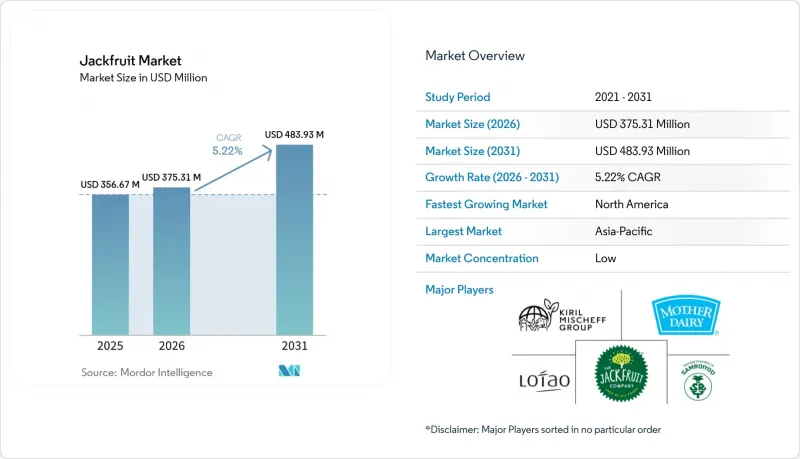
This report is Segmented by Product Type (Fresh Consumption, Food Processing, Beverage Processing, and More), by Sales Channel (Supermarkets and Hypermarkets, Convenience Stores, Specialty Stores, Online Retail, and Foodservice and Wholesale), and by Geography (North America, South America, Europe, Asia-Pacific, Middle East, and Africa). The Market Forecasts are Provided in Value (USD).
Global Jackfruit Market Trends and Insights
Plant-Based Meat Alternative Adoption
Young jackfruit has a fibrous structure that allows it to mimic pulled meat applications without relying on extrusion or isolated proteins, giving the jackfruit market a distinct place in the wider plant-based foods space. The Good Food Institute reported that shreds, chunks, and strips, the core commercial form that includes jackfruit products, posted 8% unit sales growth in 2025 and 14% unit growth in the natural channel, even as the broader United States retail plant-based meat and seafood category declined 10% in dollar sales . That pattern suggests that buyers are still willing to purchase products that feel less engineered and more recognizable, which supports a longer runway for plant-based jackfruit within the jackfruit market. Performance Food Group reinforced that commercial case in November 2024 when it launched the FarmSmart Beef and Jackfruit Burger with the Jackfruit Company, a product distributed through its foodservice network and positioned with 40% less saturated fat and 40% lower cholesterol than a 100% beef burger. As foodservice buyers test blended formats with familiar eating quality, the jackfruit market gains access to a broader operator base that may not have adopted fully plant-based menu items at scale.
Health and Fiber-Led Consumer Positioning
Health messaging is becoming increasingly important in the jackfruit market because jackfruit aligns with consumer demand for recognizable ingredients, fiber, and simpler product labels. Companies such as The Jackfruit Company have positioned jackfruit as a whole-food meat alternative with a naturally fibrous texture and clean-label appeal, supporting broader consumer interest in minimally processed plant-based meal options. The Good Food Institute found that consumers who view plant-based meat as healthier, including for higher fiber and lower saturated fat, tend to spend more in the category, which matters for premium plant-based jackfruit products. This is helping the jackfruit market appeal to flexitarian households that are not necessarily seeking a perfect meat replica, but do want a whole-food option that feels easier to trust. In practical terms, health-led positioning is expanding the jackfruit market's consumer base beyond tropical familiarity into broader clean-label meal occasions.
High Perishability and Post-Harvest Losses
High perishability remains a significant restraint in the jackfruit market, as it reduces the usable supply before processors or exporters can generate revenue from the fruit. A 2025 assessment published in the International Journal of Environmental & Agriculture Research (IJOEAR) reported that postharvest fruit and vegetable losses in Sri Lanka had previously reached 30-40%, underscoring the broader spoilage risks affecting tropical fruits such as jackfruit in markets with limited cold-chain infrastructure and inadequate handling systems. Supporting this issue, a 2025 study published in the Journal of Current Science and Technology found that untreated jackfruit deteriorated rapidly during storage, whereas treatments with hydrogen peroxide and 1-MCP were necessary to significantly reduce disease incidence and weight loss. This challenge creates a difficult commercial cycle in the jackfruit market, where farmers often encounter price declines during peak seasons, while processors face shortages of usable quality outside limited procurement periods. Without increased adoption of cold storage and value-added processing, the jackfruit market will continue to experience avoidable waste and unstable supply dynamics.
Other drivers and restraints analyzed in the detailed report include:
- Processed Format Expansion Across Retail and Foodservice
- Product Innovation in Snacks, Ready Meals, and Beverages
- Seasonal Supply Swings and Cold-Chain Gaps
For complete list of drivers and restraints, kindly check the Table Of Contents.
Segment Analysis
Food processing accounted for 45.9% of the jackfruit market size in 2025 and remained the largest product type, as it already has the strongest trade and processing infrastructure. The largest segment benefits from established demand for canned, pouch, frozen, and ready-to-cook formats that are easier to export and easier for foodservice buyers to use. Fresh consumption still holds an important place in producing countries, but it plays a smaller commercial role in the global jackfruit market because of perishability, preparation difficulty, and uneven cold-chain access, which limit wider trade. Beverage Processing is still emerging, yet the scientific literature already points to juice and ready-to-serve beverage pathways that could widen commercial use in the jackfruit industry over time. Functional and health products remain at an early stage, though seed- and flour-based product types suggest the jackfruit market can move into more specialized food and ingredient formats as commercialization improves.
Plant-based meat products are the fastest-growing product type segment, projected to grow at a 6.7% CAGR during 2026-2031, keeping it ahead of the broader jackfruit market. A 2025 study by the ICAR-Indian Institute of Horticultural Research, which evaluated 94 jackfruit accessions in southern Karnataka, reported flake recovery rates ranging from 15.8% to 49.7%. This indicates significant variability in edible yield and processing suitability among the cultivars . The study further observed that accessions with thicker, crunchier flakes and lower rind weight demonstrated greater potential for commercial use and value-added processing. Fiber foods also received commercial orders in early 2025 from major Dutch meat producers for liver sausage, burgers, and croquettes using its PrimeJack ingredient, which confirms that adoption is moving into business-to-business manufacturing channels. As a result, the fastest-growing segment is built on repeat industrial use rather than short-lived novelty, giving the jackfruit market a firmer growth base through 2031.
Geography Analysis
Asia-Pacific accounted for 70.3% of the jackfruit market share in 2025 and remained the largest regional base for production, consumption, and primary processing. India, Bangladesh, Thailand, and Indonesia continue to anchor the jackfruit market in the region because they combine large agricultural output with established familiarity in local diets. The Food and Agriculture Organization identified jackfruit as Bangladesh's priority product under the One Country One Priority Product initiative, indicating that value-added export development is becoming a policy focus rather than solely a private-sector effort. Even so, the region still carries major postharvest losses and commercialization gaps, which hold back the full revenue potential of the jackfruit market despite abundant fruit supply. Growth in Asia-Pacific is therefore supported more by improved processing, storage, and export formalization than by basic supply growth alone.
North America is the fastest regional segment in the jackfruit market and is projected to grow at a 6.5% CAGR during 2026-2031. Mainstream plant-based eating occasions, whole-food product positioning, and wider retail and foodservice penetration beyond specialty vegan channels are supporting demand in this region. Walmart and Target are offering shelf placement for plant-based snacks and meat alternatives that include jackfruit jerky, ready-to-cook pulled jackfruit, and frozen meal kits, signaling stronger acceptance of jackfruit products in mass retail rather than only natural food stores. Whole Foods Market and Sprouts Farmers Market also increased visibility of clean-label tropical fruit snacks and minimally processed meat alternatives, supporting premium positioning for jackfruit-based products across North America. At the same time, brands such as Upton's Naturals and Big Mountain Foods are offering barbecue-style and spicy jackfruit snack offerings targeted at flexitarian consumers seeking recognizable ingredients and lower-processed alternatives to soy-based meat substitutes. These developments indicate that North American demand growth is increasingly tied to mainstream retail accessibility, convenience-driven plant-based meals, and clean-label snacking trends rather than niche vegan consumption alone.
Europe is the next important growth market for jackfruit, as retailers, ingredient suppliers, and meat processors are testing more processed and blended formats. Kiril Mischeff's 2025 push for ready-to-use jackfruit pouches and Fiber Foods' 2025 orders from Dutch meat producers show that Europe is building both retail-facing and manufacturing-facing demand. South America is earlier in formal commercialization, yet it has long-term potential for local production to support low-cost processing and regional product development. The Middle East and Africa are still smaller in terms of current demand, but they are gaining relevance as import markets and as potential future supply locations for value-added ingredients. Over the longer term, the jackfruit market could see a broader production map if African processors scale near-source dehydration and other shelf-life-enhancing formats for export.
- The Jackfruit Company
- Mother Dairy Fruit and Vegetable Private Limited (National Dairy Development Board)
- Cabello Fresh Produce LLC
- Kiril Mischeff Limited
- Samroiyod Corporation Ltd.
- Thai Agri Foods Public Company Limited
- Edward & Sons Trading Co., Inc.
- Diet Fibre 365 Food Products Private Limited (Group Meeran)
- Nature's Charm Co., Ltd.
- Ecoideas Innovations Inc.
- LOTAO GmbH
- Anna Food Products
- Jackfruit Origins
- Jakana Foods Ltd.
- Dr Jackfruit India Private Limited
Additional Benefits:
- The market estimate (ME) sheet in Excel format
- 3 months of analyst support
TABLE OF CONTENTS
1 Introduction
- 1.1 Study Assumptions and Market Definition
- 1.2 Scope of the Study
2 Research Methodology
3 Executive Summary
4 Market Landscape
- 4.1 Market Overview
- 4.2 Market Drivers
- 4.2.1 Plant-based meat alternative adoption
- 4.2.2 Health and fiber-led consumer positioning
- 4.2.3 Processed format expansion across retail and foodservice
- 4.2.4 Product innovation in snacks, ready meals, and beverages
- 4.2.5 By-product valorization into flour, pectin, and biomaterials
- 4.2.6 Shelf-life extension through HPP, MAP, and advanced drying
- 4.3 Market Restraints
- 4.3.1 High perishability and post-harvest losses
- 4.3.2 Seasonal supply swings and cold-chain gaps
- 4.3.3 Export compliance bottlenecks in origin markets
- 4.3.4 Limited harvest standardization and orchard commercialization
- 4.4 Regulatory Landscape
- 4.5 Technological Outlook
- 4.6 Porter's Five Forces Analysis
- 4.6.1 Bargaining Power of Suppliers
- 4.6.2 Bargaining Power of Buyers
- 4.6.3 Threat of New Entrants
- 4.6.4 Threat of Substitutes
- 4.6.5 Intensity of Competitive Rivalry
5 Market Size and Growth Forecasts (Value)
- 5.1 By Product Type
- 5.1.1 Fresh Consumption
- 5.1.2 Food Processing
- 5.1.3 Beverage Processing
- 5.1.4 Functional and Health Products
- 5.1.5 Plant-Based Meat Products
- 5.2 By Sales Channel
- 5.2.1 Supermarkets and Hypermarkets
- 5.2.2 Convenience Stores
- 5.2.3 Specialty Stores
- 5.2.4 Online Retail
- 5.2.5 Foodservice and Wholesale
- 5.3 By Geography
- 5.3.1 North America
- 5.3.1.1 United States
- 5.3.1.2 Canada
- 5.3.1.3 Mexico
- 5.3.1.4 Rest of North America
- 5.3.2 South America
- 5.3.2.1 Brazil
- 5.3.2.2 Argentina
- 5.3.2.3 Rest of South America
- 5.3.3 Europe
- 5.3.3.1 Germany
- 5.3.3.2 United Kingdom
- 5.3.3.3 France
- 5.3.3.4 Italy
- 5.3.3.5 Spain
- 5.3.3.6 Russia
- 5.3.3.7 Rest of Europe
- 5.3.4 Asia-Pacific
- 5.3.4.1 India
- 5.3.4.2 China
- 5.3.4.3 Japan
- 5.3.4.4 Australia
- 5.3.4.5 New Zealand
- 5.3.4.6 Rest of Asia-Pacific
- 5.3.5 Middle East
- 5.3.5.1 Saudi Arabia
- 5.3.5.2 United Arab Emirates
- 5.3.5.3 Turkey
- 5.3.5.4 Rest of Middle East
- 5.3.6 Africa
- 5.3.6.1 South Africa
- 5.3.6.2 Nigeria
- 5.3.6.3 Egypt
- 5.3.6.4 Rest of Africa
- 5.3.1 North America
6 Competitive Landscape
- 6.1 Market Concentration
- 6.2 Strategic Moves
- 6.3 Market Share Analysis
- 6.4 Company Profiles (Includes Global Level Overview, Market Level Overview, Core Segments, Financials as Available, Strategic Information, Market Rank/Share for Key Companies, Products and Services, and Recent Developments)
- 6.4.1 The Jackfruit Company
- 6.4.2 Mother Dairy Fruit and Vegetable Private Limited (National Dairy Development Board)
- 6.4.3 Cabello Fresh Produce LLC
- 6.4.4 Kiril Mischeff Limited
- 6.4.5 Samroiyod Corporation Ltd.
- 6.4.6 Thai Agri Foods Public Company Limited
- 6.4.7 Edward & Sons Trading Co., Inc.
- 6.4.8 Diet Fibre 365 Food Products Private Limited (Group Meeran)
- 6.4.9 Nature's Charm Co., Ltd.
- 6.4.10 Ecoideas Innovations Inc.
- 6.4.11 LOTAO GmbH
- 6.4.12 Anna Food Products
- 6.4.13 Jackfruit Origins
- 6.4.14 Jakana Foods Ltd.
- 6.4.15 Dr Jackfruit India Private Limited
7 Market Opportunities and Future Outlook

