PUBLISHER: Mordor Intelligence | PRODUCT CODE: 2065791

PUBLISHER: Mordor Intelligence | PRODUCT CODE: 2065791
China Table Grapes - Market Share Analysis, Industry Trends & Statistics, Growth Forecasts (2026 - 2031)
According to Mordor Intelligence, the china table grapes market size is projected to grow from USD 29.64 billion in 2025 to USD 30.53 billion in 2026 and USD 35.40 billion by 2031, with a CAGR of 3.0% from 2026 to 2031.
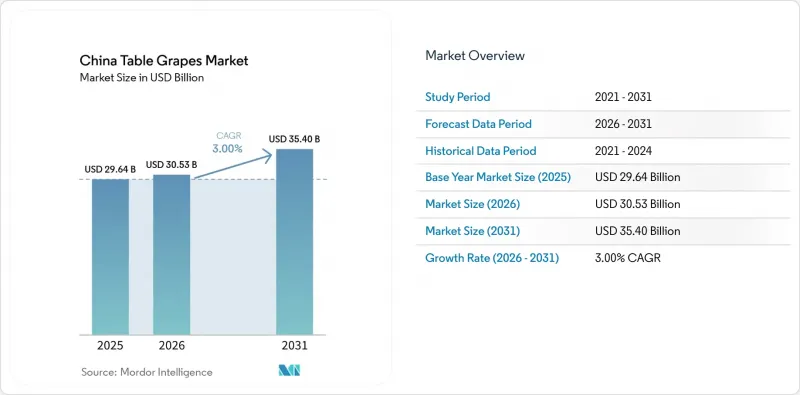
The Report Covers the China Table Grapes Market, Including Production Analysis (Volume), Consumption Analysis (Value and Volume), Import Analysis (Value and Volume), Export Analysis (Value and Volume), Wholesale Price Trend Analysis, and Forecast, and More. The Report Offers Market Size and Forecasts Regarding Value (USD) and Volume (Metric Tons).
China Table Grapes Market Trends and Insights
Favorable Government Incentives for Protected Cultivation
Government-supported investments in irrigation and modern farming infrastructure are enhancing protected cultivation practices in China's table grapes market. In the key grape-producing region of Turpan in Xinjiang, authorities allocated ¥958 million (USD 134 million) in 2025 to develop grid infrastructure, facilitating water-saving irrigation across 630,000 mu of vineyards. This investment has enabled the implementation of efficient micro-spray systems, reducing dependence on traditional flood irrigation methods. These systems enhance water-use efficiency, lower operational costs for growers, and stabilize production in arid climatic conditions.
Rising Disposable Income and Premium-Fruit Spending
Rising income levels in China are driving increased demand for premium fruit, boosting higher-value segments within the table grapes market. According to the National Bureau of Statistics of China, per capita disposable income reached CNY 41,314 (USD 5,700) in 2024, reflecting a 5.3% year-on-year increase. This consistent income growth is fostering a shift from traditional grape varieties to premium, seedless, and branded cultivars that command higher prices. Urban consumers are placing greater emphasis on quality, food safety, and product origin, leading to stronger demand for produce grown under protected cultivation. This trend allows growers to sustain price premiums and supports the development of a value-tiered market structure within China's table grapes industry.
Pest and Disease Pressure Despite Integrated Pest Management (IPM) Adoption
Pest and disease pressures continue to pose significant challenges to grape production in China, even with the implementation of integrated pest management practices. Persistent fungal diseases, such as downy mildew and gray mold, often require repeated pesticide applications, which heightens the risk of resistance development and regulatory compliance issues. According to China's updated national food safety standard, GB 2763-2026, the government has established 10,749 maximum residue limits for 585 pesticides in food, significantly tightening regulatory requirements for fruit producers. This rigorous framework increases the risk of residue non-compliance, particularly for growers dealing with recurring infestations, while also driving up production costs and exacerbating disparities between smallholders and technologically advanced farms.
Other drivers and restraints analyzed in the detailed report include:
- Heightened Health and Wellness Awareness
- Expansion of Cold-Chain Logistics Nationwide
- Intense Price Competition from Oversupply of Shine Muscat
For complete list of drivers and restraints, kindly check the Table Of Contents.
Additional Benefits:
- The market estimate (ME) sheet in Excel format
- 3 months of analyst support
TABLE OF CONTENTS
1 Introduction
- 1.1 Study Assumptions and Market Definition
- 1.2 Scope of the Study
2 Research Methodology
3 Executive Summary
4 Market Landscape
- 4.1 Market Overview
- 4.2 Market Drivers
- 4.2.1 Favorable government incentives for protected cultivation
- 4.2.2 Rising disposable income and premium-fruit spending
- 4.2.3 Heightened health and wellness awareness
- 4.2.4 Expansion of cold-chain logistics nationwide
- 4.2.5 Licensing of proprietary premium grape varieties
- 4.2.6 Live-stream and social-commerce channels boosting farmer margins
- 4.3 Market Restraints
- 4.3.1 Pest and disease pressure despite Integrated Pest Management (IPM) adoption
- 4.3.2 Intense price competition from oversupply of Shine Muscat
- 4.3.3 Soil degradation from over-fertilization and water stress
- 4.3.4 Labor availability and rising wage costs in rural regions
- 4.4 Opportunities
- 4.5 Challenges
- 4.6 Value Chain Analysis
- 4.7 Technologies and usage of AI in the Industry
- 4.8 Input Market Analysis
- 4.8.1 Seeds
- 4.8.2 Fertilizers
- 4.8.3 Crop Protection Chemicals
- 4.9 Distribution Channel Analysis
- 4.10 Market Sentiment Analysis
- 4.11 PESTLE Analysis
5 Market Size and Growth Forecasts (Value)
- 5.1 Production Analysis
- 5.1.1 Production Volume
- 5.1.1.1 Area Harvested and Yield
- 5.1.2 Consumption Analysis (Value and Volume)
- 5.1.3 Trade Analysis (Value and Volume)
- 5.1.3.1 Import Market Analysis
- 5.1.3.1.1 Import Value and Volume
- 5.1.3.1.2 Key Supplying Markets
- 5.1.3.2 Export Market Analysis
- 5.1.3.2.1 Export Value and Volume
- 5.1.3.2.2 Key Destinations Markets
- 5.1.3.1 Import Market Analysis
- 5.1.4 Wholesale Price Trend Analysis and Forecast
- 5.1.5 Regulatory Framework
- 5.1.6 Logistics and Infrastructure
- 5.1.7 Seasonality Analysis
- 5.1.1 Production Volume
6 End Use and Application
- 6.1 Primary Applications and Emerging Applications
- 6.2 Consumption Breakdown by Industries
7 Competitive Landscape
- 7.1 Overview of the Competition
- 7.2 Recent Developments
- 7.3 Market Concentration Analysis
- 7.4 List of Key Players
- 7.4.1 Joy Wing Mau Fruit Technologies Corporation Limited
- 7.4.2 Goodfarmer Foods Holding (Shenzhen) Co., Ltd.
- 7.4.3 Xinjiang Turpan Horticulture Group Co., Ltd.
- 7.4.4 Yunnan Haisheng Agriculture Co., Ltd.
- 7.4.5 Shaanxi Qinnong Modern Agriculture Group Co., Ltd.
- 7.4.6 Zhejiang Yiguo Fresh Network Technology Co., Ltd.
- 7.4.7 JD Fresh (Jingdong Zhongmai E-commerce Ltd.)
- 7.4.8 Freshippo (Alibaba Hema Network Technology Co., Ltd.)
- 7.4.9 Shenzhen Pagoda Industrial (Group) Corporation Limited
- 7.4.10 Dole (Shanghai) Fruits and Vegetables Trading Co., Ltd.
- 7.4.11 Sun World International LLC
- 7.4.12 Chilean Fruit Exporters Association
- 7.4.13 Zhangjiagang Shenyuan Grape Technology Co., Ltd.
- 7.4.14 Jinan Gogo International Trade Co., Ltd.
- 7.4.15 Shanxi Yancheng Trading Co., Ltd.
8 Market Opportunities and Future Outlook

