PUBLISHER: Mordor Intelligence | PRODUCT CODE: 2066370

PUBLISHER: Mordor Intelligence | PRODUCT CODE: 2066370
Cloud High Performance Computing (HPC) - Market Share Analysis, Industry Trends & Statistics, Growth Forecasts (2026 - 2031)
According to Mordor Intelligence, the cloud high performance computing market size was valued at USD 35.21 billion in 2025 and estimated to grow from USD 37.07 billion in 2026 to reach USD 47.93 billion by 2031, at a CAGR of 5.28% during the forecast period (2026-2031).
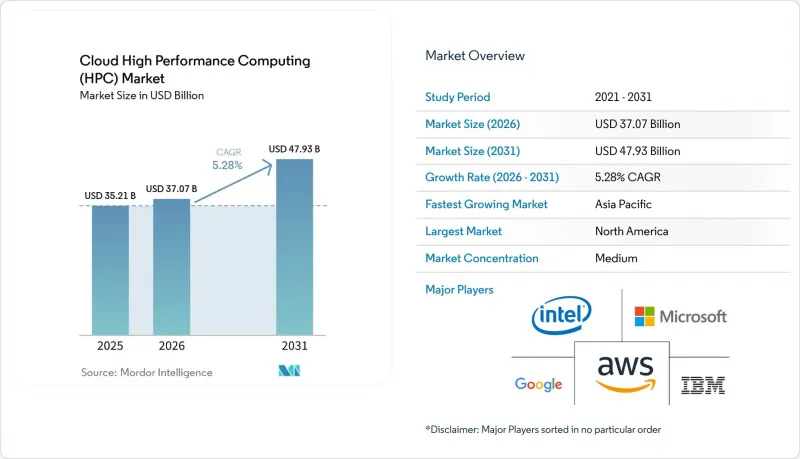
This report is Segmented by Component (Hardware, Software, and Services), Deployment Model (Public Cloud, and More), Service Model (Infrastructure As A Service, and More), Industrial Application (Aerospace and Defense, and More), Organization Size (Large Enterprises, and Small and Medium Enterprises), and Geography. The Market Forecasts are Provided in Terms of Value (USD).
Global Cloud High Performance Computing (HPC) Market Trends and Insights
Surging AI and Generative Workloads in Cloud HPC
Artificial intelligence training now consumes 40% of total cloud HPC cycles, up from 15% in 2022, a leap that reflects the compute-hungry nature of transformer-based language and vision models. Large batch sizes, distributed data-parallel algorithms, and fine-tuned hyper-parameter searches require thousands of GPUs for days at a time, conditions that correlate poorly with fixed on-premises capacity. Cloud platforms, therefore, supply elastic clusters that can be spun up for model training and spun down once validation is complete, minimizing idle capital. In 2024, Amazon Web Services released Deadline Cloud for scalable AI-assisted media rendering, signaling the depth of workload-tailored offerings. Defense and pharmaceutical organizations follow a similar pattern, utilizing cloud supercomputing for language-driven molecular design and autonomous vehicle perception pipelines, thereby shortening R&D loops and compressing time-to-insight.
Rapid Expansion of High-Bandwidth Interconnects and Accelerators
Next-generation fabrics, such as NVIDIA Quantum-2 InfiniBand and emerging 800-Gigabit Ethernet links, now deliver microsecond-level latency, enabling tightly coupled message-passing applications to run in the cloud without significant performance penalties. GPU advances, led by NVIDIA-based Grace Hopper superchips and Intel's Ponte Vecchio data-center GPUs, increase per-node throughput while improving energy efficiency.Hyperscalers are increasingly integrating custom ASICs to balance compute, memory, and network flows, effectively bridging the historical gaps between commercial clouds and national lab supercomputers. These technical leaps are pivotal for weather prediction, crash simulation, and seismic imaging solutions that rely on dense, low-latency node interconnects.
Elevated Cloud Egress and Data-Movement Costs
For multi-petabyte simulations, outbound data charges can eclipse compute fees by 200%, eroding the savings realized from on-demand resources. Genomics pipelines, seismic imaging, and high-density Monte Carlo workloads repeatedly shuttle intermediate files between object stores, databases, and downstream analytics platforms, amplifying the egress bill with each iteration. While hyperscalers have introduced reduced-tariff research channels and offline transfer appliances, the foundational economics remain challenging. Organizations therefore weigh architecture choices that minimize data round-trips, adopt in-situ analytics, or colocate post-processing near the simulation nodes, yet each workaround carries new operational complexity.
Other drivers and restraints analyzed in the detailed report include:
- Growing Adoption of Hybrid and Multicloud HPC Strategies
- Increasing Availability of HPC-Optimized Cloud Instances
- Talent Shortage in Cloud-Native HPC Operations
For complete list of drivers and restraints, kindly check the Table Of Contents.
Segment Analysis
Hardware contributed 44.12% of 2025 revenue, underscoring the capital-intensive nature of datacenter racks loaded with GPUs, high-bandwidth memory, and NVMe-backed storage arrays. NVIDIA confirmed that cloud providers form its fastest-growing commercial channel, a testament to ongoing spending on accelerators and interconnect switches. Vendors anchor differentiation around node density, energy efficiency, and thermally optimized form factors, as fleet operators chase lower watts per teraflop.
Software, however, posts the highest momentum, with an expected 8.42% CAGR through 2031, driven by schedulers that tune allocations in real-time, AI-assisted performance profilers, and workflow managers that span multicloud and hybrid estates. The expansion of the Cloud High Performance Computing market size on the software side also benefits from subscription licensing models that align costs with active use minutes, shifting budgets from capital to operating expenses.
The public cloud garnered 67.95% share in 2025 and remains the backbone for elastic, project-based simulation bursts that characterize media rendering, computer-aided engineering, and life sciences searches. Providers win workloads by exposing granular billing meters, utilizing spot pools for non-urgent jobs, and maintaining regional zones to comply with data-residency laws.
Private cloud, while smaller, is projected to log a 7.52% CAGR as regulated verticals emphasize deterministic latency and sovereign control. Enterprises craft internal clouds atop converged HPC appliances that mimic the elasticity of hyperscale data centers while maintaining air-gapped security. Hybrid orchestrators integrate these estates, presenting users with a single submission portal that assigns jobs based on cost curves and queue depth.
Geography Analysis
North America retained 39.94% share in 2025, supported by dense hyperscale footprints and federally backed exascale initiatives that validate cloud-first architectures. Continuous improvement funds from defense and space agencies feed sustained demand for advanced simulation, while a vibrant commercial ecosystem of semiconductor design, autonomous systems, and digital media consolidates regional leadership. Regulatory clarity regarding data export and encryption further accelerates cloud HPC adoption in heavily controlled industries.
The Asia-Pacific region records the highest forward growth at a 8.77% CAGR as governments earmark billions for sovereign AI and semiconductor design capacity. China increases cloud HPC budgets despite export constraints on advanced accelerators by investing in homegrown GPU alternatives and quantum-classical hybrid centers. Japan aligns HPC roadmaps with Society 5.0, pushing edge-to-cloud integration for smart manufacturing, while India's Digital Public Infrastructure initiative creates demand for large-scale language modeling in regional dialects. Regional telcos partner with hyperscalers to host in-country availability zones, alleviating data-locality concerns and facilitating broader market entry.
Europe commands a strong though more measured trajectory, aided by the European High-Performance Computing Joint Undertaking that co-finances petascale systems within EU borders. Automotive OEMs in Germany offload aerodynamic simulations to cloud instances when factory clusters max out, and renewable energy operators in the Nordics harness low-carbon datacenters driven by abundant hydro power. GDPR compliance stimulates hybrid adoption patterns, keeping sensitive telemetry on-premises but using cloud scale for large design-of-experiments runs. National digital strategies and carbon-neutral targets jointly influence procurement models, nudging adoption toward green-certified cloud regions.
- Amazon Web Services Inc.
- Microsoft Corporation
- Google LLC
- International Business Machines Corporation
- Hewlett Packard Enterprise Company
- Dell Technologies Inc.
- NVIDIA Corporation
- Advanced Micro Devices Inc.
- Intel Corporation
- Lenovo Group Limited
- NEC Corporation
- Fujitsu Limited
- Sugon Information Industry Co. Ltd.
- Atos SE
- Dassault Systemes SE
- Oracle Corporation
- Huawei Technologies Co., Ltd.
- Alibaba Group Holding Limited (Alibaba Cloud)
- Rescale Inc.
- Penguin Computing Inc.
Additional Benefits:
- The market estimate (ME) sheet in Excel format
- 3 months of analyst support
TABLE OF CONTENTS
1 INTRODUCTION
- 1.1 Study Assumptions and Market Definition
- 1.2 Scope of the Study
2 RESEARCH METHODOLOGY
3 EXECUTIVE SUMMARY
4 MARKET LANDSCAPE
- 4.1 Market Overview
- 4.2 Market Drivers
- 4.2.1 Surging AI and Generative Workloads in Cloud HPC
- 4.2.2 Rapid Expansion of High-Bandwidth Interconnects and Accelerators
- 4.2.3 Growing Adoption of Hybrid and Multicloud HPC Strategies
- 4.2.4 Increasing Availability of HPC-Optimized Cloud Instances
- 4.2.5 Demand for Sustainability-Focused HPC Infrastructure
- 4.2.6 Government-Funded Exascale and Sovereign AI Initiatives
- 4.3 Market Restraints
- 4.3.1 Elevated Cloud Egress and Data-Movement Costs
- 4.3.2 Talent Shortage in Cloud-Native HPC Operations
- 4.3.3 Export Controls on Advanced Accelerators
- 4.3.4 Latency-Sensitive Workloads Still Favor On-Premises Clusters
- 4.4 Industry Value Chain Analysis
- 4.5 Regulatory Landscape
- 4.6 Technological Outlook
- 4.7 Porter's Five Forces Analysis
- 4.7.1 Threat of New Entrants
- 4.7.2 Bargaining Power of Buyers
- 4.7.3 Bargaining Power of Suppliers
- 4.7.4 Threat of Substitute Products
- 4.7.5 Intensity of Competitive Rivalry
- 4.8 Impact of Macroeconomic Factors on the Market
5 MARKET SIZE AND GROWTH FORECASTS (VALUE)
- 5.1 By Component
- 5.1.1 Hardware
- 5.1.1.1 Servers
- 5.1.1.2 Storage
- 5.1.1.3 Networking Devices
- 5.1.1.4 Accelerators (GPUs/TPUs)
- 5.1.2 Software
- 5.1.3 Services
- 5.1.1 Hardware
- 5.2 By Deployment Model
- 5.2.1 Public Cloud
- 5.2.2 Private Cloud
- 5.2.3 Hybrid Cloud
- 5.3 By Service Model
- 5.3.1 Infrastructure as a Service (IaaS)
- 5.3.2 Platform as a Service (PaaS)
- 5.3.3 Software as a Service (SaaS)
- 5.3.4 Managed HPC Services
- 5.4 By Industrial Application
- 5.4.1 Aerospace and Defence
- 5.4.2 Energy and Utilities
- 5.4.3 Banking, Financial Services and Insurance
- 5.4.4 Media and Entertainment
- 5.4.5 Manufacturing
- 5.4.6 Life Science and Healthcare
- 5.4.7 Academic and Research
- 5.4.8 Government
- 5.4.9 Other Industrial Applications
- 5.5 By Organization Size
- 5.5.1 Large Enterprises
- 5.5.2 Small and Medium Enterprises
- 5.6 By Geography
- 5.6.1 North America
- 5.6.1.1 United States
- 5.6.1.2 Canada
- 5.6.1.3 Mexico
- 5.6.2 South America
- 5.6.2.1 Brazil
- 5.6.2.2 Argentina
- 5.6.2.3 Rest of South America
- 5.6.3 Europe
- 5.6.3.1 United Kingdom
- 5.6.3.2 Germany
- 5.6.3.3 France
- 5.6.3.4 Italy
- 5.6.3.5 Spain
- 5.6.3.6 Rest of Europe
- 5.6.4 Asia Pacific
- 5.6.4.1 China
- 5.6.4.2 Japan
- 5.6.4.3 India
- 5.6.4.4 South Korea
- 5.6.4.5 Rest of Asia Pacific
- 5.6.5 Middle East
- 5.6.5.1 United Arab Emirates
- 5.6.5.2 Saudi Arabia
- 5.6.5.3 Turkey
- 5.6.5.4 Rest of Middle East
- 5.6.6 Africa
- 5.6.6.1 South Africa
- 5.6.6.2 Nigeria
- 5.6.6.3 Rest of Africa
- 5.6.1 North America
6 COMPETITIVE LANDSCAPE
- 6.1 Market Concentration
- 6.2 Strategic Moves
- 6.3 Market Share Analysis
- 6.4 Company Profiles (includes Global Level Overview, Market Level Overview, Core Segments, Financials as available, Strategic Information, Market Rank/Share for key companies, Products and Services, and Recent Developments)
- 6.4.1 Amazon Web Services Inc.
- 6.4.2 Microsoft Corporation
- 6.4.3 Google LLC
- 6.4.4 International Business Machines Corporation
- 6.4.5 Hewlett Packard Enterprise Company
- 6.4.6 Dell Technologies Inc.
- 6.4.7 NVIDIA Corporation
- 6.4.8 Advanced Micro Devices Inc.
- 6.4.9 Intel Corporation
- 6.4.10 Lenovo Group Limited
- 6.4.11 NEC Corporation
- 6.4.12 Fujitsu Limited
- 6.4.13 Sugon Information Industry Co. Ltd.
- 6.4.14 Atos SE
- 6.4.15 Dassault Systemes SE
- 6.4.16 Oracle Corporation
- 6.4.17 Huawei Technologies Co., Ltd.
- 6.4.18 Alibaba Group Holding Limited (Alibaba Cloud)
- 6.4.19 Rescale Inc.
- 6.4.20 Penguin Computing Inc.
7 MARKET OPPORTUNITIES AND FUTURE OUTLOOK
- 7.1 White-Space and Unmet-Need Assessment

