
PUBLISHER: Mordor Intelligence | PRODUCT CODE: 2066417

PUBLISHER: Mordor Intelligence | PRODUCT CODE: 2066417
Offshore Drilling Rigs - Market Share Analysis, Industry Trends & Statistics, Growth Forecasts (2026 - 2031)
According to Mordor Intelligence, the offshore drilling rigs market size is expected to grow from USD 37.75 billion in 2025 to USD 39.26 billion in 2026 and is forecast to reach USD 45.87 billion by 2031 at 3.16% CAGR over 2026-2031.
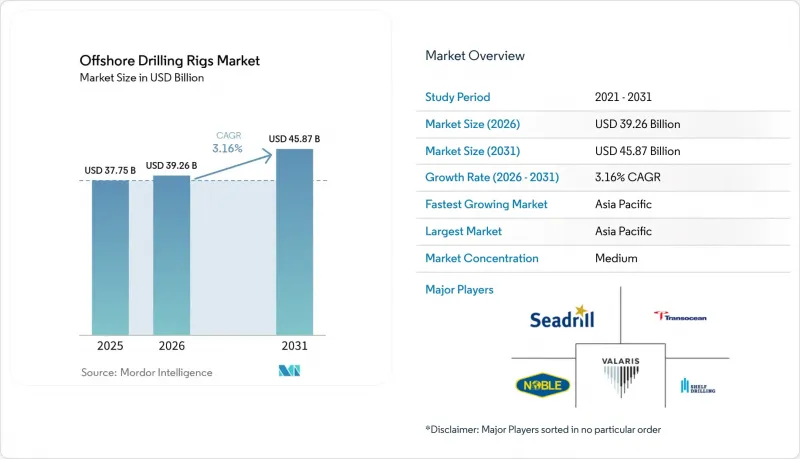
This report is Segmented by Rig Type (Jack-Ups, Semi-Submersibles, Drillships, and Other Rig Types), Water Depth (Shallow Water, Deepwater, and Ultra-Deepwater), and Geography (North America, Europe, Asia-Pacific, South America, and Middle East and Africa). The Market Sizes and Forecasts are Provided in Terms of Value (USD).
Global Offshore Drilling Rigs Market Trends and Insights
Increasing Global Energy Demand
Oil and gas are expected to retain a combined 52% share of the global energy mix through 2030, creating a durable baseload for offshore drilling campaigns. ADNOC Drilling plans to grow its fleet to 125 rigs by 2028 to help the UAE hit 5 million bpd production capacity, illustrating how national oil companies backstop demand. India's ONGC is extending jack-up charters in the Krishna-Godavari basin to preserve output from aging wells, reinforcing the shallow-water importance in energy-hungry emerging economies. Petrobras secured 12 drillships for pre-salt operations, signaling that state-backed operators can sustain drilling through price cycles. This bifurcation, OECD efficiency versus non-OECD expansion, results in a two-tier demand pattern where jack-ups cater to incremental volumes in Asia while premium floaters chase frontier deepwater barrels.
Exploration of Untapped Offshore Reserves
Namibia's Orange Basin holds an estimated 10 billion barrels of recoverable resources, with TotalEnergies and Shell collectively deploying four drillships during 2024-2025. Guyana's Stabroek block surpassed 11 billion barrels discovered, requiring a continuous fleet of six drillships to sustain its ramp-up past 640,000 bpd. These successes are lowering perceived risk and supporting well costs above USD 100 million when success probabilities rise. Angola's USD 6 billion Kaminho project will use two drillships over four years, highlighting the willingness to fund frontier deepwater when breakevens sit near USD 35 per barrel. Modern drillships capable of 10,000-foot water depths and 20,000-psi HPHT ratings thus form the growth engine of the offshore drilling rigs market.
Environmental Concerns & Stricter ESG Regulation
From 2025, the EU's Emissions Trading System extends to offshore vessels, adding up to USD 10 million per year in carbon costs for rigs lacking abatement technology. The U.S. EPA also tightened drilling-fluid discharge norms, increasing equipment spend by 15-20%. These mandates prompted Transocean to cold-stack three legacy semi-subs that were uneconomical to upgrade. Contractors with hybrid power packs and real-time emissions monitoring now enjoy bidding advantages as operators integrate ESG metrics into sourcing. Norway's Petroleum Safety Authority has introduced continuous methane monitoring requirements, adding further compliance layers for North Sea rigs.
Other drivers and restraints analyzed in the detailed report include:
- Rising Deep- & Ultra-Deepwater Discoveries in South America & Africa
- Decommissioning Backlog Driving Rig-Repurposing Demand
- Crude-Oil Price Volatility Impacting CAPEX Cycles
For complete list of drivers and restraints, kindly check the Table Of Contents.
Segment Analysis
Jack-ups controlled 43.9% of the offshore drilling rigs market share in 2025, supported by high utilization in the Persian Gulf, Southeast Asia, and the Gulf of Mexico. In contrast, drillships are forecast to post a 7.2% CAGR through 2031, pushing the offshore drilling rigs market size for this segment to an expected USD 18 billion by the end-year window. Premium units fetch USD 500,000 per day when equipped for 20,000-psi HPHT wells, such as Transocean's Deepwater Atlas, which began a three-year Equinor contract in 2025. Semi-submersibles filled mid-water campaigns with 78% utilization in 2025, largely for appraisal work in West Africa and the Far North Sea. The continuing retirement of vintage rigs concentrates demand on high-specification assets, promoting stronger pricing power for contractors that modernize their fleets.
The offshore drilling rigs market trajectory underscores a pivot toward fleet standardization and digital enablement. Samsung Heavy Industries delivered two newbuild drillships in 2024-2025 that immediately entered Petrobras' pre-salt pool, evidencing thin slack in the premium floater segment. Conversely, jack-up oversupply in Southeast Asia pressured Borr Drilling to redeploy four units to the Middle East in 2025, chasing rates 25% higher than in Thailand. Global jack-up utilization was 82% in late 2025 versus 91% for floaters, confirming that shallow-water capacity is absorbing the demand upswing more slowly than deepwater.
Geography Analysis
Asia-Pacific retained 37.6% revenue in 2025 thanks to Thailand, Vietnam, and India, and remains the fastest-growing region at 4.1% CAGR through 2031. PTTEP awarded three jack-up contracts in 2025 to extend life in the Gulf of Thailand, while PetroVietnam kept five rigs active on Bach Ho and Cuu Long, compensating for territorial constraints that slow frontier exploration. India's ONGC extended multiple jack-ups to guard against import dependence, backing the government's 1 million bpd domestic output goal by 2030. China's CNOOC deployed six floaters to South China Sea gas fields to feed the Greater Bay Area's industrial demand, while Woodside advances the Scarborough gas tieback that could enter final investment decision in 2026.
North America showed divergent trends. The U.S. Gulf of Mexico focused on subsea tieback projects, flattening rig demand, whereas Mexico's Pemex secured three jack-up contracts in 2024-2025 to stabilize 1.8 million bpd output. South America remained dominated by Brazil and Guyana. Petrobras operated twelve drillships to hold production above 3 million bpd, while Guyana's Stabroek block kept six floaters busy across development and exploration wells. Trinidad's shallow-water gas wells support Atlantic LNG throughput, sustaining moderate jack-up utilization.
Europe's activity centered on Norway, where Equinor deployed digital twins on Johan Sverdrup to shave 15% off non-productive time. The UK Continental Shelf prioritized decommissioning, letting four jack-ups work well-abandonment campaigns. The Middle East maintained high shallow-water intensity: ADNOC Drilling's 125-rig program underpins a 5 million bpd target, Qatar's North Field East gas expansion required six jack-ups in 2025, and Saudi Aramco's rig count fluctuated with OPEC+ output ceilings. Africa's ultra-deepwater frontier surged, led by Namibia and Angola. TotalEnergies' Kaminho development and Nigeria's Bonga Southwest appraisal reinforced the continent's longer-term rig demand profile.
- Keppel Corp
- Seatrium Ltd (Sembcorp Marine)
- Samsung Heavy Industries
- Hyundai Heavy Industries
- DSME
- China Merchants HI
- CIMC Raffles
- Friede & Goldman
- Damen Shipyards
- Irving Shipbuilding
- Transocean
- Valaris
- Seadrill
- Noble
- Shelf Drilling
- Borr Drilling
- Diamond Offshore
- Stena Drilling
- COSL
- KCA Deutag
Additional Benefits:
- The market estimate (ME) sheet in Excel format
- 3 months of analyst support
TABLE OF CONTENTS
1 Introduction
- 1.1 Study Assumptions & Market Definition
- 1.2 Scope of the Study
2 Research Methodology
3 Executive Summary
4 Market Landscape
- 4.1 Market Overview
- 4.2 Market Drivers
- 4.2.1 Increasing global energy demand
- 4.2.2 Exploration of untapped offshore reserves
- 4.2.3 Rising deep- & ultra-deepwater discoveries in South America & Africa
- 4.2.4 Decommissioning backlog driving rig-repurposing demand
- 4.2.5 Emergence of offshore carbon-storage & geothermal drilling
- 4.2.6 Accessibility of stranded gas via FLNG developments
- 4.3 Market Restraints
- 4.3.1 Environmental concerns & stricter ESG regulation
- 4.3.2 Crude-oil price volatility impacting CAPEX cycles
- 4.3.3 Subsea tiebacks reducing demand for new exploration wells
- 4.3.4 Supply-chain bottlenecks for ultra-deepwater equipment
- 4.4 Supply-Chain Analysis
- 4.5 Historical Day-Rate Trends (Floaters & Jack-ups)
- 4.6 Major Offshore Upstream Projects Pipeline
- 4.7 Regulatory Landscape (environmental & safety)
- 4.8 Technological Outlook (rig automation, remote ops, digital twins)
- 4.9 Porter's Five Forces
- 4.9.1 Bargaining Power of Suppliers
- 4.9.2 Bargaining Power of Buyers
- 4.9.3 Threat of New Entrants
- 4.9.4 Threat of Substitutes
- 4.9.5 Competitive Rivalry Intensity
5 Market Size & Growth Forecasts
- 5.1 By Rig Type
- 5.1.1 Jack-ups
- 5.1.2 Semi-submersibles
- 5.1.3 Drillships
- 5.1.4 Other Rig Types (Tender, Barges, Modu conversions)
- 5.2 By Water Depth
- 5.2.1 Shallow Water (Below 400 ft)
- 5.2.2 Deepwater (400 to 5,000 ft)
- 5.2.3 Ultra-deepwater (Above 5,000 ft)
- 5.3 By Geography
- 5.3.1 North America
- 5.3.1.1 United States
- 5.3.1.2 Canada
- 5.3.1.3 Mexico
- 5.3.2 Europe
- 5.3.2.1 Germany
- 5.3.2.2 United Kingdom
- 5.3.2.3 Norway
- 5.3.2.4 Russia
- 5.3.2.5 Rest of Europe
- 5.3.3 Asia-Pacific
- 5.3.3.1 China
- 5.3.3.2 India
- 5.3.3.3 Thailand
- 5.3.3.4 Vietnam
- 5.3.3.5 Australia
- 5.3.3.6 Rest of Asia-Pacific
- 5.3.4 South America
- 5.3.4.1 Brazil
- 5.3.4.2 Trinidad and Tobago
- 5.3.4.3 Rest of South America
- 5.3.5 Middle East and Africa
- 5.3.5.1 Saudi Arabia
- 5.3.5.2 United Arab Emirates
- 5.3.5.3 Qatar
- 5.3.5.4 Egypt
- 5.3.5.5 Nigeria
- 5.3.5.6 Angola
- 5.3.5.7 Namibia
- 5.3.5.8 Rest of Middle East and Africa
- 5.3.1 North America
6 Competitive Landscape
- 6.1 Market Concentration
- 6.2 Strategic Moves (M&A, Partnerships, PPAs)
- 6.3 Market Share Analysis (Market Rank/Share for key companies)
- 6.4 Company Profiles (includes Global level Overview, Market level overview, Core Segments, Financials as available, Strategic Information, Products & Services, and Recent Developments)
- 6.4.1 Keppel Corp
- 6.4.2 Seatrium Ltd (Sembcorp Marine)
- 6.4.3 Samsung Heavy Industries
- 6.4.4 Hyundai Heavy Industries
- 6.4.5 DSME
- 6.4.6 China Merchants HI
- 6.4.7 CIMC Raffles
- 6.4.8 Friede & Goldman
- 6.4.9 Damen Shipyards
- 6.4.10 Irving Shipbuilding
- 6.4.11 Transocean
- 6.4.12 Valaris
- 6.4.13 Seadrill
- 6.4.14 Noble
- 6.4.15 Shelf Drilling
- 6.4.16 Borr Drilling
- 6.4.17 Diamond Offshore
- 6.4.18 Stena Drilling
- 6.4.19 COSL
- 6.4.20 KCA Deutag
7 Market Opportunities & Future Outlook
- 7.1 White-space & Unmet-need Assessment

