
PUBLISHER: Mordor Intelligence | PRODUCT CODE: 2066500

PUBLISHER: Mordor Intelligence | PRODUCT CODE: 2066500
Hovercraft - Market Share Analysis, Industry Trends & Statistics, Growth Forecasts (2026 - 2031)
According to Mordor Intelligence, the hovercraft market size is expected to grow from USD 231.80 million in 2025 to USD 241.74 million in 2026 and is forecasted to reach USD 295.67 million by 2031 at a 4.11% CAGR over 2026-2031.
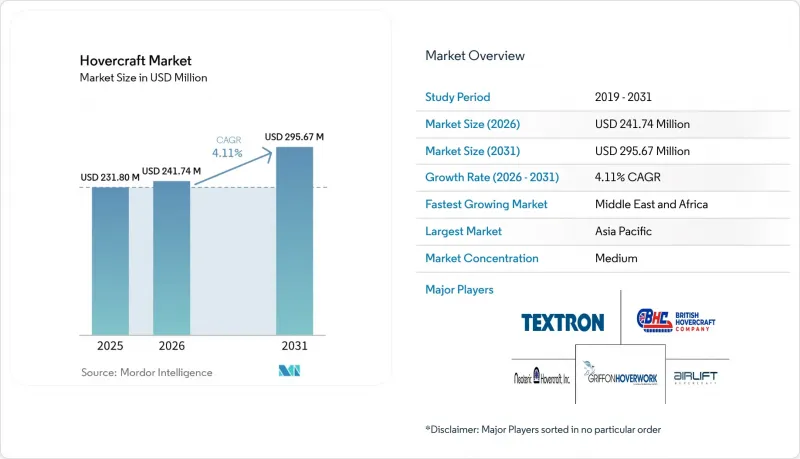
This report is Segmented by Hovercraft Size (Small, Medium, and Large), Application (Defense and Security, Passenger Ferry Services, Offshore Energy Support, and More), Propulsion System (Diesel Engine, Gas Turbine, Hybrid-Electric, Fully Electric, and Hydrogen Fuel-Cell), End User (Military and Commercial), and Geography (North America, Europe, and More). The Market Forecasts are Provided in Terms of Value (USD).
Global Hovercraft Market Trends and Insights
Rising Demand for Amphibious Transport Driven by Climate-Related Flooding
Extreme rainfall pushed coastal cities to seek all-terrain craft that can traverse submerged streets, debris-laden canals, and ice-choked rivers. India's PROTECT-funded disaster program and the US Department of Transportation's (DoT's) USD 9 billion resilience fund both create grant pathways for municipal hovercraft procurement. Provincial and county-level agencies in the Netherlands and the United Kingdom are trialing air-cushion rescue fleets for dike-breach scenarios where boats draw too much draft and wheeled vehicles stall in mud. Leasing models are emerging because flood events are episodic, allowing cities to secure capabilities without a permanent capital outlay. Demand spikes concentrate in South and Southeast Asia during monsoon seasons and along the US Gulf Coast during hurricane months, creating a predictable but short deployment window. Manufacturers that supply modular, quickly deployable small craft stand to capture this cyclical but resilient revenue stream.
Military Fleet Replacement Cycles for Modern Assault and Logistics Hovercraft
The US Navy's Ship-to-Shore Connector (SSC) program exemplifies the typical decade-long timeline of defense recapitalization. The first experimental unit sailed in 2020, and deliveries under the USD 394.3 million follow-on order are expected to run through 2030. Modern SSC hulls can lift 74 tons, enough to support an M1A2 tank, while halving the gearbox count, which reduces life-cycle maintenance costs. China's December 2024 launch of the Type 076 amphibious assault ship widens the Pacific arms race by adding a well deck sized for landing craft and hovercraft. Nordic states echo the trend; Finland ordered three 12.7 m Arctic-capable units from Griffon Marine in 2025 for ice patrol duties. Although defense budgets absorb cost overruns better than municipal coffers, competing programs such as the Polar Security Cutter in the United States siphon funds, slowing auxiliary hovercraft acquisitions.
High Operating Noise and Environmental Restrictions in Coastal Regions
Gas-turbine and high-RPM diesel fans routinely exceed 85 dB(A), breaching the US National Park Service's 75 dB(A) underway limit and comparable rules in California and Scandinavia. Port authorities at Southampton, San Francisco, and Osaka have imposed seasonal curfews that curtail tourist runs and ferry schedules. Operators pursuing compliance must derate engines, add acoustic shields, or switch to electric drives, each option imposing range or cost penalties. Hovertravel, the world's oldest passenger service, continues its Solent operations under community scrutiny and is now studying the repower of its fleet with battery-electric technology to preserve its 60-year route. Unless zero-emission retrofits reach economic parity by 2028, operators may divert investment toward hydrofoil alternatives that sail under stricter noise caps.
Other drivers and restraints analyzed in the detailed report include:
- Advances in Low-Noise Electric and Hydrogen Propulsion Technologies
- Growing Offshore Energy and Polar Logistics Requirements
- Scarcity of Certified Pilots and Specialized Maintenance Technicians
For complete list of drivers and restraints, kindly check the Table Of Contents.
Segment Analysis
Medium units secured 46.27% of 2025 revenue due to defense and offshore logistics missions, while the small-craft cohort is forecast to grow at 5.23% CAGR as cities adopt electric rescue fleets and leisure users upgrade to zero-emission models, reinforcing momentum in the hovercraft market. Medium hulls, such as the 74-ton SSC, will remain integral to force-projection strategies, and Russia's Husky-10 demonstrates how Arctic payload needs sustain mid-size demand.
Small designs under 15 meters are winning budget-constrained tenders from Finnish and Canadian agencies keen on rapid-response patrols. Battery weights scale linearly with hull volume, allowing compact footprints to reach 100-nautical-mile range thresholds sooner, thereby fueling the expansion of the hovercraft market at the municipal level. Large craft face a contracting customer base outside China and Russia because amphibious mothership decks remain limited. As a result, producers that master modular small-craft production stand to capture rising orders without the multiyear defense procurement lag.
Defense retained 37.44% of the 2025 value. Still, offshore energy support is projected to deliver a 5.24% CAGR through 2031, the fastest among the tracked uses, as wind farm operators shift from helicopters to high-speed surface-effect shuttles. Passenger ferries, exemplified by Hovertravel, face pressure from hydrofoil rivals that promise lower noise and fuel costs.
Search-and-rescue (SAR) and surveying remain niche yet strategically vital, especially as polar routes become more accessible. Offshore crew transfer economics drive recurring contracts that spread capital cost over daily rotations, contrasting with episodic defense buys. Segment operators who can certify hulls to both the IMO and offshore wind classification societies will anchor premium margins, underlining a demand pivot that diversifies the hovercraft market share away from traditional military reliance.
Geography Analysis
The Asia-Pacific region accounted for 33.11% of 2025 deliveries, as China, Japan, and India bolstered their amphibious and disaster response capabilities. The region's naval programs, including China's Type 076 launch, anchor baseline demand, while emerging municipal orders across South Asia add incremental volume. However, the hovercraft market share leadership is gradually being challenged by the Middle East and Africa, which are projected to grow at a 6.01% CAGR, driven by offshore oil crew-transfer contracts and Red Sea security patrols.
Gulf operators, such as ADNOC and Saudi Aramco, quantify helicopter cost savings in the tens of millions of dollars annually, prompting further investment in hybrid-electric crew liners. Angola's AIRCAT 35 deployment reflects similar economic conditions in West African oil plays. Europe, although hampered by tighter environmental scrutiny, maintains a steady pipeline via Arctic patrol procurements and the long-running Solent passenger service.
North America benefits from the SSC fleet renewal cycle and Canadian zero-emission design studies. Yet, US Coast Guard budget reallocations toward icebreakers slow auxiliary hovercraft buys, moderating regional expansion. South America remains underpenetrated, where shallow-draft steel boats undercut the acquisition costs of air-cushion vessels. Overall, the hovercraft market is increasingly mirroring global energy investment patterns, with high-growth corridors tied to wind-farm and hydrocarbon hubs.
- Griffon Hoverwork Ltd.
- Textron Systems Corporation (Textron Inc.)
- The British Hovercraft Company Ltd.
- Neoteric Hovercraft Inc.
- AEROHOD Ltd.
- Airlift Hovercraft Pty Ltd.
- CHRISTY HOVERCRAFT
- Hovertechnics, LLC.
- Ivanoff Hovercraft AB
- Bill Baker Vehicles Ltd.
- Mad Hovercraft
- Vigor Industrial LLC
Additional Benefits:
- The market estimate (ME) sheet in Excel format
- 3 months of analyst support
TABLE OF CONTENTS
1 INTRODUCTION
- 1.1 Study Assumptions and Market Definition
- 1.2 Scope of the Study
2 RESEARCH METHODOLOGY
3 EXECUTIVE SUMMARY
4 MARKET LANDSCAPE
- 4.1 Market Overview
- 4.2 Market Drivers
- 4.2.1 Rising demand for amphibious transport amid climate-driven floods
- 4.2.2 Military fleet replacement cycles for modern assault craft
- 4.2.3 Advances in low-noise electric and hydrogen propulsion
- 4.2.4 Relaxed regulations supporting commercial passenger services
- 4.2.5 Offshore energy and polar logistics requirements
- 4.2.6 Increased investment in flood-oriented emergency response
- 4.3 Market Restraints
- 4.3.1 High operating noise and coastal environmental restrictions
- 4.3.2 Scarcity of certified pilots and maintenance technicians
- 4.3.3 Competition from ground-effect and hydrofoil vessels
- 4.3.4 Fuel-cost volatility affecting military procurement cycles
- 4.4 Value Chain Analysis
- 4.5 Regulatory Landscape
- 4.6 Technological Outlook
- 4.7 Porter's Five Forces Analysis
- 4.7.1 Bargaining Power of Buyers
- 4.7.2 Bargaining Power of Suppliers
- 4.7.3 Threat of New Entrants
- 4.7.4 Threat of Substitute Products
- 4.7.5 Intensity of Competitive Rivalry
5 MARKET SIZE AND GROWTH FORECASTS (VALUE)
- 5.1 By Hovercraft Size
- 5.1.1 Small
- 5.1.2 Medium
- 5.1.3 Large
- 5.2 By Application
- 5.2.1 Defense and Security
- 5.2.2 Passenger Ferry Services
- 5.2.3 Offshore Energy Support
- 5.2.4 Search and Rescue
- 5.2.5 Surveying and Mapping
- 5.2.6 Agricultural and Environmental Management
- 5.3 By Propulsion System
- 5.3.1 Diesel Engine
- 5.3.2 Gas Turbine
- 5.3.3 Hybrid-Electric
- 5.3.4 Fully Electric
- 5.3.5 Hydrogen Fuel-Cell
- 5.4 By End User
- 5.4.1 Military
- 5.4.2 Commercial
- 5.5 By Geography
- 5.5.1 North America
- 5.5.1.1 United States
- 5.5.1.2 Canada
- 5.5.1.3 Mexico
- 5.5.2 Europe
- 5.5.2.1 United Kingdom
- 5.5.2.2 France
- 5.5.2.3 Germany
- 5.5.2.4 Italy
- 5.5.2.5 Rest of Europe
- 5.5.3 Asia-Pacific
- 5.5.3.1 China
- 5.5.3.2 India
- 5.5.3.3 Japan
- 5.5.3.4 South Korea
- 5.5.3.5 Australia
- 5.5.3.6 Rest of Asia-Pacific
- 5.5.4 South America
- 5.5.4.1 Brazil
- 5.5.4.2 Argentina
- 5.5.4.3 Rest of South America
- 5.5.5 Middle East and Africa
- 5.5.5.1 Middle East
- 5.5.5.1.1 Saudi Arabia
- 5.5.5.1.2 United Arab Emirates
- 5.5.5.1.3 Rest of Middle East
- 5.5.5.2 Africa
- 5.5.5.2.1 South Africa
- 5.5.5.2.2 Rest of Africa
- 5.5.5.1 Middle East
- 5.5.1 North America
6 COMPETITIVE LANDSCAPE
- 6.1 Market Concentration
- 6.2 Strategic Moves
- 6.3 Market Share Analysis
- 6.4 Company Profiles (includes Global level Overview, Market level overview, Core Segments, Financials as available, Strategic Information, Market Rank/Share for key companies, Products and Services, and Recent Developments)
- 6.4.1 Griffon Hoverwork Ltd.
- 6.4.2 Textron Systems Corporation (Textron Inc.)
- 6.4.3 The British Hovercraft Company Ltd.
- 6.4.4 Neoteric Hovercraft Inc.
- 6.4.5 AEROHOD Ltd.
- 6.4.6 Airlift Hovercraft Pty Ltd.
- 6.4.7 CHRISTY HOVERCRAFT
- 6.4.8 Hovertechnics, LLC.
- 6.4.9 Ivanoff Hovercraft AB
- 6.4.10 Bill Baker Vehicles Ltd.
- 6.4.11 Mad Hovercraft
- 6.4.12 Vigor Industrial LLC
7 MARKET OPPORTUNITIES AND FUTURE OUTLOOK
- 7.1 White-space and Unmet-Need Assessment

