
PUBLISHER: Mordor Intelligence | PRODUCT CODE: 2066510

PUBLISHER: Mordor Intelligence | PRODUCT CODE: 2066510
Pet Care - Market Share Analysis, Industry Trends & Statistics, Growth Forecasts (2026 - 2031)
According to Mordor Intelligence, the pet care market size was valued at USD 243.50 billion in 2025 and is projected to grow from USD 260.10 billion in 2026 to USD 361.20 billion by 2031, registering a CAGR of 6.80% from 2026 to 2031.
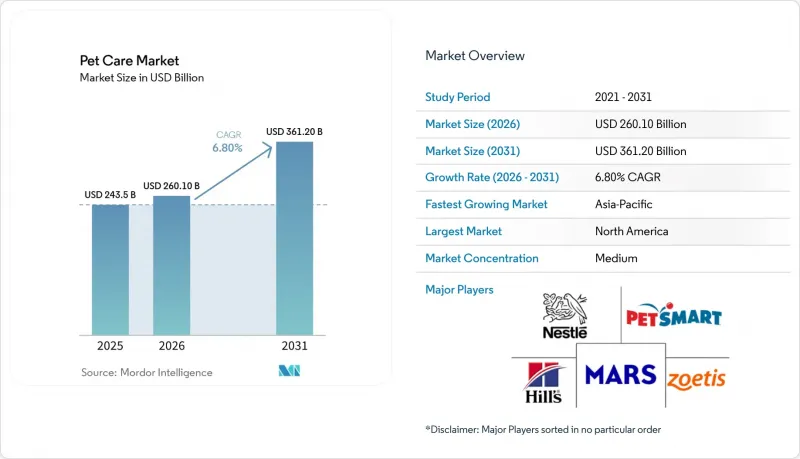
This report is Segmented by Product Type (Pet Food, Pet Healthcare, Pet Grooming Products, Pet Accessories, and Pet Services), by Animal Type (Dogs, Cats, and Other Animals), by Distribution Channel (Offline Retail and Online Retail), and by Geography (North America, South America, Europe, Asia-Pacific, Middle East, and Africa). The Market Forecasts are Provided in Terms of Value (USD).
Global Pet Care Market Trends and Insights
Pet Humanization and Premiumization
Pet humanization and premiumization are driving long-term growth in the pet care market, as consumers increasingly view companion animals as family members and allocate more spending toward wellness-focused products and services. According to the American Pet Products Association, dog ownership reached 53% of United States households in 2025, up from 51% the previous year, highlighting the growing demand for premium nutrition, preventive healthcare, diagnostics, grooming, and enrichment-related pet care products. Additionally, the rising emotional attachment to pets is fostering increased expenditure on chronic care management, specialty treatments, and age-related healthcare services, contributing to sustained value growth in the pet care market.
Preventive Care and Insurance Adoption
Preventive care and the adoption of pet insurance are driving growth in the pet care market, as insurance coverage promotes increased spending on diagnostics, treatments, and routine veterinary services. According to the North American Pet Health Insurance Association (NAPHIA), the total written premium in North America reached USD 5.2 billion in 2024, up from USD 4.2 billion in 2023. The rising adoption of pet insurance is enhancing access to preventive healthcare, chronic disease management, and advanced veterinary procedures. It also motivates pet owners to seek higher-value clinical care and wellness services for their companion animals.
Raw Material and Packaging Cost Volatility
Volatility in raw material and packaging costs continues to be a significant restraint on the pet care market. Fluctuations in the prices of protein ingredients, packaging materials, freight, and energy directly impact manufacturing expenses and consumer pricing. According to Zoetis Inc.'s 2025 Annual Report, macroeconomic pressures and reduced household spending have influenced veterinary visit trends and purchasing behavior across companion animal healthcare categories. Increasing cost sensitivity among pet owners is prompting companies to enhance supply chain management, optimize sourcing strategies, and prioritize operational efficiency to sustain margins within the pet care industry.
Other drivers and restraints analyzed in the detailed report include:
- Veterinary Clinic Corporatization and Care-Plan Cross-Sell
- Novel Proteins and Functional Ingredient Approvals
- Veterinary Labor Shortages
For complete list of drivers and restraints, kindly check the Table Of Contents.
Segment Analysis
The pet care market share for the pet food segment accounted for the largest 52.6% in 2025. Pet food remains the dominant category due to its recurring purchase frequency, wide product availability, and increasing consumer preference for premium and functional nutrition products. Demand is shifting toward fresh, refrigerated, grain-free, and veterinary-recommended formulations that address digestive health, weight management, and age-specific nutrition needs. Manufacturers are expanding premium offerings by incorporating sustainable ingredients and personalized feeding solutions. Strong retail penetration across supermarkets, pet specialty stores, veterinary clinics, and e-commerce platforms continues to support stable consumer spending in both developed and emerging companion animal care markets globally.
The pet care market size for the pet services segment is projected to grow at the fastest 10.0% CAGR from 2026 to 2031. This growth is driven by increasing expenditure on veterinary care, grooming, daycare, boarding, insurance, and preventive healthcare services. Consumers increasingly consider pet wellness and routine medical care as essential household expenses rather than discretionary spending. Subscription-based veterinary plans, telehealth consultations, diagnostics, and behavioral support services are also expanding rapidly in urban markets. Additionally, the aging pet population and rising awareness of preventive treatments continue to drive long-term demand for recurring clinical and wellness-focused pet service offerings within the companion animal healthcare ecosystem.
Geography Analysis
The pet care market share for North America held the largest 33.5% in 2025. This leading position is attributed to high pet ownership rates, advanced veterinary infrastructure, widespread adoption of preventive healthcare services, and substantial consumer spending on premium pet nutrition and wellness products. The region benefits from the expansion of veterinary clinic networks, growing demand for diagnostics and chronic disease management, and increased use of subscription-based pet healthcare services. Additionally, the rising adoption of companion animal insurance and a stronger emphasis on preventive care are driving spending across veterinary services, pharmaceuticals, nutrition, and wellness categories in the United States and Canada.
The Asia-Pacific market size is projected to grow at the fastest CAGR at 9.6% from 2026 to 2031. Urbanization, smaller household sizes, delayed parenthood, and rising disposable incomes are contributing to increased pet ownership in countries such as China, India, Japan, South Korea, and across Southeast Asia. Consumers are allocating more resources to premium nutrition, preventive healthcare, grooming, diagnostics, and wellness services for their pets. Additionally, digital commerce and app-based pet care platforms are enhancing access to products and veterinary consultation services in metropolitan areas. Both domestic and international companies are investing in premium product portfolios and omnichannel distribution strategies to strengthen their presence in the rapidly developing regional pet care markets.
Europe remains a key regional market because of established pet ownership trends, advanced veterinary services, and strong emphasis on preventive care and wellness spending. According to the Association of British Insurers, pet insurance coverage in the United Kingdom reached 4.6 million policies in 2024, compared with 4.4 million policies in 2023, reflecting rising adoption of insurance-backed veterinary care and preventive healthcare services. The region also continues benefiting from strong demand for premium pet nutrition, diagnostics, pharmaceuticals, and wellness products. Subscription-based veterinary services and omnichannel retail expansion are further supporting recurring companion animal healthcare spending across major European markets.
- Mars, Incorporated
- Nestle Purina PetCare Company (Nestle S.A.)
- Hill's Pet Nutrition, Inc. (Colgate-Palmolive Company)
- The J. M. Smucker Company
- Blue Buffalo Company, Ltd. (General Mills, Inc.)
- Spectrum Brands Holdings, Inc.
- Central Garden & Pet Company
- Freshpet, Inc.
- Unicharm Corporation
- Zoetis Inc.
- Elanco Animal Health Incorporated
- Virbac S.A.
- Dechra Pharmaceuticals PLC
- IDEXX Laboratories, Inc.
- PetSmart LLC (BC partners)
Additional Benefits:
- The market estimate (ME) sheet in Excel format
- 3 months of analyst support
TABLE OF CONTENTS
1 Introduction
- 1.1 Study Assumptions and Market Definition
- 1.2 Scope of the Study
2 Research Methodology
3 Executive Summary
4 Market Landscape
- 4.1 Market Overview
- 4.2 Market Drivers
- 4.2.1 Pet humanization and premiumization
- 4.2.2 Rising millennial and Generation Z pet ownership
- 4.2.3 Online retail and autoship expansion
- 4.2.4 Preventive care and insurance adoption
- 4.2.5 Veterinary clinic corporatization and care-plan cross-sell
- 4.2.6 Novel proteins and functional ingredient approvals
- 4.3 Market Restraints
- 4.3.1 Raw material and packaging cost volatility
- 4.3.2 Labeling and claims compliance tightening
- 4.3.3 Veterinary labor shortages
- 4.3.4 Cold-chain and last-mile economics for fresh diets
- 4.4 Regulatory Landscape
- 4.5 Technological Outlook
- 4.6 Porter's Five Forces Analysis
- 4.6.1 Threat of New Entrants
- 4.6.2 Bargaining Power of Suppliers
- 4.6.3 Bargaining Power of Buyers
- 4.6.4 Threat of Substitutes
- 4.6.5 Intensity of Competitive Rivalry
5 Market Size and Growth Forecasts (Value)
- 5.1 By Product Type
- 5.1.1 Pet Food
- 5.1.2 Pet Healthcare
- 5.1.3 Pet Grooming Products
- 5.1.4 Pet Accessories
- 5.1.5 Pet Services
- 5.2 By Animal Type
- 5.2.1 Dogs
- 5.2.2 Cats
- 5.2.3 Others
- 5.3 By Distribution Channel
- 5.3.1 Offline Retail
- 5.3.1.1 Supermarkets and Hypermarkets
- 5.3.1.2 Pet Specialty Stores
- 5.3.1.3 Veterinary Clinics
- 5.3.2 Online Retail
- 5.3.1 Offline Retail
- 5.4 By Geography
- 5.4.1 North America
- 5.4.1.1 United States
- 5.4.1.2 Canada
- 5.4.1.3 Mexico
- 5.4.1.4 Rest of North America
- 5.4.2 South America
- 5.4.2.1 Brazil
- 5.4.2.2 Argentina
- 5.4.2.3 Chile
- 5.4.2.4 Rest of South America
- 5.4.3 Europe
- 5.4.3.1 Germany
- 5.4.3.2 United Kingdom
- 5.4.3.3 France
- 5.4.3.4 Italy
- 5.4.3.5 Spain
- 5.4.3.6 Russia
- 5.4.3.7 Rest of Europe
- 5.4.4 Asia-Pacific
- 5.4.4.1 China
- 5.4.4.2 Japan
- 5.4.4.3 India
- 5.4.4.4 Australia
- 5.4.4.5 South Korea
- 5.4.4.6 Rest of Asia-Pacific
- 5.4.5 Middle East
- 5.4.5.1 Saudi Arabia
- 5.4.5.2 United Arab Emirates
- 5.4.5.3 Turkey
- 5.4.5.4 Rest of Middle East
- 5.4.6 Africa
- 5.4.6.1 South Africa
- 5.4.6.2 Egypt
- 5.4.6.3 Rest of Africa
- 5.4.1 North America
6 Competitive Landscape
- 6.1 Market Concentration
- 6.2 Strategic Moves
- 6.3 Market Share Analysis
- 6.4 Company Profiles (Includes Global Level Overview, Market Level Overview, Core Segments, Financials as Available, Strategic Information, Market Rank/Share for Key Companies, Products and Services, and Recent Developments)
- 6.4.1 Mars, Incorporated
- 6.4.2 Nestle Purina PetCare Company (Nestle S.A.)
- 6.4.3 Hill's Pet Nutrition, Inc. (Colgate-Palmolive Company)
- 6.4.4 The J. M. Smucker Company
- 6.4.5 Blue Buffalo Company, Ltd. (General Mills, Inc.)
- 6.4.6 Spectrum Brands Holdings, Inc.
- 6.4.7 Central Garden & Pet Company
- 6.4.8 Freshpet, Inc.
- 6.4.9 Unicharm Corporation
- 6.4.10 Zoetis Inc.
- 6.4.11 Elanco Animal Health Incorporated
- 6.4.12 Virbac S.A.
- 6.4.13 Dechra Pharmaceuticals PLC
- 6.4.14 IDEXX Laboratories, Inc.
- 6.4.15 PetSmart LLC (BC partners)
7 Market Opportunities and Future Outlook

