PUBLISHER: Mordor Intelligence | PRODUCT CODE: 2066578

PUBLISHER: Mordor Intelligence | PRODUCT CODE: 2066578
Train HVAC - Market Share Analysis, Industry Trends & Statistics, Growth Forecasts (2026 - 2031)
According to Mordor Intelligence, the train HVAC market was valued at USD 15.10 billion in 2025 and estimated to grow from USD 15.61 billion in 2026 to reach USD 18.45 billion by 2031, at a CAGR of 3.40% during the forecast period (2026-2031).
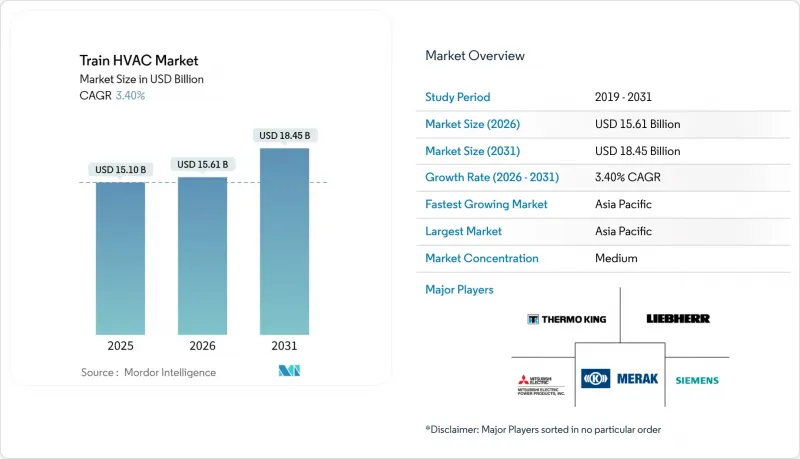
This report is Segmented by Train Type (Passenger Train, Freight Train), Installation Type (Roof-Mounted Systems, Under-Floor Systems, and More), System Technology (Vapor-Cycle Systems, Air-Cycle Systems), Component (Compressors, Condensers, and More), and Geography (North America, South America, and More). The Market Forecasts are Provided in Terms of Value (USD).
Global Train HVAC Market Trends and Insights
Government-Funded Rail-Network Expansion
Massive public outlays unlock rolling-stock orders that explicitly budget for advanced HVAC. India earmarked significant investments for coach modernization, with HVAC absorbing a significant portion of each carriage's budget. Sovereign programs in the UAE likewise bundled HVAC units into Etihad Rail's 2030 fleet plan, elevating climate control from an optional amenity to mandated infrastructure. EU funding under the Connecting Europe Facility further accelerates orders by linking grant eligibility to HVAC interoperability. These capital flows spur predictable multiyear demand and reward suppliers possessing multi-regional certification portfolios.
Rapid Growth in Passenger-Experience Standards
Operators now monetize micro-climate precision. JR East's E8 rolling stock introduced zone-based cooling that adapts to occupancy shifts, driving premium ticket surcharges on long-distance routes. European carriers validate a similar pricing uplift, confirming that thermal consistency-not absolute temperature-is the top determinant of customer satisfaction. Intelligent zoning algorithms trim energy by up to 35%, closing the payback gap for premium HVAC hardware.
High CAPEX and OPEX of Advanced HVAC Units
Sophisticated rail-grade systems command price premiums, pushing life-cycle costs per passenger car toward high levels. Retrofit budgets continue to inflate as structural rewiring and downtime add a significant share to hardware costs. Smaller regional operators lack the analytic models to monetize downstream fuel and maintenance savings, delaying adoption even when payback horizons fall below six years.
Other drivers and restraints analyzed in the detailed report include:
- Stricter Thermal-Comfort and IAQ Regulations
- Shift to Low-GWP Refrigerants to Meet 2027 F-Gas Caps
- Space / Weight Limits in Legacy Rolling-Stock Retrofits
For complete list of drivers and restraints, kindly check the Table Of Contents.
Segment Analysis
Passenger fleets dominated the train HVAC market, accounting for 74.01% in 2025, reflecting decades-old comfort mandates. The freight segment's 4.75% CAGR through 2031 outpaces the aggregate as labor rules now compel 8-hour cab-comfort compliance. Improvements reduce fatigue incidents, while shutting down idling main engines saves notable gallons of diesel per hour, encouraging railroads to retrofit cabs despite tight capital budgets.
Modern freight tenders increasingly specify integrated HVAC-APU modules that operate off-engine, cutting annual fuel use per locomotive. Vendors market these savings alongside crew-retention benefits in a labor-scarce environment. As intermodal corridors elongate travel windows, HVAC uptime becomes mission-critical, propelling unit sales beyond historical fleet-replacement cycles.
Roof-mounted units accounted for 60.12% of 2025 revenue, as OEM-delivered rolling stock adheres to a familiar architecture. Yet split/car-body rigs surge at a 6.13% CAGR because they bypass roof load limits and enable staged maintenance. European refurbishments reveal lower life-cycle service expense when compressors and condensers slide out individually for overhaul.
Projects on 1990s-era EMUs are especially receptive; avoiding roof reinforcement can reduce high per-car retrofit costs. Split adoption aligns with predictive-maintenance rollouts, allowing technicians to swap condition-flagged modules without sidelining entire coaches and injecting additional savings into operators' total-cost models.
Geography Analysis
Asia-Pacific retained 49.25% of global revenue in 2025 and is projected to post a 5.01% CAGR to 2031 as India outfits 40,000 AC coaches, and China extends high-speed mileage past 45,000 km . Thermal comfort is especially market-making in equatorial zones; Indian tenders assign a notable share of carriage budgets to HVAC, recognizing comfort as a ridership lever against low-cost airlines.
Europe contributes a steady volume as regulatory triggers-chiefly the 2027 F-Gas quota shrink-pull forward replacement demand. German S-Bahn orders totaling 1,350 R290 systems underscore early compliance moves. EU grants stipulate interoperability, nudging operators toward network-wide standardization that amplifies supplier scale effects.
North America focuses on freight locomotive upgrades, anchored in crew-retention economics and emissions mandates. The Federal Railroad Administration pilots waste-heat HVAC recovery prototypes to slash diesel use, an early sign of future subsidies. The Middle East fast-tracks high-capacity lines through desert climates-Etihad Rail's order evidences the need for robust HVAC sealing against sand ingress. Africa and South America remain smaller but are targeted by vendors offering ruggedized, cost-optimized units for mining, rail, and premium intercity services.
- Thermo King Corporation (Trane Technologies)
- Liebherr-Transportation Systems
- Mitsubishi Electric Power Products, Inc.
- MERAK (Knorr-Bremse AG)
- Toshiba Infrastructure Systems (Toshiba Corporation)
- Wabtec Corporation
- International Hispacold S.A.
- DC Airco
- Leel Electricals Limited
- SONGZ Automobile Air Conditioning Co., Ltd.
- Trans ACNR
- Subros Limited
- Lloyd Electric and Engineering
- Siemens Mobility
Additional Benefits:
- The market estimate (ME) sheet in Excel format
- 3 months of analyst support
TABLE OF CONTENTS
1 Introduction
- 1.1 Study Assumptions & Market Definition
- 1.2 Scope of the Study
2 Research Methodology
3 Executive Summary
4 Market Landscape
- 4.1 Market Overview
- 4.2 Market Drivers
- 4.2.1 Government-Funded Rail-Network Expansion
- 4.2.2 Rapid Growth in Passenger-Experience Standards
- 4.2.3 IoT-Enabled Predictive-Maintenance Retrofits
- 4.2.4 Stricter Thermal-Comfort and IAQ Regulations
- 4.2.5 On-Board Energy-Storage Integration Enables Heat-Pump HVAC Adoption
- 4.2.6 Shift to Low-GWP Refrigerants to Meet 2027 F-Gas Caps
- 4.3 Market Restraints
- 4.3.1 High CAPEX and OPEX of Advanced HVAC Units
- 4.3.2 Space / Weight Limits in Legacy Rolling-Stock Retrofits
- 4.3.3 Global Shortage of Certified Rail-HVAC Technicians
- 4.3.4 Semiconductor Supply Volatility for Inverter Drives
- 4.4 Value / Supply-Chain Analysis
- 4.5 Regulatory Landscape
- 4.6 Technological Outlook
- 4.7 Porter's Five Forces
- 4.7.1 Threat of New Entrants
- 4.7.2 Bargaining Power of Suppliers
- 4.7.3 Bargaining Power of Buyers
- 4.7.4 Threat of Substitutes
- 4.7.5 Competitive Rivalry
5 Market Size & Growth Forecasts (Value (USD))
- 5.1 By Train Type
- 5.1.1 Passenger Train
- 5.1.2 Freight Train
- 5.2 By Installation Type
- 5.2.1 Roof-Mounted Systems
- 5.2.2 Under-Floor Systems
- 5.2.3 Split / Car-Body Systems
- 5.3 By System Technology
- 5.3.1 Vapor-Cycle Systems
- 5.3.2 Air-Cycle Systems
- 5.4 By Component
- 5.4.1 Compressors
- 5.4.2 Condensers
- 5.4.3 Evaporators
- 5.4.4 Blowers and Fans
- 5.4.5 Inverters and Controls
- 5.4.6 Air Dampers and Others
- 5.5 By Geography
- 5.5.1 North America
- 5.5.1.1 United States
- 5.5.1.2 Canada
- 5.5.1.3 Rest of North America
- 5.5.2 South America
- 5.5.2.1 Brazil
- 5.5.2.2 Argentina
- 5.5.2.3 Rest of South America
- 5.5.3 Europe
- 5.5.3.1 Germany
- 5.5.3.2 United Kingdom
- 5.5.3.3 France
- 5.5.3.4 Italy
- 5.5.3.5 Spain
- 5.5.3.6 Rest of Europe
- 5.5.4 Asia-Pacific
- 5.5.4.1 China
- 5.5.4.2 India
- 5.5.4.3 Japan
- 5.5.4.4 South Korea
- 5.5.4.5 Rest of Asia-Pacific
- 5.5.5 Middle East and Africa
- 5.5.5.1 United Arab Emirates
- 5.5.5.2 Saudi Arabia
- 5.5.5.3 South Africa
- 5.5.5.4 Rest of Middle East and Africa
- 5.5.1 North America
6 Competitive Landscape
- 6.1 Market Concentration
- 6.2 Strategic Moves
- 6.3 Market Share Analysis
- 6.4 Company Profiles (includes Global Level Overview, Market Level Overview, Core Segments, Financials as Available, Strategic Information, Market Rank/Share for Key Companies, Products and Services, SWOT Analysis, and Recent Developments)
- 6.4.1 Thermo King Corporation (Trane Technologies)
- 6.4.2 Liebherr-Transportation Systems
- 6.4.3 Mitsubishi Electric Power Products, Inc.
- 6.4.4 MERAK (Knorr-Bremse AG)
- 6.4.5 Toshiba Infrastructure Systems (Toshiba Corporation)
- 6.4.6 Wabtec Corporation
- 6.4.7 International Hispacold S.A.
- 6.4.8 DC Airco
- 6.4.9 Leel Electricals Limited
- 6.4.10 SONGZ Automobile Air Conditioning Co., Ltd.
- 6.4.11 Trans ACNR
- 6.4.12 Subros Limited
- 6.4.13 Lloyd Electric and Engineering
- 6.4.14 Siemens Mobility
7 Market Opportunities & Future Outlook
- 7.1 White-Space & Unmet-Need Assessment

