PUBLISHER: Mordor Intelligence | PRODUCT CODE: 2066630

PUBLISHER: Mordor Intelligence | PRODUCT CODE: 2066630
North America Logistics Automation - Market Share Analysis, Industry Trends & Statistics, Growth Forecasts (2026 - 2031)
According to Mordor Intelligence, the north america logistics automation market size is expected to grow from USD 28.45 billion in 2025 to USD 30.51 billion in 2026 and is forecast to reach USD 43.30 billion by 2031 at 7.25% CAGR over 2026-2031.
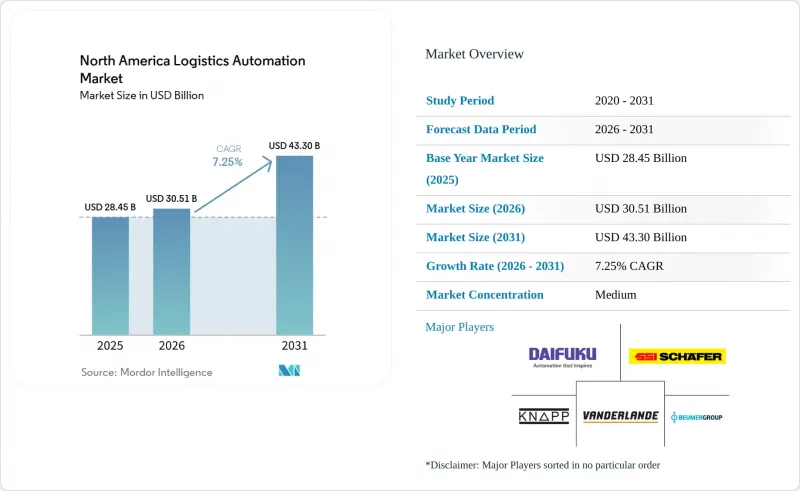
This report is Segmented by Function (Warehouse Automation and Transportation Automation), Automation Level (Fully-Automated Systems and Semi-Automated Systems), Component (Hardware, Software, and Services), End-User Industry (E-Commerce and Parcel, Food and Beverage, Grocery Retail, Apparel and Fashion, and More), and Country. The Market Forecasts are Provided in Terms of Value (USD).
North America Logistics Automation Market Trends and Insights
E-Commerce Fulfillment Density and Same-Day Service Levels
Same-day delivery has moved from a premium service into a core operating requirement across the North America logistics automation market. Amazon exceeded 1 billion same-day or overnight deliveries in the year-to-date period through mid-2026 and added 18 same-day facilities in mid-sized US metro areas in April 2026, which pushed automation demand deeper into suburban and exurban nodes. That shift forces operators to process more units per square meter, which strengthens the case for high-speed sortation, compact ASRS, and goods-to-person workflows. It also redirects investment away from only very large fulfillment centers and toward smaller micro-hubs that still need dense automation to stay competitive. In the North America logistics automation market, service-level pressure is now shaping facility design as much as labor cost or storage density. The result is a faster move toward modular systems that can be deployed close to demand without waiting for full-scale greenfield construction.
Warehouse Labor Scarcity and Wage Inflation
Labor scarcity remains one of the strongest economic drivers in the North America logistics automation market because operators are responding to a structural problem rather than a short-term cycle. Average hourly earnings in US warehousing and storage reached USD 26.58 in January 2026 and USD 26.68 in February 2026, up from USD 25.02 in January 2025, which kept wage pressure elevated across warehouse networks. Compensation costs for private industry workers rose 3.4% in the 12 months to March 2026, which shows that payroll pressure remained firm even as real gains stayed limited. A 2025 ILR Review study found that warehouse robotics was associated with a 40% reduction in severe injuries and a 77% rise in non-severe injuries, which reinforced the need for better ergonomic design at human-robot workstations. This has shifted procurement priorities toward goods-to-person stations and better workflow design rather than only toward higher robot counts. In the North America logistics automation market, software that coordinates people and machines is increasingly viewed as the clearest path to labor-productivity gains.
High Upfront Capital Outlays for Fixed Automation
Fixed automation remains a real constraint on the North America logistics automation market because large conveyor networks, integrated sortation, and end-to-end ASRS systems still require multiyear capital commitments. This pressure is strongest among mid-market 3PLs and regional distributors that do not have the same balance sheet flexibility as large retailers or large distributors. Steel-related equipment inflation has also made investment decisions harder by extending payback periods and increasing caution around turnkey projects. Operators do have some relief through tax policy, as the Section 179 deduction ceiling for qualifying equipment placed in service in 2026 reached USD 2,560,000 under IRS guidance. The same tax framework also supports 100% bonus depreciation for qualifying property, which lowers the effective first-year cost of eligible automation assets. Even with that support, many buyers in the North America logistics automation market still prefer phased deployments or flexible commercial models when project risk remains high.
Other drivers and restraints analyzed in the detailed report include:
- AMR and AI Orchestration Adoption Across Fulfillment Centers
- Nearshoring-Led Network Redesign in Mexico and The United States
- Legacy-System Integration and Brownfield Retrofit Complexity
For complete list of drivers and restraints, kindly check the Table Of Contents.
Segment Analysis
Warehouse automation held 61.34% of revenue in 2025, which placed it at the center of the North America logistics automation market as operators focused on picking, storage, sortation, and conveyor-intensive flows inside the facility. Warehouse automation accounted for 61.34% of the North America logistics automation market share in 2025 because the return on investment has historically been easiest to capture inside controlled indoor environments. Goods-to-person ASRS, AMR fleets, and warehouse execution software continue to define this segment because they directly improve throughput, labor productivity, and order accuracy. Medline expanded that pattern in May 2026 when it deployed its 24th AutoStore installation at its Aurora, Colorado distribution center, adding 96 robots and 38,000 bins to support regional demand. The North America logistics automation market continues to treat indoor handling as the first place where high-volume operators standardize automation across a national footprint.
Transportation automation started from a smaller base, but it is the fastest-growing function at a 7.94% CAGR through 2031, and that growth reflects the early commercialization of SAE Level 4 freight lanes. Gatik became the first US company to complete fully driverless commercial deliveries at scale in January 2026, recording 60,000 driverless orders for Fortune 50 retailers in Texas, Arkansas, and Arizona without incident. Aurora Innovation and McLane also announced in May 2026 that they would begin driverless hauls in Texas between Dallas and Houston, with plans to expand across the US Sun Belt.
Semi-automated systems held 55.90% of revenue in 2025, which reflected the practical structure of most active warehouses in the North America logistics automation market. Semi-automated systems carried 55.90% of revenue because most brownfield sites still combine WMS-directed human labor with targeted robotics for repetitive tasks such as goods-to-person picking, pallet movement, or palletizing. This model helps operators improve throughput without taking on the cost and operational risk of a full cutover. Staples Canada showed the appeal of this approach in 2025 when it deployed 50 Locus Robotics AMRs in a Vancouver fulfillment center and reached full operational integration within 4 days. In the North America logistics automation industry, this hybrid structure remains the default for facilities with variable volumes, seasonal spikes, and existing layouts that are not easy to redesign.
Fully-automated systems are growing faster, with an 8.13% CAGR through 2031, because greenfield projects and major network refreshes are now being designed for unattended or near-unattended workflows. Falling sensor costs, better perception software, and stronger confidence in continuous robotic operation are supporting that move. Locus Robotics launched Locus Array at MODEX 2026 as a fully autonomous fulfillment system that combines mobile robotics, an integrated picking arm, and AI-powered perception, with early deployments already underway at DHL Supply Chain in North America. Locus then acquired Nexera Robotics in May 2026 to add NeuraGrasp technology and widen the system's SKU-handling range. The North America logistics automation market is therefore narrowing the gap between partial automation and full autonomy as mobile robotics and robotic manipulation increasingly run on a shared orchestration layer.
List of Companies Covered in this Report:
- Daifuku Co., Ltd.
- SSI SCHAEFER AG
- KNAPP AG
- Vanderlande Industries B.V.
- BEUMER Group GmbH & Co. KG
- Dematic Corp.
- Mecalux, S.A.
- Swisslog Holding AG
- TGW Logistics Group GmbH
- WITRON Logistik + Informatik GmbH
- Kardex Holding AG
- AutoStore Holdings Ltd.
- Exotec SAS
- Geekplus Technology Co., Ltd.
- Hai Robotics Co., Ltd.
- GreyOrange Pte. Ltd.
- Locus Robotics Corp.
- Cimcorp Oy
- System Logistics S.p.A.
- Bastian Solutions
Additional Benefits:
- The market estimate (ME) sheet in Excel format
- 3 months of analyst support
TABLE OF CONTENTS
1 INTRODUCTION
- 1.1 Study Assumptions and Market Definition
- 1.2 Scope of the Study
2 RESEARCH METHODOLOGY
3 EXECUTIVE SUMMARY
4 MARKET LANDSCAPE
- 4.1 Market Overview
- 4.2 Market Drivers
- 4.2.1 E-commerce Fulfillment Density and Same-day Service Levels
- 4.2.2 Warehouse Labor Scarcity and Wage Inflation
- 4.2.3 AMR and AI Orchestration Adoption Across Fulfillment Centers
- 4.2.4 Nearshoring-led Network Redesign in Mexico and the United States
- 4.2.5 Ergonomic-risk Mitigation in High-throughput Fulfillment Sites
- 4.2.6 Tax Incentives for Domestic and Cross-border Automation Investments
- 4.3 Market Restraints
- 4.3.1 High Upfront Capital Outlays for Fixed Automation
- 4.3.2 Legacy-system Integration and Brownfield Retrofit Complexity
- 4.3.3 Steel Tariff Volatility and Longer Automation Payback
- 4.3.4 Robot-cell Safety and Cybersecurity Compliance Burden
- 4.4 Industry Value Chain Analysis
- 4.5 Regulatory Landscape
- 4.6 Technological Outlook
- 4.7 Porter's Five Forces Analysis
- 4.7.1 Bargaining Power of Suppliers
- 4.7.2 Bargaining Power of Buyers
- 4.7.3 Threat of New Entrants
- 4.7.4 Threat of Substitutes
- 4.7.5 Intensity of Competitive Rivalry
- 4.8 Assessment of Macroeconomic Trends on the Market
5 MARKET SIZE AND GROWTH FORECASTS (VALUE)
- 5.1 By Function
- 5.1.1 Warehouse Automation
- 5.1.1.1 Component
- 5.1.1.1.1 Hardware
- 5.1.1.1.1.1 Mobile Robots
- 5.1.1.1.1.2 Automated Storage and Retrieval Systems
- 5.1.1.1.1.3 Automated Sorting Systems
- 5.1.1.1.1.4 Conveyor Systems
- 5.1.1.1.1.5 Automatic Identification and Data Collection (AIDC)
- 5.1.1.1.1.6 Order Picking
- 5.1.1.1.2 Software
- 5.1.1.1.3 Services
- 5.1.1.1.1 Hardware
- 5.1.1.1 Component
- 5.1.2 Transportation Automation
- 5.1.2.1 Component
- 5.1.2.1.1 Hardware
- 5.1.2.1.2 Software
- 5.1.2.1.3 Services
- 5.1.2.1 Component
- 5.1.1 Warehouse Automation
- 5.2 By Automation Level
- 5.2.1 Fully-Automated Systems
- 5.2.2 Semi-Automated Systems
- 5.3 By Component
- 5.3.1 Hardware
- 5.3.2 Software
- 5.3.3 Services
- 5.4 By End-User Industry
- 5.4.1 E-commerce and Parcel
- 5.4.2 Food and Beverage
- 5.4.3 Grocery Retail
- 5.4.4 Apparel and Fashion
- 5.4.5 Manufacturing
- 5.4.6 Other End-User Industries
- 5.5 By Country
- 5.5.1 United States
- 5.5.2 Canada
- 5.5.3 Mexico
6 COMPETITIVE LANDSCAPE
- 6.1 Market Concentration
- 6.2 Strategic Moves
- 6.3 Market Share Analysis
- 6.4 Company Profiles (includes Global level Overview, Market level overview, Core Segments, Financials as available, Strategic Information, Market Rank/Share for key companies, Products and Services, and Recent Developments)
- 6.4.1 Daifuku Co., Ltd.
- 6.4.2 SSI SCHAEFER AG
- 6.4.3 KNAPP AG
- 6.4.4 Vanderlande Industries B.V.
- 6.4.5 BEUMER Group GmbH & Co. KG
- 6.4.6 Dematic Corp.
- 6.4.7 Mecalux, S.A.
- 6.4.8 Swisslog Holding AG
- 6.4.9 TGW Logistics Group GmbH
- 6.4.10 WITRON Logistik + Informatik GmbH
- 6.4.11 Kardex Holding AG
- 6.4.12 AutoStore Holdings Ltd.
- 6.4.13 Exotec SAS
- 6.4.14 Geekplus Technology Co., Ltd.
- 6.4.15 Hai Robotics Co., Ltd.
- 6.4.16 GreyOrange Pte. Ltd.
- 6.4.17 Locus Robotics Corp.
- 6.4.18 Cimcorp Oy
- 6.4.19 System Logistics S.p.A.
- 6.4.20 Bastian Solutions
7 MARKET OPPORTUNITIES AND FUTURE OUTLOOK
- 7.1 White-space and Unmet-Need Assessment

