PUBLISHER: Mordor Intelligence | PRODUCT CODE: 2066718

PUBLISHER: Mordor Intelligence | PRODUCT CODE: 2066718
Battery Manufacturing Equipment - Market Share Analysis, Industry Trends & Statistics, Growth Forecasts (2026 - 2031)
According to Mordor Intelligence, the battery manufacturing equipment market size is expected to grow from USD 17.09 billion in 2025 to USD 18.02 billion in 2026 and is forecast to reach USD 23.43 billion by 2031 at 5.41% CAGR over 2026-2031.
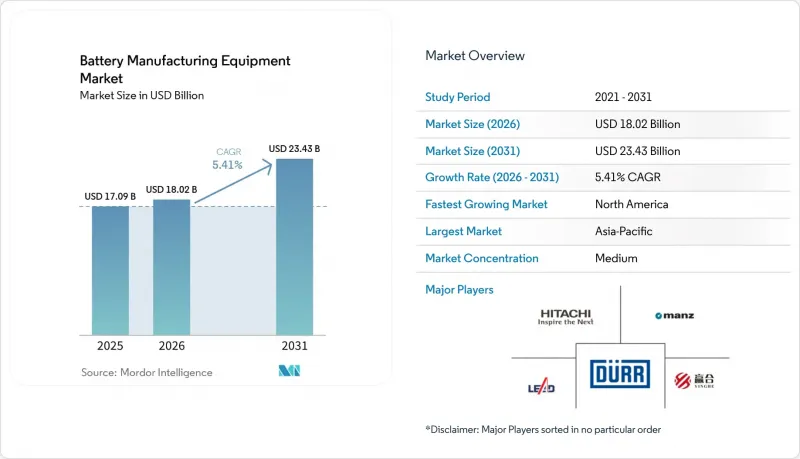
This report is Segmented by Battery Chemistry (Lithium-Ion, Solid-State, and More), Machine Type (Coating and Drying Systems, Formation and Testing Lines, and More), Automation Level (Fully-Automatic, AI-Supervised "lights-Out" Lines, and More), End-User (Automotive OEMs and Tier-1s, Energy Storage System Integrators, and More), and Geography (North America, Europe, Asia-Pacific, and More).
Global Battery Manufacturing Equipment Market Trends and Insights
Surging EV Production Capacity Expansion Plans
Automakers announced 1.2 TWh of new lithium-ion capacity during 2024, triple the 2023 level, as companies bring cell production in-house to secure supply amid geopolitical risk. Ford's USD 3.5 billion lithium-iron-phosphate plant in Michigan requires 35 GWh of coating, stacking, and formation equipment by 2026, pressuring vendors for quick delivery. General Motors' Ultium Cells venture ordered 12 GWh of modular lines capable of both pouch and prismatic formats, signaling a preference for flexibility under future-chemistry uncertainty. Chinese majors CATL, BYD, and EVE Energy tendered 180 GWh of kit in 2024, yet 15-20% of contracts include clauses permitting deferral if lithium prices fall below USD 12,000 t, baking commodity risk into equipment deals. Volkswagen's PowerCo set a 95% OEE target within six months of commissioning at its Valencia plant, filtering out suppliers lacking real-time process-control algorithms. Tesla's USD 1.8 billion 4680 dry-electrode spend through mid-2024 shows that next-generation formats can double per-line capital needs even as they promise lower per-kWh cell costs.
Government Subsidies & IRA-Driven On-Shoring
The IRA's Advanced Manufacturing Production Credit of USD 45 kWh for cells underpins North American gigafactory economics despite 40-60% labor premiums over Asia. Panasonic's USD 4 billion Kansas project depends on these credits, while LG Energy Solution and SK On filed for USD 1.2 billion each and now demand U.S. content guarantees from Wuxi Lead and Manz. Europe's Net-Zero Industry Act offers investment tax credits up to 40% of equipment outlay, but member states disbursed just EUR 2.1 billion of an earmarked EUR 8 billion by late 2024, delaying orders. Canada's CAD 1.3 billion (USD 962 million) award to Stellantis-LGES and Volkswagen-PowerCo requires 60% regional content, prompting Durr and Andritz to convert idle paint-shop assets into battery-equipment lines. Japan's JPY 350 billion (USD 2.3 billion) 2024 subsidy tranche ring-fences solid-state pilot-line spend for domestic vacuum-deposition tools, protecting Hitachi High-Tech and Ulvac.
High Capex & Long Payback of Turnkey Lines
A 10 GWh fully automated lithium-ion line needs USD 650-850 million, stretching payback to 7-9 years at prevailing cell prices of USD 90-110 kWh, which deters second-tier buyers lacking robust balance sheets. Northvolt's November 2024 bankruptcy, tied to USD 5.8 billion in equipment debt, spooked lenders and tightened project-finance covenants. India's Reliance New Energy postponed tooling orders after failing to secure a USD 2.5 billion loan, underlining how finance risk decouples machinery demand from EV sales trajectories. Manz saw Q3 2024 order intake slide 23% as customers phased purchases, buying coating kits now and deferring formation spend. The U.S. DOE approved just USD 1.1 billion of the USD 17 billion requested for battery projects in 2024, leaving suppliers with conditional orders that may never convert. Leasing models pioneered by Durr and Buhler cut upfront cash by 60% but cap supplier ROIC below 10%, dampening long-term investment appetite.
Other drivers and restraints analyzed in the detailed report include:
- Grid-Scale ESS Build-Out Needing High-Throughput Lines
- Dry-Electrode & Solvent-Free Coating Adoption
- Raw-Material Price Volatility Dampening Orders
For complete list of drivers and restraints, kindly check the Table Of Contents.
Segment Analysis
Lithium-ion accounted for 83.42% of 2025 revenue, underscoring its entrenched role in EVs and consumer devices. Solid-state lines, however, are projected to surge at 30.2% CAGR, driving a parallel ecosystem of vacuum-deposition coaters and inert-atmosphere stackers that cost almost triple per GWh. Toyota indicated that the sulfide-electrolyte kit requires 2.8X the capital of lithium-ion equivalents. Solid Power's USD 62 million pilot order with Buhler highlights early demand for sub-5 ppm moisture environments. Sodium-ion remains niche but offers format flexibility that may lift adoption in stationary storage once performance stabilizes. Legacy lead-acid and nickel systems are expected to erode at -2.28% CAGR, though price-sensitive markets still value their recyclability.
The rising premium of solid-state tooling enlarges the Battery manufacturing equipment market size for niche high-energy systems and shifts supplier focus toward Japanese vacuum specialists. These high-margin modules, bundled with sulfide-handling options, offset slower growth in mature lithium-ion lines. The competitive set expands as startups co-develop equipment directly with cell innovators, shortening design cycles. Meanwhile, regulatory recycled-content mandates spur early investment in recycling modules that can be integrated alongside lithium-ion and sodium-ion primary lines, broadening the chemistry mix within turnkey packages.
Coating and drying systems captured the largest 18.84% revenue share in 2025, reflecting their role in electrode quality and capital intensity. Still, formation and testing equipment is set to expand at a 12.5% CAGR because next-generation cells require longer, more complex conditioning cycles. Samsung SDI's Gen5 prismatic program doubled its formation footprint amid tighter calendar-life targets, delaying ramp schedules until extra chambers arrived. Calendaring presses grow at a 6.05% CAGR as high-nickel cathodes demand extreme nip pressure, while slitting and laser-notching segments face price erosion from Chinese challengers.
As dwell times lengthen, gigafactories re-allocate budgets toward downstream assets, increasing the Battery manufacturing equipment market share of formation chambers and AI-supervised test racks. Suppliers able to combine predictive maintenance with chamber design gain pricing power. Simultaneously, dry-electrode adoption threatens wet-coating incumbents but lifts demand for high-precision calendaring and vacuum-degassing systems. The shift pulls capital into recycling and black-mass equipment as plants pre-integrate end-of-life flows to satisfy EU rules, widening the machine-type spread within turnkey orders.
Geography Analysis
Asia-Pacific generated 54.73% of 2025 revenue, led by China's 480 GWh installed capacity and South Korea's export orientation, though regional growth moderates to 3.98% CAGR as the domestic EV boom matures. China alone delivered 38.1% of global orders, yet lithium-price swings triggered deferrals, exposing suppliers over-reliant on local demand. Japan and South Korea accelerate solid-state pilot programs backed by government subsidies, nudging up their collective share.
North America accounted for 19.12% of 2025 spend and is advancing at a 12.2% CAGR, the fastest worldwide, as IRA credits de-risk new capacity despite higher labor costs. U.S. projects total 320 GWh announced through 2030, while Canada grows 14.35% CAGR on the back of Stellantis-LGES and Volkswagen-PowerCo ventures. Mexico follows with 9.42% CAGR, anchored by Tesla's Nuevo Leon site, though infrastructure delays extend commissioning by up to nine months. Europe secured 21.83% of 2025 revenue, expanding 8.55% CAGR under the Net-Zero Industry Act's 90 GWh target. Germany remains Europe's core at 8.4% global share, but orders back-load to 2025-2026 pending subsidy clarity. France and Spain outpace the region as Automotive Cells Company and Volkswagen unlock grants. Nordic momentum slows after Northvolt's bankruptcy clouds EUR 1.2 billion in open contracts. South America (2.22%) and Middle East & Africa (2.10%) post mid-single-digit growth as resource players eye downstream integration but lack subsidy depth.
- Durr AG
- Wuxi Lead Intelligent Equipment Co., Ltd.
- Yinghe Technology Co., Ltd.
- Manz AG
- Hitachi High-Tech Corp.
- Schuler AG
- Andritz AG
- Sovema Group S.p.A.
- Komori Corp.
- Buhler Group
- Hanwha Machinery
- PNT Group
- ABB Ltd.
- Siemens AG
- IPG Photonics Corp.
- TMAX (Xiamen Tmax Battery Equipments)
- TOB New Energy Technology Co.
- ACEY New Energy Technology
- Festo AG
- Honeywell International Inc.
Additional Benefits:
- The market estimate (ME) sheet in Excel format
- 3 months of analyst support
TABLE OF CONTENTS
1 Introduction
- 1.1 Study Assumptions & Market Definition
- 1.2 Scope of the Study
2 Research Methodology
3 Executive Summary
4 Market Landscape
- 4.1 Market Overview
- 4.2 Market Drivers
- 4.2.1 Surging EV production capacity expansion plans
- 4.2.2 Government subsidies & IRA-driven on-shoring
- 4.2.3 Falling $/GWh gigafactory CAPEX
- 4.2.4 Grid-scale ESS build-out needing high-throughput lines
- 4.2.5 Dry-electrode & solvent-free coating adoption
- 4.2.6 AI-enabled inline inspection boosting OEE
- 4.3 Market Restraints
- 4.3.1 High capex & long payback of turnkey lines
- 4.3.2 Raw-material price volatility dampening orders
- 4.3.3 Shortage of cell-assembly automation engineers
- 4.3.4 Tightening solvent-use rules (NMP, VOC)
- 4.4 Supply-Chain Analysis
- 4.5 Regulatory Landscape
- 4.6 Technological Outlook
- 4.7 Porter's Five Forces
- 4.7.1 Bargaining Power of Suppliers
- 4.7.2 Bargaining Power of Buyers
- 4.7.3 Threat of New Entrants
- 4.7.4 Threat of Substitutes
- 4.7.5 Intensity of Rivalry
5 Market Size & Growth Forecasts
- 5.1 By Battery Chemistry
- 5.1.1 Lithium-ion
- 5.1.2 Solid-state
- 5.1.3 Sodium-ion
- 5.1.4 Lead-acid
- 5.1.5 Nickel-based
- 5.1.6 Flow Batteries (Zn-Br, Vanadium etc.)
- 5.2 By Machine Type
- 5.2.1 Coating and Drying Systems
- 5.2.2 Calendaring Presses
- 5.2.3 Mixing and Homogenizers
- 5.2.4 Slitting Machines
- 5.2.5 Laser Notching and Cutting
- 5.2.6 Electrode Stacking
- 5.2.7 Vacuum Drying and Degassing
- 5.2.8 Electro-lyte Filling
- 5.2.9 Assembly and Handling Robots
- 5.2.10 Formation and Testing Lines
- 5.2.11 Packaging and Sealing
- 5.2.12 Recycling and Black-mass Processing Equipment
- 5.3 By Automation Level
- 5.3.1 Manual/Lab-scale
- 5.3.2 Semi-automatic
- 5.3.3 Fully-automatic
- 5.3.4 AI-supervised "lights-out" lines
- 5.4 By End-User
- 5.4.1 Automotive OEMs and Tier-1s
- 5.4.2 Energy Storage System Integrators
- 5.4.3 Consumer Electronics
- 5.4.4 Industrial and Power Tools
- 5.4.5 Aerospace and Defense
- 5.4.6 Other End Users
- 5.5 By Geography
- 5.5.1 North America
- 5.5.1.1 United States
- 5.5.1.2 Canada
- 5.5.1.3 Mexico
- 5.5.2 Europe
- 5.5.2.1 Germany
- 5.5.2.2 United Kingdom
- 5.5.2.3 France
- 5.5.2.4 Italy
- 5.5.2.5 Spain
- 5.5.2.6 NORDIC Countries
- 5.5.2.7 Russia
- 5.5.2.8 Rest of Europe
- 5.5.3 Asia-Pacific
- 5.5.3.1 China
- 5.5.3.2 India
- 5.5.3.3 Japan
- 5.5.3.4 South Korea
- 5.5.3.5 ASEAN Countries
- 5.5.3.6 Australia and New Zealand
- 5.5.3.7 Rest of Asia Pacific
- 5.5.4 South America
- 5.5.4.1 Brazil
- 5.5.4.2 Argentina
- 5.5.4.3 Rest of South America
- 5.5.5 Middle East and Africa
- 5.5.5.1 Saudi Arabia
- 5.5.5.2 South Africa
- 5.5.5.3 Rest of Middle East and Africa
- 5.5.1 North America
6 Competitive Landscape
- 6.1 Market Concentration
- 6.2 Strategic Moves (M&A, Partnerships, PPAs)
- 6.3 Market Share Analysis (Market Rank/Share for key companies)
- 6.4 Company Profiles (includes Global level Overview, Market level overview, Core Segments, Financials as available, Strategic Information, Products & Services, and Recent Developments)
- 6.4.1 Durr AG
- 6.4.2 Wuxi Lead Intelligent Equipment Co., Ltd.
- 6.4.3 Yinghe Technology Co., Ltd.
- 6.4.4 Manz AG
- 6.4.5 Hitachi High-Tech Corp.
- 6.4.6 Schuler AG
- 6.4.7 Andritz AG
- 6.4.8 Sovema Group S.p.A.
- 6.4.9 Komori Corp.
- 6.4.10 Buhler Group
- 6.4.11 Hanwha Machinery
- 6.4.12 PNT Group
- 6.4.13 ABB Ltd.
- 6.4.14 Siemens AG
- 6.4.15 IPG Photonics Corp.
- 6.4.16 TMAX (Xiamen Tmax Battery Equipments)
- 6.4.17 TOB New Energy Technology Co.
- 6.4.18 ACEY New Energy Technology
- 6.4.19 Festo AG
- 6.4.20 Honeywell International Inc.
7 Market Opportunities & Future Outlook
- 7.1 White-space & Unmet-Need Assessment

