PUBLISHER: Mordor Intelligence | PRODUCT CODE: 2066772

PUBLISHER: Mordor Intelligence | PRODUCT CODE: 2066772
North America B2C Legal Services - Market Share Analysis, Industry Trends & Statistics, Growth Forecasts (2026 - 2031)
According to Mordor Intelligence, the north america b2C legal services market size is expected to grow from USD 109.37 billion in 2025 to USD 114.60 billion in 2026 and is forecast to reach USD 144.76 billion by 2031 at 4.78% CAGR over 2026-2031.
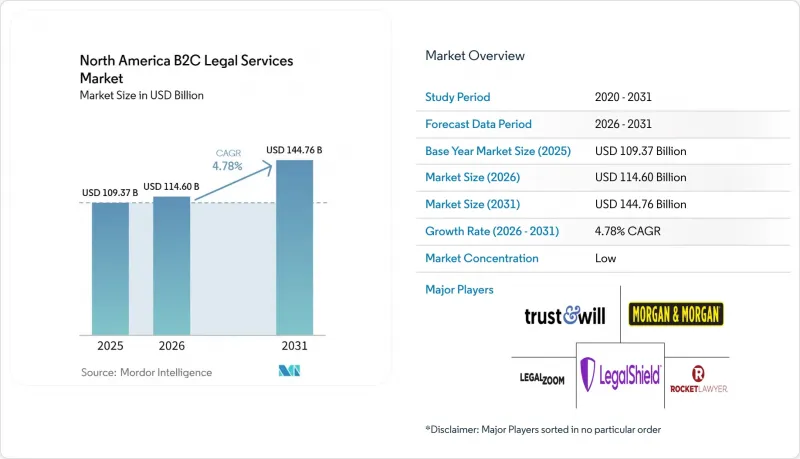
This report is Segmented by Case Type (Family Law, Personal Injury, and More), Delivery Mode (In-Person Consultations, Hybrid, and Fully Virtual), Provider Type (Solo & Small Law Firms, Mid-Size Law Firms, and More), Service Type (Legal Assistance, Legal Documentation, and More), and Country (United States, Canada, and Mexico). The Market Size and Forecasts are Provided in Terms of Value (USD).
North America B2C Legal Services Market Trends and Insights
Court digitization and normalized remote hearings reduce access barriers and travel time for consumers
Modernization across courts is shortening case timelines and reshaping client acquisition economics for the North America B2C Legal Services market. The United States judiciary tested new components for the CM/ECF replacement in 2026 with a faster rollout path now expected at district courts, reinforcing the durability of digital-first workflows. California trial courts conduct about 150,000 remote civil proceedings each month, with strong satisfaction among users and court staff, which signals permanence for remote and hybrid hearings. Ontario built out more than 145 courtrooms with virtual-hearing technology and processed over 1.987 million documents electronically in fiscal 2024-2025, while achieving high completion rates for refugee protection matters within 20 months. Mississippi completed statewide e-filing adoption by July 2025, improving docket transparency and real-time access for litigants and attorneys. Utah's Court Xchange platform lifted digital filings by 42% in the Salt Lake City District Court and doubled pro se initiations in rural San Juan County, illustrating how digital access expands participation beyond urban cores.
An aging population accelerates estate planning, probate, and elder law demand
Demographic change is compressing intergenerational wealth-transfer timelines in Canada and the United States, and low planning penetration creates a clear advisory gap for the North America B2C Legal Services market. By 2030, 22.5% of Canadians are projected to be 65 or older, which lifts demand for wills, powers of attorney, and elder care planning. Less than a quarter of Canadians over 65 had an estate plan as of 2025, which amplifies the need for accessible planning tools and simple pricing. In the United States, only 32% of adults reported having a will in 2025, even as older cohorts display higher completion rates, underscoring uneven preparation. A USD 105 trillion transfer is expected over 25 years in the United States, with most funds earmarked for heirs and a significant share for charities, which underpins steady growth for estate planning, probate, and related services. Canadian tax changes coming into effect in 2026, including the higher capital gains inclusion rate and a larger Lifetime Capital Gains Exemption, further encourage proactive structuring and trust reviews.
State UPL and multijurisdictional licensing rules constrain cross-border virtual scaling
UPL and MJP constraints fragment service delivery models that could otherwise scale with remote hearings and digital filing in the North America B2C Legal Services market. Each U.S. state defines the practice of law independently, and UPL exposure can attach without a showing of consumer harm, which increases risk for national platforms. New York ethics guidance in 2026 set boundaries for participation in out-of-state ABS firms when the predominant effect is in New York, which tightens cross-border fee-sharing conditions. Multiple courts and bars also set certification or consent requirements for generative AI use, increasing supervisory burdens for multistate practices. In Canada, provincial admissions are still required for cross-provincial representations, which limits national platforms to province-based service footprints. The net effect is higher compliance costs and slower national expansion relative to the potential enabled by court digitization.
Other drivers and restraints analyzed in the detailed report include:
- Immigration inflows and pathway policy shifts sustain family and humanitarian case volumes
- Consumer preference for flat fees, online payments, and rapid intake boosts conversion in B2C
- BC's Enhanced Care no-fault auto regime curtails PI litigation
For complete list of drivers and restraints, kindly check the Table Of Contents.
Segment Analysis
Personal injury held 28.30% of the North America B2C Legal Services market share in 2025, and immigration is projected to be the fastest-growing case type at 7.60% CAGR through 2031, reflecting durable demand from pathway shifts and large adjudication backlogs. Estate planning and probate benefit from an aging population and large wealth transfers, while family law and criminal defense track steady demographic baselines rather than policy-sensitive cycles. Bankruptcy and debt relief softened as consumer delinquency patterns normalized from pandemic-era peaks, yet filings remain elevated compared to pre-2020 levels inside many local courts. Large PI firms like Morgan & Morgan expanded in 2025 and 2026, opening new offices and adding attorneys while reporting USD 1.098 billion in verdicts across 295 trials in 2025, which illustrates scale advantages in contingency-fee litigation.
At the same time, virtual competitors pressure traditional PI acquisition models as online-first providers lower lead costs via search, social, and programmatic channels. British Columbia's Enhanced Care framework materially reduced post-2021 tort litigation, which narrows the provincial PI pool, even as the United States remains the dominant share of the North America B2C Legal Services market. Immigration's projected 7.60% CAGR is supported by sustained United States asylum volumes, Canadian refugee and protected-person admissions, and large family-based petition flows that generate stable advisory work under flat-fee pricing. Bilingual practices targeting Hispanic communities and cross-border matters stand to gain share as Spanish-language intake grows in the United States metros with high migrant populations.
Hybrid delivery captured 55.50% share in 2025 as clients combined in-person engagement for critical steps with remote updates and filings for routine events in the North America B2C Legal Services market. Fully virtual platforms are projected to grow at 12.20% CAGR through 2031 on the back of normalized remote hearings and the spread of digital intake and e-filing in high-volume courts. California's 150,000 monthly remote civil proceedings and Ontario's substantial document e-filing volumes show how hybrid is now standard operating procedure in the region. Survey evidence from Minnesota indicates most hearing participants prefer remote attendance, which locks in digital access gains.
The North America B2C Legal Services market size for fully virtual models is projected to expand at a 12.20% CAGR between 2026 and 2031, reflecting broad comfort with video consultations and mobile-first workflows among younger cohorts. LegalZoom's subscription base and rising average order value illustrate how documentation, compliance, and DIFM concierge can scale without bricks-and-mortar buildouts. Hybrid will remain prevalent for complex PI and certain criminal matters where physical presence and rapport building can be decisive, but even these matters benefit from remote discovery and motion practice. Technology investments such as AI-enabled cameras and public participation pods in court innovation labs further reduce the experiential gap between virtual and in-person settings.
List of Companies Covered in this Report:
- LegalZoom
- Rocket Lawyer
- LegalShield
- Trust & Will
- FreeWill
- Morgan & Morgan
- The Cochran Firm
- Ben Crump Law
- The Barnes Firm
- UpRight Law
- Boundless Immigration
- Murthy Law Firm
- Hacking Immigration Law
- Diamond & Diamond Lawyers
- Slater Vecchio LLP
- LawDepot
- Willful
- Rasa Public Benefit Corp.
- 1Law
Additional Benefits:
- The market estimate (ME) sheet in Excel format
- 3 months of analyst support
TABLE OF CONTENTS
1 Introduction
- 1.1 Scope of the Study
2 Research Methodology
3 Executive Summary
4 Market Landscape
- 4.1 Market Overview
- 4.2 Market Drivers
- 4.2.1 Court digitization and normalized remote hearings reduce access barriers and travel time for consumers
- 4.2.2 Aging population accelerates estate planning, probate, and elder law demand
- 4.2.3 Immigration inflows and pathway policy shifts sustain family and humanitarian case volumes
- 4.2.4 Consumer preference for flat fees, online payments, and rapid intake boosts conversion in B2C
- 4.2.5 ABS and regulatory sandboxes (AZ, UT, DC) catalyze new B2C delivery models and pricing
- 4.2.6 Embedded legal fee financing (BNPL, pay-over-time) increases affordability and matter starts
- 4.3 Market Restraints
- 4.3.1 State UPL and multijurisdictional licensing rules constrain cross-border virtual scaling
- 4.3.2 BC's Enhanced Care no-fault auto regime curtails PI litigation addressable market
- 4.3.3 Generative-AI chatbots pose malpractice/UPL risk, tempering automation of front-end advice
- 4.3.4 Rising privacy/cyber obligations raise compliance costs for online-only models
- 4.4 Value / Supply-Chain Analysis
- 4.5 Regulatory Landscape
- 4.6 Technological Outlook
- 4.7 Porter's Five Forces Analysis
- 4.7.1 Threat of New Entrants
- 4.7.2 Bargaining Power of Suppliers
- 4.7.3 Bargaining Power of Buyers
- 4.7.4 Threat of Substitutes
- 4.7.5 Competitive Rivalry
- 4.8 Other North America Specific Analyses
- 4.8.1 Access-to-Justice gap indicators and unmet demand pockets
- 4.8.2 Remote-hearing and e-filing penetration by state/province and practice area
- 4.8.3 Fee transparency and alternative fee models (flat fee, subscription) adoption
- 4.8.4 Language access and bilingual service availability (e.g., Spanish) in client intake
5 Market Size & Growth Forecasts
- 5.1 By Case Type
- 5.1.1 Family Law
- 5.1.2 Personal Injury
- 5.1.3 Estate Planning & Probate
- 5.1.4 Criminal Defense (Misdemeanor & Felony)
- 5.1.5 Immigration
- 5.1.6 Bankruptcy & Debt Relief
- 5.2 By Delivery Mode
- 5.2.1 In-Person Consultations
- 5.2.2 Hybrid (In-Person + Virtual)
- 5.2.3 Fully Virtual / Online Platforms
- 5.3 By Provider Type
- 5.3.1 Solo & Small Law Firms (<10 attorneys)
- 5.3.2 Mid-size Law Firms (11-50 attorneys)
- 5.3.3 Large Law Firms (>50 attorneys)
- 5.3.4 Online-only Legal Platforms
- 5.4 By Service Type
- 5.4.1 Legal Assistance
- 5.4.2 Legal Documentation
- 5.4.3 Legal Advice
- 5.4.4 Other Services
- 5.5 By Country
- 5.5.1 United States
- 5.5.2 Canada
- 5.5.3 Mexico
6 Competitive Landscape
- 6.1 Market Concentration
- 6.2 Strategic Moves
- 6.3 Market Share Analysis
- 6.4 Company Profiles {(includes Global level Overview, Market level overview, Core Segments, Financials as available, Strategic Information, Market Rank/Share for key companies, Products & Services, and Recent Developments)}
- 6.4.1 LegalZoom
- 6.4.2 Rocket Lawyer
- 6.4.3 LegalShield
- 6.4.4 Trust & Will
- 6.4.5 FreeWill
- 6.4.6 Morgan & Morgan
- 6.4.7 The Cochran Firm
- 6.4.8 Ben Crump Law
- 6.4.9 The Barnes Firm
- 6.4.10 UpRight Law
- 6.4.11 Boundless Immigration
- 6.4.12 Murthy Law Firm
- 6.4.13 Hacking Immigration Law
- 6.4.14 Diamond & Diamond Lawyers
- 6.4.15 Slater Vecchio LLP
- 6.4.16 LawDepot
- 6.4.17 Willful
- 6.4.18 Rasa Public Benefit Corp.
- 6.4.19 1Law
7 Market Opportunities & Future Outlook
- 7.1 White-space & unmet-need assessment

