PUBLISHER: Mordor Intelligence | PRODUCT CODE: 2072449

PUBLISHER: Mordor Intelligence | PRODUCT CODE: 2072449
Middle East and North Africa Agriculture - Market Share Analysis, Industry Trends & Statistics, Growth Forecasts (2026 - 2031)
According to Mordor Intelligence, the middle east and North Africa agriculture market size is expected to grow from USD 262.43 billion in 2025 to USD 273.56 billion in 2026 and is forecast to reach USD 336.58 billion by 2031 at 4.24% CAGR over 2026-2031.
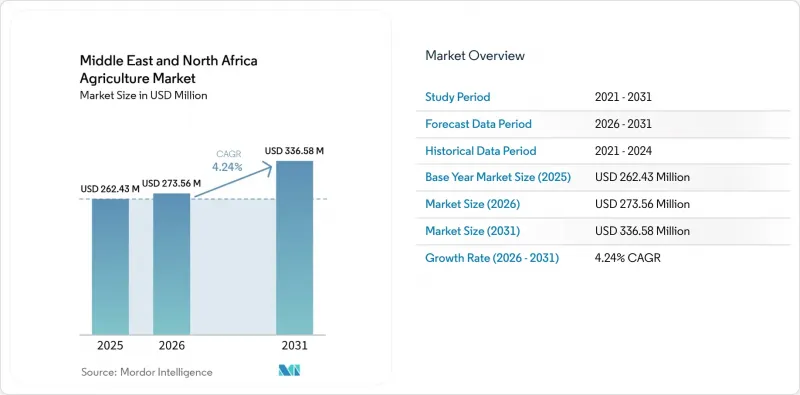
This report is Segmented by Crop Type (Grains and Cereals, and More), and by Geography (Middle East, and More). The Report Includes Production Analysis (Volume), Consumption Analysis (Value and Volume), Export Analysis (Value and Volume), Import Analysis (Value and Volume), and Price Trend Analysis. The Market Forecasts are Provided in Terms of Value (USD) and Volume (Metric Tons).
Middle East and North Africa Agriculture Market Trends and Insights
Government-Backed Mega-Irrigation Expansion Programs
Government-funded irrigation projects are transforming agricultural production patterns across the Middle East and North Africa. Jordan's USD 5 billion desalination plant, scheduled for January 2025, will provide fresh water for 300 km of new agricultural zones. Egypt's Mustaqbal Misr project aims to convert 1.5 million feddans of desert into arable land. Saudi Arabian research institutes are developing salt-tolerant crop varieties specifically designed for desalinated water irrigation. Ethiopia's investment forum showcased USD 600 million in domestic irrigation equipment manufacturing capacity, indicating progress toward agricultural self-sufficiency and employment growth. These developments, combined with decreasing desalination costs, are establishing water-secure agricultural corridors that will support the Middle East and North Africa agriculture market's long-term growth.
Accelerated Adoption of Climate-Smart Greenhouse Systems
Climate challenges, including heat waves and irregular rainfall patterns, have driven increased adoption of controlled-environment farming in the Middle East and North Africa (MENA) region. The United Arab Emirates uses multi-tiered glasshouses that reduce water consumption by 90% compared to open-field farming while minimizing seasonal yield variations. Saudi Arabian coastal resorts implement advanced heat-blocking covers that maintain temperatures below 30°C inside greenhouses, even when external temperatures exceed 45°C. Government support through subsidized electricity rates and streamlined organic certification processes reduces operational costs. Farmers report investment recovery within four years, supported by premium pricing for consistent year-round supply. The transition to advanced greenhouse technology strengthens the Middle East and North Africa agricultural market's competitive position.
Dependence on Imported Seed Genetics and Inputs
Commercial seed in core markets primarily comes from overseas breeders, which exposes growers to foreign exchange risks and potential export restrictions. Ethiopia's seed audit revealed yield reductions of up to 30% when imported hybrid seeds are planted outside their intended agro-ecological zones. Gulf producers experience similar challenges with fertilizer supply, as shipping disruptions can delay essential top dressings. While national seed-multiplication programs are expanding, the time required for varietal development indicates that import dependency will continue in the medium term, constraining growth in the Middle East and North Africa agriculture market.
Other drivers and restraints analyzed in the detailed report include:
- Growing Intra-Country Grain Procurement Agreements
- Scaling Desalination-Powered Hydroponics
- Pollination Inefficiencies in Vertical Farms
For complete list of drivers and restraints, kindly check the Table Of Contents.
Segment Analysis
Grains and cereals hold 47.12% of the Middle East and North Africa agriculture market share in 2025, serving as essential components of regional diets and strategic reserves. Egypt's public wheat procurement reached 14.4 million metric tons in 2024 through direct contracts, providing millers with a consistent supply and strengthening domestic food security. Nigeria's irrigation-focused rice production, backed by minimum price guarantees, is increasing average yields to 4.5 metric tons per hectare, reducing import requirements and stabilizing urban market prices. North African barley production meets both human consumption and animal feed needs, creating balanced demand patterns that provide steady income for farmers. The implementation of precision planting technologies and remote sensing improves input efficiency across extensive grain fields, maintaining the segment's dominant position in the Middle East and North Africa agriculture market.
The oilseeds and pulses segment is projected to grow at a 4.86% CAGR through 2031. Nigeria's soybean production region has secured USD 2 billion in processing facility investments, with potential annual export revenues of USD 200 million in the coming decade. Ethiopia and Egypt are expanding chickpea and fava bean production to meet increasing protein demand from urban consumers focused on health. Local processing facilities prefer domestic supply sources to reduce transportation costs associated with imported meals, supporting the expansion of cultivation areas. The development of drought-resistant, short-duration crop varieties improves yields and water efficiency, supporting the continued growth of this rapidly expanding segment in the Middle East and North Africa agriculture market.
Complete Report Scope:
- By Crop Type (Production Analysis (Volume), Consumption Analysis (Volume and Value), Import Analysis (Volume and Value), Export Analysis (Volume and Value), and Price Trend Analysis)
- Grains and Cereals
- Oilseeds and Pulses
- Fruits and Vegetables
- Forage and Fodder Crops
- By Geography
- Middle East
- United Arab Emirates
- Saudi Arabia
- Bahrain
- Kuwait
- Oman
- Qatar
- Rest of Middle East
- North Africa
- Egypt
- Libya
- Algeria
- Morocco
- Tunisia
- Sudan
- Rest of North Africa
- Middle East
Additional Benefits:
- The market estimate (ME) sheet in Excel format
- 3 months of analyst support
TABLE OF CONTENTS
1 Introduction
- 1.1 Study Assumptions and Market Definition
- 1.2 Scope of the Study
2 Research Methodology
3 Executive Summary
4 Market Landscape
- 4.1 Market Overview
- 4.2 Market Drivers
- 4.2.1 Government-Backed Mega-Irrigation Expansion Programs
- 4.2.2 Accelerated Adoption of Climate-Smart Greenhouse Systems
- 4.2.3 Rapid Rise of Agri-Fintech Platforms Improving Farm Liquidity
- 4.2.4 Growing Intra-Country Grain Procurement Agreements
- 4.2.5 Scaling Desalination-Powered Hydroponics
- 4.2.6 Emergence of Carbon-Credit Revenues for Conservation Tillage
- 4.3 Market Restraints
- 4.3.1 Dependence on Imported Seed Genetics and Inputs
- 4.3.2 Pollination Inefficiencies in Vertical Farms
- 4.3.3 Fragmented Land-Holding Patterns
- 4.3.4 Limited Cold-Chain Nodes Between Farmgate and Ports
- 4.4 Regulatory Landscape
- 4.5 Technological Outlook
- 4.6 Value / Supply-Chain Analysis
- 4.7 PESTLE Analysis
5 Market Size and Growth Forecasts (Value and Volume)
- 5.1 By Crop Type (Production Analysis (Volume), Consumption Analysis (Volume and Value), Import Analysis (Volume and Value), Export Analysis (Volume and Value), and Price Trend Analysis)
- 5.1.1 Grains and Cereals
- 5.1.2 Oilseeds and Pulses
- 5.1.3 Fruits and Vegetables
- 5.1.4 Forage and Fodder Crops
- 5.2 By Geography
- 5.2.1 Middle East
- 5.2.1.1 United Arab Emirates
- 5.2.1.2 Saudi Arabia
- 5.2.1.3 Bahrain
- 5.2.1.4 Kuwait
- 5.2.1.5 Oman
- 5.2.1.6 Qatar
- 5.2.1.7 Rest of Middle East
- 5.2.2 North Africa
- 5.2.2.1 Egypt
- 5.2.2.2 Libya
- 5.2.2.3 Algeria
- 5.2.2.4 Morocco
- 5.2.2.5 Tunisia
- 5.2.2.6 Sudan
- 5.2.2.7 Rest of North Africa
- 5.2.1 Middle East
6 Competitive Landscape
- 6.1 List of Stakeholders
- 6.1.1 Olam Agri Holdings Pte Ltd
- 6.1.2 Al Ghurair Resources International LLC
- 6.1.3 Bunge Global SA (Viterra, Inc.)
- 6.1.4 Cargill, Incorporated
- 6.1.5 Louis Dreyfus Company B.V.
- 6.1.6 Almarai Company
- 6.1.7 Fresh Del Monte Produce Inc.
- 6.1.8 Americana Group
- 6.1.9 Mirak Group Ltd.
- 6.1.10 Pure Harvest Smart Farms Ltd
- 6.1.11 Core Fruit (Pty) Ltd
- 6.1.12 Al Alamiya Farm
- 6.1.13 Torba Farm
- 6.1.14 The Fruit Farm Group South Africa (Pty) Ltd
7 Market Opportunities and Future Outlook

