
PUBLISHER: Mordor Intelligence | PRODUCT CODE: 2072450

PUBLISHER: Mordor Intelligence | PRODUCT CODE: 2072450
Vietnam Retail - Market Share Analysis, Industry Trends & Statistics, Growth Forecasts (2026 - 2031)
According to Mordor Intelligence, the vietnam retail market size is projected to expand from USD 163.44 billion in 2025 and USD 171.40 billion in 2026 to USD 217.44 billion by 2031, registering a CAGR of 4.87% between 2026 to 2031.
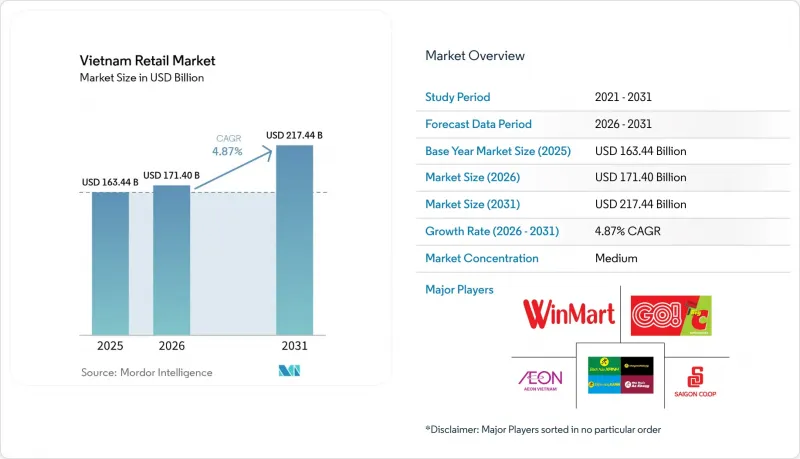
This report is Segmented by Product Type (Food, Beverage, and Tobacco Products, Personal Care and Household Care, and More), Retail Channel (Traditional Mom and Pop Retail, Modern Trade Retail, E-Commerce, and Others), and Format (Hypermarkets, Supermarkets, Convenience Stores, Department Stores, Specialty Stores, and Others). The Market Forecasts are Provided in Terms of Value (USD).
Vietnam Retail Market Trends and Insights
Rise of Middle-Class Disposable Income
Vietnam's middle-income cohort widened in 2025, shifting spend toward packaged convenience foods, imported personal-care brands, and ready-to-eat solutions that carry premiums above traditional formats. This trend lifted own-label trajectories as retailers used private-label margins to counter rising rents and labor costs while keeping price points attractive to value-focused shoppers. The pattern is strongest in HCMC and Hanoi, where the threshold for modern retail adoption has moved downward and widened the base of households that frequent chain stores and malls. Discretionary categories like apparel and footwear captured more incremental wallet share while staple food spend moderated as households diversified consumption toward packaged and premium alternatives. Foreign mall operators capitalized by curating premium specialty zones at new flagship centers, with Lotte Mall West Lake Hanoi reporting high traffic and sales during its first 15 months, which drew international beauty and fashion brands to the capital's retail stage.
Expanding Urban Grocery Penetration Beyond Tier-1 Cities
Tier-2 and Tier-3 cities like Hai Phong, Quang Ninh, Can Tho, and Da Nang posted faster 2024 retail sales growth than HCMC, opening whitespace for modern grocery formats to scale networks beyond saturated metro cores. Mobile World's Bach Hoa Xanh reached company-level profitability in 2024 and is targeting hundreds of new grocery stores focused on Central Vietnam as management aims to balance network density in the south with expansion into underpenetrated provinces. Improved transport links have cut travel times and logistics costs in the Mekong, lifting consumer access to larger-format outlets while giving suppliers better routing to distribution hubs. Central Retail's project pipeline for new malls in Hung Yen and Yen Bai supports the push into the northern corridor that has seen faster retail growth tied to industrial expansion and worker inflows. Pharmacy chains also validated the multi-format playbook in secondary cities as Long Chau scaled coverage across all provinces and used health services to drive recurring store traffic and cross-selling activity.
High Commercial-Rent Inflation in Prime Retail Corridors
Prime street-level retail rents in central districts of HCMC and Hanoi approached USD 150 per square meter per month by mid-2025, and that moved occupancy decisions toward smaller footprints and secondary streets where traffic is lower but occupancy costs are sustainable. This pressure compressed convenience chain margins and spurred network optimization and relocation decisions that reduced exposure to premium corridors in favor of multi-node coverage and dark-store fulfillment. Electronics retailers trimmed locations in 2024 when density and rent escalations reduced sales per square meter and placed pressure on store economics. Malls held relatively stable occupancy on average, yet street-facing stores faced higher tenant churn when lease renewals reset rents in line with tourist recovery and weekday office footfall. Operators responded by shifting growth to fulfillment-only sites and logistics-linked clusters in secondary cities where inbound demand supports 30-minute delivery in dense neighborhoods at a fraction of prime street rents.
Other drivers and restraints analyzed in the detailed report include:
- Acceleration of Last-Mile Cold-Chain Logistics
- Mandatory E-Invoice Regime Improving Tax Compliance
- Fragmented Supply Chain of Fresh Categories
For complete list of drivers and restraints, kindly check the Table Of Contents.
Segment Analysis
Food, beverage, and tobacco secured a 48.35% share in 2025 within the Vietnam retail market, while personal care and household care are tracking a 6.46% CAGR from 2026 to 2031 as imported skincare and premium detergents gain shelf space and command higher price points. This mix reflects how modern grocery, malls, and livestreaming are reinforcing premiumization while consumers maintain stable spending on staple categories. Electronics and appliances generated sizeable revenue through chain distribution in 2024, which underscores how households balance upgrades with basic food spending. Apparel and footwear captured a larger share of new wallet additions between 2024 and 2025 on the back of fast-fashion churn and online content that amplifies product discovery. Furniture and hobby categories saw slower growth as smaller urban dwellings and shorter replacement cycles constrained ticket sizes, while a delayed international entry kept local assemblers and online platforms in the lead.
The category mix is evolving from a 2020 baseline toward higher-value packaged foods and dairy as cold storage and transport improve and as retailers push chilled ready meals and imported SKUs into convenience footprints. Personal care leaders worked with platforms to capture growth during mega-sales periods, which produced outsized gains and showed that video-first merchandising accelerates conversion for beauty brands. Private-label penetration at cooperatives and chain grocers rose in 2024 as a subset of shoppers traded down to high-quality equivalents priced below branded rivals, and that deepened as loyalty programs and store membership nudged repeat purchase. Pharmacy chains added health services that drove basket expansion into health-adjacent items like supplements and personal care, and that widened the halo effect for convenience and grocery retail. These shifts illustrate how the Vietnam retail market combines stable staples with faster premiumization in health and beauty segments that build unit economics beyond base categories.
Complete Report Scope:
- By Product Type
- Food, Beverage, and Tobacco Products
- Personal Care and Household Care
- Apparel, Footwear, and Accessories
- Furniture, Toys, and Hobby
- Industrial and Automotive
- Electronic and Household Appliances
- Other Products
- By Retail Channel
- Traditional Mom and Pop Retail
- Modern Trade Retail
- E-Commerce and Others
- By Format
- Hypermarkets
- Supermarkets
- Convenience Stores
- Department Stores
- Specialty Stores
- Others (drugstore, cash & carry, wholesaler)
List of Companies Covered in this Report:
- Masan Group (WinCommerce/WinMart)
- Saigon Co.op
- Mobile World Investment Corp. (The Gioi Di Dong, Dien May Xanh, Bach Hoa Xanh)
- Central Retail Vietnam (GO!/Big C, Tops Market)
- AEON Vietnam
- Lotte Mart Vietnam
- FPT Retail (FPT Shop, F.Studio)
- Vincom Retail
- Circle K Vietnam
- 7-Eleven Vietnam
- GS25 Vietnam
- Coop Food
- Guardian Vietnam
- Nguyen Kim
- MediaMart
- Lazada Vietnam
- Shopee Vietnam
- Tiki Corporation
- Sendo
Additional Benefits:
- The market estimate (ME) sheet in Excel format
- 3 months of analyst support
TABLE OF CONTENTS
1 Introduction
- 1.1 Study Assumptions & Market Definition
- 1.2 Scope of the Study
2 Research Methodology
3 Executive Summary
4 Market Landscape
- 4.1 Market Overview
- 4.2 Market Drivers
- 4.2.1 Rise of middle-class disposable income
- 4.2.2 Expanding urban grocery penetration beyond Tier-1 cities
- 4.2.3 Acceleration of last-mile cold-chain logistics
- 4.2.4 Mandatory e-invoice regime improving tax compliance
- 4.2.5 Growing uptake of social-commerce live-streaming
- 4.2.6 Cross-border 'gray' imports eroding local assortment
- 4.3 Market Restraints
- 4.3.1 High commercial-rent inflation in prime retail corridors
- 4.3.2 Fragmented supply chain of fresh categories
- 4.3.3 Persistent cash-on-delivery preference slowing digital payments
- 4.3.4 Limited nationwide data-analytics talent pool for modern retail
- 4.4 Value / Supply-Chain Analysis
- 4.5 Regulatory Landscape
- 4.6 Technological Outlook
- 4.7 Porter's Five Forces
- 4.7.1 Threat of New Entrants
- 4.7.2 Bargaining Power of Suppliers
- 4.7.3 Bargaining Power of Buyers
- 4.7.4 Threat of Substitutes
- 4.7.5 Competitive Rivalry
5 Market Size & Growth Forecasts
- 5.1 By Product Type
- 5.1.1 Food, Beverage, and Tobacco Products
- 5.1.2 Personal Care and Household Care
- 5.1.3 Apparel, Footwear, and Accessories
- 5.1.4 Furniture, Toys, and Hobby
- 5.1.5 Industrial and Automotive
- 5.1.6 Electronic and Household Appliances
- 5.1.7 Other Products
- 5.2 By Retail Channel
- 5.2.1 Traditional Mom and Pop Retail
- 5.2.2 Modern Trade Retail
- 5.2.3 E-Commerce and Others
- 5.3 By Format
- 5.3.1 Hypermarkets
- 5.3.2 Supermarkets
- 5.3.3 Convenience Stores
- 5.3.4 Department Stores
- 5.3.5 Specialty Stores
- 5.3.6 Others (drugstore, cash & carry, wholesaler)
6 Competitive Landscape
- 6.1 Market Concentration
- 6.2 Strategic Moves
- 6.3 Market Share Analysis
- 6.4 Company Profiles (includes Global level Overview, Market level overview, Core Segments, Financials as available, Strategic Information, Market Rank/Share for key companies, Products & Services, and Recent Developments)
- 6.4.1 Masan Group (WinCommerce/WinMart)
- 6.4.2 Saigon Co.op
- 6.4.3 Mobile World Investment Corp. (The Gioi Di Dong, Dien May Xanh, Bach Hoa Xanh)
- 6.4.4 Central Retail Vietnam (GO!/Big C, Tops Market)
- 6.4.5 AEON Vietnam
- 6.4.6 Lotte Mart Vietnam
- 6.4.7 FPT Retail (FPT Shop, F.Studio)
- 6.4.8 Vincom Retail
- 6.4.9 Circle K Vietnam
- 6.4.10 7-Eleven Vietnam
- 6.4.11 GS25 Vietnam
- 6.4.12 Coop Food
- 6.4.13 Guardian Vietnam
- 6.4.14 Nguyen Kim
- 6.4.15 MediaMart
- 6.4.16 Lazada Vietnam
- 6.4.17 Shopee Vietnam
- 6.4.18 Tiki Corporation
- 6.4.19 Sendo
7 Market Opportunities & Future Outlook
- 7.1 Omni-channel grocery models integrating dark-stores in Tier-2 cities
- 7.2 Private-label penetration in fresh & chilled categories

