PUBLISHER: Mordor Intelligence | PRODUCT CODE: 2072470

PUBLISHER: Mordor Intelligence | PRODUCT CODE: 2072470
Compressed Air Energy Storage (CAES) - Market Share Analysis, Industry Trends & Statistics, Growth Forecasts (2026 - 2031)
According to Mordor Intelligence, compressed air energy storage market size in 2026 is estimated at USD 4.33 billion, growing from 2025 value of USD 3.65 billion with 2031 projections showing USD 10.17 billion, growing at 18.6% CAGR over 2026-2031.
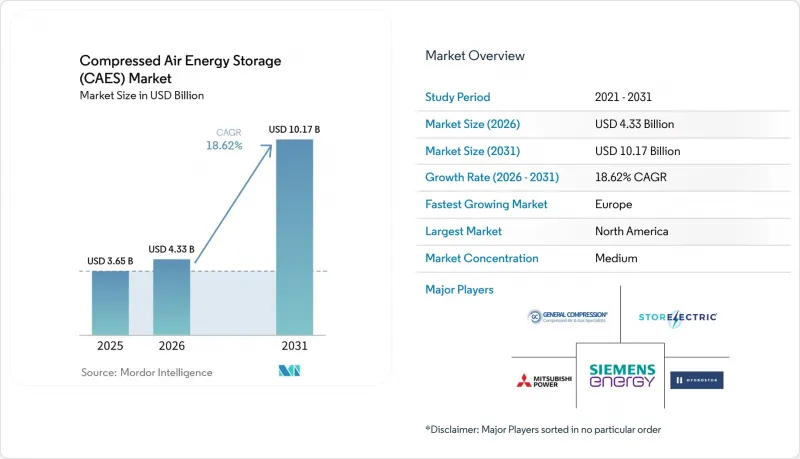
This report is Segmented by Type (Diabatic, Adiabatic, and More), Storage Configuration (Salt-Domed Cavern, Hard-rock/Mined Cavern, and More), Power Capacity (Small-Scale and Medium-Scale), Application (Renewable-Integration Firming, Power-To-X Hydrogen Hybrids, and More), End-User (Electric Utility, Data Centres and Digital Infra, and More), and Geography (North America, Europe, and More)
Global Compressed Air Energy Storage (CAES) Market Trends and Insights
Renewable-Energy Penetration Mandates Drive Grid Stability Investments
Mandates in California, the EU, and select Australian states are compelling utilities to secure long-duration capacity that can bridge daily renewable gaps. California alone has earmarked USD 270 million for non-lithium storage and set a 4 GW target for assets with a six-hour duration, providing compressed air energy storage market projects with a clear policy runway. The UK's cap-and-floor scheme, finalized in 2025, offers a regulated revenue stream for assets with discharge windows exceeding 6 hours, making CAES a bankable proposition for investors. These frameworks directly address the "duck curve," a scenario in which solar output falls steeply as evening demand rises, creating a four- to six-hour deficit that favors CAES over batteries. Australia's New South Wales followed suit, contracting 1 GW/13 GWh of long-duration storage capacity, further expanding the compressed air energy storage market.
Declining $/kWh Costs for Adiabatic CAES Technology
Thermal-management advances and standardized turbomachinery have driven adiabatic CAPEX down to USD 1,100-1,400 per kW, lifting round-trip efficiencies to 70-75%, and closing much of the gap versus pumped-hydro assets. Packed-bed heat-storage modules using phase-change materials now reach 61.5% energy efficiency and recoup costs within 3.5 years, enabling fossil-free operation and recurring carbon-credit revenue. Emerging low-temperature adiabatic designs operating at 90-200 °C are snaring frequency-regulation contracts thanks to sub-90-second start-up times. These cost and performance gains are positioning the compressed air energy storage market as a mainstream choice for multi-service portfolios that include arbitrage, spinning reserve, and synthetic inertia.
High Up-Front Capital Expenditure Constrains Market Entry
Typical utility-scale CAES installations require USD 1,600-2,300 per kW for diabatic designs, with overall project budgets exceeding USD 100 million. The McIntosh plant's inflation-adjusted build-out cost illustrates the sizable balance-sheet exposure developers face. Four- to six-year payback horizons-even for 75%-efficient adiabatic systems-compare unfavorably with two- to three-year returns on front-of-the-meter battery arrays. Geological surveys, bespoke turbomachinery, and cavern-lining warranties increase contingency allowances, which dampens the appeal of the compressed air energy storage industry in capital-scarce regions that lack targeted policy support.
Other drivers and restraints analyzed in the detailed report include:
- Government Long-Duration Storage Tenders Accelerate Deployment
- Repurposing Depleted Gas Fields Reduces Infrastructure Costs
- Battery Price Deflation Creates Competitive Pressure
For complete list of drivers and restraints, kindly check the Table Of Contents.
Segment Analysis
Adiabatic designs captured rising investor attention as round-trip efficiencies surged toward 75% and fuel-free operation aligned with corporate net-zero targets. The adiabatic segment is forecast to grow at a 22.10% CAGR to 2031, despite diabatic plants still holding a 49.75% market share in the compressed air energy storage market as of 2025. Forward-looking utilities favor adiabatic assets for zero-emission credentials, while regions with abundant gas pipelines and urgent capacity shortages continue to commission diabatic units. The compressed air energy storage market size for advanced isothermal prototypes remains small, but could expand once deep-ocean tethering tests validate a 90% theoretical efficiency.
Thermal-storage media costs have fallen by almost 30% since 2022, underpinning the adiabatic runway. Diabatic stalwarts are responding with hybrid-steam cycles that marginally improve efficiency yet rely on lower fuel heat rates to stay relevant. Isothermal ocean-floor pilots target offshore wind balancing, but CAPEX estimates between USD 1,500 and USD 3,000 per kW constrain near-term uptake. Continual innovation in phase-change composites, meanwhile, keeps the compressed air energy storage industry on a rapid learning curve.
Salt caverns accounted for 52.40% of the compressed air energy storage market size in 2025, owing to their geological prevalence in North America and Europe, proven sealing integrity, and mature leaching techniques. Developers report leakage rates below 0.02% per year, reinforcing bankability. Hard-rock and mined caverns, however, are growing at a 24.80% CAGR as operators retrofit abandoned mines in Australia, Germany, and China, benefiting from pre-existing shafts that slash excavation costs.
Above-ground pressure vessels cater to remote microgrids and fast-track projects under 10 MW but become cost-prohibitive at utility scale. Aquifer storage remains limited to pilot deployments because heterogenous porosity complicates pressure management. Underwater pipe concepts, although technically viable, still wrestle with mooring and maintenance logistics. Consequently, salt-domed and hard-rock caverns are likely to dominate the compressed air energy storage market share throughout the decade.
Complete Report Scope:
- By Type
- Diabatic
- Adiabatic
- Isothermal
- Super-/Advanced Isothermal
- By Storage Configuration
- Salt-domed cavern
- Hard-rock/mined cavern
- Aquifer
- Abandoned mine/tunnel
- Above-ground pressure vessel
- Underwater/seabed pipe
- By Power Capacity
- Small-scale (Below 10 MW)
- Medium-scale (10 to 100 MW)
- By Application
- Renewable-integration firming
- Peak-shaving and load-shifting
- T&D deferral
- Backup and resilience/microgrids
- Industrial waste-heat recovery
- Power-to-X hydrogen hybrids
- By End-User
- Electric utilities
- Independent power producers
- Commercial and industrial
- Remote and off-grid communities
- Data centres and digital infra
- By Geography
- North America
- United States
- Canada
- Mexico
- Europe
- Germany
- United Kingdom
- Italy
- Spain
- France
- Netherlands
- Norway
- Russia
- Rest of Europe
- Asia-Pacific
- China
- Japan
- India
- South Korea
- ASEAN Countries
- Australia
- Rest of Asia-Pacific
- South America
- Brazil
- Argentina
- Rest of South America
- Middle East and Africa
- Saudi Arabia
- United Arab Emirates
- Israel
- South Africa
- Egypt
- Rest of Middle East and Africa
- North America
Geography Analysis
North America captured 34.40% of revenues in 2025, driven by federal lending support and ambitious state procurement targets. Hydrostor's 400 MW Willow Rock center in California exemplifies large-scale momentum, while Canada's Quinte facility secured USD 200 million in growth capital to advance a 500 MW build-out. Mexico, though still exploratory, boasts ample salt formations that could host future sites once policy incentives materialize.
Europe's 27.10% CAGR trajectory rests on cohesive decarbonization mandates. The UK's cap-and-floor plan ensures baseload-style earnings, encouraging tender pipelines that favor technologies with discharge thresholds exceeding six hours. Germany's grid-balancing needs have catalyzed proposals for CAES systems utilizing disused salt mines, and the Netherlands is studying repurposed gas fields for hybrid hydrogen-CAES hubs. Eastern Europe's mining legacies offer an optionality for low-cost cavern conversion as renewable energy penetration grows.
Asia-Pacific region is evolving into a test bed for giga-scale installations. China's 300 MW Jiangsu plant validated 40-bar, 600 °C operation, and additional 500 MW projects are moving through provincial approvals. Australia's Long Duration Storage auctions secured over 1 GW of capacity, which includes CAES bids with 8-15-hour capabilities. Japan's research consortia are evaluating seabed-pipe isothermal prototypes, while India's Renewable Energy Storage Roadmap indicates potential fiscal incentives for assets with a storage duration of >= 10 hours. Overall, the compressed air energy storage market is expanding rapidly, particularly where high renewable energy penetration is combined with supportive financing mechanisms.
- Siemens Energy AG
- Hydrostor Inc.
- General Compression Ltd.
- Apex CAES LLC
- Ridge Energy Storage LP
- Storelectric Ltd.
- Mitsubishi Power Americas
- Dresser-Rand (Siemens)
- ALACAES SA
- RWE Power AG
- Corre Energy BV
- Bright Energy Storage
- Stiesdal Storage Tech.
- NRStor Inc.
- Shell Energy Storage
- Huaibei A-CAES Co.
- PG&E (Diablo CAES proj.)
- Cavergy Solutions Ltd.
- Enel Green Power (EGP)
- E.ON SE (Huntorf owner)
Additional Benefits:
- The market estimate (ME) sheet in Excel format
- 3 months of analyst support
TABLE OF CONTENTS
1 Introduction
- 1.1 Study Assumptions & Market Definition
- 1.2 Scope of the Study
2 Research Methodology
3 Executive Summary
4 Market Landscape
- 4.1 Market Overview
- 4.2 Global Installed & Planned CAES Capacity Analysis (MW)
- 4.3 Market Drivers
- 4.3.1 Renewable-energy penetration mandates
- 4.3.2 Declining $/kWh for adiabatic CAES
- 4.3.3 Government long-duration storage tenders
- 4.3.4 Repurposing depleted gas fields for CAES
- 4.3.5 AI-optimised thermal management boosts round-trip efficiency
- 4.3.6 Corporate 24/7 clean-power PPAs driving over 8-hour storage
- 4.4 Market Restraints
- 4.4.1 High up-front capex & long payback
- 4.4.2 Geological site limitations
- 4.4.3 Battery price deflation pressure
- 4.4.4 Community opposition over cavern integrity & seismicity
- 4.5 Supply-Chain Analysis
- 4.6 Regulatory Landscape
- 4.7 Technological Outlook
- 4.8 Porter's Five Forces
- 4.8.1 Bargaining Power of Suppliers
- 4.8.2 Bargaining Power of Buyers
- 4.8.3 Threat of New Entrants
- 4.8.4 Threat of Substitutes
- 4.8.5 Intensity of Competitive Rivalry
5 Market Size & Growth Forecasts
- 5.1 By Type
- 5.1.1 Diabatic
- 5.1.2 Adiabatic
- 5.1.3 Isothermal
- 5.1.4 Super-/Advanced Isothermal
- 5.2 By Storage Configuration
- 5.2.1 Salt-domed cavern
- 5.2.2 Hard-rock/mined cavern
- 5.2.3 Aquifer
- 5.2.4 Abandoned mine/tunnel
- 5.2.5 Above-ground pressure vessel
- 5.2.6 Underwater/seabed pipe
- 5.3 By Power Capacity
- 5.3.1 Small-scale (Below 10 MW)
- 5.3.2 Medium-scale (10 to 100 MW)
- 5.4 By Application
- 5.4.1 Renewable-integration firming
- 5.4.2 Peak-shaving and load-shifting
- 5.4.3 T&D deferral
- 5.4.4 Backup and resilience/microgrids
- 5.4.5 Industrial waste-heat recovery
- 5.4.6 Power-to-X hydrogen hybrids
- 5.5 By End-User
- 5.5.1 Electric utilities
- 5.5.2 Independent power producers
- 5.5.3 Commercial and industrial
- 5.5.4 Remote and off-grid communities
- 5.5.5 Data centres and digital infra
- 5.6 By Geography
- 5.6.1 North America
- 5.6.1.1 United States
- 5.6.1.2 Canada
- 5.6.1.3 Mexico
- 5.6.2 Europe
- 5.6.2.1 Germany
- 5.6.2.2 United Kingdom
- 5.6.2.3 Italy
- 5.6.2.4 Spain
- 5.6.2.5 France
- 5.6.2.6 Netherlands
- 5.6.2.7 Norway
- 5.6.2.8 Russia
- 5.6.2.9 Rest of Europe
- 5.6.3 Asia-Pacific
- 5.6.3.1 China
- 5.6.3.2 Japan
- 5.6.3.3 India
- 5.6.3.4 South Korea
- 5.6.3.5 ASEAN Countries
- 5.6.3.6 Australia
- 5.6.3.7 Rest of Asia-Pacific
- 5.6.4 South America
- 5.6.4.1 Brazil
- 5.6.4.2 Argentina
- 5.6.4.3 Rest of South America
- 5.6.5 Middle East and Africa
- 5.6.5.1 Saudi Arabia
- 5.6.5.2 United Arab Emirates
- 5.6.5.3 Israel
- 5.6.5.4 South Africa
- 5.6.5.5 Egypt
- 5.6.5.6 Rest of Middle East and Africa
- 5.6.1 North America
6 Competitive Landscape
- 6.1 Market Concentration
- 6.2 Strategic Moves (M&A, Partnerships, PPAs)
- 6.3 Market Share Analysis (Market Rank/Share for key companies)
- 6.4 Company Profiles (includes Global level Overview, Market level overview, Core Segments, Financials as available, Strategic Information, Products & Services, and Recent Developments)
- 6.4.1 Siemens Energy AG
- 6.4.2 Hydrostor Inc.
- 6.4.3 General Compression Ltd.
- 6.4.4 Apex CAES LLC
- 6.4.5 Ridge Energy Storage LP
- 6.4.6 Storelectric Ltd.
- 6.4.7 Mitsubishi Power Americas
- 6.4.8 Dresser-Rand (Siemens)
- 6.4.9 ALACAES SA
- 6.4.10 RWE Power AG
- 6.4.11 Corre Energy BV
- 6.4.12 Bright Energy Storage
- 6.4.13 Stiesdal Storage Tech.
- 6.4.14 NRStor Inc.
- 6.4.15 Shell Energy Storage
- 6.4.16 Huaibei A-CAES Co.
- 6.4.17 PG&E (Diablo CAES proj.)
- 6.4.18 Cavergy Solutions Ltd.
- 6.4.19 Enel Green Power (EGP)
- 6.4.20 E.ON SE (Huntorf owner)
7 Market Opportunities & Future Outlook
- 7.1 White-space & Unmet-Need Assessment

