PUBLISHER: Mordor Intelligence | PRODUCT CODE: 2072497

PUBLISHER: Mordor Intelligence | PRODUCT CODE: 2072497
Small Kitchen Appliances - Market Share Analysis, Industry Trends & Statistics, Growth Forecasts (2026 - 2031)
According to Mordor Intelligence, the small kitchen appliances market size is expected to grow from USD 62.19 billion in 2025 to USD 65.46 billion in 2026 and is forecast to reach USD 84.63 billion by 2031 at 5.27% CAGR over 2026-2031.
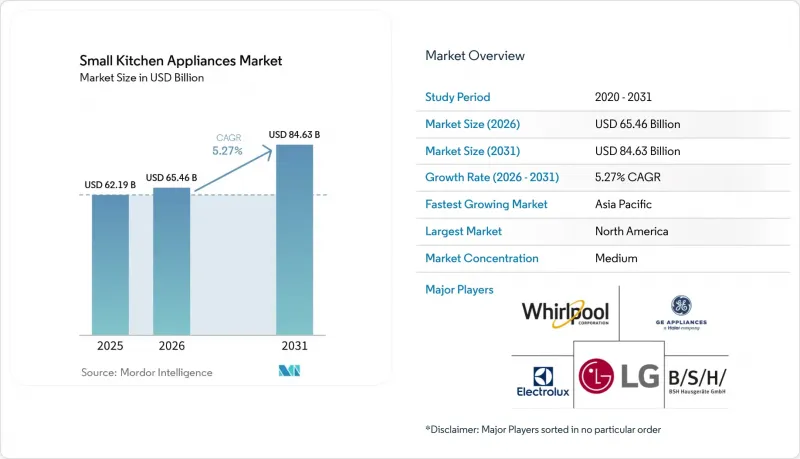
This report Segments by Product (Coffee Makers, Electric Cookers, and More), by End User (Residential and Commercial), by Distribution Channel (B2C / Retail and B2B (directly From the Manufacturers)), and by Geography (North America, South America, and More). The Market Forecasts are Provided in Terms of Value (USD).
Global Small Kitchen Appliances Market Trends and Insights
Rising Urban Living & Space Constraints
Urban density pushes designers toward smaller, multi-functional devices that add minimal footprint yet deliver restaurant-grade results. Smart compact dishwashers, stackable espresso stations, and wall-mounted ovens exemplify how the small kitchen appliances market solves space shortages. Demand concentrates in APAC megacities where housing supply trails population growth, creating durable opportunities for manufacturers that master modularity. Brand differentiation increasingly hinges on fold-flat handles, hidden ventilation, and cabinetry integration that converts living rooms into pop-up kitchens. Vendors able to certify performance without enlarging form factors win loyalty among renters and condo owners concerned with every square inch.
Growing Demand for Convenient & Time-Saving Appliances
Consumers in the global kitchen appliances market increasingly equate convenience with automation, motivating brands to embed AI that adjusts temperature, monitors doneness, and proposes recipes. Panasonic's HomeCHEF platform demonstrates how voice commands and cloud recipes transform an oven into a meal planner. SharkNinja's 89% sales jump in food-prep devices underscores willingness to pay for speed and cognitive ease . Dual-income households now view countertop appliances as everyday productivity tools, not holiday luxuries. As AI modules become standard, convenience transitions from premium extra to base expectation, pushing laggards aside.
High Upfront Cost of Premium Smart Appliances
AI modules, multiple sensors, and secure connectivity add 30-50% to base prices, slowing adoption among value-focused households. In developing regions, buyers favor essential features over cloud analytics, creating market bifurcation between luxury and mass. Brands attempt to soften the blow with financing plans and entry-level smart lines, yet sticker shock remains a barrier. Competitors introducing basic connectivity at lower margins squeeze incumbents' premium tiers. The small kitchen appliances market, therefore, balances innovation with affordability or risks stalling volume growth.
Other drivers and restraints analyzed in the detailed report include:
- Increasing Disposable Income in Emerging Economies
- Integration of Compact IH & Pressure Tech in Multi-Cookers
- Volatility in Raw-Material Prices
For complete list of drivers and restraints, kindly check the Table Of Contents.
Segment Analysis
Air fryers lead unit growth with a 6.42% CAGR through 2031 as consumers seek up to 90% oil reduction without flavor loss, hindustantimes.com. Their surge catalyzes frozen-food makers to label packaging with air-fry instructions, shown by a 90% increase in SKUs during 2024 conagrabrands.com. Coffee makers still hold the largest 22.35% slice, underpinning stable repeat-purchase behavior anchored in morning rituals. The small kitchen appliances market size for coffee makers remains resilient even while share flattens due to air-fryer momentum. Emerging niches, such as automated bread makers and sous-vide sticks, gain traction as social media spotlights specialty cooking. Multi-functional electric cookers blend pressure, induction, and robotic stirring to attract upgrade shoppers who aim to clear counter clutter. Routine categories like toasters and kettles log steady replacement demand but now incorporate connectivity and style updates to keep relevance. Overall, product competition shifts toward versatility and wellness alignment.Compact ovens with convection, steam, and air-fry modes in one chassis illustrate how the small kitchen appliances market presses suppliers to consolidate functions.
Grills, blenders, and juicers ride the wellness trend, particularly in APAC cities where smoothie culture accelerates. Countertop refrigeration, enabled by inverter tech, births a fresh subcategory that addresses beverage storage in micro-apartments. Product bundling, such as blender-cup packages and fryer-rack accessories, supports margin retention. Small-batch manufacturing and color variants satisfy consumers who view appliances as visible decor.
Complete Report Scope:
- By Product
- Food Processors
- Juicers and Blenders
- Grills and Roasters
- Air Fryers
- Coffee Makers
- Electric Cookers
- Toasters
- Electric Kettles
- Countertop Ovens
- Other Small Kitchen Appliances (bread makers, waffle makers, egg cookers, etc.)
- By End User
- Residential
- Commercial
- By Distribution Channel
- B2C / Retail
- Multi-brand Stores
- Exclusive Brand Outlets
- Online Retail
- Other Distribution Channels
- B2B (directly from the manufacturers)
- B2C / Retail
- By Geography
- North America
- Canada
- United States
- Mexico
- South America
- Brazil
- Peru
- Chile
- Argentina
- Rest of South America
- Europe
- United Kingdom
- Germany
- France
- Spain
- Italy
- BENELUX
- NORDICS
- Rest of Europe
- Asia-Pacific
- India
- China
- Japan
- Australia
- South Korea
- South-East Asia
- Rest of Asia-Pacific
- Middle East & Africa
- United Arab Emirates
- Saudi Arabia
- Turkey
- South Africa
- Nigeria
- Rest of Middle East & Africa
- North America
Geography Analysis
North America held 32.55% of 2025 revenue, anchored by high replacement cycles and early smart-home adoption, packagingdigest.com. U.S. households boosted air-fryer ownership so rapidly that the category became the fourth most common kitchen device. Canada's updated energy standards push manufacturers to rate products above Tier II, favoring inverter motors that slash standby draw canadagazette.gc.ca. Mexico benefits from proximity to U.S. retail chains, fostering near-shoring of assembly to hedge tariff risk and speed delivery. Despite maturity, upsell potential remains via voice-enabled cooktops and countertop wine dispensers.
Asia-Pacific shows the fastest 6.15% CAGR through 2031, propelled by urbanization, rising incomes, and e-commerce. China exported 4.48 billion household appliances in 2024, up 20.8%, underlining the region's scale and domestic appetite. India, with projected consumer-durables expansion this year, fuels premium small kitchen appliances market demand for air-fryers and multi-cookers ibef.org. Southeast Asia's supermarket boom and logistical upgrades open last-mile delivery to peri-urban areas previously underserved. Local brands experiment with rice cooker-air-fryer hybrids tailored to staple diets, reinforcing regional customization as a growth lever.
Europe registers stable growth driven by eco-design rules that nudge buyers toward A-class efficiency labels and recyclable packaging. Germany and France favor induction and steam functions that align with low-fat cooking, while Italy's design heritage boosts demand for colored finishes and retro handles. South America advances steadily yet faces exchange-rate swings that influence affordability. The Middle East and Africa region witnesses rising demand in metropolitan hubs such as Dubai and Lagos, but fragmented regulations necessitate country-specific certification strategies. As connectivity spreads, data-localization laws could shape cloud services that power smart ovens, adding complexity to multinational rollouts.
- AB Electrolux
- BSH Hausgerate GmbH
- De'Longhi S.p.A.
- Dongbu Daewoo Electronics
- Fotile
- Galanz
- Groupe SEB
- Haier Inc.
- Instant Brands
- Joyoung
- Keurig Dr Pepper
- LG Electronics
- Midea Group
- Miele & Cie. KG
- Ninja
- Panasonic Corporation
- Robam
- Samsung Electronics
- Supor
- Whirlpool Corporation
Additional Benefits:
- The market estimate (ME) sheet in Excel format
- 3 months of analyst support
TABLE OF CONTENTS
1 Introduction
- 1.1 Study Assumptions & Market Definition
- 1.2 Scope of the Study
2 Research Methodology
3 Executive Summary
4 Market Landscape
- 4.1 Market Overview
- 4.2 Market Drivers
- 4.2.1 Rising Urban Living & Space Constraints
- 4.2.2 Growing Demand for Convenient & Time-Saving Appliances
- 4.2.3 Increasing Disposable Income in Emerging Economies
- 4.2.4 Rapid E-Commerce Expansion Boosting Product Accessibility
- 4.2.5 Integration of Compact IH & Pressure Tech in Multi-Cookers
- 4.2.6 Micro-Form-Factor Inverter Compressors Enabling Countertop Refrigeration
- 4.3 Market Restraints
- 4.3.1 High Upfront Cost of Premium Smart Appliances
- 4.3.2 Volatility in Raw-Material Prices
- 4.3.3 Fire-Safety Rules Limiting Wattage in Multi-Unit Dwellings
- 4.4 Industry Value Chain Analysis
- 4.5 Porter's Five Forces Analysis
- 4.5.1 Threat of New Entrants
- 4.5.2 Bargaining Power of Suppliers
- 4.5.3 Bargaining Power of Buyers
- 4.5.4 Threat of Substitutes
- 4.5.5 Competitive Rivalry
- 4.6 Insights into the Latest Trends and Innovations in the Market
- 4.7 Insights on Recent Developments (New Product Launches, Strategic Initiatives, Investments, Partnerships, JVs, Expansion, M&As, etc.) in the Market
5 Market Size & Growth Forecasts (Value)
- 5.1 By Product
- 5.1.1 Food Processors
- 5.1.2 Juicers and Blenders
- 5.1.3 Grills and Roasters
- 5.1.4 Air Fryers
- 5.1.5 Coffee Makers
- 5.1.6 Electric Cookers
- 5.1.7 Toasters
- 5.1.8 Electric Kettles
- 5.1.9 Countertop Ovens
- 5.1.10 Other Small Kitchen Appliances (bread makers, waffle makers, egg cookers, etc.)
- 5.2 By End User
- 5.2.1 Residential
- 5.2.2 Commercial
- 5.3 By Distribution Channel
- 5.3.1 B2C / Retail
- 5.3.1.1 Multi-brand Stores
- 5.3.1.2 Exclusive Brand Outlets
- 5.3.1.3 Online Retail
- 5.3.1.4 Other Distribution Channels
- 5.3.2 B2B (directly from the manufacturers)
- 5.3.1 B2C / Retail
- 5.4 By Geography
- 5.4.1 North America
- 5.4.1.1 Canada
- 5.4.1.2 United States
- 5.4.1.3 Mexico
- 5.4.2 South America
- 5.4.2.1 Brazil
- 5.4.2.2 Peru
- 5.4.2.3 Chile
- 5.4.2.4 Argentina
- 5.4.2.5 Rest of South America
- 5.4.3 Europe
- 5.4.3.1 United Kingdom
- 5.4.3.2 Germany
- 5.4.3.3 France
- 5.4.3.4 Spain
- 5.4.3.5 Italy
- 5.4.3.6 BENELUX
- 5.4.3.7 NORDICS
- 5.4.3.8 Rest of Europe
- 5.4.4 Asia-Pacific
- 5.4.4.1 India
- 5.4.4.2 China
- 5.4.4.3 Japan
- 5.4.4.4 Australia
- 5.4.4.5 South Korea
- 5.4.4.6 South-East Asia
- 5.4.4.7 Rest of Asia-Pacific
- 5.4.5 Middle East & Africa
- 5.4.5.1 United Arab Emirates
- 5.4.5.2 Saudi Arabia
- 5.4.5.3 Turkey
- 5.4.5.4 South Africa
- 5.4.5.5 Nigeria
- 5.4.5.6 Rest of Middle East & Africa
- 5.4.1 North America
6 Competitive Landscape
- 6.1 Market Concentration
- 6.2 Strategic Moves
- 6.3 Market Share Analysis
- 6.4 Company Profiles (includes Global Level Overview, Market Level Overview, Core Segments, Financials as Available, Strategic Information, Market Rank/Share for Key Companies, Products & Services, and Recent Developments)
- 6.4.1 AB Electrolux
- 6.4.2 BSH Hausgerate GmbH
- 6.4.3 De'Longhi S.p.A.
- 6.4.4 Dongbu Daewoo Electronics
- 6.4.5 Fotile
- 6.4.6 Galanz
- 6.4.7 Groupe SEB
- 6.4.8 Haier Inc.
- 6.4.9 Instant Brands
- 6.4.10 Joyoung
- 6.4.11 Keurig Dr Pepper
- 6.4.12 LG Electronics
- 6.4.13 Midea Group
- 6.4.14 Miele & Cie. KG
- 6.4.15 Ninja
- 6.4.16 Panasonic Corporation
- 6.4.17 Robam
- 6.4.18 Samsung Electronics
- 6.4.19 Supor
- 6.4.20 Whirlpool Corporation
7 Market Opportunities & Future Outlook
- 7.1 Smart & Connected Appliances
- 7.2 Growing Preference for Multi-functional Small Kitchen Appliances

