PUBLISHER: Mordor Intelligence | PRODUCT CODE: 2123709

PUBLISHER: Mordor Intelligence | PRODUCT CODE: 2123709
United States Small Kitchen Appliances - Market Share Analysis, Industry Trends & Statistics, Growth Forecasts (2026 - 2031)
According to Mordor Intelligence, the United States small kitchen appliances market size was valued at USD 11.64 billion in 2025 and estimated to grow from USD 12.07 billion in 2026 to reach USD 14.49 billion by 2031, at a CAGR of 3.72% during the forecast period (2026-2031).
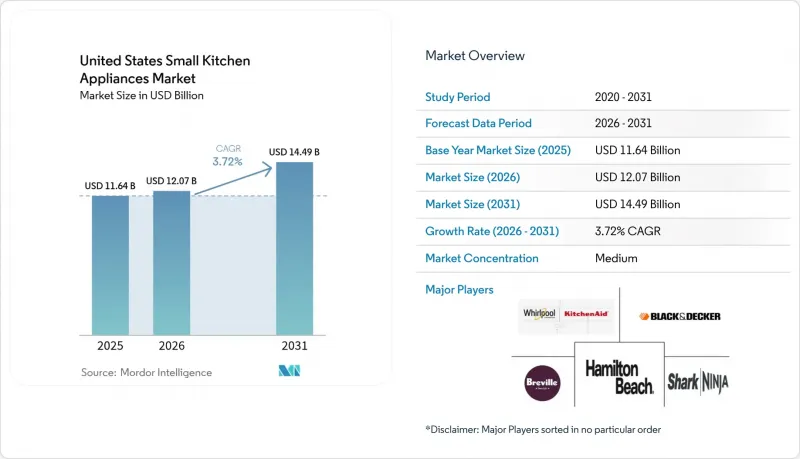
This report is Segmented by Product (Food Processors, Juicers & Blenders, Grills & Roasters, Air Fryers, Coffee Makers, Electric Cookers, and Other Small Kitchen Appliances), End User (Residential, Commercial), Distribution Channel (Multi-Brand Stores, and Other), and Geography (Northeast, Midwest, South, West). The Market Forecasts are Provided in Terms of Value (USD).
United States Small Kitchen Appliances Market Trends and Insights
Rising Disposable Income and Urbanization
Metropolitan population gains and higher real wages support the premium adoption of compact, multifunctional devices. Smaller urban kitchens create a paradoxical lift for countertop units that consolidate tasks, a trend GE Appliances calls "Appliances Anywhere" as appliances migrate into home offices and entertainment areas. Urban buyers pay premiums for connectivity, a dynamic underscored by SharkNinja's 45% food-prep sales surge in Q1 2025 among large cities . The driver remains sensitive to macro cycles, yet continues to pull average selling prices upward when consumer confidence is strong.
Expansion of Residential Real Estate Projects
Housing starts show a strong correlation with first-time appliance installations and comprehensive full-kitchen upgrades across the United States. Builders are increasingly incorporating high-end countertop ovens, beverage systems, and integrated smart appliances into model homes to enhance appeal. Whirlpool's 2025 KitchenAid showcase, featuring fully customizable finishes and premium design options, exemplifies how these channels drive consumer interest and adoption. The Southeast and Western regions, where single-family construction remains particularly robust, contribute disproportionately to revenue growth and market expansion. While material cost inflation can temporarily slow the pace of new builds, persistent demographic growth and household formation trends support sustained long-term demand for residential kitchen appliances.
Volatile Raw-Material Prices Increasing Unit Costs
Global semiconductor shortages continue to disrupt launch calendars for feature-rich appliance models, forcing manufacturers to rely on SKUs built with legacy microcontrollers and slowing the overall pace of innovation. Volatile prices for steel, aluminum, and resin further squeeze profit margins, creating persistent cost pressures across the manufacturing chain. Newell Brands' Q4 2024 revenue fell 6.1% to USD 1.9 billion despite modest margin gains, reflecting cautious pricing amid cost spikes . Extended retail contracts frequently limit the ability to pass increased costs directly to consumers, constraining pricing flexibility. As a result, manufacturers are compelled to implement internal cost-saving measures and operational efficiencies rather than raising list prices to maintain profitability.
Other drivers and restraints analyzed in the detailed report include:
- Convenience-Driven Time-Saving Purchasing Behavior
- Federal and State Energy-Efficiency Incentive Programs
- Fast-Shifting Consumer Style & Design Preferences
For complete list of drivers and restraints, kindly check the Table Of Contents.
Segment Analysis
Coffee makers retained 26.70% revenue leadership in the United States small kitchen appliances market in 2025, spanning value drip machines to premium super-automatic espresso stations. Air fryers, however, are posting the swiftest 6.29% CAGR to 2031 as calorie-conscious consumers replace deep-fry routines with rapid-convection alternatives. The United States' small kitchen appliances market size for air fryers is driven by repeat-purchase intention among prior adopters. Multifunctional countertop ovens that combine air-fry, bake, and toast modes leverage this enthusiasm and reclaim counter space once devoted to single-purpose units.Secondary categories such as blenders, juicers, and immersion mixers ride health-and-wellness tailwinds fostered by smoothie culture. Bread makers, waffle irons, and egg cookers attract gifting occasions, though their demand curve flattens outside of holiday windows. KitchenAid's automatic espresso entry and SharkNinja's forthcoming Ninja Swirl by CREAMi illustrate how incumbents use brand authority to seed fresh niches without cannibalizing core franchises. Coffee segment upgrade cycles now revolve around grinder precision, brew-temperature stability, and Bluetooth-enabled recipe recall, all factors elevating average selling prices.
Complete Report Scope:
- By Product
- Food Processors
- Juicers and Blenders
- Grills and Roasters
- Air Fryers
- Coffee Makers
- Electric Cookers
- Toasters
- Electric Kettles
- Countertop Ovens
- Other Small Kitchen Appliances (bread makers, waffle makers, egg cookers, etc.)
- By End User
- Residential
- Commercial
- By Distribution Channel
- B2C / Retail
- Multi-brand Stores
- Exclusive Brand Outlets
- Online Retail
- Other Distribution Channels
- B2B (directly from the manufacturers)
- B2C / Retail
- By Geography
- Northeast
- Southeast
- Midwest
- Southwest
- West
List of Companies Covered in this Report:
- Hamilton Beach Brands Holding Company
- Newell Brands (Oster, Crock-Pot)
- Spectrum Brands (Black & Decker)
- Breville Group Limited
- Gourmia
- Smeg SpA
- Electrolux AB (Frigidaire)
- Whirlpool Corporation (KitchenAid)
- Cuisinart (Conair Corp.)
- Panasonic Corporation
- SharkNinja Operating LLC
- Instant Brands
- De'Longhi America
- LG Electronics USA
- Midea America Corp.
- BSH Home Appliances Corp. (Bosch)
- KRUPS (Groupe SEB)
- GE Appliances (Haier)
- Chefman
- Vitamix Corporation*
Additional Benefits:
- The market estimate (ME) sheet in Excel format
- 3 months of analyst support
TABLE OF CONTENTS
1 Introduction
- 1.1 Study Assumptions & Market Definition
- 1.2 Scope of the Study
2 Research Methodology
3 Executive Summary
4 Market Landscape
- 4.1 Market Overview
- 4.2 Market Drivers
- 4.2.1 Rising Disposable Income and Urbanization
- 4.2.2 Expansion of Residential Real Estate Projects
- 4.2.3 Convenience-Driven Time-Saving Purchasing Behavior
- 4.2.4 Rapid Growth of Online Retail Channels
- 4.2.5 Specialty Beverage Culture Boosting Single-Serve Devices
- 4.2.6 Federal & State Energy-Efficiency Incentive Programs
- 4.3 Market Restraints
- 4.3.1 Volatile Raw-Material Prices Increasing Unit Costs
- 4.3.2 Fast-Shifting Consumer Style & Design Preferences
- 4.3.3 E-Waste & Right-to-Repair Legislation Prolonging Lifecycles
- 4.3.4 Supply-Chain Localization Raising Domestic Production Costs
- 4.4 Industry Value Chain Analysis
- 4.5 Porter's Five Forces Analysis
- 4.5.1 Threat of New Entrants
- 4.5.2 Bargaining Power of Suppliers
- 4.5.3 Bargaining Power of Buyers
- 4.5.4 Threat of Substitutes
- 4.5.5 Competitive Rivalry
- 4.6 Insights into the Latest Trends and Innovations in the Market
- 4.7 Insights on Recent Developments (New Product Launches, Strategic Initiatives, Investments, Partnerships, JVs, Expansion, M&As, etc.) in the Market
5 Market Size & Growth Forecasts (Value)
- 5.1 By Product
- 5.1.1 Food Processors
- 5.1.2 Juicers and Blenders
- 5.1.3 Grills and Roasters
- 5.1.4 Air Fryers
- 5.1.5 Coffee Makers
- 5.1.6 Electric Cookers
- 5.1.7 Toasters
- 5.1.8 Electric Kettles
- 5.1.9 Countertop Ovens
- 5.1.10 Other Small Kitchen Appliances (bread makers, waffle makers, egg cookers, etc.)
- 5.2 By End User
- 5.2.1 Residential
- 5.2.2 Commercial
- 5.3 By Distribution Channel
- 5.3.1 B2C / Retail
- 5.3.1.1 Multi-brand Stores
- 5.3.1.2 Exclusive Brand Outlets
- 5.3.1.3 Online Retail
- 5.3.1.4 Other Distribution Channels
- 5.3.2 B2B (directly from the manufacturers)
- 5.3.1 B2C / Retail
- 5.4 By Geography
- 5.4.1 Northeast
- 5.4.2 Southeast
- 5.4.3 Midwest
- 5.4.4 Southwest
- 5.4.5 West
6 Competitive Landscape
- 6.1 Market Concentration
- 6.2 Strategic Moves
- 6.3 Market Share Analysis
- 6.4 Company Profiles (includes Global Level Overview, Market Level Overview, Core Segments, Financials as available, Strategic Information, Market Rank/Share for Key Companies, Products & Services, Recent Developments)
- 6.4.1 Hamilton Beach Brands Holding Company
- 6.4.2 Newell Brands (Oster, Crock-Pot)
- 6.4.3 Spectrum Brands (Black & Decker)
- 6.4.4 Breville Group Limited
- 6.4.5 Gourmia
- 6.4.6 Smeg SpA
- 6.4.7 Electrolux AB (Frigidaire)
- 6.4.8 Whirlpool Corporation (KitchenAid)
- 6.4.9 Cuisinart (Conair Corp.)
- 6.4.10 Panasonic Corporation
- 6.4.11 SharkNinja Operating LLC
- 6.4.12 Instant Brands
- 6.4.13 De'Longhi America
- 6.4.14 LG Electronics USA
- 6.4.15 Midea America Corp.
- 6.4.16 BSH Home Appliances Corp. (Bosch)
- 6.4.17 KRUPS (Groupe SEB)
- 6.4.18 GE Appliances (Haier)
- 6.4.19 Chefman
- 6.4.20 Vitamix Corporation*
7 Market Opportunities & Future Outlook
- 7.1 Demand for Smart and Connected Kitchen Appliances
- 7.2 Growing Preference for Multi-functional Kitchen Appliances
- 7.3 Modular, Compact Desgins Gaining Traction

