PUBLISHER: Mordor Intelligence | PRODUCT CODE: 2072511

PUBLISHER: Mordor Intelligence | PRODUCT CODE: 2072511
Distribution Board - Market Share Analysis, Industry Trends & Statistics, Growth Forecasts (2026 - 2031)
According to Mordor Intelligence, the distribution board market size is projected to expand from USD 5.45 billion in 2025 and USD 5.81 billion in 2026 to USD 8.34 billion by 2031, registering a CAGR of 7.51% between 2026 to 2031.
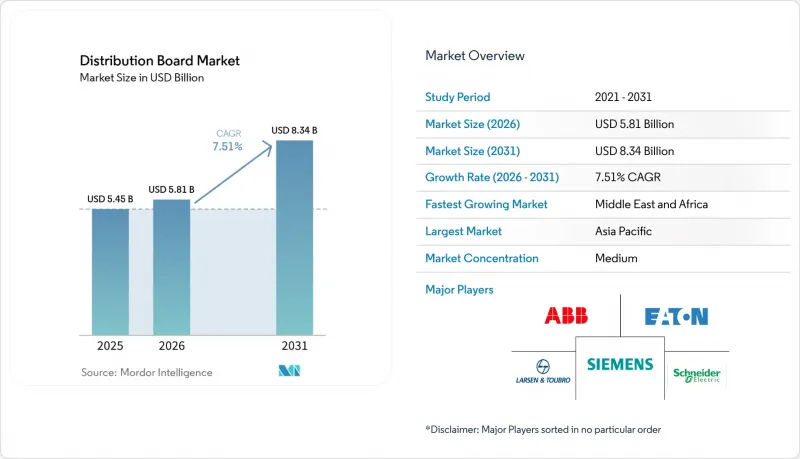
This report is Segmented by Type (Main Distribution Boards, Final Distribution Boards, and More), Voltage Level (Low Voltage, Medium Voltage, and High Voltage), Technology (Conventional Boards and Smart/IoT-enabled Boards), Mounting Type (Wall-Mounted and Floor/Free-Standing), End-User (Utilities, Industrial, Commercial, and Residential), and Geography (Asia-Pacific, Middle East and Africa, and More).
Global Distribution Board Market Trends and Insights
Rapid Build-Out of Data-Center Capacity
Hyperscale operators added 1,200 MW in 2025 and have already pre-booked equipment for 1,800 MW of annual builds by 2027. Each facility specifies 50-150 distribution boards to manage redundant feeds, battery strings, and cooling loads, pushing suppliers with pre-certified modular products to the front of bid lists. The move toward 48-V DC distribution inside racks is stimulating demand for hybrid AC-DC panels capable of seamless utility, generator, and lithium-battery interfaces. Northern Virginia, Singapore, and Frankfurt together absorbed 38% of global hyperscale capacity additions in 2025 and pulled distribution-board lead times forward by up to nine months. Operators now request embedded power-quality analytics that flag harmonic distortion and voltage sags in real time, thereby supporting 99.99% uptime commitments.
Grid-Modernization Mandates (Smart-Grid Roll-Outs)
India's Revamped Distribution Sector Scheme budgeted USD 38 billion for network upgrades through 2025, including millions of advanced distribution transformers and associated switchgear. The European Union's REPowerEU push compels members to accommodate 600 GW of renewables by 2030, necessitating bi-directional boards at the grid edge. China's State Grid installed 420,000 intelligent terminals in 2025, trimming technical losses by up to 6%. Equipment must now comply with IEC 61850 to plug into utility SCADA layers. Transitioning from mechanical breakers to electronic trip units has doubled maintenance intervals, lowering lifecycle expenses for network owners by 12-18%.
Raw-Material (Cu, Al, Steel) Price Volatility
Copper topped USD 10,200/t in early 2025, up 22% versus 2023, while aluminum jumped 18% to USD 2,650/t, squeezing panel margins by several points. U.S. and EU steel tariffs layered an extra 8-12% onto enclosure costs, pushing manufacturers toward alternative mills in Turkey and India and extending lead times. Smaller vendors lacking hedging programs saw working-capital needs swell 20%, limiting their ability to pursue large tenders. Hybrid busbar materials and composite housings are now under evaluation to shave 10-15% off raw-material exposure while staying within IEC 61439 tolerances.
Other drivers and restraints analyzed in the detailed report include:
- Explosion of Rooftop-PV + Storage Retrofits (Last-Mile Boards)
- Surge in EV-Fleet Depot Electrification Projects
- Acute Shortage of Certified Installers in Fast-Growing APAC
For complete list of drivers and restraints, kindly check the Table Of Contents.
Segment Analysis
Final boards are forecast to post a 9.1% CAGR, noticeably exceeding overall distribution board market growth as rooftop solar, EV charging, and smart-home circuits proliferate. Main boards kept a 43.8% distribution board market share in 2025 as the hub for substations and large-scale industrial plants. Sub-main boards occupy the middle tier, feeding specific building zones in modular offices and data-center halls. Prefabricated packages cut main and sub-main installation time by 40%, permitting contractors to align with hyperscale commissioning schedules.
California's Title 24 code and Germany's KfW 442 grant have pulled forward millions of residential panel upgrades, lifting final-board shipments in existing housing stock. OEMs now supply plug-and-play designs with factory-wired solar, battery, and arc-fault modules that reduce labor by up to 50%. Main boards still handle 1,600-6,300 A ratings in utilities and heavy industry, where IEC 61439 compliance is mandatory. Sub-main solutions gain share in multi-tenant offices and logistics parks by enabling zoned load management and 15-20% copper savings.
Low-voltage products captured 65.1% of the distribution board market size in 2025 and are on track for a 7.9% CAGR to 2031. The segment covers nearly all residential, commercial, and light-industrial installations below 1 kV, making it both the largest and the fastest bucket. Medium-voltage units sit in substations and factories, channeling power from the grid to transformers. High-voltage cabinets above 36 kV stay niche within transmission corridors and steel mills.
Rooftop solar interconnections and 350-kW DC chargers both land inside the low-voltage envelope, boosting panel count at the grid edge. India's grid-modernization drive is stimulating medium-voltage demand by adding 420,000 intelligent terminals that link SCADA networks to field assets. High-voltage procurement remains tied to decades-long transmission projects, constraining growth to a 4-5% CAGR. IEC 61936 compliance inflates engineering spend by 10%, but utilities insist on it for safety and reliability.
Complete Report Scope:
- By Type
- Main Distribution Boards (MDB)
- Sub-Main Distribution Boards (SMDB)
- Final Distribution Boards (FDB)
- By Voltage Level
- Low Voltage (Up to 1 kV)
- Medium Voltage (1 to 36 kV)
- High Voltage (Above 36 kV)
- By Technology
- Conventional Boards
- Smart/IoT-enabled Boards
- By Mounting Type
- Wall-Mounted
- Floor/Free-Standing
- By End-User
- Utilities
- Industrial
- Commercial
- Residential
- By Geography
- North America
- United States
- Canada
- Mexico
- Europe
- Germany
- United Kingdom
- France
- Italy
- NORDIC Countries
- Russia
- Rest of Europe
- Asia-Pacific
- China
- India
- Japan
- South Korea
- ASEAN Countries
- Rest of Asia-Pacific
- South America
- Brazil
- Argentina
- Colombia
- Rest of South America
- Middle East and Africa
- Saudi Arabia
- United Arab Emirates
- South Africa
- Egypt
- Rest of Middle East and Africa
- North America
Geography Analysis
Asia-Pacific anchored 44.7% of 2025 sales after China's State Grid deployed 420,000 intelligent terminals and India earmarked USD 38 billion for system upgrades. Widespread rooftop-solar rollouts across ASEAN added 12 GW of new capacity, each system requiring a dedicated final panel. Japan and South Korea led smart-panel adoption by enforcing IEC 61850 integration in distribution assets. Labor shortages remain the chief headwind, pushing project timelines out by up to six months and inflating wages more than 30%.
The Middle East and Africa region is expected to clock a 9.4% CAGR through 2031 as Saudi Arabia's NEOM and Red Sea construction zones embrace prefabricated electricity kits that slice installation labor in half. The UAE vaulted into the top tier of data-center destinations by adding 180 MW in 2025, translating to several thousand panel orders. Egypt targets 50,000 smart distribution assets by 2027 to curb outage frequency, while South Africa's renewables program embeds bi-directional boards that manage rooftop exports. Varying certification schemes still complicate exports, extending engineering cycles by up to five months.
North America and Europe continue to mature yet absorb sizeable volumes. Northern Virginia alone integrated 320 MW of data-center capacity in 2025, forcing OEMs to pull inventory forward by nine months. The EU's REPowerEU statute magnifies demand for grid-edge boards with bi-directional controls, while Germany's KfW 442 incentivized 180,000 home solar-battery upgrades that each needed a new final panel. Utilities across both regions roll out AMI networks that dovetail with smart boards for real-time load shifting. South America, led by Brazil's USD 4.2 billion grid-expansion plan, offers steady but smaller growth pulses.
- ABB Ltd.
- Siemens AG
- Schneider Electric SE
- Eaton Corporation Plc
- Legrand SA
- Larsen & Toubro Ltd.
- Hager Group
- Havells India Ltd.
- Alfanar Group
- General Electric Co.
- Mitsubishi Electric Corp.
- Rockwell Automation Inc.
- CHINT Group
- Rittal GmbH & Co. KG
- Lucy Electric Ltd.
- Arabian Gulf Switchgear
- Blakley Electrics Ltd.
- IEM (Industrial Electric Mfg.)
- ESL Power Systems
- East Coast Power Systems
Additional Benefits:
- The market estimate (ME) sheet in Excel format
- 3 months of analyst support
TABLE OF CONTENTS
1 Introduction
- 1.1 Study Assumptions & Market Definition
- 1.2 Scope of the Study
2 Research Methodology
3 Executive Summary
4 Market Landscape
- 4.1 Market Overview
- 4.2 Market Drivers
- 4.2.1 Rapid build-out of data-center capacity
- 4.2.2 Grid-modernization mandates (smart-grid roll-outs)
- 4.2.3 Explosion of rooftop-PV + storage retrofits (last-mile boards)
- 4.2.4 Shift to prefabricated/modular electrification packages
- 4.2.5 Digitisation of O&M through embedded predictive analytics
- 4.2.6 Surge in EV-fleet depot electrification projects
- 4.3 Market Restraints
- 4.3.1 Raw-material (Cu, Al, steel) price volatility
- 4.3.2 Cyber-hardening costs for connected boards
- 4.3.3 Standards fragmentation across export markets
- 4.3.4 Acute shortage of certified installers in fast-growing APAC
- 4.4 Supply-Chain Analysis
- 4.5 Regulatory Landscape
- 4.6 Technological Outlook
- 4.7 Porter's Five Forces
- 4.7.1 Bargaining Power of Suppliers
- 4.7.2 Bargaining Power of Buyers
- 4.7.3 Threat of New Entrants
- 4.7.4 Threat of Substitutes
- 4.7.5 Intensity of Competitive Rivalry
5 Market Size & Growth Forecasts
- 5.1 By Type
- 5.1.1 Main Distribution Boards (MDB)
- 5.1.2 Sub-Main Distribution Boards (SMDB)
- 5.1.3 Final Distribution Boards (FDB)
- 5.2 By Voltage Level
- 5.2.1 Low Voltage (Up to 1 kV)
- 5.2.2 Medium Voltage (1 to 36 kV)
- 5.2.3 High Voltage (Above 36 kV)
- 5.3 By Technology
- 5.3.1 Conventional Boards
- 5.3.2 Smart/IoT-enabled Boards
- 5.4 By Mounting Type
- 5.4.1 Wall-Mounted
- 5.4.2 Floor/Free-Standing
- 5.5 By End-User
- 5.5.1 Utilities
- 5.5.2 Industrial
- 5.5.3 Commercial
- 5.5.4 Residential
- 5.6 By Geography
- 5.6.1 North America
- 5.6.1.1 United States
- 5.6.1.2 Canada
- 5.6.1.3 Mexico
- 5.6.2 Europe
- 5.6.2.1 Germany
- 5.6.2.2 United Kingdom
- 5.6.2.3 France
- 5.6.2.4 Italy
- 5.6.2.5 NORDIC Countries
- 5.6.2.6 Russia
- 5.6.2.7 Rest of Europe
- 5.6.3 Asia-Pacific
- 5.6.3.1 China
- 5.6.3.2 India
- 5.6.3.3 Japan
- 5.6.3.4 South Korea
- 5.6.3.5 ASEAN Countries
- 5.6.3.6 Rest of Asia-Pacific
- 5.6.4 South America
- 5.6.4.1 Brazil
- 5.6.4.2 Argentina
- 5.6.4.3 Colombia
- 5.6.4.4 Rest of South America
- 5.6.5 Middle East and Africa
- 5.6.5.1 Saudi Arabia
- 5.6.5.2 United Arab Emirates
- 5.6.5.3 South Africa
- 5.6.5.4 Egypt
- 5.6.5.5 Rest of Middle East and Africa
- 5.6.1 North America
6 Competitive Landscape
- 6.1 Market Concentration
- 6.2 Strategic Moves (M&A, Partnerships, PPAs)
- 6.3 Market Share Analysis (Market Rank/Share for key companies)
- 6.4 Company Profiles (includes Global level Overview, Market level overview, Core Segments, Financials as available, Strategic Information, Products & Services, and Recent Developments)
- 6.4.1 ABB Ltd.
- 6.4.2 Siemens AG
- 6.4.3 Schneider Electric SE
- 6.4.4 Eaton Corporation Plc
- 6.4.5 Legrand SA
- 6.4.6 Larsen & Toubro Ltd.
- 6.4.7 Hager Group
- 6.4.8 Havells India Ltd.
- 6.4.9 Alfanar Group
- 6.4.10 General Electric Co.
- 6.4.11 Mitsubishi Electric Corp.
- 6.4.12 Rockwell Automation Inc.
- 6.4.13 CHINT Group
- 6.4.14 Rittal GmbH & Co. KG
- 6.4.15 Lucy Electric Ltd.
- 6.4.16 Arabian Gulf Switchgear
- 6.4.17 Blakley Electrics Ltd.
- 6.4.18 IEM (Industrial Electric Mfg.)
- 6.4.19 ESL Power Systems
- 6.4.20 East Coast Power Systems
7 Market Opportunities & Future Outlook
- 7.1 White-Space & Unmet-Need Assessment

