PUBLISHER: Mordor Intelligence | PRODUCT CODE: 2072520

PUBLISHER: Mordor Intelligence | PRODUCT CODE: 2072520
Singapore Cyber Insurance - Market Share Analysis, Industry Trends & Statistics, Growth Forecasts (2026 - 2031)
According to Mordor Intelligence, the singapore cyber insurance market size is expected to grow from USD 56.72 million in 2025 to USD 61.78 million in 2026 and is forecast to reach USD 94.73 million by 2031 at 8.93% CAGR over 2026-2031.
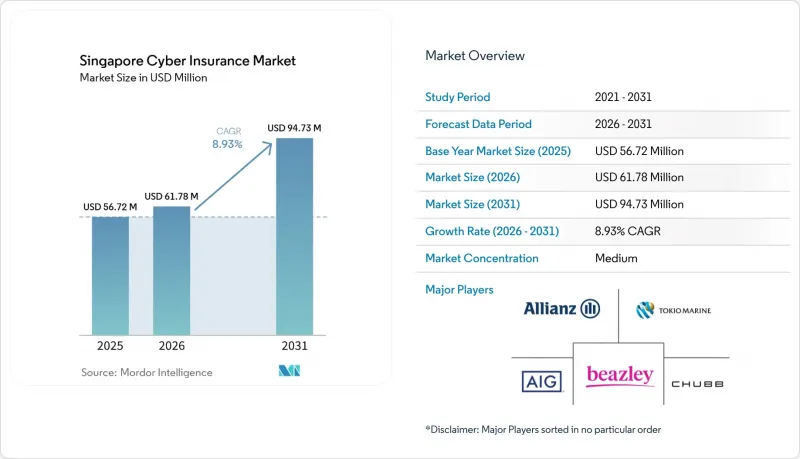
This report is Segmented by Product Type (Packaged, Stand-Alone), Enterprise Size (Large Enterprises, Medium Enterprises, Small & Micro Enterprises), Industry Vertical (BFSI, IT & Telecom, Retail & E-Commerce, Healthcare & Life Sciences, Manufacturing, Government & Public Sector, Education), and Geography (Singapore). The Market Forecasts are Provided in Terms of Value (USD).
Singapore Cyber Insurance Market Trends and Insights
PDPA & Cybersecurity Act Breach-Reporting Mandates
Regulatory enforcement is a strong growth catalyst. The Personal Data Protection Commission can fine up to 10% of annual turnover, a ceiling that compels firms to treat cyber insurance as essential rather than discretionary. Breach notification within three calendar days for incidents affecting 500 or more individuals creates operational urgency that aligns neatly with incident response endorsements. Amendments to the Cybersecurity Act widened the definition of critical information infrastructure, pulling more technology and logistics operators under direct supervision. Recent undertakings involving vendor lapses emphasize supply-chain diligence, a risk that underwriters now scrutinize during proposal assessment. Extraterritorial provisions extend to any entity processing Singapore residents' data, broadening the potential client pool beyond domestic registrants. As penalties climb, firms increasingly seek policies that cover regulatory investigations, legal defense, and notification costs.
Surge in Ransomware Frequency & Costs
The Cyber Security Agency logged 132 ransomware cases in 2023, with double and triple extortion tactics now commonplace. The Toppan Next Tech breach spilled over to DBS Group and Bank of China customers, illustrating how a vendor incident can cascade across an entire financial ecosystem. Income Insurance's DataPost event exposed personal details of 146 policyholders, underlining the persistence of supply-chain risk. QBE research predicts global incidents will double compared with 2020 levels, reinforcing premium momentum as loss ratios rise. Attackers commercialize ransomware-as-a-service kits, lowering technical barriers and expanding the pool of adversaries. This evolving threat landscape strengthens the value proposition of cyber insurance bundled with pre-breach security services.
High Premiums & Stringent Underwriting for SMEs
Smaller firms often view cyber cover as too expensive relative to cash flow. Traditional underwriting protocols mirror enterprise-grade security checklists and insist on multi-factor authentication, patch cadence reports, and incident rehearsals that exceed SME resources. Cyber Sierra raised USD 4.3 million to automate assessments and lower acquisition cost, yet its SGD 232,000 2023 revenue shows market infancy. Government vouchers partially defray costs, but sticker shock still delays purchase decisions.
Other drivers and restraints analyzed in the detailed report include:
- SME Cyber-Hygiene Programmes (Cyber Essentials, DEB)
- Increasing Capacity via Singapore Cyber-Risk Pool & ILS
- Limited Local Loss/Claims Data for Actuarial Pricing
For complete list of drivers and restraints, kindly check the Table Of Contents.
Segment Analysis
Stand-alone covers commanded 53.65% of the Singapore cyber insurance market share in 2025 and are forecast to grow at a 9.84% CAGR, underscoring the shift toward bespoke wordings that address regulatory investigations, cloud outages, and AI-related liabilities. Enterprises favor these policies because packaged extensions rarely match the breadth of protection required for cross-border data flows. AXA XL's 2024 Gen-AI endorsement, which protects against data poisoning and IP violations, exemplifies the innovation pace within the stand-alone space. Brokers report rising demand for supply-chain failure and reputational harm clauses that provide fixed payouts after defined triggers. This appetite accelerates as multinational clients integrate Singapore operations into global cyber towers.
Packaged add-ons, which held a 46.35% share, still appeal to smaller businesses entering the market for the first time. These buyers often transition to stand-alone forms once compliance audits highlight exclusion gaps. Over time, stand-alone penetration is expected to raise the overall Singapore cyber insurance market size by broadening coverage scopes and deepening policy limits. New parametric proposals tied to cloud downtime aim to simplify claims and are piloted within the stand-alone arena. Product designers also explore endorsements for quantum-resistant encryption failure, a forward-looking risk relevant to Singapore's advanced tech ecosystem.
Complete Report Scope:
- By Product Type (Value)
- Packaged
- Stand-alone
- By Enterprise Size (Value)
- Large Enterprises
- Medium Enterprises
- Small & Micro Enterprises
- By Industry Vertical (Value)
- BFSI
- IT & Telecom
- Retail & E-commerce
- Healthcare & Life Sciences
- Manufacturing
- Government & Public Sector
- Education
List of Companies Covered in this Report:
- Chubb
- AIG
- Beazley
- Tokio Marine
- Allianz
- Sompo
- Zurich
- AXA XL
- CNA Hardy
- QBE
- Delta Insurance
- Starr Insurance
- Munich Re
- Arch Capital
- Fairfax Asia
- Berkshire Hathaway Specialty
- Lloyd's Syndicates (e.g., Hiscox 33)
- Marsh McLennan (broker analytics)
- Aon (broker analytics)
- Gallagher Re
Additional Benefits:
- The market estimate (ME) sheet in Excel format
- 3 months of analyst support
TABLE OF CONTENTS
1 Table of Contents - Singapore Cyber Insurance Market
2 Introduction
- 2.1 Study Assumptions & Market Definition
- 2.2 Scope of the Study
3 Research Methodology
4 Executive Summary
5 Market Landscape
- 5.1 Market Overview
- 5.2 Market Drivers
- 5.2.1 PDPA & Cybersecurity Act breach-reporting mandates
- 5.2.2 Surge in ransomware frequency & costs
- 5.2.3 SME cyber-hygiene programmes (Cyber Essentials, DEB)
- 5.2.4 Increasing capacity via Singapore Cyber-Risk Pool & ILS
- 5.2.5 Gen-AI deepfake social-engineering threat escalation
- 5.2.6 Government procurement cyber-thresholds for vendors
- 5.3 Market Restraints
- 5.3.1 High premiums & stringent underwriting for SMEs
- 5.3.2 Limited local loss/claims data for actuarial pricing
- 5.3.3 Rate-softening threatens long-term policy sustainability
- 5.3.4 War / systemic-event exclusions & supply-chain caps
- 5.4 Value / Supply-Chain Analysis
- 5.5 Regulatory Landscape
- 5.6 Technological Outlook
- 5.7 Porter's Five Forces
- 5.7.1 Bargaining Power of Buyers
- 5.7.2 Bargaining Power of Suppliers
- 5.7.3 Threat of New Entrants
- 5.7.4 Threat of Substitutes
- 5.7.5 Competitive Rivalry
6 Market Size & Growth Forecasts
- 6.1 By Product Type (Value)
- 6.1.1 Packaged
- 6.1.2 Stand-alone
- 6.2 By Enterprise Size (Value)
- 6.2.1 Large Enterprises
- 6.2.2 Medium Enterprises
- 6.2.3 Small & Micro Enterprises
- 6.3 By Industry Vertical (Value)
- 6.3.1 BFSI
- 6.3.2 IT & Telecom
- 6.3.3 Retail & E-commerce
- 6.3.4 Healthcare & Life Sciences
- 6.3.5 Manufacturing
- 6.3.6 Government & Public Sector
- 6.3.7 Education
7 Competitive Landscape
- 7.1 Market Concentration
- 7.2 Strategic Moves
- 7.3 Market Share Analysis
- 7.4 Company Profiles (includes Global level Overview, Market level overview, Core Segments, Financials as available, Strategic Information, Market Rank/Share for key companies, Products & Services, and Recent Developments)
- 7.4.1 Chubb
- 7.4.2 AIG
- 7.4.3 Beazley
- 7.4.4 Tokio Marine
- 7.4.5 Allianz
- 7.4.6 Sompo
- 7.4.7 Zurich
- 7.4.8 AXA XL
- 7.4.9 CNA Hardy
- 7.4.10 QBE
- 7.4.11 Delta Insurance
- 7.4.12 Starr Insurance
- 7.4.13 Munich Re
- 7.4.14 Arch Capital
- 7.4.15 Fairfax Asia
- 7.4.16 Berkshire Hathaway Specialty
- 7.4.17 Lloyd's Syndicates (e.g., Hiscox 33)
- 7.4.18 Marsh McLennan (broker analytics)
- 7.4.19 Aon (broker analytics)
- 7.4.20 Gallagher Re
8 Market Opportunities & Future Outlook
- 8.1 White-space & Unmet-Need Assessment

