PUBLISHER: Mordor Intelligence | PRODUCT CODE: 2072541

PUBLISHER: Mordor Intelligence | PRODUCT CODE: 2072541
Asia-Pacific Pasta And Noodles - Market Share Analysis, Industry Trends & Statistics, Growth Forecasts (2026 - 2031)
According to Mordor Intelligence, the asia-Pacific pasta and noodles market size in 2026 is estimated at USD 54.17 billion, growing from 2025 value of USD 52.33 billion with 2031 projections showing USD 64.39 billion, growing at 3.52% CAGR over 2026-2031.
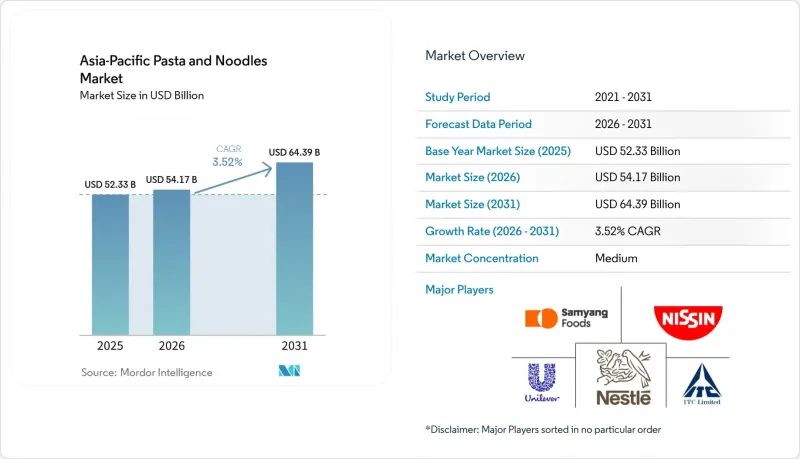
This report is Segmented by Ingredients (Rice, Corn, Millet, Wheat, and Other Ingredients), Product Type (Dried, Instant, and Canned and Frozen), Distribution Channel (Supermarkets/Hypermarkets, Convenience Stores, Online Retail Stores, and Other Distribution Channels), and Geography (China, Japan, India and More). The Market Forecasts are Provided in Terms of Value (USD).
Asia-Pacific Pasta And Noodles Market Trends and Insights
Increased Preference for International Cuisine Among Urban Consumer
Consumer preferences in urban Asian markets have evolved significantly, influencing the noodles and pasta market as international cuisines gain popularity beyond traditional consumption patterns. This market transformation is evident in metropolitan areas of China, India, and Australia, where higher disposable incomes and exposure to global food trends drive the adoption of Italian, Mediterranean, and fusion cuisines. The shift has created opportunities in the premium segment for authentic international products. This change reflects broader lifestyle modifications, with pasta becoming a staple in middle-class household meals. In 2024, China consumed approximately 43,802 million servings of instant noodles, according to the World Instant Noodles Association (WINA), demonstrating strong demand in this category . These factors contribute to a dual growth trajectory in the Asia-Pacific noodles and pasta market.
Rising Popularity of Millet-Based Noodles/Pasta
Millet integration is transforming the Asia-Pacific noodles and pasta market as consumers actively seek healthier, sustainable, and culturally significant products. Major food manufacturers in India and China now incorporate millets as premium ingredients in their noodle and pasta products, responding to this market shift. These ancient grains provide superior nutritional benefits, containing 10-12% protein content and maintaining a lower glycemic index compared to wheat-based alternatives. The diabetic population in the Asia-Pacific region particularly benefits from these millet-based products due to their blood sugar management properties. Food companies are accelerating their product development efforts to capture this growing market opportunity. ITC Limited demonstrates this trend through its comprehensive millet program launched in January 2023, which introduced various millet-based products, including noodles, pasta, dosa mix, and idli mix. The company's initiative reflects the broader industry movement toward incorporating traditional grains into modern food products while meeting consumer demands for healthier alternatives.
Health Concerns Over MSG, Sodium, and Additives in Packaged Noodles and Pasta
The growing health consciousness among consumers presents a significant challenge to the Asia-Pacific noodles and pasta market. Increased awareness about nutritional content, particularly regarding high sodium levels, monosodium glutamate (MSG), and artificial preservatives, has led to increased scrutiny of conventional instant noodles and processed pasta products. This trend is particularly evident in developed markets like Japan and Australia, where consumers demand transparent food labeling and prefer low-sodium, preservative-free, and nutritionally balanced options. The impact of health awareness extends to emerging urban markets in China and India, where dietary education and wellness-focused purchasing decisions are becoming more prevalent among middle-class consumers. Government regulations are also evolving to address these health concerns. For instance, Malaysia's Salt Reduction Strategy requires manufacturers to meet specific sodium reduction targets for processed foods, including instant noodles, by 2025. These regulatory requirements create operational challenges for manufacturers, who must reformulate products while maintaining taste and shelf life, often requiring significant investment.
Other drivers and restraints analyzed in the detailed report include:
- Demand for Affordable, Ready-to-Eat Food Options
- Government Support Accelerates Millet-Based Product Development
- Varying Food Safety Standards Across Asia-Pacific Countries
For complete list of drivers and restraints, kindly check the Table Of Contents.
Segment Analysis
In 2025, wheat commands a dominant 48.74% share of the Asia-Pacific noodles and pasta market, underpinned by its versatility and a well-established manufacturing base. This wheat dominance is especially pronounced in China and Japan, where wheat-based noodles play a pivotal role in traditional dishes. Meanwhile, millet-based products are on an upward trajectory, with a projected CAGR of 3.97% from 2026 to 2031, as manufacturers tap into their nutritional advantages and resilience to climate variations.
Rice noodles enjoy robust market traction, particularly in Southeast Asia, and are witnessing a surge in global demand, fueled by a growing appetite for gluten-free options and the rising allure of Asian cuisine. Innovations, like seaweed-enhanced formulations, are propelling the "Other Ingredients" segment, boosting both nutritional value and sustainability. Corn-based alternatives continue to see steady demand, especially in the gluten-free arena. The market is also witnessing a rise in hybrid formulations, with manufacturers crafting ingredient blends that optimize nutrition, texture, and production efficiency.
Complete Report Scope:
- By Ingredients
- Rice
- Corn
- Millet
- Wheat
- Other Ingredients
- By Product Type
- Dried
- Instant
- Canned and Frozen
- By Distribution Channel
- Supermarkets/Hypermarkets
- Convenience Store
- Online Retail Stores
- Other Distribution Channel
- By Geography
- China
- India
- Japan
- Australia
- Rest of Asia-Pacific
List of Companies Covered in this Report:
- Nestle S.A.
- Unilever PLC
- Nissin Foods Holdings Co. Ltd.
- Samyang Foods Inc.
- ITC Limited
- Uni-President Enterprises Corporation
- Ting Hsin International Group
- Tingyi (Cayman Islands) Holding Corp.
- The Campbell Soup Company
- Corno Macaroni Co. Ltd.
- Nongshim Holdings
- Barilla Group
- CJ CheilJedang Corp.
- Sanyo Foods Co., Ltd.
- Indofood CBP Sukses Makmur Tbk
- Ottogi Co., Ltd.
- Sun Noodle Company
- Conagra Brands, Inc.
- Toyo Suisan Kaisha Ltd.
- Marico Limited
Additional Benefits:
- The market estimate (ME) sheet in Excel format
- 3 months of analyst support
TABLE OF CONTENTS
1 INTRODUCTION
- 1.1 Study Assumptions and Market Definition
- 1.2 Scope of the Study
2 RESEARCH METHODOLOGY
3 EXECUTIVE SUMMARY
4 MARKET LANDSCAPE
- 4.1 Market Overview
- 4.2 Market Drivers
- 4.2.1 Increased Preference for International Cuisine Among Urban Consumer
- 4.2.2 Rising Popularity of Millet-Based Noodles/ Pasta
- 4.2.3 Demand for Affordable, Ready-to-Eat Food Food Option
- 4.2.4 Government Support Accelerates Millet-Based Product Development
- 4.2.5 Manufacturing advances enhance product quality
- 4.2.6 Retail and e-commerce expansion improves product reach
- 4.3 Market Restraints
- 4.3.1 Health Concerns Over MSG, Sodium, and Additive in Packaged Noodles and Pasta
- 4.3.2 Varying Food Safety Standards Across Asia-Pacific Countries
- 4.3.3 Diverse food safety regulations create compliance issues
- 4.3.4 Traditional rice-based meal preferences limit pasta adoption
- 4.4 Consumer Behaviour Analysis
- 4.5 Regulatory Outlook
- 4.6 Porter's Five Forces
- 4.6.1 Threat of New Entrants
- 4.6.2 Bargaining Power of Buyers/Consumers
- 4.6.3 Bargaining Power of Suppliers
- 4.6.4 Threat of Substitute Products
- 4.6.5 Intensity of Competitive Rivalry
5 MARKET SIZE AND GROWTH FORECASTS (VALUE)
- 5.1 By Ingredients
- 5.1.1 Rice
- 5.1.2 Corn
- 5.1.3 Millet
- 5.1.4 Wheat
- 5.1.5 Other Ingredients
- 5.2 By Product Type
- 5.2.1 Dried
- 5.2.2 Instant
- 5.2.3 Canned and Frozen
- 5.3 By Distribution Channel
- 5.3.1 Supermarkets/Hypermarkets
- 5.3.2 Convenience Store
- 5.3.3 Online Retail Stores
- 5.3.4 Other Distribution Channel
- 5.4 By Geography
- 5.4.1 China
- 5.4.2 India
- 5.4.3 Japan
- 5.4.4 Australia
- 5.4.5 Rest of Asia-Pacific
6 COMPETITIVE LANDSCAPE
- 6.1 Market Concentration
- 6.2 Strategic Moves
- 6.3 Company Ranking Analysis
- 6.4 Company Profiles (includes Global-level Overview, Market-level Overview, Core Segments, Financials (if available), Strategic Information, Market Rank/Share, Products and Services, Recent Developments)
- 6.4.1 Nestle S.A.
- 6.4.2 Unilever PLC
- 6.4.3 Nissin Foods Holdings Co. Ltd.
- 6.4.4 Samyang Foods Inc.
- 6.4.5 ITC Limited
- 6.4.6 Uni-President Enterprises Corporation
- 6.4.7 Ting Hsin International Group
- 6.4.8 Tingyi (Cayman Islands) Holding Corp.
- 6.4.9 The Campbell Soup Company
- 6.4.10 Corno Macaroni Co. Ltd.
- 6.4.11 Nongshim Holdings
- 6.4.12 Barilla Group
- 6.4.13 CJ CheilJedang Corp.
- 6.4.14 Sanyo Foods Co., Ltd.
- 6.4.15 Indofood CBP Sukses Makmur Tbk
- 6.4.16 Ottogi Co., Ltd.
- 6.4.17 Sun Noodle Company
- 6.4.18 Conagra Brands, Inc.
- 6.4.19 Toyo Suisan Kaisha Ltd.
- 6.4.20 Marico Limited
7 MARKET OPPORTUNITIES AND FUTURE OUTLOOK

