PUBLISHER: Mordor Intelligence | PRODUCT CODE: 2072548

PUBLISHER: Mordor Intelligence | PRODUCT CODE: 2072548
Natural Sweeteners - Market Share Analysis, Industry Trends & Statistics, Growth Forecasts (2026 - 2031)
According to Mordor Intelligence, the natural sweeteners market size is expected to grow from USD 8.78 billion in 2025 to USD 9.59 billion in 2026 and is forecast to reach USD 16.06 billion by 2031 at 10.87% CAGR over 2026-2031.
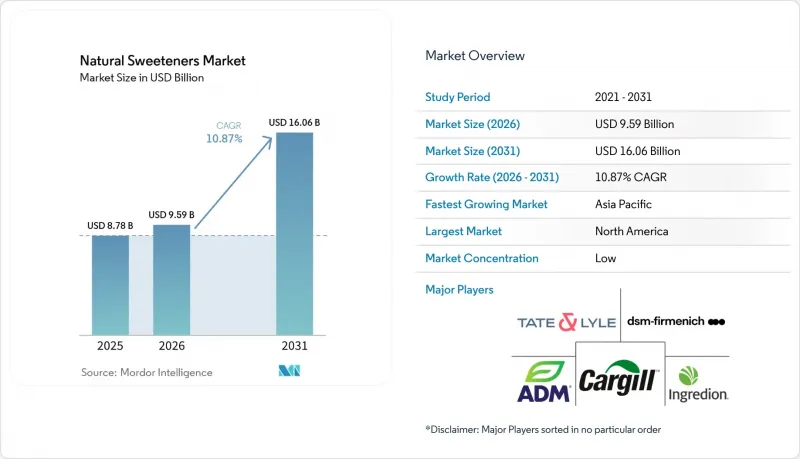
This report is Segmented by Product Type (Natural High-Intensity Sweeteners and Sugar Alcohols (Polyols)), by Form (Solid, and Liquid/Syrup), by Application (Food and Beverages, Pharmaceuticals and Nutraceuticals, and More), and by Geography (North America, Europe, Asia-Pacific, and More). The Market Forecasts are Provided in Terms of Value (USD).
Global Natural Sweeteners Market Trends and Insights
Growing consumer awareness about health risks associated with artificial sweeteners
The natural sweeteners market is primarily driven by increasing consumer awareness about potential health risks associated with artificial sweeteners. Health authorities' scrutiny and scientific research have raised concerns about the long-term safety of synthetic sweeteners, including aspartame, saccharin, and sucralose. The International Agency for Research on Cancer's (IARC) 2023 classification of aspartame as "possibly carcinogenic to humans" has heightened public concern and increased demand for natural alternatives . Moreover, artificial sweeteners may adversely affect gut microbiota, potentially impacting metabolic functions and glucose regulation. These findings have led to increased skepticism toward synthetic additives, particularly among health-conscious consumers and individuals managing diabetes or obesity, resulting in a shift toward clean-label and natural ingredients.
Rising prevalence of diabetes and obesity
According to the International Diabetes Federation, approximately 589 million adults (20-79 years) are living with diabetes, with over 4 in 5 adults (81%) in low- and middle-income nations . Alarmingly, over half of these individuals lack access to treatment. In response to this pressing health challenge, there's been a surge in demand for glucose-neutral sugar substitutes. Natural sweeteners, notably stevia and monk fruit, have gained prominence due to their zero glycemic index. These sweeteners are now integral to medical nutrition therapy for diabetes patients. Studies highlight that steviol glycosides can boost insulin sensitivity and improve glucose tolerance. The U.S. Department of Agriculture's Dietary Guidelines for Americans 2025-2030 recommend that added sugars should constitute no more than 10% of daily caloric intake, further emphasizing the shift towards natural sweeteners. As obesity rates climb, especially in emerging markets leaning towards Western diets, the natural sweeteners market continues to flourish, suggesting this growth trend will persist well beyond the forecast period.
Higher production costs compared to artificial sweeteners
Natural sweeteners face significant market penetration challenges due to their higher production costs compared to artificial alternatives like aspartame and sucralose. This cost difference impacts mass market applications and price-sensitive regions, where manufacturers operate with minimal margins and consumers demonstrate limited willingness to pay premium prices for natural ingredients. The elevated production costs restrict natural sweeteners' adoption across various food categories, despite increasing consumer interest. While established natural sweeteners like stevia have achieved some cost reductions through economies of scale, new alternatives such as monk fruit and rare sugar alcohols maintain substantial price premiums. The U.S. International Trade Commission's investigation into erythritol imports from China illustrates how production costs and pricing affect market dynamics, with domestic producers competing against lower-cost imports. Despite production technology improvements, costs remain a limiting factor in the medium term, especially in applications where price sensitivity outweighs clean-label preferences.
Other drivers and restraints analyzed in the detailed report include:
- Increasing adoption of natural ingredients in food and beverage manufacturing
- Government regulations supporting the use of natural sweeteners over artificial alternatives
- Limited availability of raw materials for natural sweetener production
For complete list of drivers and restraints, kindly check the Table Of Contents.
Segment Analysis
Sugar alcohols (polyols) made up the largest portion of the natural sweeteners market, contributing 80.81% of the total revenue in 2025. This segment leads the market due to its extensive use in sugar-free and low-calorie food and beverage products, such as candies, baked goods, chewing gum, and dairy substitutes. Popular sugar alcohols like erythritol, xylitol, maltitol, and sorbitol provide sweetness with fewer calories compared to regular sugar. This makes them a preferred choice for manufacturers aiming to cater to health-conscious consumers. Additionally, these sweeteners offer functional benefits, such as adding bulk, improving texture, and enhancing stability, making them suitable for a wide range of food applications.
Natural high-intensity sweeteners are expected to grow the fastest, with a projected CAGR of 13.01% during 2026-2031. The increasing demand for clean-label, plant-based, and low-calorie sweetening options is driving the popularity of ingredients like stevia and monk fruit extracts. Food and beverage companies are increasingly using these sweeteners to reduce sugar content while maintaining the desired sweetness in their products. Advances in extraction methods and taste-masking technologies are further improving the quality of these sweeteners, making them more appealing for use in beverages, snacks, dairy products, and nutritional supplements. This trend reflects the growing consumer focus on healthier and more natural alternatives to traditional sugar.
Complete Report Scope:
- By Product Type
- Natural High-Intensity Sweeteners
- Stevia
- Monk Fruit (Luo Han Guo)
- Others
- Sugar Alcohols (Polyols)
- Xylitol
- Sorbitol
- Mannitol
- Erythritol
- Others
- Natural High-Intensity Sweeteners
- By Form
- Solid
- Liquid/Syrup
- By Application
- Food and Beverages
- Food
- Bakery and Confectionery
- Dairy and Desserts
- Meat and Savory Products
- Sauces, Dressings and Spreads
- Other Processed Foods
- Beverages
- Soft Drinks
- Sport Drinks
- Other Beverages
- Food
- Pharmaceuticals and Nutraceuticals
- Personal Care and Cosmetics
- Other Applications
- Food and Beverages
- By Geography
- North America
- United States
- Canada
- Mexico
- Rest of North America
- Europe
- Germany
- United Kingdom
- Italy
- France
- Spain
- Netherlands
- Poland
- Belgium
- Sweden
- Rest of Europe
- Asia-Pacific
- China
- India
- Japan
- Australia
- Indonesia
- South Korea
- Thailand
- Singapore
- Rest of Asia-Pacific
- South America
- Brazil
- Argentina
- Colombia
- Chile
- Peru
- Rest of South America
- Middle East
- South Africa
- Saudi Arabia
- United Arab Emirates
- Nigeria
- Egypt
- Morocco
- Turkey
- Rest of Middle East and Africa
- North America
Geography Analysis
North America leads the natural sweeteners market with a 35.23% share in 2025, driven by stringent regulatory frameworks and high consumer awareness of health issues associated with sugar consumption. The region's well-established food and beverage industry, combined with regulations on sugar intake, supports market growth. The presence of key industry players has strengthened research and development activities and product innovation. The increasing prevalence of lifestyle-related diseases influences market expansion. According to the Centers for Disease Control and Prevention's National Diabetes Statistics Report, more than 38 million Americans have diabetes (about 1 in 10), and about 90% to 95% have type 2 diabetes, creating substantial demand for sugar alternatives .
Asia-Pacific is the fastest-growing region with a projected CAGR of 11.83% from 2026-2031, driven by increasing health consciousness, rising disposable incomes, and growing prevalence of lifestyle diseases in countries like China and India. China dominates regional production of key natural sweeteners, including stevia and monk fruit, providing local manufacturers with competitive advantages through vertical integration and supply chain control. Japan represents a mature market with high natural sweetener penetration, having approved stevia before Western markets, while India emerges as a high-growth opportunity due to its large diabetic population and government initiatives to reduce sugar consumption.
Europe maintains a significant market presence, characterized by stringent regulatory standards and consumer preferences for clean-label products. The European Food Safety Authority's ongoing re-evaluation of sweeteners, including erythritol's safety assessment in December 2023, demonstrates the region's methodical approach to natural sweetener adoption. The European Commission's Farm to Fork Strategy supports natural sweetener adoption through its focus on sustainable food systems and healthier diets. The United Kingdom's sugar tax on soft drinks, implemented in 2018 and expanded in 2024, has increased demand for natural sweeteners in beverages. Nordic countries lead adoption rates with consumers willing to pay premiums for natural products, while Southern European markets show growing interest based on traditional emphasis on natural ingredients and Mediterranean dietary patterns.
- Cargill Inc.
- Archer-Daniels-Midland Company
- Tate & Lyle PLC
- Ingredion Incorporated
- DSM-Firmenich AG
- Roquette Freres
- International Flavors & Fragrances Inc.
- Guilin Layn Natural Ingredients Corp.
- GLG Life Tech Corporation
- Symrise AG
- Whole Earth Brands, Inc.
- Sunwin Stevia International
- Saraya Co. Ltd.
- Jungbunzlauer Suisse AG
- DuPont de Nemours, Inc.
- ZuChem Inc.
- FoodChem International Corporation
- Fooditive Group
- Pyure Brands LLC
- SweeGen, Inc
Additional Benefits:
- The market estimate (ME) sheet in Excel format
- 3 months of analyst support
TABLE OF CONTENTS
1 INTRODUCTION
- 1.1 Study Assumptions and Market Definition
- 1.2 Scope of the Study
2 RESEARCH METHODOLOGY
3 EXECUTIVE SUMMARY
4 MARKET LANDSCAPE
- 4.1 Market Overview
- 4.2 Market Drivers
- 4.2.1 Growing consumer awareness about health risks associated with artificial sweeteners
- 4.2.2 Rising prevalence of diabetes and obesity
- 4.2.3 Increasing adoption of natural ingredients in food and beverage manufacturing
- 4.2.4 Government regulations supporting the use of natural sweeteners over artificial alternatives
- 4.2.5 Technological advancements improving the taste and functionality of natural sweeteners
- 4.2.6 Rising disposable income enables consumers to purchase premium natural sweetener products
- 4.3 Market Restraints
- 4.3.1 Higher production costs compared to artificial sweeteners
- 4.3.2 Limited availability of raw materials for natural sweetener production
- 4.3.3 Competition from Artificial Sweeteners may hamper the market growth
- 4.3.4 Technical Challenges in Food Processing Applications
- 4.4 Supply Chain Analysis
- 4.5 Regulatory Analysis
- 4.6 Porter's Five Forces
- 4.6.1 Threat of New Entrants
- 4.6.2 Bargaining Power of Buyers
- 4.6.3 Bargaining Power of Suppliers
- 4.6.4 Threat of Substitutes
- 4.6.5 Competitive Rivalry
5 MARKET SIZE AND GROWTH FORECASTS (VALUE)
- 5.1 By Product Type
- 5.1.1 Natural High-Intensity Sweeteners
- 5.1.1.1 Stevia
- 5.1.1.2 Monk Fruit (Luo Han Guo)
- 5.1.1.3 Others
- 5.1.2 Sugar Alcohols (Polyols)
- 5.1.2.1 Xylitol
- 5.1.2.2 Sorbitol
- 5.1.2.3 Mannitol
- 5.1.2.4 Erythritol
- 5.1.2.5 Others
- 5.1.1 Natural High-Intensity Sweeteners
- 5.2 By Form
- 5.2.1 Solid
- 5.2.2 Liquid/Syrup
- 5.3 By Application
- 5.3.1 Food and Beverages
- 5.3.1.1 Food
- 5.3.1.1.1 Bakery and Confectionery
- 5.3.1.1.2 Dairy and Desserts
- 5.3.1.1.3 Meat and Savory Products
- 5.3.1.1.4 Sauces, Dressings and Spreads
- 5.3.1.1.5 Other Processed Foods
- 5.3.1.2 Beverages
- 5.3.1.2.1 Soft Drinks
- 5.3.1.2.2 Sport Drinks
- 5.3.1.2.3 Other Beverages
- 5.3.1.1 Food
- 5.3.2 Pharmaceuticals and Nutraceuticals
- 5.3.3 Personal Care and Cosmetics
- 5.3.4 Other Applications
- 5.3.1 Food and Beverages
- 5.4 By Geography
- 5.4.1 North America
- 5.4.1.1 United States
- 5.4.1.2 Canada
- 5.4.1.3 Mexico
- 5.4.1.4 Rest of North America
- 5.4.2 Europe
- 5.4.2.1 Germany
- 5.4.2.2 United Kingdom
- 5.4.2.3 Italy
- 5.4.2.4 France
- 5.4.2.5 Spain
- 5.4.2.6 Netherlands
- 5.4.2.7 Poland
- 5.4.2.8 Belgium
- 5.4.2.9 Sweden
- 5.4.2.10 Rest of Europe
- 5.4.3 Asia-Pacific
- 5.4.3.1 China
- 5.4.3.2 India
- 5.4.3.3 Japan
- 5.4.3.4 Australia
- 5.4.3.5 Indonesia
- 5.4.3.6 South Korea
- 5.4.3.7 Thailand
- 5.4.3.8 Singapore
- 5.4.3.9 Rest of Asia-Pacific
- 5.4.4 South America
- 5.4.4.1 Brazil
- 5.4.4.2 Argentina
- 5.4.4.3 Colombia
- 5.4.4.4 Chile
- 5.4.4.5 Peru
- 5.4.4.6 Rest of South America
- 5.4.5 Middle East
- 5.4.5.1 South Africa
- 5.4.5.2 Saudi Arabia
- 5.4.5.3 United Arab Emirates
- 5.4.5.4 Nigeria
- 5.4.5.5 Egypt
- 5.4.5.6 Morocco
- 5.4.5.7 Turkey
- 5.4.5.8 Rest of Middle East and Africa
- 5.4.1 North America
6 COMPETITIVE LANDSCAPE
- 6.1 Market Concentration
- 6.2 Strategic Moves
- 6.3 Market Positioning Analysis
- 6.4 Company Profiles (includes Global level Overview, Market level overview, Core Segments, Financials as available, Strategic Information, Market Rank/Share for key companies, Products and Services, and Recent Developments)
- 6.4.1 Cargill Inc.
- 6.4.2 Archer-Daniels-Midland Company
- 6.4.3 Tate & Lyle PLC
- 6.4.4 Ingredion Incorporated
- 6.4.5 DSM-Firmenich AG
- 6.4.6 Roquette Freres
- 6.4.7 International Flavors & Fragrances Inc.
- 6.4.8 Guilin Layn Natural Ingredients Corp.
- 6.4.9 GLG Life Tech Corporation
- 6.4.10 Symrise AG
- 6.4.11 Whole Earth Brands, Inc.
- 6.4.12 Sunwin Stevia International
- 6.4.13 Saraya Co. Ltd.
- 6.4.14 Jungbunzlauer Suisse AG
- 6.4.15 DuPont de Nemours, Inc.
- 6.4.16 ZuChem Inc.
- 6.4.17 FoodChem International Corporation
- 6.4.18 Fooditive Group
- 6.4.19 Pyure Brands LLC
- 6.4.20 SweeGen, Inc
7 MARKET OPPORTUNITIES AND FUTURE OUTLOOK

